Storing digital copies of real-world assets (tokens) on the blockchain has the potential to fundamentally change the interests and ownership associated with everyday assets. We believe that as blockchain technology becomes more popular throughout society in the next decade, the tokenization of RWA will have an impact on every industry.
summary
Two trends
Tokenization is a story of two trends happening on two sides of real world assets (RWA), namely the digitization and the financialization of RWA. (i) Digitization is the conversion of physical assets into digital formats and the subsequent further improvement of how these assets are represented and used in digital databases. (ii) Financialization is the trend of converting real assets into financial instruments by redesigning cash flows and investment opportunities.
Both structural trends, now accelerated by blockchain-based tokenization, are reshaping RWA. (i) Digitalization is driven by blockchain’s ability to convert physical assets into digital assets, while (ii) Financialization leverages the programmability of tokens to enable innovative financial engineering. Our framework aims to demystify tokenization and its impact on the digitization and financialization of RWA. Our goal is to give founders and investors a deeper understanding of the full potential of RWA tokenization.
The time has come
Today’s enthusiasm for the tokenization of real-world assets (RWA) is very different from the initial buzz in 2019-2020. We believe there are three key differences compared to previous cycles.
First, the current market is characterized by increasing participation from financial players such as banks, hedge funds and asset managers, unlike the previous cycle, where retail investors were most enthusiastic. Today, these institutions bring large asset pools and deep expertise, accelerating the adoption of tokenization of financial assets.
Second, advances in blockchain technology have improved scalability, security, and interoperability, and development tools and standards have also improved. Large financial institutions are currently piloting tokenization projects, demonstrating their commitment and enthusiasm for the innovation and possibilities of RWA tokenization.
Finally, the regulatory environment has evolved in favor of the tokenization of real world assets (RWA), with significant advances in digital asset regulation providing a solid framework for institutional participation. A typical example is the UK's Electronic Trade Documents Act, which seamlessly integrates with blockchain applications to realize the tokenization of RWA. In addition, the emergence of transmission mechanisms such as central bank digital currency (CBDC) and stablecoins have filled the previously existing gaps and enabled on-chain transaction settlement. The synergy of gradually improving regulations, technological advancements and better transmission mechanisms brings hope for future applications of RWA tokenization.
unrecognized potential
We believe the TAM of tokenized assets has been underestimated in previous estimates and will reach $20 trillion by 2030. By 2023, the tokenized total addressable market (TAM) is estimated to be between $10-15 trillion. We think this is an underestimation and expect the true potential to be much greater. While the methodology used for these estimates appears reasonable, it is incomplete.
It does not take into account the potential value increase after the asset is tokenized. Value appreciation is the result of building a market around tokenized RWA. Having a market facilitates the discovery of prices for previously illiquid assets. We believe this will lead to an increase in asset values as assets are more likely to fall into the hands of those whose assets appreciate the fastest.
Another oversight in this approach is underestimating the ability of tokenization to isolate different asset elements. For example, tokenization could separate carbon certificates from a piece of forest land. In this way, it would be possible to create separate, liquid markets for these elements, allowing further price discovery and appreciation of specific parts of the asset.
A brief overview of our framework
There are two distinct trends in the tokenization of RWA, making it difficult to assess its net benefit. These trends are structural and have been developing over the past decade. Tokenization of RWA is the driving force for the next phase of these two trends:
Asset digitization - converting physical assets into digital formats or migrating existing digital assets onto new infrastructure (i.e. blockchain) to unlock more benefits.
Tokenization examples – inventory, supply chain assets, financial products…
Asset Financialization - The process of converting any asset into a financial instrument by redesigning cash flows, investment opportunities, and capital formation.
Tokenization examples - data, intellectual property, in-game assets...
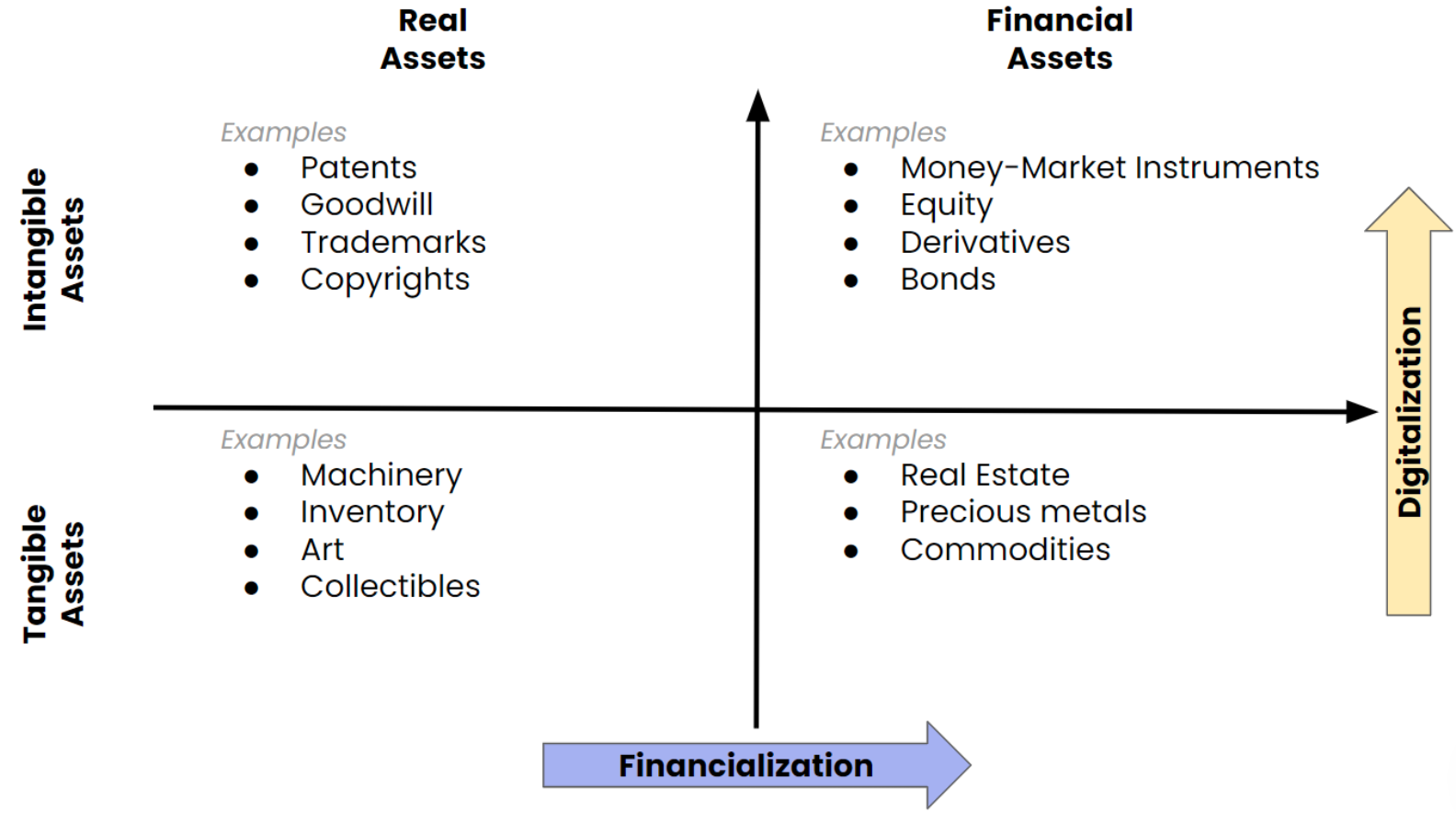
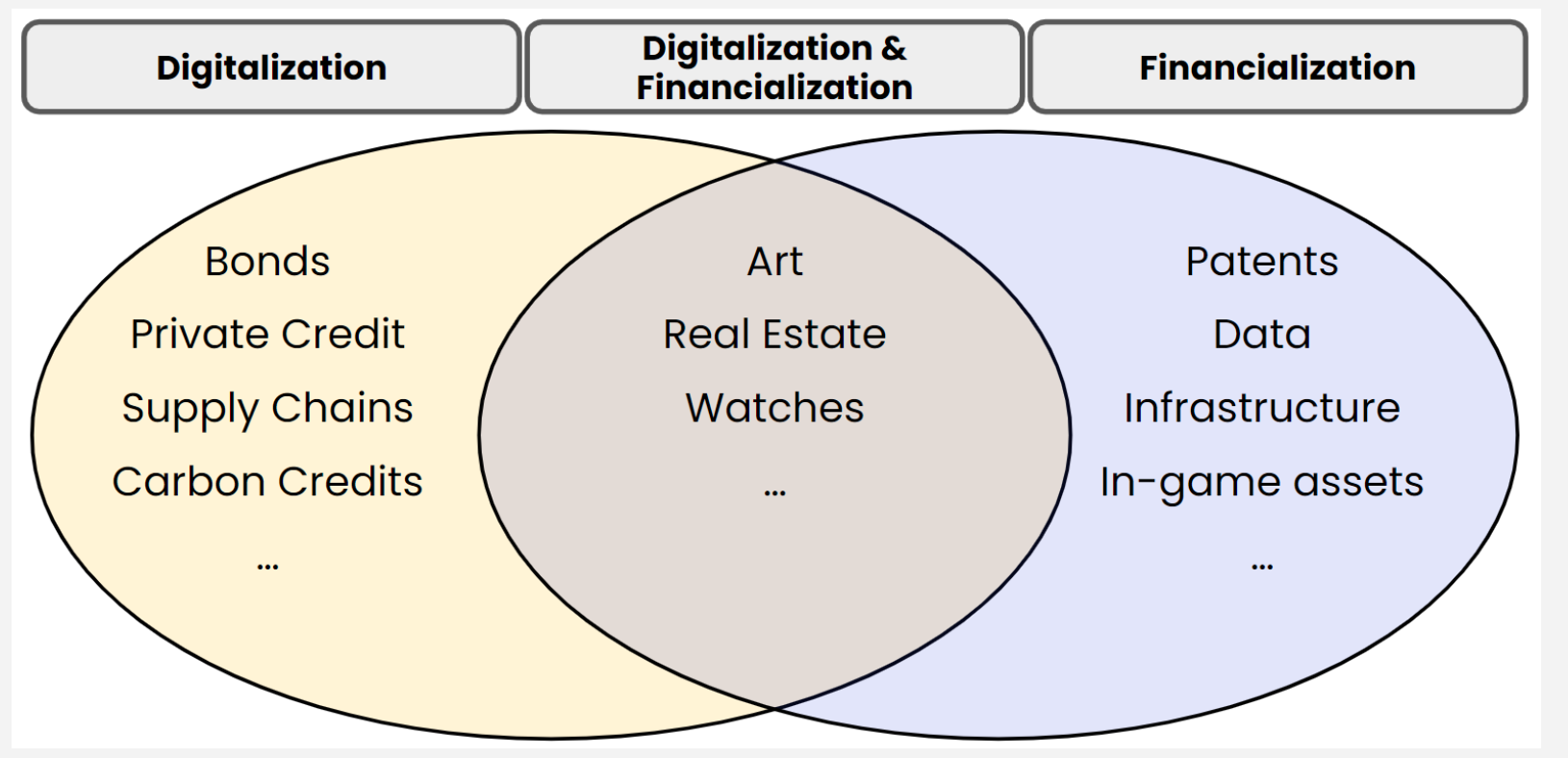
As the tokenization of RWA drives the financialization and digitization of assets, we expect more assets to become intangible financial assets over time.
Advantage
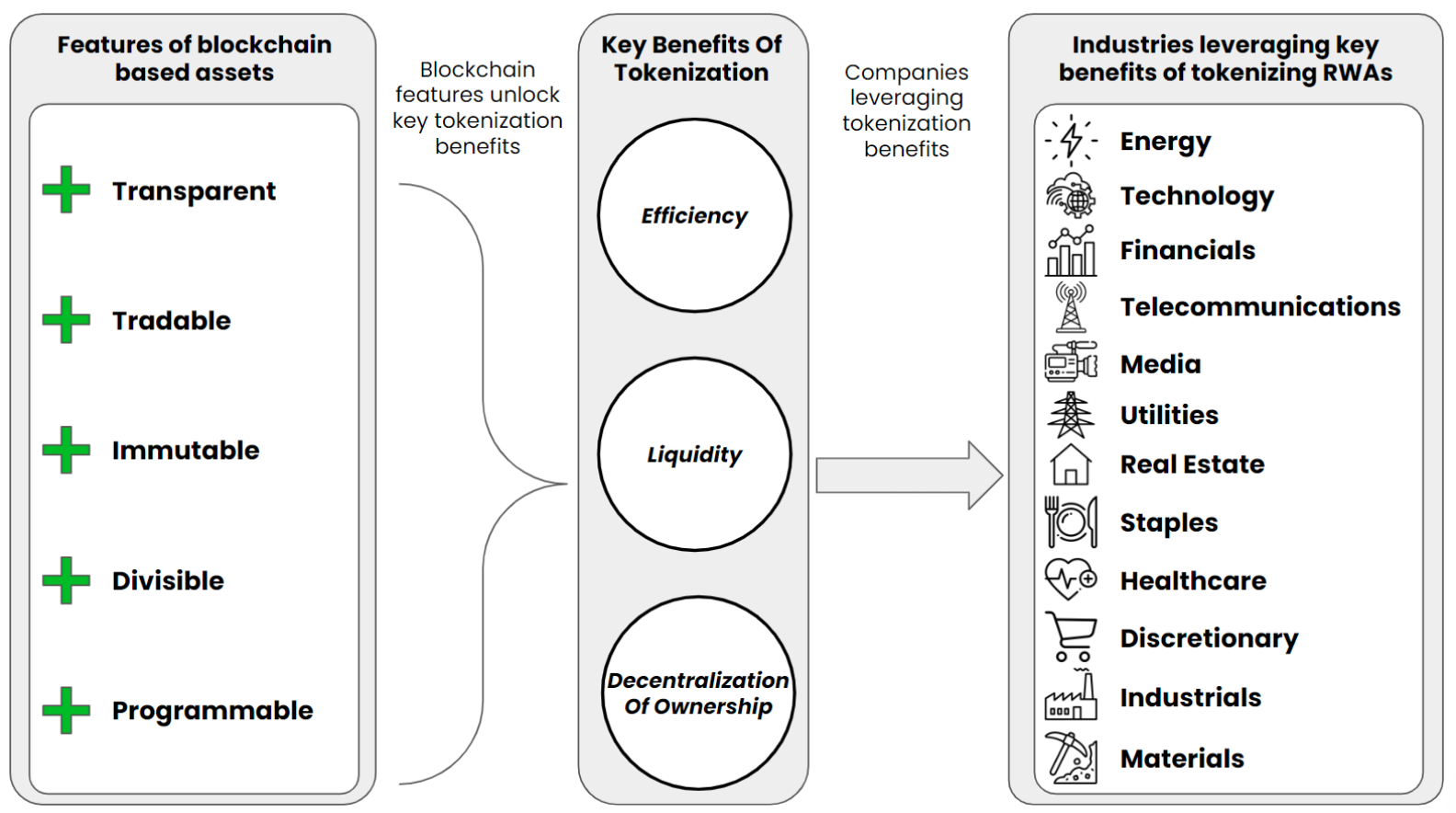
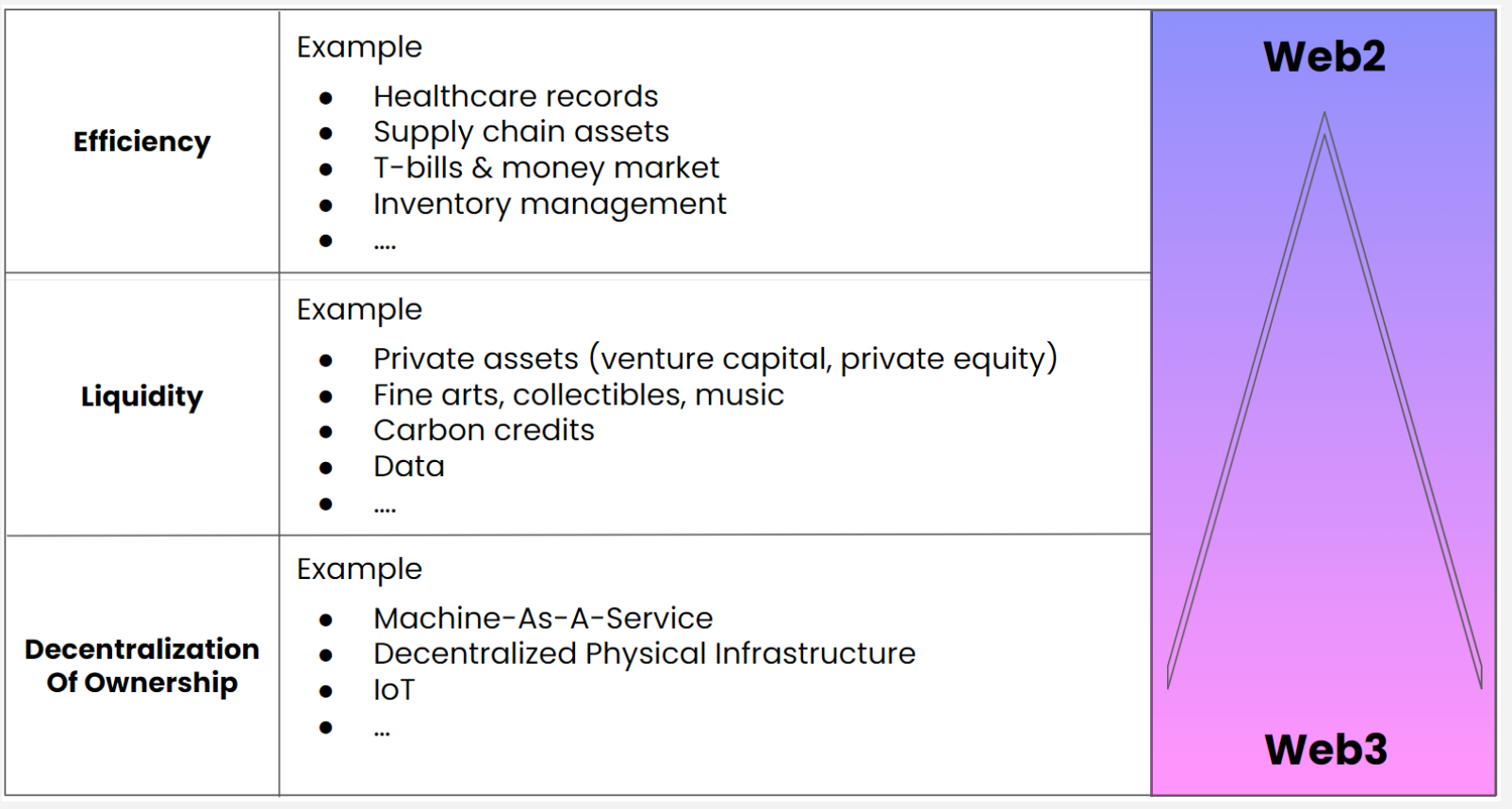
We believe that by leveraging the characteristics of blockchain technology, tokenization can bring three major benefits:
Efficiency - Improve existing processes and operations by increasing asset transparency and traceability
Challenge - Form an Alliance
Examples - Inventory management, trade finance, medical records, supply chain assets...
Liquidity - allows assets to change ownership in a transparent and orderly manner and builds a market around the asset.
Challenge - Liquidity Split
Examples - venture capital, art, collectibles, music, retail real estate, carbon credits…
Decentralization of ownership - allowing asset ownership to be distributed in a transparent and orderly manner
Challenges - Ownership Regulation
Examples - Decentralized Physical Infrastructure (DePIN), IoT, Machines-as-a-service...
Why Now?
We believe that the market is really different this time. After nearly five years of initial hype, the tokenization of RWA now looks different. We discovered three key reasons that make us confident that this time is different.
More attention and activity - We are seeing more attention and activity coming from more participants actively trying out the technology.
Technology Stack and SDK - We are seeing significant progress in the blockchain technology stack and SDK, especially in terms of scalability, security, and interoperability of tokenized assets.
Legal and Regulatory Clarity - Over the past few years, we have seen regulatory improvements to address the need for RWA tokenization, and we expect this process to accelerate as more stakeholders publicly express interest .
Why are financial assets valued so much?
The financial industry is currently at the forefront of blockchain-based tokenization of assets. Tokenization promises to revolutionize the way financial assets such as stocks, bonds and real estate are digitally represented and traded. There are numerous use cases being explored within the financial industry for blockchain integration and tokenization.
We believe there are four main reasons why the idea of tokenized RWA is so popular among financial markets:
High fit - The tokenization of RWA is highly aligned with the financial industry. It facilitates and improves existing decentralization of (i) processes, (ii) liquidity and (iii) ownership of financial assets.
Terminology and Founder Market Fit - Finance professionals are already very familiar with the concepts of efficiency, liquidity, and decentralized ownership. As a result, they realize the value proposition of RWA tokenization faster. This understanding is less common in other industries such as media, healthcare, utilities, and more.
Intangible assets and digital representations – Financial assets are already largely intangible and digital representations, making them easier to tokenize.
Huge Value - Financial assets are the largest pool of assets in the world. Therefore, the tokenization opportunities associated with these assets are second to none.
Why do we believe tokenization will continue to gain adoption?
We believe that tokenization will continue to dominate in the coming years. In addition to the strong fit, we see other trends in financial markets that will accelerate the adoption of RWA tokenization in the coming years:
High Cost of Capital - Increases in risk-free rates expose the true cost of capital inefficiencies. The cost of inefficient clearing, trading and financing activities has increased exponentially over the past 18 months, prompting financial institutions to search for solutions.
Launching platforms - Many large financial institutions have committed to building their own tokenization platforms. While we do not believe this is the end state of RWA tokenization, financial institutions are now starting to populate financial instruments on the blockchain.
Race to the bottom - Sales and trading, asset management and other business lines have been facing cost pressures in recent years due to increasing regulatory burdens and the rise of challenger banks/fintechs. We believe that as tokenization is explored more seriously, existing financial players will recognize its scale and cost-effectiveness potential.
What are we excited about?
It is generally accepted that there are three distinct layers to the technology stack supporting RWA tokenization.
Standards - Define how assets and ownership are represented.
Infrastructure - Provides the infrastructure to reflect and store RWA on the blockchain.
Application - Provides utility to holders of tokenized assets.
We are seeing exciting developments in both infrastructure and applications.
infrastructure
The infrastructure still has a long way to go before we are ready for the RWA tokenization endgame. Nonetheless, there are some interesting opportunities in the short term, particularly around the tokenization of financial assets.
Tokenized infrastructure from general to specific use cases
Over the past five years, we have seen significant improvements in technology to facilitate tokenization. We see L1 scaling, wallets, token standards (ERC20, ERC721, ERC3643, ERC2222, etc.)…general tokenization infrastructure is maturing. As tokenization use cases become more complex, we expect innovation and founder attention to shift from general-purpose tokenization infrastructure to use-case-specific tokenization infrastructure.
For founders, the opportunity now lies in building infrastructure to attract buyers.
We continue to see bottlenecks in tokenization demand. While there are many opportunities to tokenize and segment asset classes, we see many industry verticals struggling to build a liquid market around these tokenized assets, even for assets that already have an existing liquid market. We believe the opportunity now for founders is to build the infrastructure to attract buyers.
Here are some products we’re excited about:
DAO Vault Tools: Tools that allow DAOs to quickly make decisions and execute on tokenized assets to manage and decentralize funds.
Risk Management and Valuation Tools: Traditional investors, while interested in the yields offered by Treasury bills and the like, struggle to assess the risk premium required for tokenized products. On-chain indexing tools can help investors quantify risks and respond with confidence.
Regulatory-first on-chain tools: Regulatory compliance remains a bottleneck. There are some compliance tools, but these should be simplified and abstracted for better onboarding and user experience.
Full Token SDK: Assets are represented by a simple token, without leveraging additional smart contract functionality to automatically enforce the terms and conditions associated with the underlying asset. If we want to move from “dumb” tokens to “smart” tokens, we need to provide users with tools to improve token smart contract programming. Additionally, regulation is needed to make these rules enforceable.
Interoperability of Tokenized Assets in a Multi-Chain Reality
We believe we are moving toward a multi-chain reality as blockchain evolves from monolithic, general-purpose ledgers to modular, vertical or application-specific builds. This is particularly evident in the financial services space, where we are currently seeing tokens being launched on both permissioned and permissionless blockchains.
We believe that X-Chain interoperability for tokenized assets should be established. Here are some examples:
data feed
Liquidity aggregator
6.2 Application
We classify applications based on their strengths rather than end markets. The different advantages and some application examples are briefly described below.
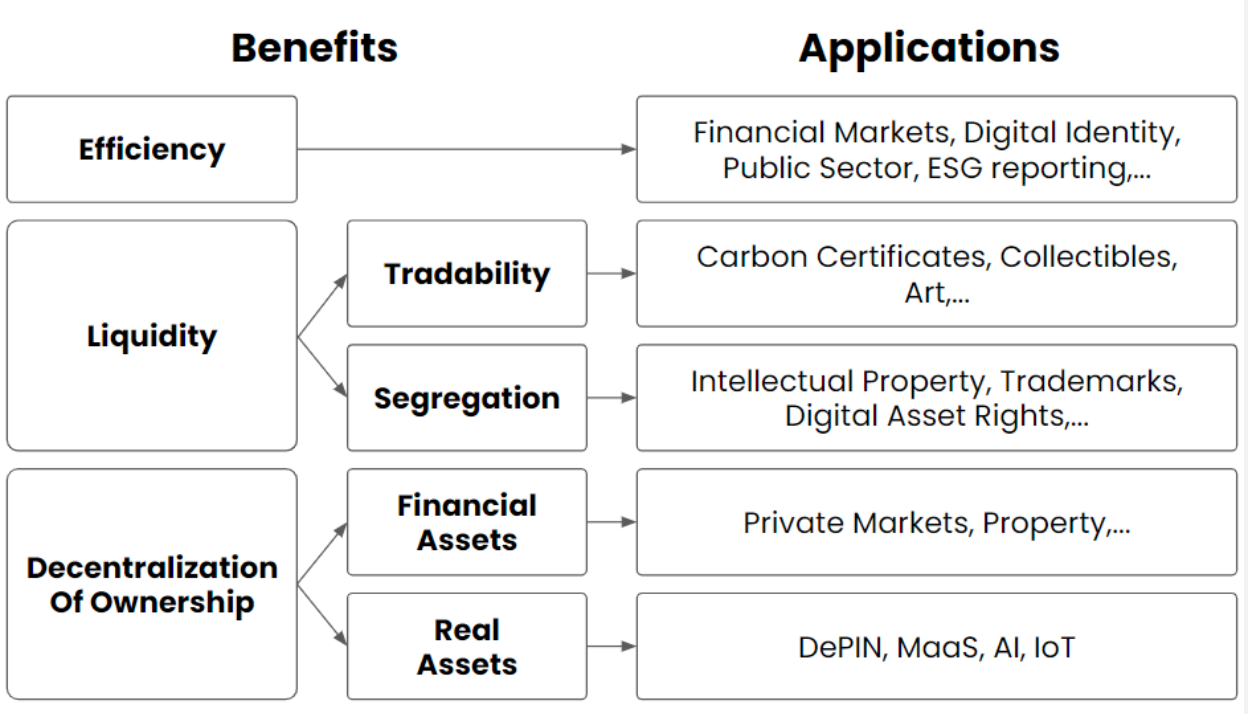
Efficiency – While not necessarily aligned in terms of economic incentives, blockchainization can unlock interests between stakeholders operating on the same value chain.
Sustainability Reporting – Blockchain can be used to track carbon emissions across the entire value chain
Financial Markets - The infrastructure and processes of financial markets are completely different for different asset classes. Tokenization can unify practices across asset classes.
Digital Identity - Tokenizing and storing personal data in Web 3 wallets allows individuals and legal entities to control the flow of information and digital footprints.
fluidity
Although difficult, we believe that creating a liquid market through RWA tokenization can unlock the financial value contained in assets that are currently difficult to trade.
For use cases that excite us, we further break down liquidity into 1) tradability and 2) isolation.
Tradeability – Tokenization has the potential to create a market for assets that were previously “over the counter” (OTC).
Carbon Certificates - Blockchain-traded carbon certificates combine efficiency and liquidity, increasing efficiency (transparency, reporting...) and improving liquidity in previously inefficient markets.
Collectibles - Tokenization brings efficient, low-cost tradability to previously OTC markets.
Segregation - Tokenization has the potential to create new assets by isolating parts of an asset and placing them on-chain. Liquid markets can then be created around these new assets.
Digital Property Rights Example - Separating digital property rights from overall property rights. These rights can be used to define ownership of assets in the augmented reality-based metaverse and can be publicly traded. (See Darabase ).
By creating a liquid market around digital property rights, Darabase expects global property values to rise by 2%. The markup stems from under-utilization of digital property rights, which are not tradable and therefore under-utilized.
Other examples include the intellectual property market, trademark market, etc.
As tokenization becomes more common across industries, we can expect to see more of this separation of asset rights.
Decentralized ownership
Decentralization of ownership best aligns with the Web3 narrative. We believe that the benefits vary depending on whether we are dealing with ownership of financial assets or ownership of real assets.
financial asset ownership
Applications of financial assets revolve around capital formation and the ability to derive from:
Private Equity Markets - Investment opportunities that were previously difficult to access in VC and PE become easy to pass
Property - In the United States, property ownership currently accounts for 60% of disposable income, crowding out ownership from the middle class. Tokenization can reorganize property ownership.
real asset ownership
Tokenization reorganizes capital formation around capital-intensive industries. Traditionally, capital-intensive industries have been difficult to enter due to the high initial investment required. By decentralizing the ownership of physical assets, the barriers to entry for these industries can be lowered, challenging their existing business models, and thereby improving efficiency.
Decentralized Physical Infrastructure (DePIN) - Computing, Telecommunications, Storage, Utilities, and More
Machines as a Service - Learn more
AI democratization – distribution of AI capabilities through partial ownership of infrastructure and computing power
IoT - Redistributing asset ownership structures to unlock the full potential of IoT and smart cities
How do we think about adoption?
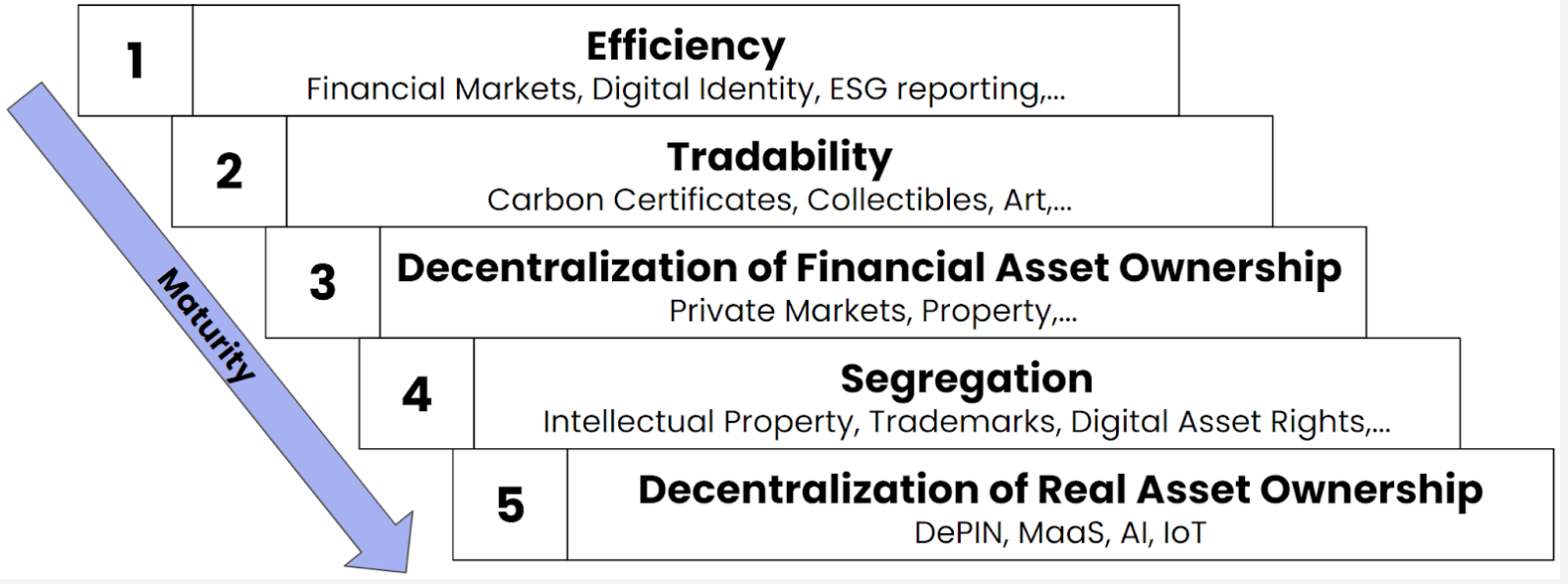
While there are many moving parts, we believe there are two prerequisites for the adoption of any tokenized asset.
Regulation – The regulatory framework for this new asset class is critical. Not only are token holders unable to comply, but the embedded terms and conditions associated with the tokens cannot be enforced without regulation.
Product demand – While part of this is related to regulation, it also requires buyers to have clear demand for the token product. We are at a stage where infrastructure development exceeds demand. Our demand for these services is starting to pick up.
We developed an adoption framework based on different applications that leverage the key benefits mentioned above.
Financialization of real assets
Another important trend is the financialization of real assets, which we believe will open up new markets and asset classes.
In recent years, there has been a clear trend toward the financialization of real assets, driven by advances in technology and education. Financialization means that financial markets, financial instruments and financial incentives have an increasing influence on the management and utilization of real assets in the wider economy. This trend has expanded liquidity and investment opportunities, particularly in real assets, as financial returns and cash flow have traditionally played a smaller role in the value proposition.
We believe tokenization will play a key role in the next phase of the financialization of these assets by unlocking efficiency, liquidity and decentralized ownership of these assets. We see that tokenization brings liquidity and decentralization to the cash flows associated with these physical assets. Previously, these cash flows were difficult to separate from physical assets due to transparency and efficiency issues, and tokenization provides a technological solution that opens physical assets to financialization. This movement will eventually allow physical assets to become both physical and financial assets, similar to what is already happening with real estate.
challenge
In addition to the specific challenges related to the main advantages, the tokenization of RWA also faces overarching challenges. Here are a few of the main challenges:
Network Effects - Blockchain-based applications, by their very nature, rely on network effects. For RWA, user network effects are needed to turn efficiency, liquidity, or decentralization of ownership into a viable value proposition that convinces new users to tokenize and populate RWA into a shared blockchain.
Oracle Problem - Difficulty reflecting digital assets that represent tangible RWA. A safe and secure method is needed to ensure that data inputs (tokens) reflect the state of real-world assets.
Tokenization Standards - Standardization of the tokenization of real-world assets is critical to ensuring compatibility, regulatory compliance, and investor trust in blockchain-based finance. However, the decentralized nature of blockchain and the need to address legal and technical challenges make achieving universal standards a complex task. Overcoming these challenges is critical.