Since its inception, Metaplex will have generated $23.5 million in revenue based on daily SOL rates.
Written by James Ho
Compiled by: TechFlow TechFlow
The Solana ecosystem has recovered, and its NFT infrastructure protocol Metaplex has experienced a 10-fold increase in the past month.
However, compared with other application layer projects on Solana, this project does not seem to have been mentioned by many people, and due to its rooted infrastructure, the related products and technical principles are not particularly intuitive.
Two months ago, encryption VC Modular Captital conducted an in-depth explanation and study of Metaplex on its blog. We have compiled it to give everyone a better understanding of this rapidly becoming popular project.
Summary
- Metaplex is a mature NFT infrastructure protocol in the Solana ecosystem. They facilitate over 99.9% of NFT minting. They have established infrastructure standards for NFTs (token metadata) and developed applications like Candy Machine and Creator Studio to make it easier for creators to set up fair launches.
- Despite the huge decline in the NFT market in general (floor prices and market volume are down 85-99%), Metaplex's minting volume has increased more than 5x year-on-year, thanks to the launch of Bubblegum, a platform for minting compressed NFTs. (compressed NFT) project.
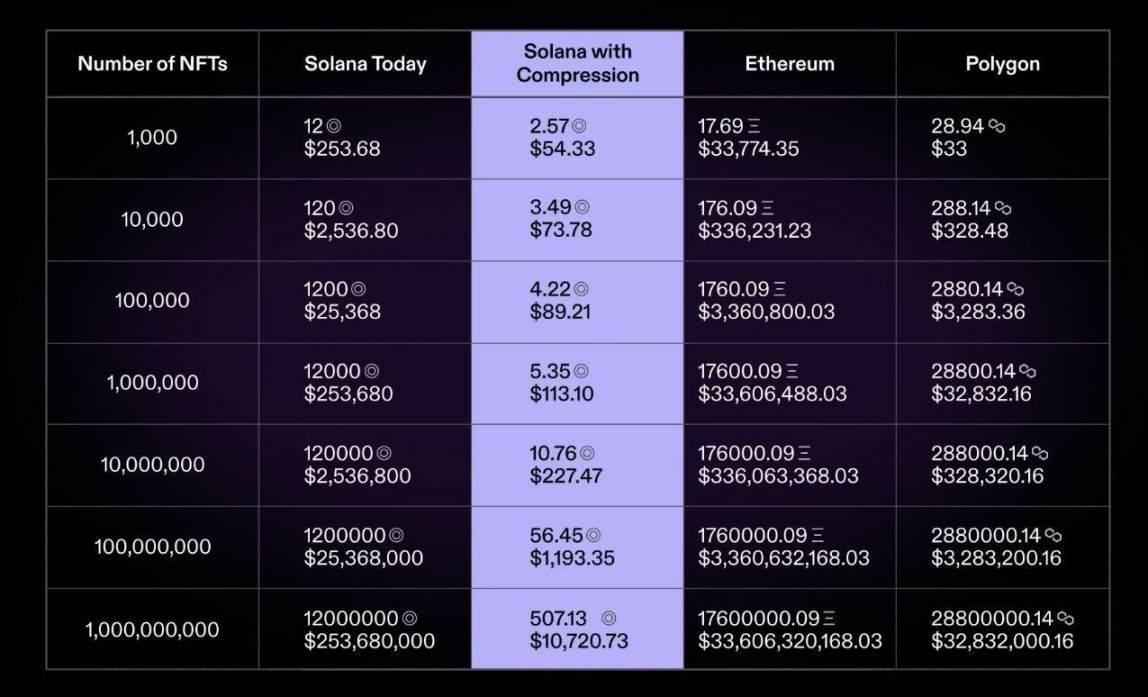
- Metaplex's compressed NFTs reduce the cost of minting NFTs by over 1000x (from over $10 for Ethereum to less than $0.001 per mint for Solana). This has led to a proliferation of experiments integrating NFTs into social, payment, creator, and physical infrastructure applications. Metaplex mints 180 million NFTs every year, while Ethereum mints 25 million (more than 7 times more).
- Metaplex recently started charging fees to maintain the program. If tolling starts in 2022, Metaplex will generate $13.9 million in revenue.
- Solana has achieved success in mainstream web3 consumer use cases with its unique parallel computing architecture and local fee marketplace. We believe NFTs can play a vital role in this, as a narrative that represents any unique digital content.
- Unlike the highly competitive NFT market, we believe Metaplex has little competition and is likely to continue to lead NFT minting through its infrastructure standards and front-end applications.
- Metaplex has the potential to become a Shopify-like product that allows creators to mint, manage, and monetize their NFTs. Over the next 3-5 years, we see Metaplex having the potential to support billions of NFT mintings per year and generate $25 million to over $100 million in revenue.
background
NFTs were the key innovation in crypto during the last crypto cycle. NFTs are unique digital identifiers recorded on the blockchain that are used to prove the provenance, authenticity and ownership of digital assets.
The first attempts at NFTs involved the ERC-721 standard on Ethereum, which was first introduced in September 2017. CryptoKitties created one of the first blockchain games that allows users to collect and breed digital cats (both represented as NFTs). This caused congestion on the Ethereum network in November/December 2017 and accounted for over 20% of network activity.
Centered around digital images, NFTs are making serious inroads into mainstream audiences. CryptoPunks (launched in June 2017) and Bored Ape Yacht Club (BAYC, launched in April 2021) are among the most valuable NFT collectibles, with 1 NFT worth over $400,000 at the peak of the market in 2021-22. During that period, we saw NFT trading volume in the market grow from zero in 2020 to an annualized $60 billion. NFT markets like OpenSea were valued at more than $13 billion at the peak of the market cycle, with monthly transaction volumes of more than $2-3 billion, annualized revenue of more than $1 billion, and a growth rate of 2.5%.
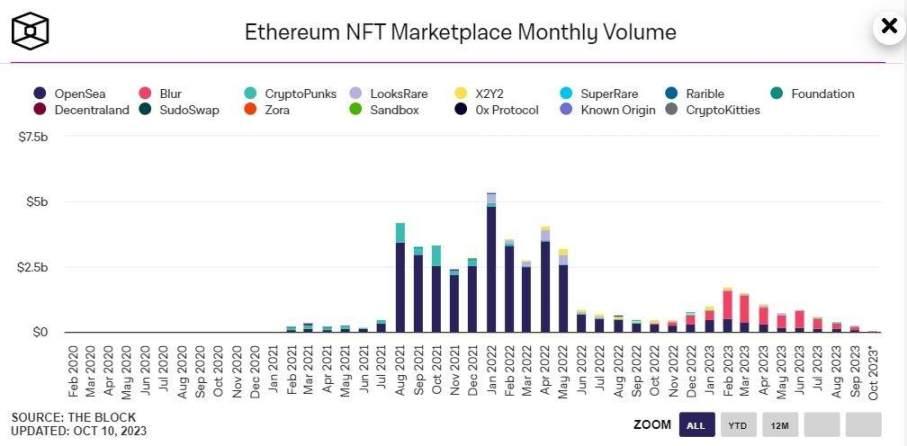
Like the rest of cryptocurrency, NFT floor prices and trading volumes have dropped significantly over the past two years. Blue-chip NFTs like Punks and BAYC are down 80-90% from their market peaks, while NFT market trading volume has dropped from an annualized $60 billion to over $3 billion. However, NFT still achieves an annual transaction volume of more than 3 billion US dollars, and the floor price of Punks and BAYC is 35,000-70,000 US dollars, which proves the power of digital community and culture. For reference, eBay processed $74 billion in GMV in 2022.
During the 2021-22 period, NFTs will be primarily associated with speculative JPEGs, similar to how Ethereum was primarily associated with initial coin offerings (ICOs) during the 2017-18 period. However, since then, Ethereum and smart contracts have evolved into much more. Today, smart contracts are the driving force behind permissionless finance, stablecoins, decentralized autonomous organizations, governance, tokenization of traditional assets, physical infrastructure networks, and more. Likewise, we believe NFTs are a narrative of the next decade that enable digital property rights and ownership of any content type
Historically, a key barrier to NFT adoption has been the cost of minting, which grows beyond highly speculative use cases. For a standard set of 10,000 NFTs, the cost today on the Ethereum network is 176 ETH, which is nearly $300,000 (around $800,000 at peak), which equates to $30 per mint ($80 per min at peak) . This may be an acceptable cost for speculative users, but may be prohibitive for daily use.
In order for NFTs to become ubiquitous, they need to structurally shift from scarcity to abundance.
Introducing Metaplex
Metaplex is the protocol behind the NFT standard in the Solana ecosystem. The company was originally incubated at Solana Labs, founded by a team including Stephen Hess (former head of product at Solana Labs), and began operating as an independent organization in the fall of 2021. Metaplex has developed a series of products that allow artists, brands, and creators to mint NFTs and launch self-hosted minting pages through a series of APIs and low-code tools.
Metaplex drives the vast majority of activity (99.9% of NFT minting) and spans multiple product lines of infrastructure and application tools. Here are some examples:
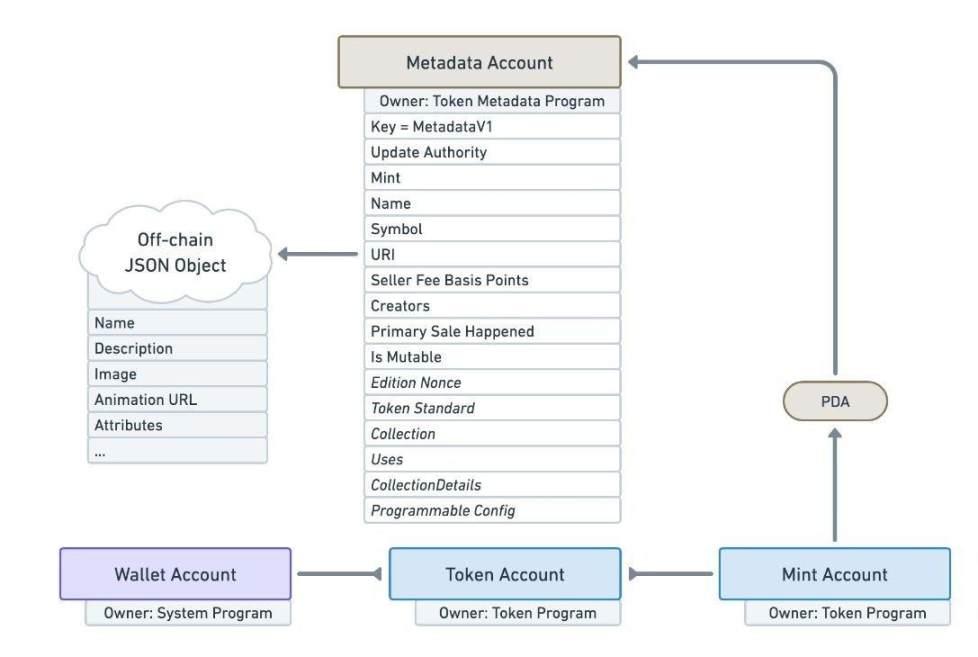
- Token Metadata – The Solana program is responsible for attaching additional metadata to fungible or non-fungible tokens. For NFTs, this includes name, symbol, URI, characteristics, royalty fees, etc.
- Candy Machine – The leading minting and distribution program for launching fair NFT collections on Solana. It allows creators to put their digital assets on-chain in a secure and customizable way.
- Auction House – An agreement that allows a marketplace to implement a no-escrow sales contract.
- Fusion – A program that adds on-chain tracking and composability around NFT ownership. It is used by creators to implement complex ownership models.
- Creator Studio – No-code, web-based tool for creators that allows them to easily create, sell and NFT on Solana without writing any code.
- Bubblegum – Program for creating and interacting with compressed Metaplex NFTs that are secured on-chain using Merkle trees.
Since its inception, Metaplex has facilitated the minting of 144K+ collections, 61.7M+ NFTs, 14M+ collectors, and $1.1B+ in creator revenue. The minting cost of 10,000 NFTs is only $2,500-3,000 (equivalent to $0.25-0.30 per mint), compared to $2.5-30 million for Ethereum ($25-30 per mint).
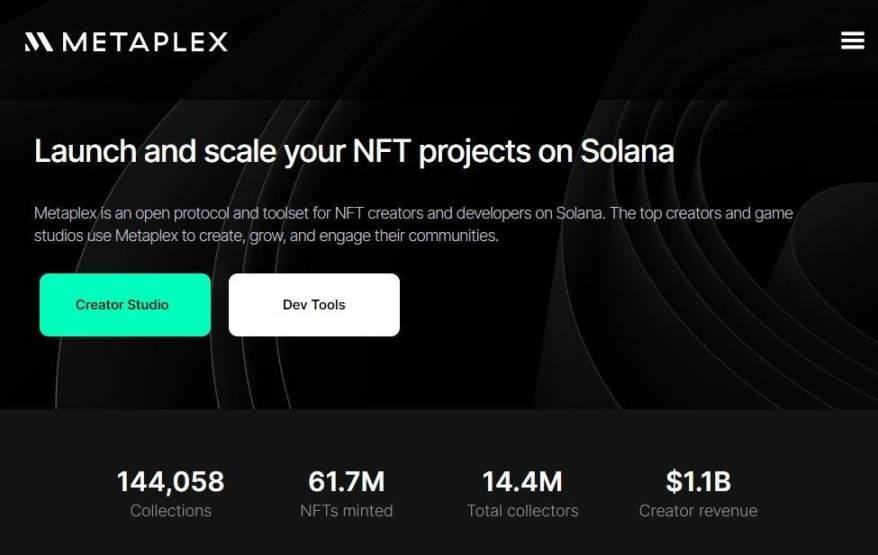
Metaplex's most commonly used programs include Candy Machine and Token Metadata. Unlike most other blockchains, Solana separates logic and data into two distinct components – these are called programs and accounts. Instead of storing data in internal variables, the program (which holds the application logic) interacts with the account (which holds the state and data) and is able to modify them. One such program is Candy Machine, the leading minting and distribution program for fair NFT issuance on Solana. Token Metadata is another such program that attaches metadata to fungible and non-fungible tokens on Solana.
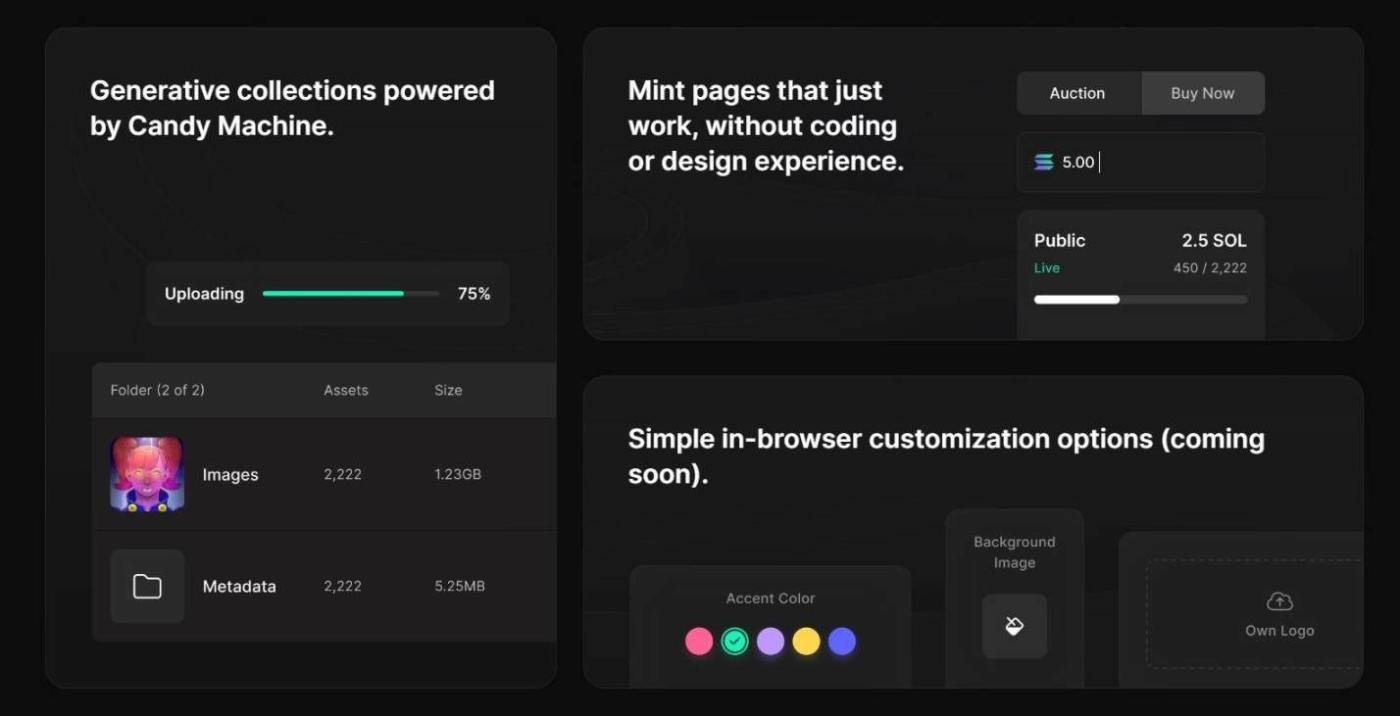
Metaplex's programs are publicly available for everyone to view and fork under an open source license. Although the source code is public, Metaplex's license does not allow others to copy or fork the code for profit, or to provide competing products or commercial substitutes that conflict with Metaplex's financial interests. Additionally, Solana’s architecture that separates programs and accounts means that if a new startup were to fork Metaplex’s NFT standard, many of the key players in the ecosystem (such as NFT markets, wallets, custodians, and node providers) would The program needs to be integrated. This creates a huge coordination overhead.
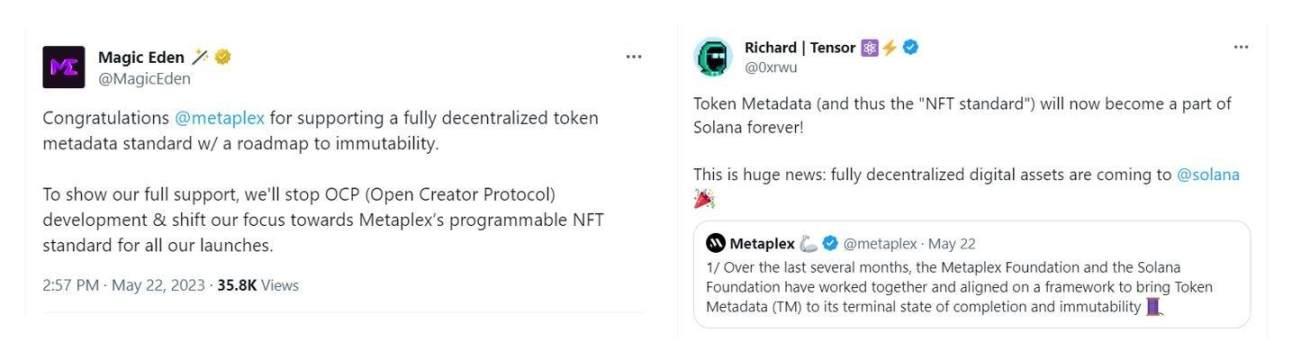
In fact, Magic Eden (Solana NFT Marketplace) has previously attempted to launch its Open Creators Protocol (OCP), which defines a new standard for NFT collections with mandatory royalties. The effort had limited success but was later shut down.
The result of the above is that Metaplex has a strong and dominant position in the Solana NFT ecosystem while building programs at the application and infrastructure standards layer.
Compressed NFT
Despite challenging NFT and cryptocurrency market conditions, Metaplex has used its infrastructure to significantly increase the number of NFTs minted each week, from 500,000 per week for much of 2022 to 3 million+ per week today. This more than 5x growth was driven by the launch of the compressed NFT standard, further reducing casting costs. Today, the cost to mint 100,000 compressed NFTs is just $100, which equates to less than $0.001 per mint.
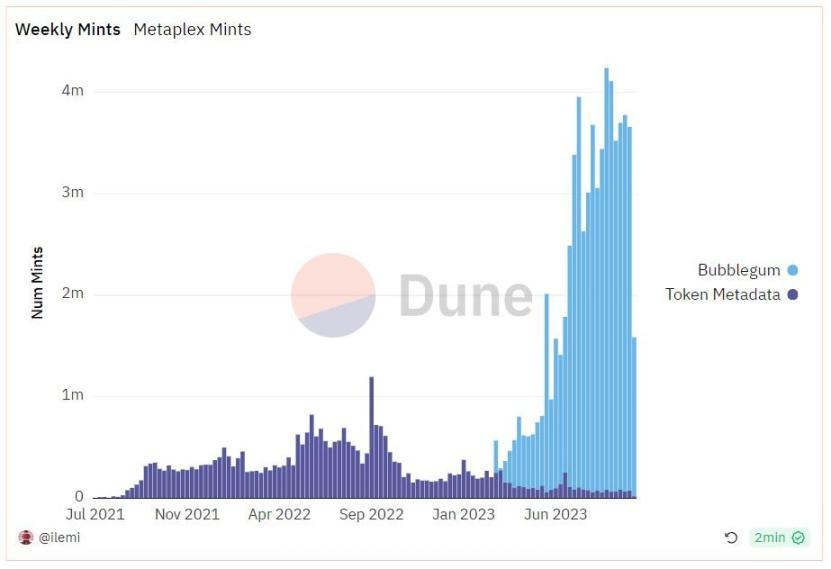
Metaplex's compressed NFT program (called Bubblegum) achieves this breakthrough through Solana's Merkle tree program (called account compression). This is achieved by moving the storage of NFT metadata (image URL, characteristics) off-chain through indexers and RPC node providers. Rather than storing metadata in a typical Solana account, compressed NFTs store metadata in a ledger.
The result is that compressed NFTs inherit the security and speed of the Solana blockchain while reducing storage costs by moving such storage off-chain. Since the entire computational history is on the Solana ledger, if any indexer or RPC provider goes down, the entire state data can be reconstructed by replaying all historical transactions. It is worth noting that all compressed NFTs are compatible with the regular NFT standard and can be losslessly decompressed into regular Metaplex NFTs. In a way, this is similar to Ethereum's rollups offloading computation and state storage to the L2 blockchain (Optimism, Arbitrum), while Ethereum itself stores merkle roots and data availability. This enables Ethereum to trustlessly rebuild state if the L2 rollup blockchain is compromised.
Metaplex launched compressed NFT in November 2022. Since then, 57 million+ compressed NFTs have been minted. Due to the low cost of casting, many applications have found creative use cases:
- DripHaus – a platform that connects creators and fans by airdropping their works (art, music, games, comics) to fans. On Solana, 20 million+ compressed NFTs have been minted for $2,000, while on Ethereum the cost will be over $300 million.
- Helium – A decentralized network of 2 million+ IoT hotspots owned by users. Helium migrated from their own blockchain to Solana, and in the process they issued 1 million+ compressed NFTs on Solana to represent user-owned hotspots.
- Dialect – wallet-to-wallet messaging app. Emojis and stickers are tokenized as compressed NFTs, making them collectible and ownable. Users can mint custom emojis and stickers and share them with friends. Over 20,000+ users have minted and collected these stickers.
- Tiplink – Crypto payment application that allows users to send and receive funds via web links or URLs. Tiplink allows new users to claim compressed NFTs generated by artificial intelligence, allowing users to test its products as a growth strategy. Tiplink has acquired over 1 million users (independent minters) through this acquisition strategy.
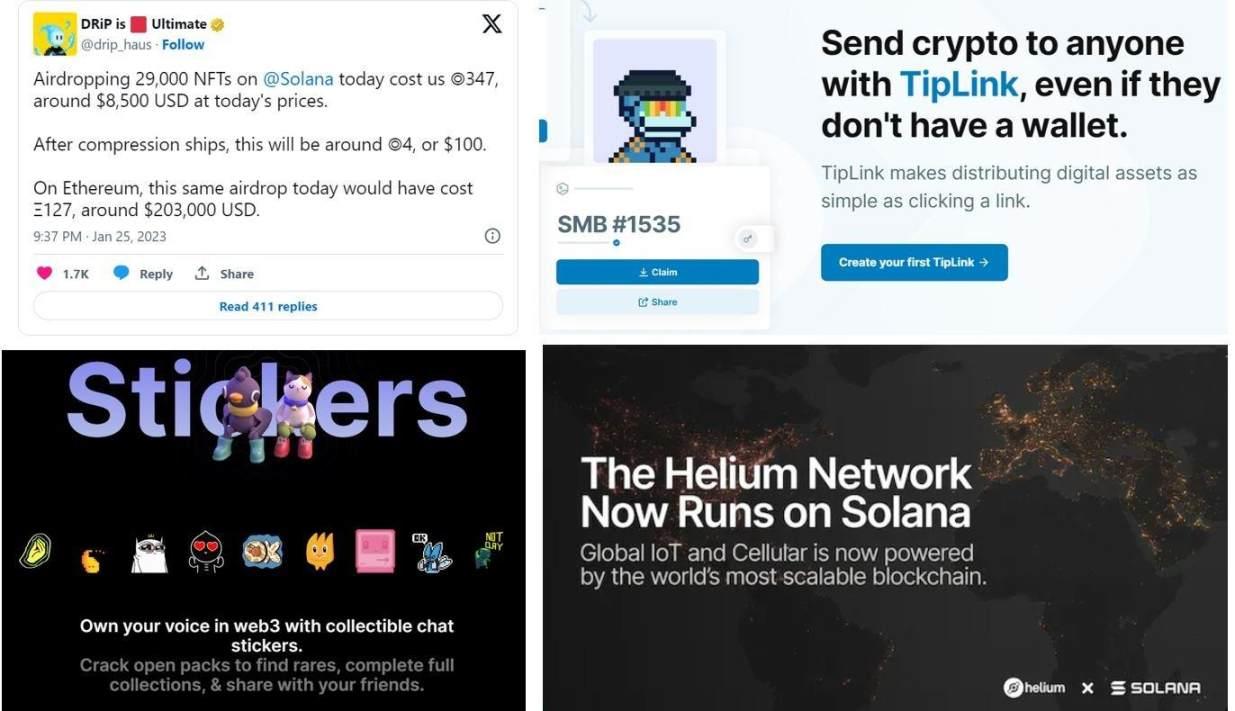
We have experienced cases such as Dialect, Tiplink, and DripHaus using compressed NFTs, which is not possible in Ethereum or other ecosystems. As the cost of minting NFTs drops to less than $0.001, applications are finding innovative ways to integrate NFTs into everyday use cases—including payments, artwork, chat stickers, and physical infrastructure networks. Additionally, Magic Eden and Tensor have launched support for compressed NFTs in their markets, demonstrating the adoption of the compressed NFT standard from the Solana ecosystem.
Monetization
For most of its history, Metaplex operated all of its products free of charge. The company raised $47 million in venture capital from Multicoin Capital, Jump Crypto, Asymmetric, and many other leading funds, selling 10.2% of its tokens in strategic rounds. This capital funds the development and maintenance of a broad range of programs in the Metaplex program library. In late May 2023, Metaplex announced plans to further improve the sustainability of the protocol. These changes include:
- There are plans to convert the Token Metadata program to be fully immutable, meaning it will no longer be able to be upgraded or modified.
- Access to the Token Metadata program will remain permissionless, all users will be treated equally, and will not be token-gated using $MPLX before or after.
- Introduce small fees for use of the Token Metadata program, primarily 0.01 SOL (approximately $0.20 USD) for the creation of each uncompressed NFT.
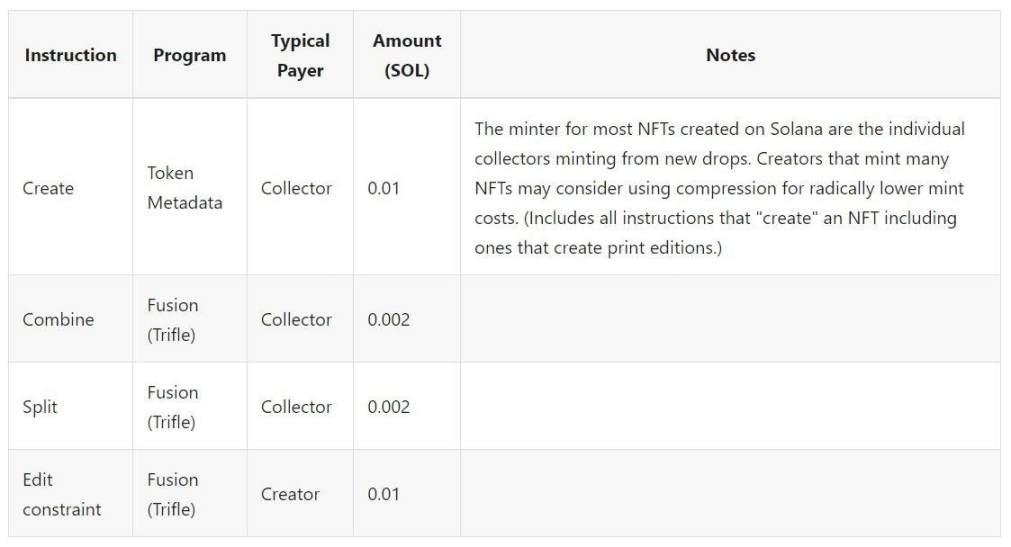
Fee income is used to fund the development of other programs maintained by Metaplex (such as Candy Machine, Auction House, and Bubblegum). Notably, these changes are strongly supported by key players such as Solana Labs (from which Metaplex spun off), Magic Eden, and Tensor (these are the largest Solana NFT marketplaces).
In 2022, Metaplex facilitated the minting of 22 million NFTs. At that day's price, if Metaplex charged 0.01 SOL ($0.20) per mint, this would translate into $4.4 million in revenue, or $13.9 million if charged at the daily SOL price. Since its inception, Metaplex will have generated $23.5 million in revenue based on daily SOL rates.
Since the introduction of compressed NFTs, over 99% of ongoing NFT minting is now done under Bubblegum. Please note that minting of compressed NFTs is not currently monetized. Currently only standard NFTs using the Token Metadata program are monetized. We believe that in the medium term, Metaplex's main focus should be to further drive experimentation, use and adoption of Bubblegum, which has significant growth potential in mainstream consumer crypto applications.
Historically, NFTs have been scarce. In a world where NFTs cost $20-$30 to mint, this is a logical conclusion, supporting only high-value, artificially scarce assets like CryptoPunks and BAYC. However, with prices reduced by more than 1,000 times, we believe NFTs are transforming into the core infrastructure that supports digital experiences - whether in consumer payments, gaming, social, identity, music, physical infrastructure and more.
Going forward, we believe NFTs will increasingly be about abundance.
Metaplex has built leading NFT infrastructure standards and applications that are the most usable and scalable for consumer products reaching over 100 million users. In 2022, Metaplex demonstrated annual revenue potential of $4-14 million in limited use cases. We believe the protocol has the potential to drive billions of NFT mints per year (from the current 150-200 million annualized), continue to build leading infrastructure standards and applications, and grow into a sizable revenue and business Results.
Valuation and Scenario Analysis
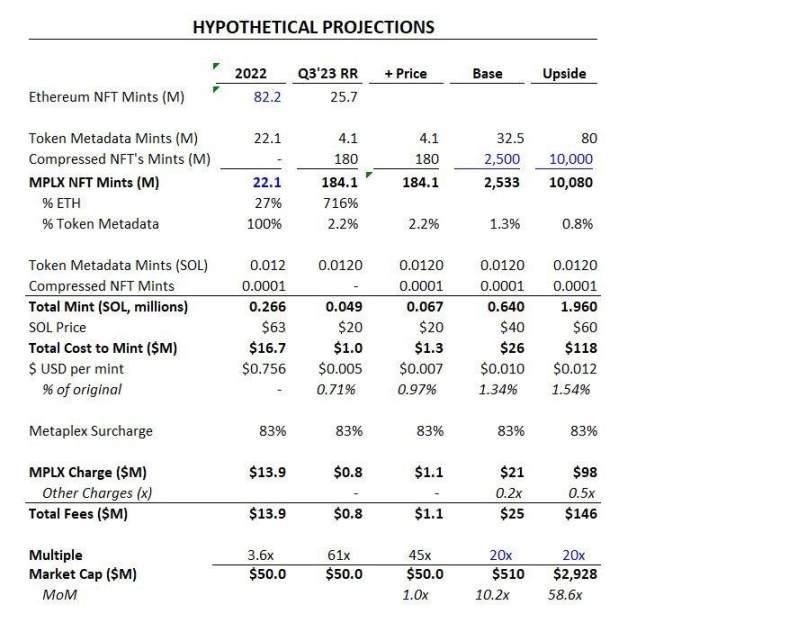
Considering that Metaplex's experimentation and monetization of compressed NFTs has just begun, it is difficult to predict the future state of Metaplex. We try to flesh out various scenarios:
- Our 2022 scenario highlights what Metaplex's revenue would be if Metaplex charged fees. Given that Solana’s minting costs are significantly lower than Ethereum and NFT valuations are higher, we believe Metaplex will have the pricing power to implement fees without losing too many minting times and earn $14 million in revenue for the year.
- Our current scenario highlights the incredible growth of compressed NFTs, at an annualized rate through Q3 2023. Impressively, Metaplex’s annualized minting volume exceeds 180 million, which is 9 times the amount Ethereum mints today and 2.7 times the amount Ethereum mints in 2022. As the cost of minting is reduced by 100x (in SOL terms), we see a corresponding increase in mintage of 30x. Although NFT trading volume and floor price dropped by more than 95%.
- Our fee scenario assumes Metaplex will charge the same 83% fee for its compressed NFT product as its traditional minting. Considering this only increases the price of compressed NFTs from $0.002 to $0.004, we don’t think this will significantly impact the number of NFTs being minted. Metaplex will be able to generate $1 million in revenue at these current valuations. For reference, OpenSea generated $7.6 billion in revenue in 2022 and now has $30 million in revenue.
Our base case assumes that Metaplex can increase its usage 10x from now on. Solana's price increases from $20 to $40. This will result in over $20 million in minting revenue, at an average cost of $0.02 per NFT, for a total of 2.5 billion NFTs minted. Metaplex can also add value-added services regarding NFT management and sales. Similar to Shopify, which allows online merchants to create and manage stores, Metaplex is trying to build a comprehensive service for the issuance and management of NFTs. We think this could add another $5 million in app-related revenue (at $10-20 per month, this would require 20-40k subscribers). At a multiple of 20x, this would support a valuation of $500 million.
Our optimistic scenario assumes that Metaplex can drive 1 billion NFT mintings per year. For reference, compare to the following annual figures:
- 2.5 billion blog posts
- 8.6 billion TikTok videos uploaded
- $70 billion spent on virtual goods (assuming $10 per item = 7 billion items)
- 200 billion tweets
- 1.8 trillion photos
- 8.4 trillion text messages
Although the cost per mint will increase as the price of SOL rises, we believe minters are willing to pay a premium commensurate with Solana minting if the Solana ecosystem becomes increasingly valuable. At a multiple of 20x, this would translate into a $3 billion result.
Risks and Countermeasures
The use of NFTs is still in its early and emerging stages. Most NFTs minted during 2021-2022 are related to speculation. Today we see attempts at adoption in messaging (stickers), payments (increasing acquisition), creator content (discovery), and physical infrastructure (tokenized representation), but these are still in the early stages and if applied Programs don't build businesses on them, they may not last or ultimately become monetizable.
Risks from Solana interfaces. Because Solana separates logic and state into programs and accounts, it allows specific programs such as Metaplex Token Metadata or the Solana Program Library (SPL) to dominate the standard for SPL token and NFT minting. The Solana ecosystem has been developing interfaces that will replicate functionality within the EVM ecosystem, allowing developers to replicate the ERC-20, 721 or 1155 standards to issue fungible and non-fungible tokens. This is still a work in progress and developers will need to build new code bases to replicate/surpass what Metaplex offers today for the already low cost. Still, this could be a long-term risk.
Solana ecosystem dependencies. Today, most activity is happening in Ethereum or EVM-compatible ecosystems, whether it’s decentralized finance, stablecoins, payments, NFTs, etc. Despite the FTX incident, Solana has proven itself to have a strong community, a unique architecture with parallel transaction processing, a local fee market, and scalability that grows in tandem with computing and Moore's Law. However, as the Ethereum ecosystem continues to mature and solve its own scalability challenges, even if NFTs succeed in becoming a widely adopted technology in everyday consumer applications, it is possible that this will not happen with Solana.