



Author: SenseAI
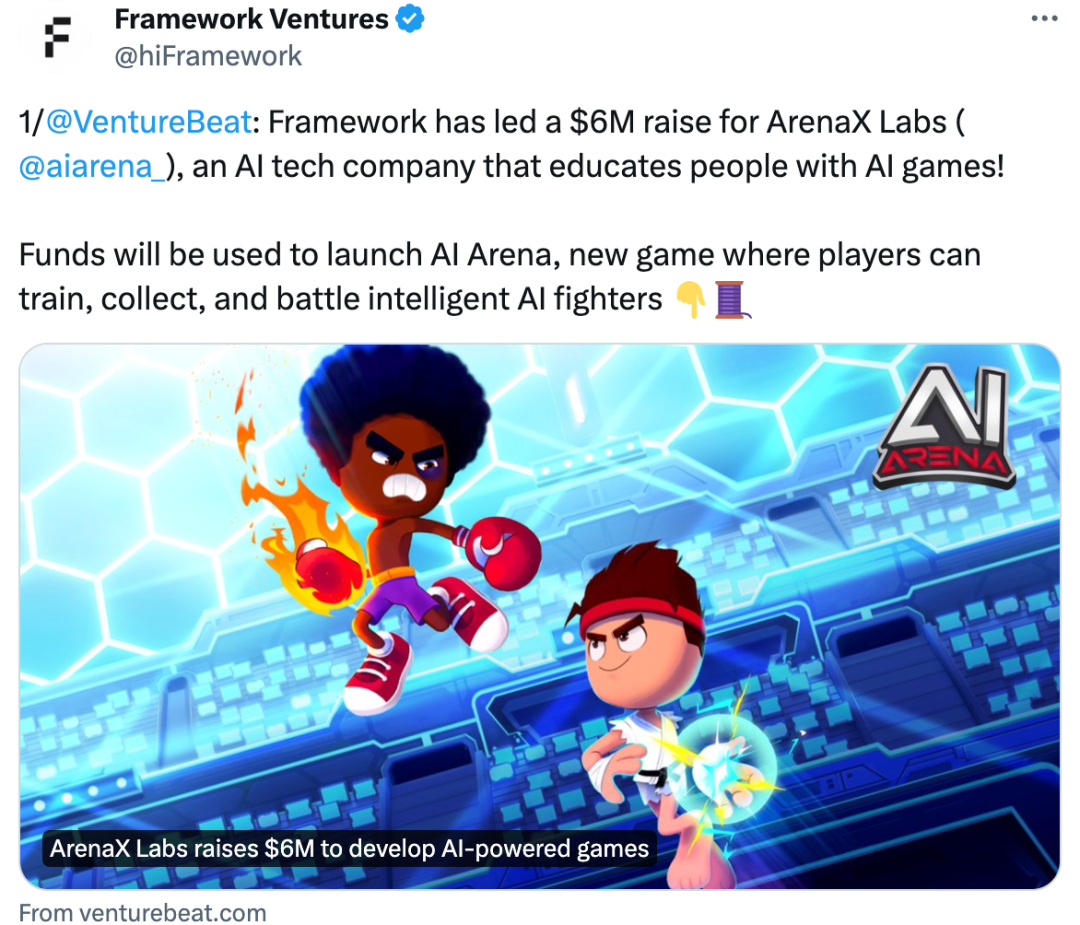
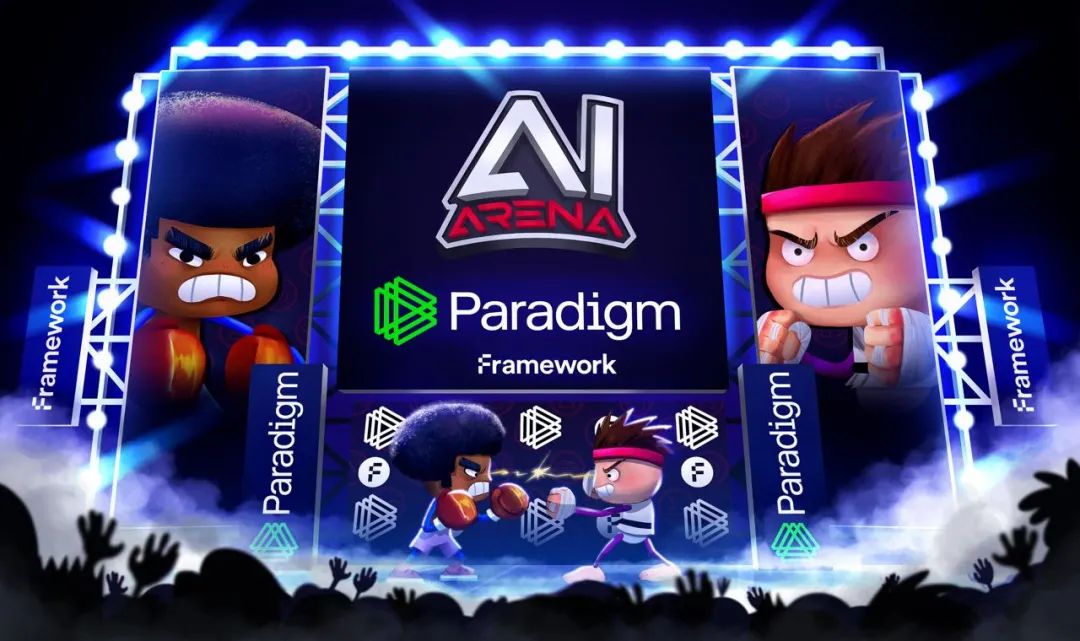
AI Arena is an AI-driven Web3 competitive game that allows users to train their own AI characters to fight. The outcome of each battle depends on the player's skills in training. It is designed to help users understand the operation and learning process of artificial intelligence . AI Arena is currently open for pre-registration, and ArenaX Labs plans to launch a beta version of the game on the Arbitrum mainnet soon.
AI Arena developer ArenaX Labs announced the completion of a new round of financing of US$6 million, led by Framework Ventures, with participation from SevenX Ventures, FunPlus/Xterio and Moore Strategic Ventures. It plans to use the funds to build a PvP fighting platform and develop similar game.
Sense thinking
We try to put forward more divergent deductions and reflections based on the content of the article, and welcome exchanges.
- AI Arena is not only a game that combines AI, but also a platform for cultivating players' AI abilities. With the advent of the AI era, how to train an AI assistant that suits you has become a necessity in people's work and life. Skills have become an important indicator of employee work ability in the workplace.
- The combination of AI and games allows players to improve certain soft skills while having fun and leisure. AI Arena has made a bold attempt in this regard and found a suitable entry point. In the future, as more and more players master In addition to the ability to train AI assistants, AI Arena can also provide an AI bilateral trading market based on protecting the intellectual property rights of AI practitioners, and provide transactions that match buyers and sellers.
This article has a total of 2334 words, and it takes about 8 minutes to read carefully.
AI Native product analysis
AI Arena
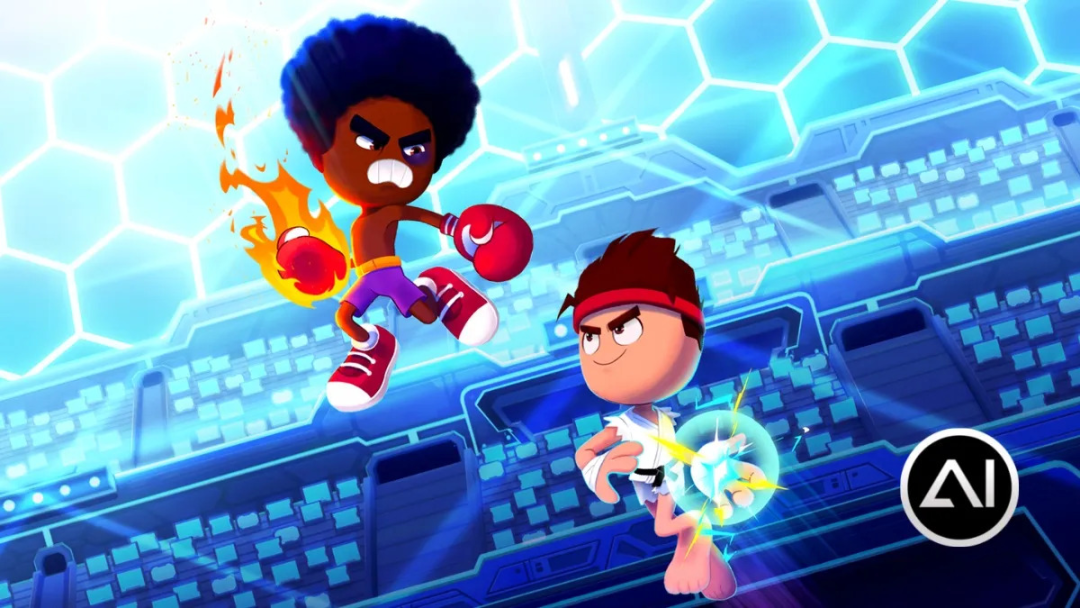
1. Product: AI Arena
2. Founder: AI Arena is developed by its parent company ArenaX Labs. ArenaX Labs was co-founded by three founders (Brandon Da Silva, Dylan Pereira, and Wei Xie) in 2018 and is committed to producing independent games.
3. Product introduction:
AI Arena is an Ethereum-native game where players around the world can purchase, train, and battle NFT characters powered by artificial intelligence. It is an NFT tokenization platform powered by real AI. In the game, players design and train AI-driven NFT fighting characters in a global PVP arena competition, and let these characters compete automatically, with the ultimate goal of knocking their opponents off the platform. Players help AI characters progress through a process called "imitation learning," in which they learn skills by observing human behavior. In turn, players can evaluate the AI's abilities through the "AI Inspector" and point out its weaknesses as future improvements. key training areas.
4. Development story:
- Completed a US$5 million seed round of financing in October 2021, led by Paradigm and participated by Framework Ventures;
- A new round of financing of US$6 million was completed in January 2024, led by Framework Ventures, with participation from SevenX Ventures, FunPlus/Xterio and Moore Strategic Ventures.
01. AI Arena Product Vision
Brandon Da Silva is the CEO of ArenaX Labs, the parent company of AI Arena. Before founding AI Arena, he worked for five years in investing and managing OPTrust, Canada's largest pension fund. Integrating machine learning into investment analysis is the main theme of his career. Brandon once explained on his Twitter why he decided to build AI Arena - to lower the threshold of the AI industry, so that all AI enthusiasts are no longer restricted by academic qualifications and have a platform to display their abilities; use NFT to carry AI models, and realize a technician's complete Have the dream of earning your own labor; attract everyone to contact AI in a more interesting way, and stimulate the enthusiasm for learning AI during the game. These three goals form the value flywheel of AI Arena. In the long term, AI Arena will create a two-sided AI market based on the game platform, aiming to protect the intellectual property rights of AI practitioners, help them monetize, and match the needs of buyers and sellers.
02. How does AI Arena combine with AI?
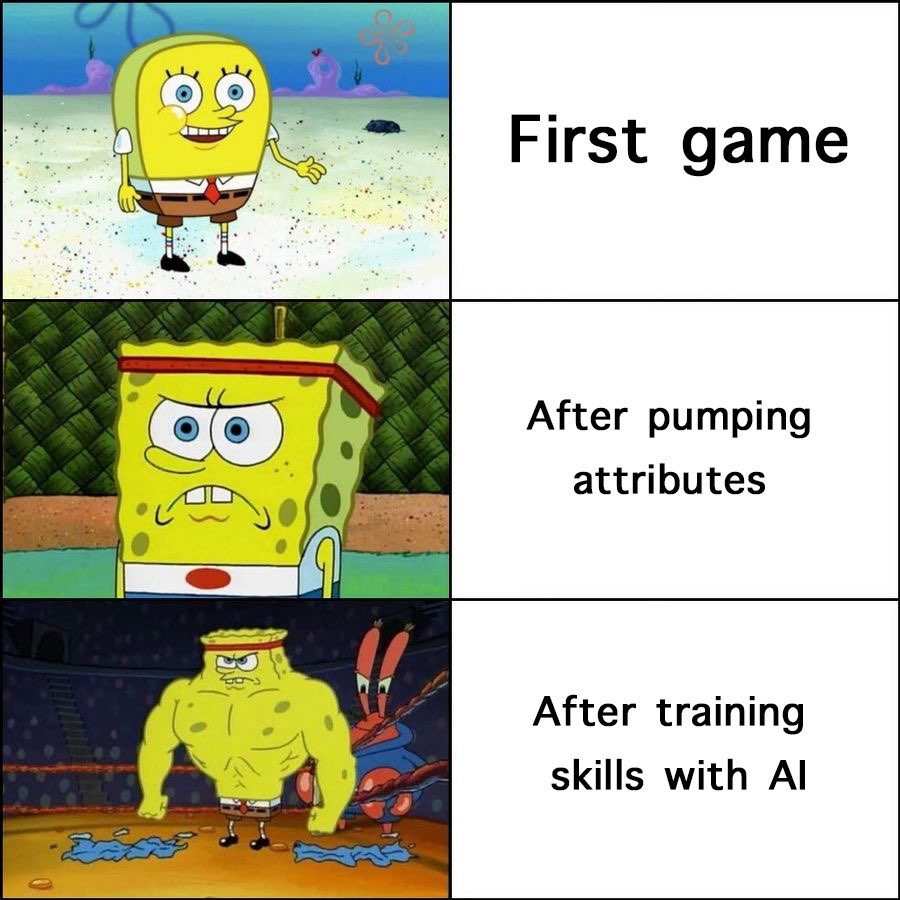
Although AI Arena is a fighting game, similar to games such as Super Smash Bros. Brawl and Street Fighter, AI Arena is also a project involving multiple fields: AI/ML, encryption, games and NFT. It is similar to other fighting games. An important difference in the game is that the player does not have control over the "fighters" he or she owns.
So how does it fight?
The boxers are powered by AI, which tells it what moves to make in certain situations; each boxer has a different AI, so whether you can train your boxer to become a boxing champion is entirely up to the player.
You can think of this game as you coaching a boxer getting ready for a fight. Players can upgrade it by configuring its training regimen or actual combat so that it learns to copy your moves.
Why do we need neural networks?
Simply put, a neural network means that it can theoretically learn a mapping of any user action. In order to allow boxers to use neural network learning strategies, AI Arena will adopt simulation learning and reinforcement learning, in which the neural network architecture is stored on IPFS (InterPlanetary File System).
The connections between neurons become "weights." When your neural network is "learning", what is happening is that it is changing the value of the weights. Weights will ultimately determine how states are mapped to actions, which means we can interpret weights as "intelligence." Neural network weights are unique to each NFT and stored on Ethereum.
Training a boxer is the process of changing the weights in a neural network so that the AI can function. For example: If we are in front of an opponent, we may want our boxer to take the initiative. There are a series of weights that can achieve this, and the focus of training is to let the AI learn to take specific actions in specific scenarios.
AI Arena has the following training programs embedded in the application:
(1) Imitation learning
The best way to understand imitation learning through observational learning is to imagine that you are a master and your AI is a boxer you are preparing for a fight. You fight with your AI, and it learns to mimic your movements in specific scenarios.
Through practical demonstrations, you can test some actions and observe how the AI imitates you. Please note: it won't copy your movements immediately because the neural network takes a little time to learn, so you may need to repeat your movements a few more times before the AI learns it.
(2) Self-study
The most perfect boxing partner is the user yourself. Through self-learning, your AI is always constantly challenging itself and improving. In self-learning, it doesn't make much sense for the AI to learn and fight like its opponents, since the opponents are clones of the AI itself. But if there are no experts to show the AI how to fight, how will it learn what to do? - through rewards. The AI will learn to take actions that give it more positive rewards and take fewer actions that give it negative rewards.
Of course, AI Arena has repeatedly emphasized that its concern is to provide equal opportunities for everyone - the team hopes that rewards will be given more to users who insist on training AI, rather than rewarding users with more resources.
03. A brief analysis of the innovation path combining games and AI
Among the currently popular artificial general intelligence AGI (Artificial General Intelligence) technology, Large Language Model (LLM) is the absolute protagonist. As more and more teams invest in the development of artificial intelligence agents (AI) driven by LLM -Agents) system, making it possible for AI Agents to redefine the innovation path of Web3 games. For example: the game "The Sims" uses LLM technology to generate 25 virtual characters, each character is controlled by an Agent supported by LLM. Live and interact in a sandbox environment.
The design of Generative Agents is very clever. It combines LLM with memory, planning and reflection functions, which allows the Agent program to make decisions based on previous experience and interact with other Agents. This game shows people the capabilities of AI Agents, such as generating new social behaviors, information dissemination, relationship memory (such as two virtual characters continuing to discuss topics) and coordination of social activities (such as hosting parties and inviting other virtual characters), etc. wait. All in all, AI-Agent is a very interesting tool, and its application in games is worth exploring in depth.
Although there have been many different attempts to apply AI in the field of Web3 games, it is currently recognized that the most mature application in the Web3 game track is NFT Agent. In the future, NFT must be an important part of Web3 games. With the development of metadata management technology in the Ethereum ecosystem, programmable dynamic NFTs have emerged. For NFT creators, they can make NFT functions more flexible through algorithms. For users, there can be more interactions between users and NFT, and the generated interactive data becomes a source of information. AI Agent can optimize the interaction process and expand the application scenarios of interactive data, injecting more innovation and value into the NFT ecosystem.
The AI Arena mentioned earlier is the world's first battle game that combines AI and NFT. Users can use the LLM model to continuously train their own battle elves (NFT), and then send the trained battle elves to PvP/PvE battlefields for battle. . The battle mode is similar to Super Smash Bros., but adds more competitive fun through AI training.
In short, the combination of games and AI can not only solve the problem of Web3 games sacrificing user experience for the sake of security and decentralization, but it is also most likely to become the first area to expand the user base among AI application scenarios.






