Foreword:
According to the definition of the Ethereum Foundation, Layer 2 of Ethereum = Rollup. According to Vitalik's recent new point of view, if other EVM chains use non-Ethereum as DA (Data Availability), then it is Ethereum Validium (moving the data availability layer of the blockchain outside the chain, using valid proofs to ensure the chain integrity of external transactions). Although there is still a certain degree of controversy over the precise definition of Layer 2 due to DA issues, the upgrade route of Ethereum is still centered on Rollup, and DA is responsible for saving or uploading Rollup transaction data during the Ethereum upgrade. important role. Whether Optimistic Rollup and ZK Rollup can access related data through DA will affect their own security to a certain extent, even if their dependence levels are different. Faced with the innovation of Cosmos shared security and Celestia's DA penetration, as well as the market makers' drive, can EigenLayer, which draws lessons from native Ethereum, regain the market by upgrading middleware to Ethereum-level security narratives? sovereignty?
EigenLayer
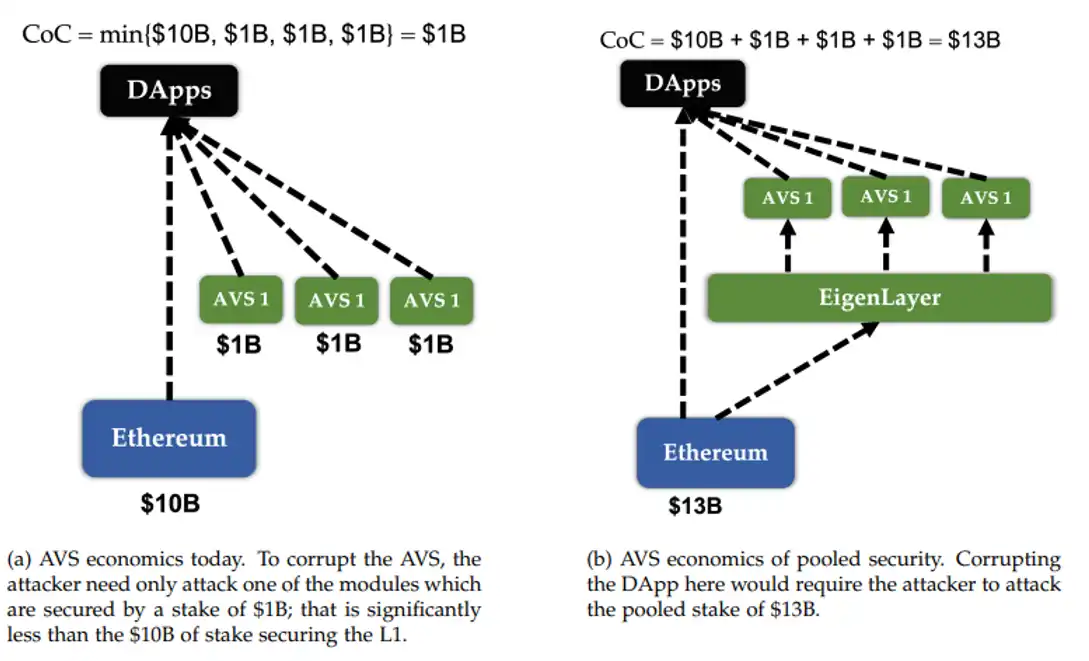
To simply understand, EigenLayer is a re-staking protocol based on Ethereum, which provides Ethereum-level security for the entire Ethereum cryptoeconomic system in the future. It allows users to re-pledge native ETH, LSDETH and LP Token through the EigenLayer smart contract and receive verification rewards, allowing third-party projects to enjoy the security of the ETH mainnet while also receiving more reward income, thereby achieving a win-win situation.
The reason why Ethereum is able to attract a large amount of transaction volume and liquidity is that it is currently recognized by most people as the most secure first-layer blockchain besides Bitcoin. EigenLayer directly connects the security and liquidity of Ethereum through Actively Validated Services (AVS). Its essence is to directly entrust the security verification of its token model to Ethereum nodes (which can be simply understood as node operations). business), this process is called re-staking. This article only cites the first AVS project developed by the EigenLayer team: EigenDA.
EigenDA: Rollup data availability
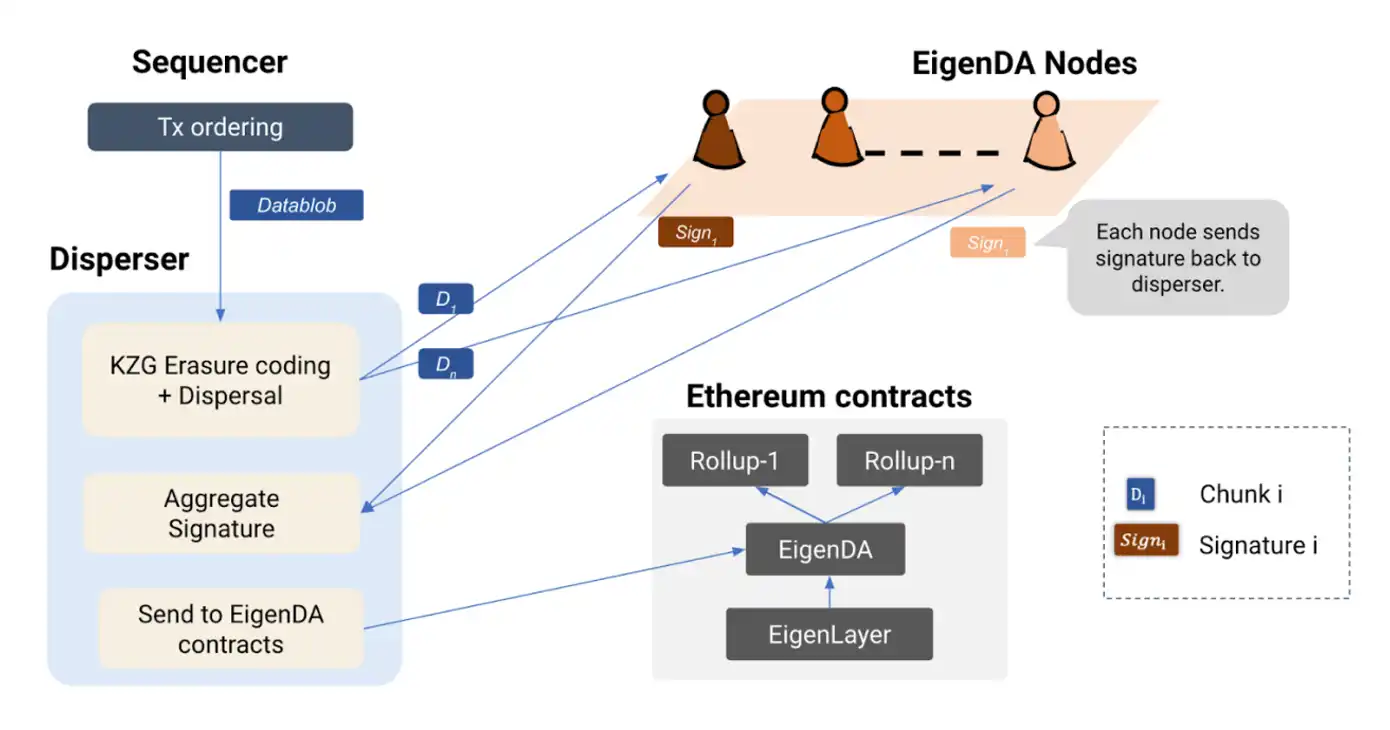
According to the official explanation and introduction (no actual relevant data to support it yet), EigenDA is a decentralized data availability (DA) service built on Ethereum using EigenLayer Restaking, and will be the first active verification service on EigenLayer ( AVS). Among them, Restakers can entrust the pledge to the executing EigenDA and the node operator that performs the verification task, and receive service fees in return, and Rollups can publish data to EigenDA, thereby reducing transaction fee costs, obtaining higher transaction throughput and improving the entire Security of the EigenLayer ecosystem. Security and transaction throughput in this development process will expand with the overall development of staking volume, related ecological protocols, and operators.
EigenDA aims to provide innovative DA solutions for Rollups, allowing Ethereum stakers and verifiers to improve security by connecting to each other, achieving the purpose of reducing costs while increasing throughput. Among them, the EigenLayer shared security system ensures decentralization. The degree of optimization will adopt a multi-node approach. According to EigenDA’s tweet, its currently integrated Layer 2 solutions include Celo for the transition from L1 to Ethereum L2; Mantle and its supporting products outside the BitDAO ecosystem; Fluent that provides the zkWASM execution layer; Offshore that provides the Move execution layer, and OP Stack in Optimism (currently used in EigenDA test network).
EigenDA is a secure, high-throughput and decentralized data availability (DA) service built on Ethereum, developed based on EigenLayer Restaking. Here are some of the key features and benefits EigenDA is designed to achieve:
characteristic:
Shared security: EigenDA utilizes EigenLayer's shared security model to enable validators (Restakers) to participate in the verification process by contributing ETH to improve the overall security of the network;
Data Availability: The main goal of EigenDA is to ensure data availability on Layer 2 networks. It uses validators to verify and ensure the data validity of the Rollup network, prevent bad behavior and ensure the normal operation of the network;
Decentralized sorting: EigenDA uses EigenLayer's decentralized sorting mechanism to ensure that transactions in the Rollup network are executed in the correct order, thereby maintaining the correctness and consistency of the entire system;
Flexibility: EigenDA’s design allows L2 developers to adjust various parameters as needed, including the trade-off between security and activity, the mode of staking tokens, erasure coding ratio, etc., to adapt to different scenarios and needs.
Advantage:
Economic benefits: EigenDA realizes the shared security of ETH through EigenLayer, thereby reducing potential staking costs. It reduces the operating cost of each operator by decentralizing data verification work and provides a more cost-effective verification service;
High throughput: EigenDA is designed to scale horizontally, with its throughput increasing as more operators join the network. In private testing, EigenDA has demonstrated throughput of up to 10 MBps, with a roadmap for expansion to 1 GBps, providing the possibility to support applications with high bandwidth requirements, such as multiplayer games and video streaming;
Security mechanism: EigenDA uses multi-layer security mechanisms, including EigenLayer's shared security, Proof of Custody mechanism, and Dual Quorum, to ensure the security, decentralization, and censorship resistance of the network;
Customizability: EigenDA offers a flexible design that allows L2 developers to adjust various parameters to their specific needs and use cases to find a balance between security and performance.
Re-pledge mode
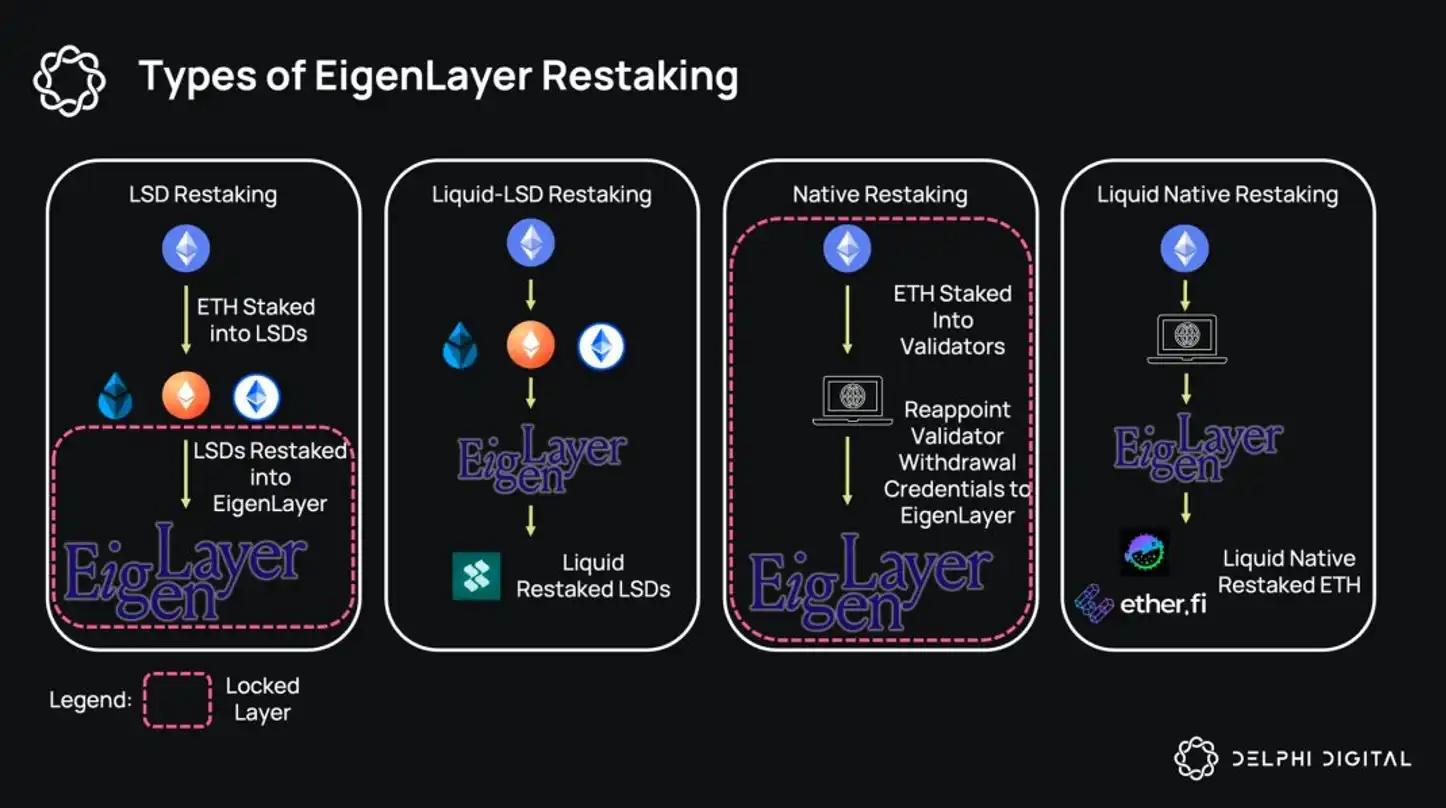
● Native ETH re-pledge:
Applicable to independent ETH pledgers, they can point their pledged ETH to the EigenLayer smart contract through withdrawal certificates to re-pledge and obtain additional income. If an independent pledger commits misconduct, EigenLayer can directly confiscate its withdrawal certificate;
● LST re-pledge:
LST (Liquid Staking Token) is the abbreviation of Liquid Staking Token. Ordinary investors, even if they do not have 32 ETH, can "carpool" through liquid staking protocol such as Lido and Rocket Pool, deposit ETH into the pledge pool, and receive LST representing their ETH and their claim rights to pledge income. Users who have pledged ETH in Lido and Rocket Pool can transfer their LST holdings to the EigenLayer smart contract and re-stake to obtain additional income;
● LP Token re-pledge:
LP Token re-pledge is divided into ETH LP re-pledge and LST LP re-pledge.
○ ETH LP re-pledge: Users can re-pledge a pair of DeFi protocol LP Tokens including ETH to EigenLayer.
○ LST LP re-pledge: Users can re-pledge a pair of DeFi protocol LP Token containing lsdETH to EigenLayer. For example, the stETH-ETH LP Token of the Curve protocol can be pledged to EigenLayer again.
Celestia in Cosmos
At present, no blockchain can truly solve the Blockchain Trilemma problem of decentralization, security and scalability. Cosmos believes that only a multi-chain design architecture can overcome the trade-offs between them to a certain extent. . Before discussing Celestia, let's briefly review Cosmos, where blockchains achieve interoperability through the IBC (Inter-Blockchain Communication) protocol. Below is a detailed discussion of security between Cosmos chains:
IBC protocol security: IBC is a protocol in the Cosmos network that ensures communication between chains. It ensures the confidentiality and integrity of messages by using mechanisms such as encryption and signatures. The IBC protocol includes a series of verification steps to ensure the trustworthiness of cross-chain communications. Through IBC, the Cosmos chain can securely transmit messages and assets to prevent fraud and tampering;
Consensus mechanism security: Each blockchain in the Cosmos ecosystem may adopt different consensus mechanisms, the most common of which is Tendermint. The Tendermint consensus algorithm ensures consistency between nodes through Byzantine Fault Tolerance (BFT). This means that the system can still function normally in the presence of a certain number of malicious nodes. The security of the consensus mechanism is crucial to the stability and security of the entire network;
Hub security: There is a centralized blockchain called Hub in the Cosmos network, which serves as a bridge between different chains. The security of the Hub plays a key role in the stability of the entire ecosystem. If the Hub is not secure, it may cause problems for the entire network. Therefore, ensuring the security of the Hub is an important task in the Cosmos ecosystem, which involves strict control of its consensus mechanism and node management;
Asset security: Since assets can be transferred between Cosmos chains, it is crucial to ensure the security of assets. By using cryptography, the Cosmos chain is protected against malicious activities such as double spend attack. At the same time, the design of the IBC protocol makes the cross-chain transmission of assets more secure and reliable;
Smart contracts and application layer security: The Cosmos network allows the development of smart contracts and distributed applications. Ensuring this level of security is achieved by ensuring code quality, auditing, and bug fixes for smart contracts and applications running on the blockchain.
Celestia achieves scalability and flexibility through a modular design that separates consensus and execution, promoting a customizable ecosystem for a variety of blockchain solutions. In contrast, Cosmos promotes blockchain collaboration with an ecosystem-neutral approach, emphasizing the interconnectivity between independent blockchains, and uses Tendermint to integrate consensus and execution, providing a cohesive environment that brings The intuitive negative impact is the loss of its own flexibility. Celestia's modular approach provides enhanced scalability and development flexibility, and provides customized solutions to meet different application needs. There are even calls that Celestia+Cosmos is the ultimate form of future application chains.
Celestia's ICS and EigenLayer's EigenDA

But what deserves attention is the ICS (Interchain Security) mentioned in Celestia’s proposal recently. The difference is that EigenLayer is a data availability layer built on Ethereum. By comparing ICS with EigenLayer, we can learn from the following To understand the relationship between them:
● Shared security: Celestia's proposal discusses the possibility of using ICS to use validators in the Cosmos ecosystem (such as the Cosmos Hub's validators) as Celestia's Rollup orderers. This approach allows multiple Rollup networks to share the same set of validators to achieve shared security. This idea is somewhat similar to the shared security concept in EigenLayer, which provides security by utilizing the validator of the underlying blockchain network. The difference is that ICS uses Cosmos Hub's validator to provide verification services for connected blockchains, improving the security of the entire ecosystem through a shared security model, while EigenDA provides verification services through EigenLayer on Ethereum, using ETH's verification Restakers to verify the data availability of the Rollup network;
● Decentralized sorter: The concept of decentralized sorter mentioned by Celestia makes use of the ICS method. This is somewhat similar to using EigenLayer's Restaking Primitive (re-pledge mechanism) in EigenLayer to build a decentralized sorter. Both attempt to achieve a more decentralized sorting mechanism through the characteristics of the underlying protocol;
● Rollups composability: Celestia mentioned that cross-Rollup composability can be achieved by using the same sequencer in multiple Rollup networks (possibly via ICS). This is somewhat similar to the goal mentioned in EigenLayer of having multiple AVS (Active Verification Services) collaborate with each other in the EigenLayer ecosystem to achieve a higher level of composability and interoperability;
● Economics: Putting aside the technical aspects of Celestia and EigenLayer, and considering it from a market perspective, users are more concerned about their own benefits. EigenLayer’s layer-by-layer benefits stacking on LST, etc., and the future of EigenLayer as a whole The ecological airdrop expected value is slightly stronger than Celestia.
Comparison between DA layers
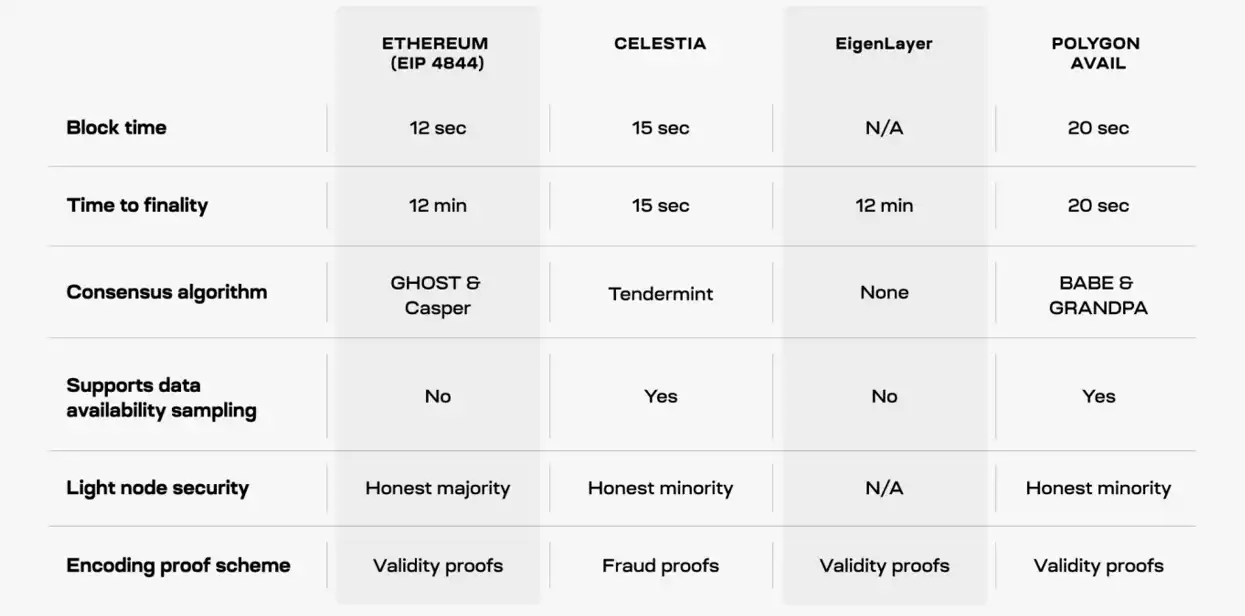
Data Availability is referred to as DA. Currently, the upgrade route of Ethereum is mainly based on Rollup. The role of DA in the process is to save or upload all transaction data of the entire Rollup. The emergence of Rollup is to solve the scalability problem of Layer1, but actually accessing Layer2 data through DA will affect the overall security and TPS level. In order for Layer2 to inherit the security of Ethereum, Ethereum needs to be able to optimize the security of the entire protocol. Mechanism to upload large amounts of Layer2 data.
In the consensus mechanism, there is a fundamental dilemma, namely effectiveness and security. The former ensures the rapid processing of transactions, and the latter ensures the accuracy and security of transactions. For this purpose, different blockchain systems will do Choose different options to achieve a balance that meets your actual needs. Among them, Ethereum, Celestia, EigenLayer and Avail solutions are all designed to provide scalable data availability for Rollup. Based on the relevant data provided by Researcher@likebeckett and Avail officials, I made the following summary.
Celestia:
Decentralized Orderer Proposal: Celestia discussed a proposal proposed by COO Nick White to use Interchain Security (ICS) from the Cosmos ecosystem to implement Celestia’s decentralized orderer as a way to leverage Cosmos through ICS The Hub’s validators provide shared security for the DA layer;
Atomic cross-Rollup composability: Celestia improves composability by leveraging ICS to enable atomic transactions between multiple Rollup networks. The same sorter enables multiple Rollup networks to work together to solve the problems of liquidity fragmentation and reduced composability;
Multi-Rollup Interoperability: Leveraging the same sequencer, Celestia can facilitate interoperability between multiple Rollup networks, enabling better liquidity and data availability.
EigenLayer and EigenDA:
Data availability service with shared security: EigenLayer provides data availability service through EigenDA, which is different from the traditional blockchain, but a set of smart contracts built on Ethereum, making full use of the concept of shared security. EigenDA can provide efficient, secure, and scalable data availability as part of the Celestia ecosystem;
Decentralized sorting: EigenLayer emphasizes its decentralized sorting mechanism, which essentially adds ETH tokens and slashing conditions to the PoS process of the Rollup sorter to provide higher security for the Layer 2 network. Through this mechanism, EigenLayer implements an efficient sorting process;
Data availability service: EigenDA focuses on providing data availability services for Layer 2 networks, providing high-performance data transmission for on-chain applications through EigenLayer shared security and decentralized sorting.
Avail:
Data availability design: Avail focuses on data availability design and introduces data availability sampling technology. This technology improves the scalability of the network by allowing light nodes to verify data availability by downloading only a small portion of a block, rather than relying entirely on full nodes to obtain data;
Inter-blockchain interactivity: Avail is designed to increase inter-blockchain interactivity. Light nodes that support data availability sampling make increasing block size more flexible and improve overall throughput;
EIP 4844 Adaptability: Avail was actively involved in the implementation of Ethereum's EIP 4844 and is an important part of Polygon's modular blockchain vision. The proposal aims to increase block sizes and lay the foundation for the implementation of Danksharding, which allows Avail to adapt to Ethereum. Ecosystem upgrade.
Conclusion
For Rollup, in 24 years, in addition to the deterministic narrative brought by the Cancun upgrade, the debate on the DA issue also brought about issues about the precise positioning of Layer 2. For the time being, we put aside the legitimacy and security that Ethereum DA actually faces. , cost issues aside, this debate between Celestia and EigenDA can easily lead to a thought: under the confrontation between the Ether Killer and the Ether Wall, will there be more market competition in the direction of combinable modules in the future? Ethereum’s expansion method has seen a new round of blooming.
Although the blockchain itself has many limitations, from the perspective of financial markets, most of the rising momentum of all markets comes from the "imaginary space", and there must always be fresh stories to feed. As for innovation itself, in addition to maintaining its own correctness, "side doctrine" is also a narrative direction that breaks out of the original framework.