Author: Jiang Haibo, PANews
Layer 1 and Layer 2 blockchains have once again become the focus of recent attention. Among Layer 1 that is about to launch the mainnet, ZetaChain may be the one with more potential. ZetaChain has been tested for a long time, during which it attracted a large number of users and developers. It has also cooperated with hundreds of projects and has been deployed on the test network. Once the mainnet is launched, it may bring a huge ecosystem to ZetaChain.
Innovative L1 brings full-chain interoperability
ZetaChain is a Layer 1 blockchain and smart contract platform designed for interoperability between blockchains. Its innovation is that it provides omnichain interoperability and can connect different blockchains, including blockchains that do not support smart contracts, such as Bitcoin and Dogecoin. This enables applications and smart contracts created on the ZetaChain platform to run across multiple chains, enabling seamless flow of assets and data.
This interoperability solves the problems of "cross-chain" and "multi-chain". Traditionally, the operating environments between different blockchains are isolated, and assets on non-smart contract chains such as Bitcoin are more difficult to effectively utilize. ZetaChain makes the flow of assets and information between different blockchains possible through its full-chain smart contracts and cross-chain messaging mechanism. Full-chain smart contracts also solve the multi-chain problem. ZetaChain hosts an execution layer compatible with the Ethereum Virtual Machine (EVM), referred to as zEVM. Developers only need to deploy a single full-chain contract to ZetaChain, and they can maintain the assets and data status on all connected chains, thus becoming a "one-stop" platform that allows developers to build and deploy all chains in one place. application. Likewise, users can access all assets and data within ZetaChain.
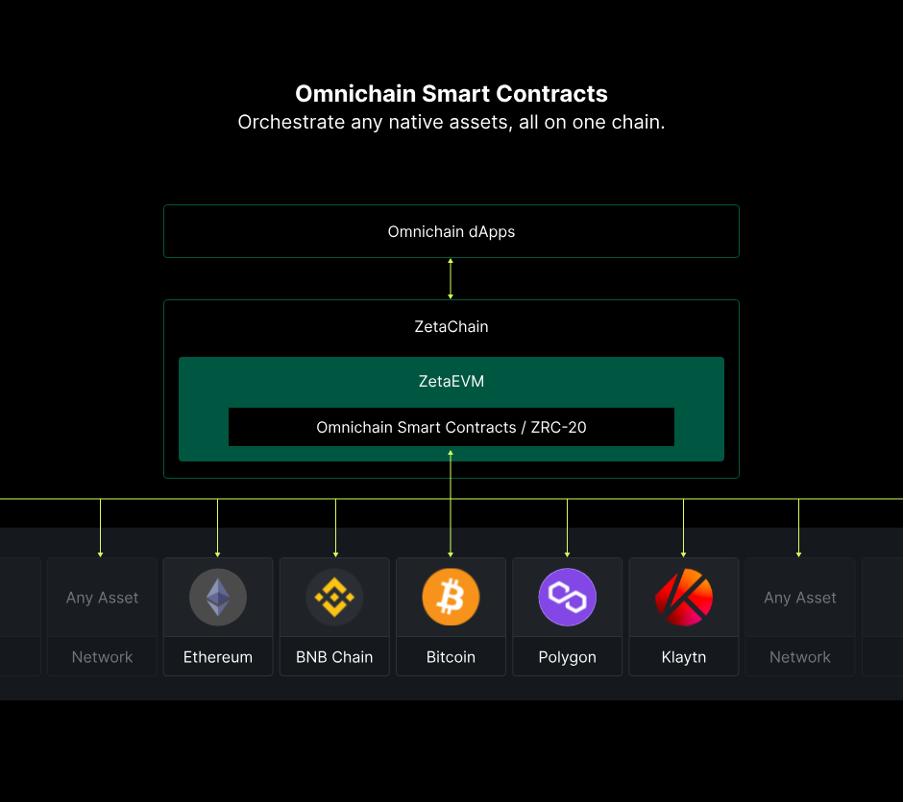
In terms of security and network architecture, ZetaChain is first and foremost a proof-of-stake (PoS) blockchain built on the Cosmos SDK and Tendermint consensus mechanism. All cross-chain transactions are completely transparent and verifiable, which is different from some cross-chain transactions. The trust models of the schemes are different. In ZetaChain's network, no single node has access control rights to any private key, which reduces the risk of private key leakage and ensures the security of assets during storage. In the process of sending assets, ZetaChain uses ZETA tokens as an intermediary, which helps minimize the attack surface and reduce the security risks faced by users.
Overall, ZetaChain uses a simpler and more robust trust model, where only its network is trusted to deliver data/value, rather than relying on third parties. Through these mechanisms, a secure cross-chain interaction platform is provided for developers and users.
ZetaChain's full-chain interoperability not only solves key issues in the existing blockchain ecosystem, but also provides new possibilities for decentralized applications, heralding a more interconnected and efficient blockchain future.
It has reached ecological partnerships with nearly 200 projects such as Sushi and Curve.
ZetaChain is committed to developing its full-chain capabilities. In addition to solving the challenges of cross-chain and multi-chain development, it also hopes to achieve the decentralization of the global financial and crypto ecosystem. In this process, sufficient funds and resources are also needed to develop the ecosystem. ZetaChain has also reached cooperation with many well-known projects.
Since completing its seed round of financing in March 2022, ZetaChain has made significant progress in funding and ecosystem development. Its financing activities have attracted support from a number of well-known crypto companies and industry leaders, including early employees and executives from Coinbase, Binance, Polygon, etc., as well as a $27 million Series A financing completed in June 2023, with participants covering Blockchain. com, Jane Street Capital and many other fields.
In addition, ZetaChain launched a $5 million funding program in April 2023 to support full-chain dApp developers. By December 2023, its ecosystem has grown to 197 projects, covering DeFi, games, infrastructure, NFT and other fields. Among them, the cooperation with Sushi is particularly highlighted. This series of actions reflects ZetaChain’s deep involvement and expanding influence in the blockchain industry.
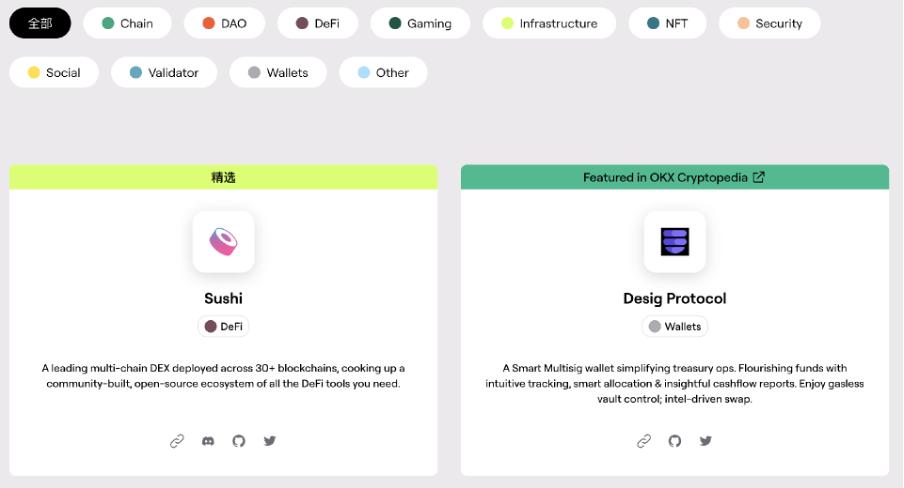
Sushi is a well-known multi-chain DEX that already supports more than 30 networks. As mentioned above, the liquidity in these networks is segmented, and the use of assets such as BTC also relies on cross-chain bridges. The collapse of cross-chain bridges such as Multichain has dealt a heavy blow to Sushi users. ZetaChain can solve these problems. By integrating Sushi v2 AMM, v3 AMM and SushiXSwap, users will be able to directly trade native Bitcoin in more than 30 networks. This not only eliminates the risks of encapsulating assets and cross-chain bridges, but also develops a large amount of new liquidity. Sushi first plans to introduce liquidity and asset trading functions on the ZetaChain testnet. After the ZetaChain mainnet is launched, Sushi will deploy the complete functionality of native Bitcoin cross-chain transactions on the mainnet.
In addition, ZetaChain has also reached cooperation with many institutions in the industry, such as chainalysis and Halborn to strengthen security measures; it has cooperated with BYTE City and Ultiverse to enter the development of a truly open metaverse and full-chain GameFi.
ZetaChain’s alliance with numerous partners not only proves the reliability and appeal of its technology, but also adds to the diversity and innovation of its ecosystem, which is critical to its long-term success.
The ZetaChain team is also actively organizing and participating in various activities. From November 13 to 19, 2023, the ZetaChain team participated in the DevConnect event held in Istanbul; from November 17 to 19, it participated in the ETHGlobal Istanbul event; in December, it participated in the India Blockchain Week.
More than 2.66 million addresses participated in the test, and jointly held test events with OKX Web3 Wallet and Bitget Wallet
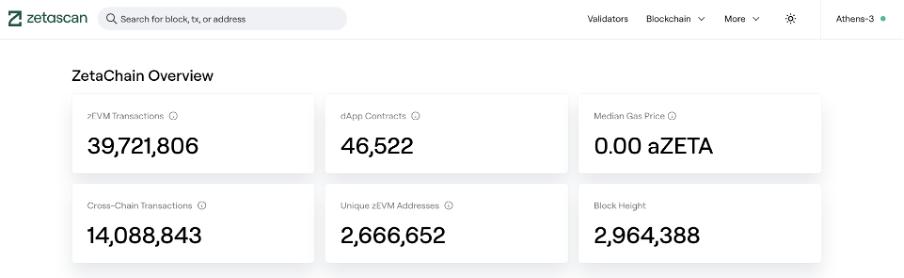
ZetaChain launched its first test network as early as August 6, 2022. The official website shows that it is currently using the Athens-3 test network. So far, 2.66 million independent addresses have participated in the test, and developers have built 46,522 smart contracts on it and initiated 14.08 million cross-chain transactions. In order to encourage the use of the test network, ZetaChain has also developed a points system, and both OKX Wallet and Bitget Wallet have jointly held test events with ZetaChain.
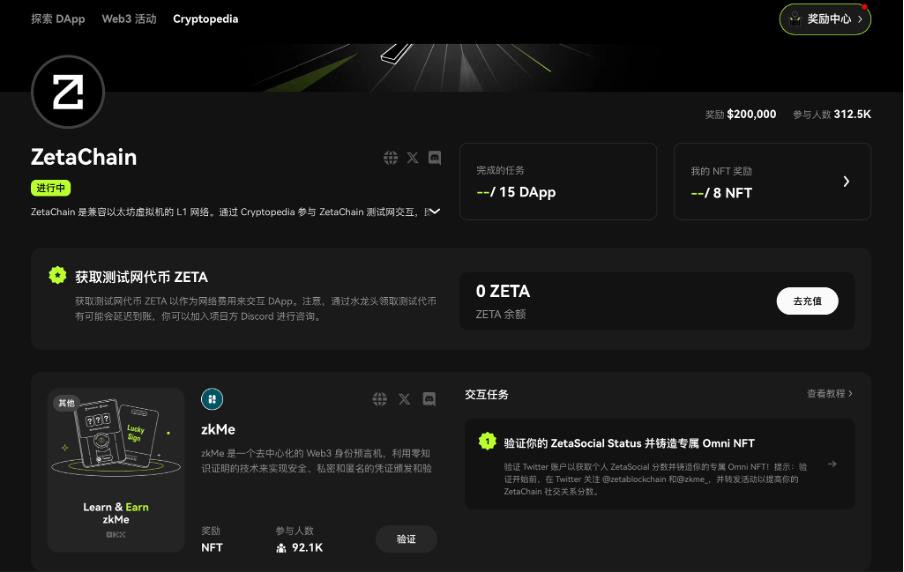
On October 16, 2023, the OKX official website issued an announcement announcing its cooperation with ZetaChain and its ecosystem projects (including Eddy Finance, zkMe, Desig, Project Twelve and LENX) to launch Cryptopedia Season 8. Users participating in experiencing these new projects Have a chance to share 100,000 ZETA token rewards. Users need to download the OKX app, create or import a wallet, select Cryptopedia: Learn to Earn, select ZetaChain and interact with the DApp, and verify after completing the task. Currently, the OKX Web3 wallet page shows that the event is still ongoing, with 312,500 people participating.
On November 20, Bitget Wallet also announced a joint TaskGet test event with ZetaChain, allowing users to obtain rare NFT opportunities by completing ZetaChain-related tasks. The event focuses on promoting interaction with the ZetaChain testnet ecosystem and involves multiple decentralized applications such as XDAO, LENX, iZUMi Finance, Eddy Finance, Bounce Finance, and zkMe. Participating users have the opportunity to share 700,000 ZETA token rewards.
As the mainnet approaches, the points system is currently closed. Users can no longer obtain new points, but they can still view rankings and other information. By partnering with OKX and Bitget Wallet, ZetaChain’s test event not only showcases the functionality and efficacy of its platform, but also demonstrates its broad acceptance and engagement within the cryptocurrency community.
Future plans: the mainnet will be launched in the first quarter of 2024
The closure of the points system may be due to the upcoming launch of ZetaChain’s mainnet, which is expected to be launched at the end of January 2024. The team stated that it will hold an AMA on the ZetaChain mainnet countdown at 11 a.m. on January 30, Beijing time, and hold a full-chain summit at ETHDenver from February 29 to March 3, 2024.
At present, ZetaChain’s airdrops can be queried and pre-claimed. ZetaChain has reserved 10% (210 million ZETA) of tokens in the token distribution for airdrops, wallet activities and other community user-centered reward programs. This creation The airdrop will distribute 31.5 million ZETA to over 800,000 ZetaLabs users and contributors.
With the ZetaChain mainnet expected to be launched in the first quarter of 2024, participants in the ZetaChain ecosystem are paying attention to this major event. The launch of the mainnet is not only an important milestone in the development of ZetaChain itself, but also indicates that the entire blockchain ecosystem may usher in major changes. The successful deployment of the mainnet will validate the technical commitment demonstrated by ZetaChain during the testnet phase and transform these concepts into actual applications and services.
First of all, the launch of the ZetaChain mainnet will further enhance ZetaChain’s capabilities as a full-chain interoperability platform. By connecting different blockchains, including non-smart contract chains, ZetaChain will be able to achieve the seamless flow of assets and data across the broader network, thereby breaking the existing silo phenomenon and helping to solve the problem of decentralized liquidity and provide Provide users and developers with a more unified and efficient blockchain experience.
Secondly, after the mainnet is launched, ZetaChain will be able to better support developers. By simplifying the development process of cross-chain applications, ZetaChain is expected to attract more developers to build innovative dApps. This will not only help increase the appeal of the ZetaChain platform, but may also spawn a series of new applications and services, further enriching the entire blockchain ecosystem.
In addition, the launch of the ZetaChain mainnet is expected to attract more investment and user participation. With the launch of new applications and the migration of existing projects, ZetaChain's user base and transaction volume are expected to grow significantly. This will bring greater visibility and recognition to ZetaChain, potentially attracting more partners and investors.
As a platform dedicated to full-chain interoperability, the success of ZetaChain may promote innovation in interoperability and cross-chain solutions throughout the industry, which is not only crucial to the project itself, but will also bring new opportunities to the industry. opportunities, but will also face challenges in delivering on its vision and technological promise. As the mainnet launch approaches, ZetaChain and its community are at an exciting turning point, heralding new possibilities and future growth.