The last video is ready: understand the development paradigm of BTC L2 in one breath ~ https://www.bilibili.com/video/BV1dw411575M/?vd_source=e88bbc11f1ecd88d1c5847538efee51c
The competition in Alt L1 has become fierce. Near has launched a DA solution and Sui's TVL has been rising. Only Ethereum is still unhurriedly upgrading its mainnet. Two major competition points have emerged in L2: parallel EVM and decentralized sequencer.
At present and in the future, a basic fact is that it is difficult to shake the status of Ethereum. The concept of modularity will be generalized. If Vitalik’s suppression of Celestia is unsuccessful, then the market will choose the best. Combination and modularization do not only occur in the same place. Within the system, market principles will encourage project parties to freely assemble various elements, such as the combined availability of various public chains, L2 and Bitcoin, as evidenced by the popularity of BTC L2.
If Near can do the job of DA, then high-performance public chains such as Aptos, Solana and Sui can also be "L2-ified" and eventually be compatible and absorbed by Ethereum.
Parallel EVM can be understood as a parallelized EVM compatible chain/L2. We can start from the blockchain speed. In theory, there are only two ways to solve the slow running of the blockchain:
- Add more hardware and continuously tune it. For example, Solana's hardware configuration is uniquely high-end, and the management and configuration of the "computer room" allow Solana to enjoy ultra-high network speeds and improved throughput;
- Multi-core parallelism, multi-line concurrency. After the hardware is improved, multi-core can truly realize multi-tasking. In addition, efficiency can also be improved by continuously dividing tasks into details, which is also a common practice for computers.
The default hardware utilization has reached the extreme, so parallel EVM can be classified and understood from the following three levels:
- Parallelism is a common practice in the computer field and can be used by any public chain and L2 . For example, Alt L1 such as Aptos, Sui and Solana, or Sei, which claims to be the first L1 compatible with EVM, as well as Ethereum L2 projects such as Scroll (2024 roadmap), Lumio , Eclipse, and heterogeneous chains such as Neon EVM. EVM-compatible solution, Neon EVM belongs to the Solana ecosystem, and claims to be the first EVM-compatible solution.
- Parallel EVM refers in a narrow sense to L1/L2 that is compatible with EVM . In theory, Ethereum itself can also implement parallel transformation. This is the parallel EVM that best meets the definition, but the action is too large and is almost impossible to exist;
- Parallel EVM can be expanded in a broad sense. Any parallel computing chain , regardless of whether it is compatible with EVM, can be included as long as it can open up the link with EVM. For example, Aptos can be used as the "accelerator" of Ethereum.
Examining non-EVM-compatible Alt L1 also has special significance. They can be connected to the EVM ecosystem. In addition, the Block-STM solution pioneered by Aptos has also become the de facto template and source of ideas for many emerging parallel EVM solutions, which will be detailed below.
Preface: A popular explanation of threads, processes, parallelism and concurrency, and EVM
I classified it along the lines of dismantling parallel EVM, but the explanation of the concept of parallelism is still incomplete. If I talk directly about the logic of project implementation, it will be confusing, and it will simply make people faint with its clarity.
Similarly, explanations such as " A process is the smallest unit of resource allocation, and a thread is the smallest unit of CPU scheduling " are professional, but they are not very friendly to most people. I would like to take buying melons as an example to illustrate this process.
Let’s first pave the way. The bottom layer of our computer is physical hardware, and above it is the operating system and various applications. When the computer processes tasks, it allocates software and hardware resources according to priority. Let’s illustrate this process with Huaqiang buying melons. :
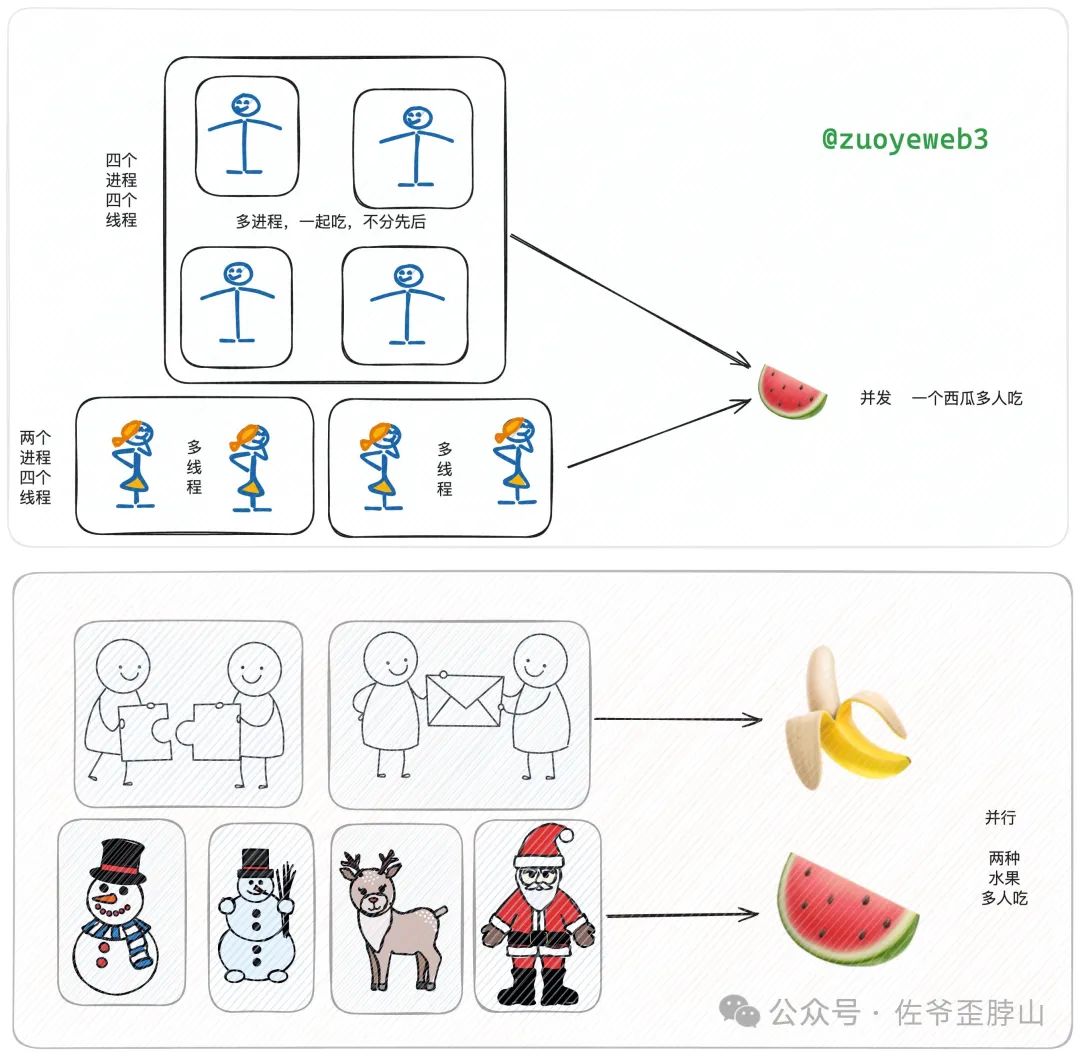 The relationship between threads, processes, parallelism and concurrency
- Huaqiang is riding a bicycle to buy a watermelon. This is a single behavior and the smallest unit. It is a thread. A watermelon is the physical hardware resource that can be called at this time. Are there more?
- Two Huaqiang want to buy a watermelon together. This is a composite behavior, because there are two Huaqiang who want to eat the melon, but it should be noted that there is still only one watermelon at this time, and there is no more. And the two Huaqiang made an appointment to chop watermelons together. Whoever doesn't go is not a brother. So at this time, two Huaqiang buying melons is a process, and each Huaqiang eating melons is still a thread, so one process includes two thread.
At this time, the situation where there is only one watermelon but multiple people need to eat it is concurrency. The key point here is that everyone eats the watermelon together, and it is necessary to ensure that everyone can take at least one bite, because no matter how many people eat the melon, there is no difference between them. Seating and ordering will not affect the final result of one melon and multiple meals.
If you are smart, you must have seen the problem. Why do so many people have to eat watermelon together? The owner of the watermelon stall is essentially the owner of the fruit shop. You can also eat bananas. You are right. This is the need for supply-side reform . The reason is that now the boss has announced that bananas are also on the market, so the physical resources (fruits) have increased at this time. Huaqiang can be divided into two rows to eat different fruits. This is parallel, two rows side by side, each eating what he likes.
(Anti-collision statement: The above explanation is relatively popular but not professional. If there is any dispute, the programmer’s knowledge shall prevail. I am a dabbler)
The next step is to combine them with EVM to assemble the true meaning of parallel EVM.
Although EVM is often mentioned, its true direction is unclear. In particular, virtual machines (VMs) always give people a feeling of moving from reality to virtuality. In fact, to put it bluntly, virtual machines are specialized For operating systems, programmers do not need to develop for physical entities, they only need to adapt at the software level.
To simplify, the function of EVM is transactions. Users submit instructions, and then EVM will be executed one by one according to the user's needs, such as transfers, SWAP, pledges, or other actions that require interaction with smart contracts. The focus here is on instructions and execution one by one. EVM can understand the user's needs, but execution needs to be queued and the order cannot be changed at will.
Therefore, parallel EVM essentially changes the order of execution and allows multiple smart contracts (instructions) to be executed at the same time. It is equivalent to the stall owner hiring workers. He sells watermelons and the younger brother sells bananas. In the end, the money earned belongs to the boss.
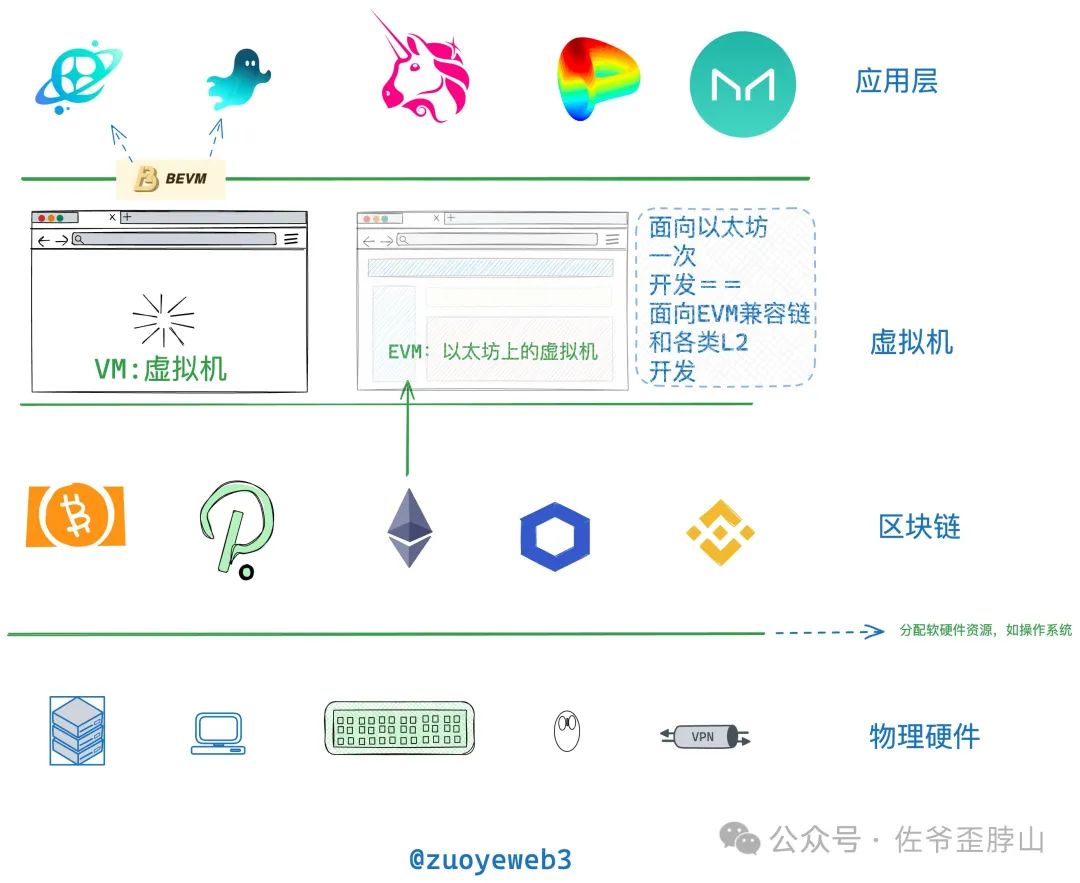 EVM description
The most typical one is the BTC L2 mentioned in my previous article. The current BTC L2 basically wants to connect Bitcoin to the EVM ecosystem. In fact, they themselves are a virtual machine on Bitcoin, and developers develop for them. , there is no need to consider the limitations of Bitcoin's own architecture and programming language, and the familiar EVM development process can be used in one step.
EVM is the same as this. To put it to the extreme, if you are a front-end, you can even develop document-oriented without understanding the hardware, operating system principles, and Ethereum principles. You only need to understand the instructions of EVM development tools and interfaces. For example, write the front-end interface of a certain DEX (only a theoretical explanation, but it is actually very complicated).
In a nutshell, a virtual machine (VM) is a processing workshop that eliminates hardware and principles. For example, if Huaqiang buys melons and makes watermelon juice, then the virtual machine is a juicer. A cup of watermelon juice only requires three steps: open the lid, Add watermelon, squeeze juice, and done.
In the same way, EVM is the Ethereum juicer. EVM compatibility is the Pinduoduo replacement juicer bought by L1/L2. Although it has some flaws, it can still be used. Parallel EVM means multiple juicers working together.
It’s not that you can’t afford it by hand, but that a juicer is more cost-effective.
Finally, the concept of parallel EVM has resurfaced. This is essentially due to the speed limitation caused by Ethereum’s ability to only process a single transaction in sequence. Its mainnet TPS can only be stabilized at around 10. More centralized EVM-compatible chains such as BNB Chain (BSC) It can only be mentioned to about 200. As long as there is no revolutionary breakthrough in physical hardware and Ethereum itself cannot be transformed into a parallel mechanism, the parallel EVM track will be hot for a long time. After all, no one will disdain the speed.
Current situation: Optimistic verification has become the consensus, and the Move system is gradually gaining momentum.
The concepts of parallelism and VM have been around for a long time, but the introduction to blockchain, especially the concept of parallel EVM, actually started in 2022. Aptos released "Block-STM: Scaling Blockchain Execution by Turning Ordering Curse to a Performance Blessing" paper, and then the Polygon PoS chain tried to add this feature at the end of the year. Not only that, many of the solutions and ideas proposed by Aptos in this paper have also become common choices in the industry and need to be introduced.
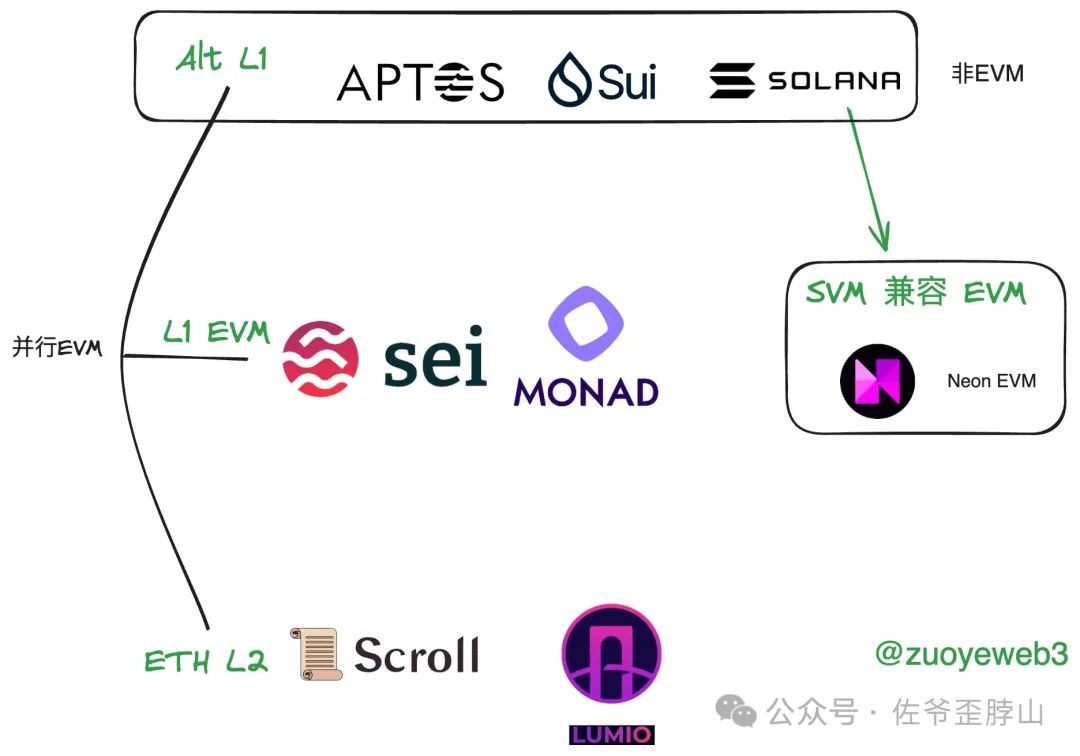 Parallel EVM related projects and classifications
The starting point of dreams: Block-STM
It can be said that Aptos is the master of blockchain parallelization. Although Solana and Near have already explored it, Aptos uses STM (Software Transactional Memory) in the blockchain to re-order transactions. The core idea is to first assume that all sorted transactions are correct. After parallel execution, if any errors are found, individual errors will be solved separately. According to the 80/20 rule, most transactions can be accelerated and executed. This is the so-called optimistic verification mechanism. The idea is basically the same as the optimistic verification mechanism in Rollup.
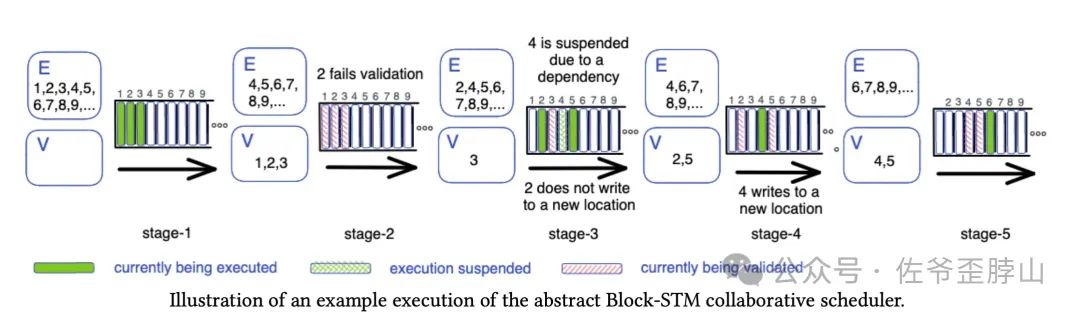 Block-STM
Specifically, Block-STM divides the execution process of the blockchain into two stages: the sequencing stage and the execution stage.
- In the sorting phase, Block-STM uses STM to sort transactions to ensure the order of transactions;
- In the execution phase, Block-STM uses the sorting results to execute transactions in parallel, thereby improving execution efficiency.
Parallel EVMs since then are basically similar to this, except that there are implementation differences in sequencing and execution, and compatibility with EVMs needs to be added. For example, Neon EVM and Polygon PoS both fall into this category.
Sui transformation: everything is an object
Sui and Aptos come from the same school and are highly similar, but the biggest difference is that Sui takes objects as its core. For example, in the transfer process from Alice to Bob, it works as follows:
- Aptos: Alice's account minus 1 USDT, and Bob's account plus 1 USDT, involving the accounting information and balance changes of the two accounts;
- Sui: 1 USDT remains unchanged, only its ownership attribute is changed, and the ownership is changed from Alice to Bob, which only involves information changes of 1 USDT;
As you can see, the starting point of Sui is not to examine the accounts of both parties to the transaction, but to involve the attribute changes of the object. From this, it can be extended not only to token transfers, but also to assets such as NFT.
To further extend, if an asset only involves attribute changes between points, there is no need to synchronize all nodes, as long as both parties recognize the transaction. In this way, such transactions can be processed in parallel.
Of course, the specific implementation of the two is much more complicated, and parallelism will also bring many problems, but it is enough to understand this.
Solana and Neon EVM: backdoor listing
Solana's own parallel processing is implemented through the Sea Level mechanism, which is similar to Block-STM (in fact, it should be reversed, Sea Level was proposed in 2019, and Block-STM was proposed in 2022), both of which require transactions to be sorted and then executed.
Solana's "innovation" lies in the special optimization of hardware resources. In theory, not only can all instructions be sorted, but the optimized multi-threading can exert the full performance of the processor to achieve high concurrency. Theoretical TPS value is 50,000, actual measurement The peak can reach around 5,000.
So where does this relate to Neon EVM?
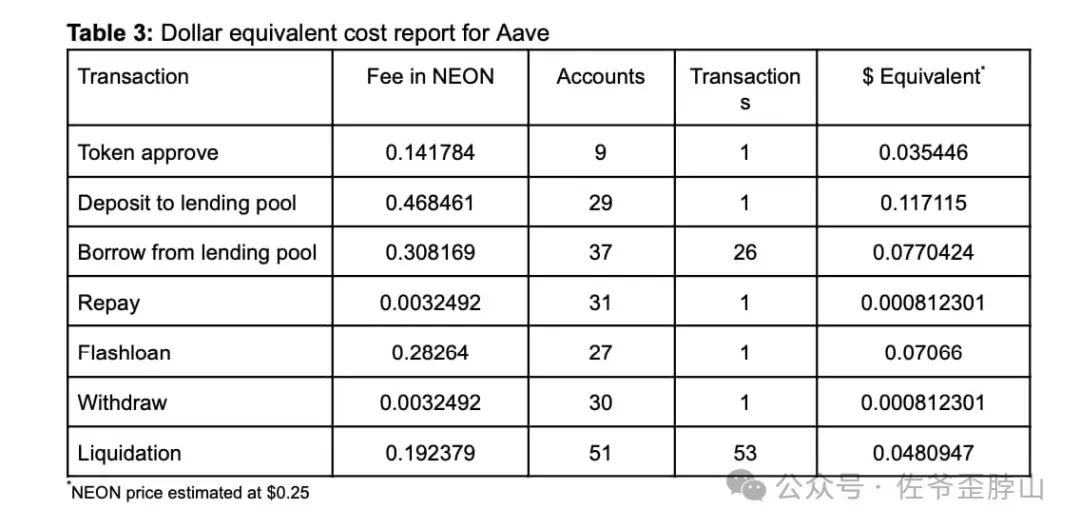 Neon EVM cost
What Neon has to do is synchronize the transaction information of EVM, and then use Solana to calculate it. This way, it can not only take advantage of the richness and security of dApps in the EVM ecosystem, but also use Solana to speed up and reduce fees. Compared with the expensive and slow Ethereum main network , Neon’s authorization, transfer, deposit and borrowing are basically below 0.1 or even 0.01 US dollars.
It is not appropriate to say that Neon has turned Solana into an alternative L2 of Ethereum. By analogy, L1/L2 EVM can not only achieve parallelism by itself, but can also act as an intermediary. It is only responsible for compatibility with EVM or only L1/L2, while Outsource the rest.
This is also what I said at the beginning, the true meaning of generalized modularization. L1/L2 parallel EVM can be a combination of three projects, or even a cross-chain combination. In this way, the gameplay will be diverse.
Sei V2 and Monad: happy together, byte compatible
In terms of technical implementation, Sei V2 and Monad are very similar. Both are byte-level compatible EVMs for Ethereum. In fact, in terms of parallel thinking, they all chose the familiar optimistic verification, sorting first, and then executing the ones that can be executed. Execute, if an error occurs, resolve the dependencies separately.
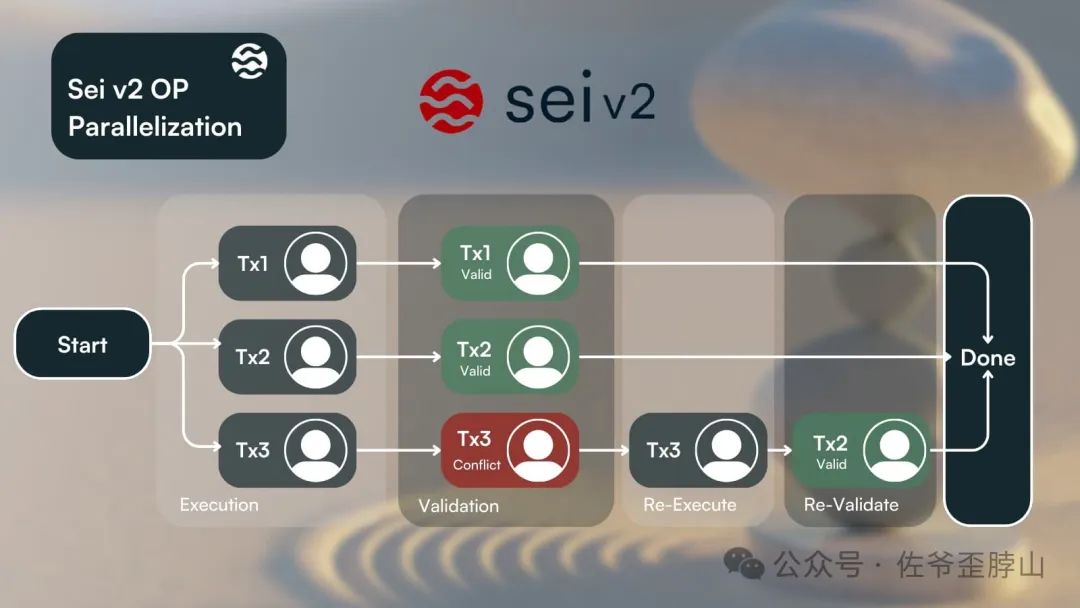 Sei V2 Parallel Solution Description
Of course, mature products and ideas can be used by everyone, but it should be noted that, like BTC L2, there is not much real technological innovation, and it is still mainly "combination". Solana is the only large-scale practice of parallelism, and the combination of software and hardware L1 runs a high concurrency effect, and the others are more "EVM + parallel compatible" packages.
You can definitely think that since Solana can be used as an accelerator, Aptos and so on can also be used. In fact, Lumio also thinks so. As long as it acts as an intermediary and is compatible with EVM and achieves parallelism, it can be called parallel EVM. Therefore, , I won’t explain too much about Lumio.
Conclusion: The Dilemma of Parallel EVM
In this article, I emphasize that the core of parallel EVM is the allocation of hardware resources and the sequencing and execution of tasks. Both are indispensable. The upper limit of software optimization is the parameter limit of the physical hardware. After all, Bolt cannot exceed the speed of light. , but parallel EVM is currently mainly the transformation and imitation of Aptos' Block-STM, which is also a basic fact.
In addition, there is currently no need to over-explore parallel practices on Ethereum L2. They need to solve the centralization problem of the sequencer, and the efficiency is already high enough.
Parallel EVM is not mysterious. I have omitted technical details such as the reading and writing mechanism design, TPS comparison, data recording and status synchronization of each project in the text. There is no need for ordinary people to understand these things. Keep in mind that we are currently in optimistic verification. Play the whole game, optimistic verification is just to execute it first and then troubleshoot. If there is an update, I will add it to everyone in time.