Original author: Lin Chuan (X: @Mtyl_7th )
introduction
UXLink, a new Web3 social platform, is on the rise. Through "acquaintance socialization", it is taking a different path from other well-known social projects before. It is a pioneer in exploring how to build real and meaningful social connections in a decentralized world. So, what is unique about UXLink, and how is it different from previous well-known Web3 social projects? This article will deeply explore the core concepts and technological innovations of UXLink, and also look forward to the future of this project.
“Chapter 1: What is UXLink? How can ordinary users get started?
UXLink is an emerging Web3 social project in 2023. Its product has been launched since the end of April 2023 and has now entered a stage of rapid growth. The number of registered users has exceeded 3.1 million and the DAU has exceeded 200,000.
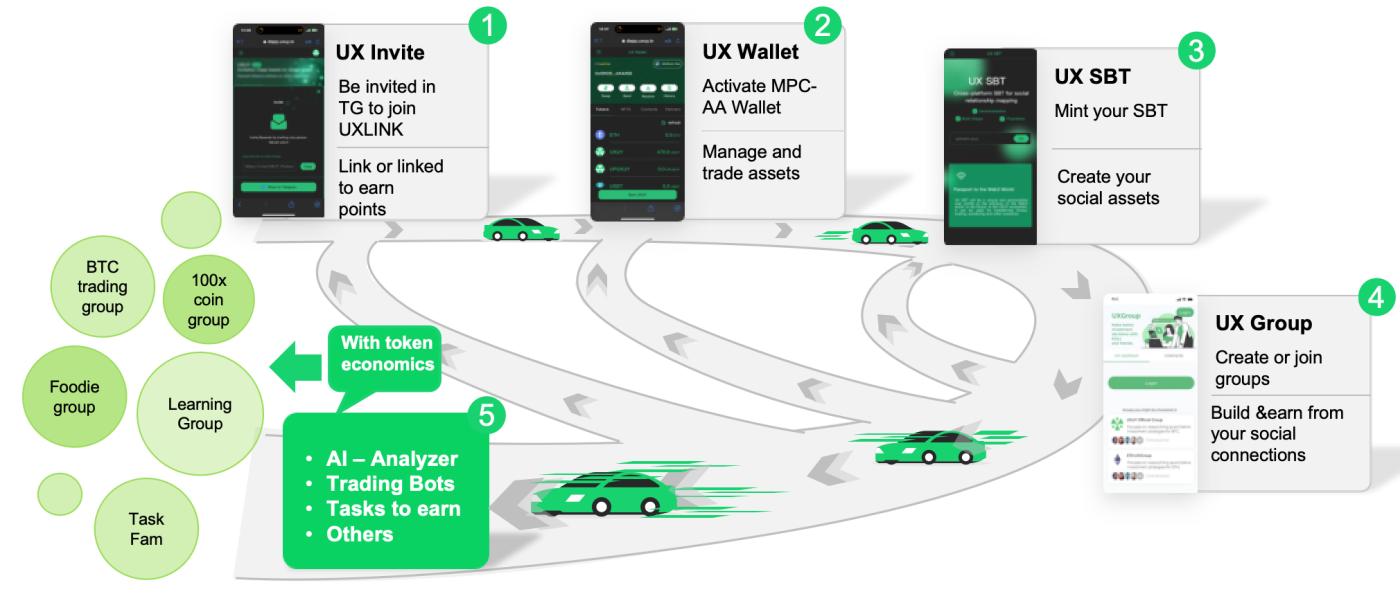
Mass Adoption (Web3 mass adoption) is one of UXLink's missions. It is very user-friendly to get started with UXLink. It does not require any financial preparation or even an on-chain wallet. You only need to have a Telegram account and be invited by an acquaintance to experience the product within 1 minute. Users can directly go to UXLink's official TG bot account @uxlink_bot, or click on the invitation link of other users to automatically become a new user of UXLink and enter the product interaction interface in Telegram.

For ordinary users, one of the core growth methods of UXLink is Link to Earn. Users can invite more friends to become UXLink users, obtain UXUY token points incentives, build their own social network, and capture their own social value. When registering, UXLink will automatically create an account abstraction (MPC-AA) wallet for users on the Arbitrum chain. Users can enter the backend to view their social relationships, on-chain balances, etc., and can also perform further operations such as mint SBT. . Users can also create UXLink groups, and each group will have its own wallet address and account system.
The process for users to enter UXLink is briefly described in the figure below. Compared with many other previous Web3 social products (such as Lens Protocol, FriendTech, etc.), this user experience can be said to be quite friendly.
For many readers, you may now have this doubt: There have been many social products & protocols before, and now there is UXLink, so how is UX different from those products? Why should I spend time understanding & experiencing it? ?
The following article will focus on answering this question.
"Chapter 2: Acquaintance Socialization - UXLink's Path to Differentiated Agreements
2.1 The difference between UXLink and other previous social protocols
The track of Web3 social products & protocols has always been a hotly discussed track in Web3. For example, just in 2023, social protocols such as Nostr, Farcaster, Lens Protocol, and Cvberconnect have attracted widespread attention and discussion.
Although these social protocols differ in details such as narrative focus, technical architecture, initial user portraits, operational strategies, protocol-product relationships, etc., they have one thing in common: the social relationships they have accumulated tend to be more like Twitter, The one-way following relationship between KOLs and fans like Weibo, rather than the two-way acquaintance social relationship like WeChat and Whatsapp. This model emphasizes a "following" mechanism, in which KOLS generate content and fans follow and consume the content.
UXLink takes a different path, focusing on converting users' existing acquaintance social relationships into social protocols and helping users build new acquaintance social relationships. Acquaintance social relationships refer to those connections based on real-life acquaintance, intimacy, or shared experiences. At the core of this relationship lies trust and a deep personal connection that goes far beyond a simple KOL-fan connection. Just like the various small communities and circles of acquaintances that exist widely in Web3, the establishment and maintenance of these communities often involve the people in them building a certain amount of trust in each other. The trust value generated by this social relationship is higher than the relationship between KOL and fans.
Imagine a common scenario: an emerging Web3 project has just issued a currency, but what it does and the value of its currency are highly controversial in the market. For a user, if it is a KOL-fan link relationship, when the KOL says that he is optimistic about this project, only when the fans strongly believe in the KOL’s professional judgment in this field will they be greatly affected and take research and action. . But if it is a link relationship between acquaintances, in a group where acquaintances are socializing, on the one hand, users will take the initiative to ask about this new project out of curiosity and trust in their friends; If you have any doubts, you can also communicate and discuss with each other. It can be seen that from the perspective of project promotion and conversion, acquaintance social relationships have greater potential conversion value than KOL-fan relationships. Therefore, the UXLink protocol built on acquaintance social relationships may have greater commercial value than some social protocols built on KOL-fan relationships.
2.2 The core of UXLink’s acquaintance social product: groups
When discussing UXLink’s acquaintance social relationships, a core concept that must be mentioned is “groups”. Group, as a collective communication space of UXLink, is not just a simple chat room, it reflects the practical application of personal social graph, transforming personal social network into real-time, dynamic communication and interaction platform.
To illustrate with a specific example, assume that a user has a social graph containing 200 people, including relatives, friends, teachers, classmates, and comrades at work. While such a massive social network sounds valuable, users may be faced with a question: How do I use this network effectively?
UXLink offers a solution: consolidate these 200 people into a group. This group is not only a place for information exchange, but also a living embodiment of the social graph. Currently, UXLink mainly supports the creation of scenarios such as Telegram groups, making such groups possible. In this Telegram group of 200 people, group members can collect, make payments and distribute benefits, fully embodying a dynamic social network.
More importantly, new social graphs can also be generated between groups. This means that the group is not just a closed communication space, but a platform that can continuously expand and deepen social networks. In reality, the discussions in these groups may involve many aspects, ranging from trivial matters in daily life to professional investment discussions.
In UXLink’s groups, group owners play a central role in spreading news. Currently, there are more than 70,000 groups on the platform, some of which are very active and efficient. This huge network not only promotes the rapid flow of information, but also provides a new perspective for marketing.
From a marketing perspective, the three major challenges faced by users include: distrust, not being convinced, and not understanding. In UXLink’s group, these three problems can be effectively solved. Compared with advertisements, recommendations from acquaintances are easier to gain trust; if users have questions about a certain topic or product, continuous discussion and interaction in the group can help convince them; and for complex concepts or products, groups provide a The best place to solve problems in real time.
In summary, UXLink not only promotes active use of social graphs through its unique group functionality, but also provides users with a powerful platform for trust building, information exchange, and problem solving. In this new era of social networking based on acquaintances, UXLink’s group function is undoubtedly an important bridge between personal social networks and practical applications.
Speaking of groups, some readers may think of FriendTech, a popular Web3 social product in the second half of 2023.
FriendTech's Room concept has many similarities with UXlink's groups, but FriendTech's financial attributes are too strong. The motivation for users to buy another user's Key is often because there is room for its currency price to rise, rather than wanting to participate in Room discussions. , and build social connections with users. Such a mechanism design requires FriendTech to maintain a high user growth rate, increase the price of maintaining Key through the continuous addition of new users, and enhance community confidence.
However, FriendTech is not an easy entry point for users outside the circle. When almost all the intended users in the Web3 field are converted, user growth will be unsustainable. Uxlink is different. Groups are mainly about communication and mutual influence between people. They are more like a class or a small enterprise. The benefits are based on BUILD, not on the realization of KOL, and bring benefits to users and third parties. actual value.
In addition, FriendTech has many other inappropriate designs in its economic models and products, which I won’t mention here. But from FriendTecr, we can see the power of the social function of "groups".
2.3 The value of UXLink protocol to Developers and third-party Web3 project parties
UXLink has accumulated a large number of real users and acquaintance social relationship groups, and deployed a protocol layer at the bottom.
UXLink’s products are divided into three tiers:
The UXLink basic application layer can provide ecological applications with basic product services such as growth fission and groups, wallet account services based on MPC-TSS (Multi-party computation, ThresholdSignature Scheme), and group-based EOA account services.
UXLink protocol service layer, WEB3 developers can efficiently process users' social identity and social relationship data services through the APIs (API's and ABI's for onchain and offchain systems) provided by UXLink. UXLink Protocol has a hybrid on-chain and off-chain scalable technology architecture (EVM+IPFS+Cloud) to support mass adoption application scenarios, stores identity and relationship data on the chain, and processes complex business scenario data off-chain to support the use of UXLink Protocol application.
The UXLink infrastructure layer is a hybrid scalable architecture (EVM + IPFS + Clouds), mainly involving EVM chains (Ethereum Mainnet, Arbitrum L2 Chain, BNBChain, Polygon and Base Chain, etc.), decentralized storage and centralized data indexing, etc. Serve.
Returning to acquaintance social relationships, because the nature of the relationship is different, the data thickness is also different, similar to the relationship between WeChat and Weibo. Relationships determine trust, and data determines accuracy. Take a new function that was launched recently as an example:
Since February, UXLink has launched a multi-wallet function, encouraging users to link WEB3 wallets under the same account and helping users manage these wallets. Throughout February, there have been cumulative wallet balances exceeding $1 billion. Among them, a well-known WEB3 wallet is the main wallet of UXLink. In 14 days, more than 200,000 addresses were linked to the UXLink network, with an average of about 70 U per wallet. In promoting the registration of a well-known wallet, 8,500 Linkers and 4,200 groups contributed more than 80% of the results, and the conversion rate exceeded 40%. The campaign’s high conversion and deposit rates highlighted the power of UXLink’s social and group interactions in driving user engagement. On average, each Linker contributed more than 20 new wallets, which not only demonstrates UXLink’s strong social network effect, but also proves the high activity and quality of its user base. Furthermore, the deposit rate reached 72%, showing the high engagement and commitment of these new wallet users.
From the perspective of geographical distribution, this event successfully attracted users from Southeast Asia, Africa/Nigeria, India, Europe, the United States, Singapore and other regions, achieving the geographical coverage of the event target.
All in all, the cooperative promotion activities between UXLink and third-party wallets demonstrate the huge business potential of UXLink as a social product in the Web3 social field. For some project parties with publicity and promotion needs, cooperation with UXLink for user growth may become a feasible solution.
“Chapter 3: Future Prospects and Challenges of UXLink
UXLink, in addition to bringing new social experiences to Web3 users through its innovative acquaintance social model, also opens up a new way for more users to enter the Web3 world.
Web3 social networking has always been considered one of the core applications in the Mass Adoption (Web3 large-scale adoption) narrative. The fundamental reason is that it can build a bridge for users outside the circle to enter comfortably. In line with the last bull market, various high-performance public chains, account abstract wallets and other infrastructure have matured. Users outside the Web3 circle no longer need to understand the cumbersome blockchain to experience new-generation Web3 social products like UXlink. , public and private keys, wallets and other concepts, which greatly lowers their entry barriers. In addition, the invitation system of acquaintance social networking is easier to spread than the KOL-fan mechanism.
Being able to bring more users to the Web3 industry and allow users to continue to improve, so that more developers and third-party applications can better serve users, will be more valuable to this industry in the long run.
This is what UXLink is doing, and let’s look forward to its further growth and development in this bull market. Social is the crown jewel of any WEB add-on, does UXLink have a chance to be that crown jewel of WEB3?