With the completion of the Cancun upgrade, the prices of Ethereum and its related ecological tokens have performed well recently. At the same time, modular concept projects and Ethereum Layer 2 projects have successively launched mainnet, further promoting the current market's optimism about the Ethereum ecosystem. The Liquid Restaking narrative has also begun to attract capital attention due to the popularity of the EigenLayer project.
However, from ETH -> LST -> LRT, is it an ecological catalyst for Ethereum or a matryoshka doll as most people say?
This research report focuses on the ecological situation of the LRT track and elaborates on the current situation, opportunities and future of the LRT track. At present, many LRT protocols do not issue tokens, and the homogeneity of projects is serious. But the more optimistic ones are KelpDAO, Puffer Finance, and Ion Protocol. These three types of protocols have development routes that are obviously different from other LRT protocols. The future of LRT racing remains a rapidly growing niche market. Huobi Research predicts that only a few leading projects will emerge in the future.
This research report was written by the Research team of HTX Ventures. HTX Ventures is the global investment arm of Huobi HTX, integrating investment, incubation and research to identify the best and most promising teams around the world.
Is LRT a matryoshka doll? Take a look at the evolution path of LRT
The concept of “re-pledge” was first proposed by Eigenlayer in June 2023. It allows users to re-stake already staked Ethereum or Liquidity Staked Tokens (LST) to provide additional security for various decentralized services on Ethereum and earn additional rewards for themselves. Based on the re-pledge service provided by Eigenlayer, Liquidity Re-pledge Token (LRT) related projects came into being.
LRT liquidity re-pledge token refers to a "re-pledge certificate" obtained after pledging LST.
So,
1. How was this re-pledge certificate LRT born?
2. From ETH -> LST -> LRT, is it a matryoshka doll as most people say?
This requires tracing the evolution path of LRT.
Phase 1: Ethereum native staking
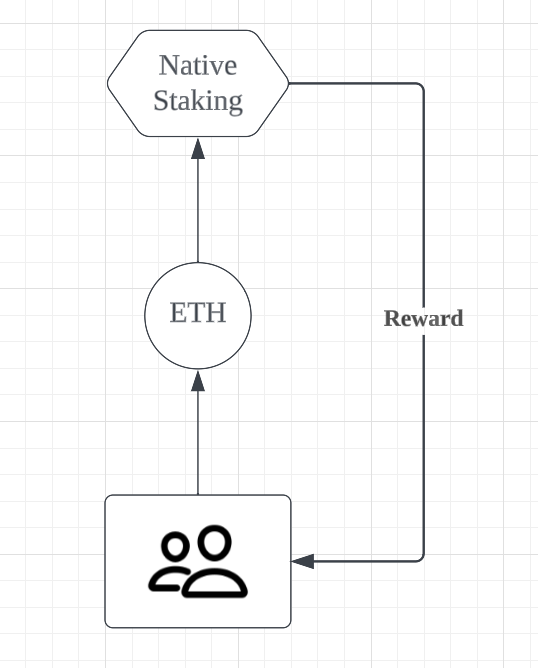
After Ethereum upgraded to the PoS mechanism, in order to maintain the security of the Ethereum network, the identity of miners also changed to verifiers, responsible for storing data, processing transactions, adding new blocks to the blockchain, and receiving rewards. To become a validator, you need to stake at least 32 ETH on Ethereum and a dedicated computer connected to the Internet 24/7.
Phase 2: The birth of the LST protocol
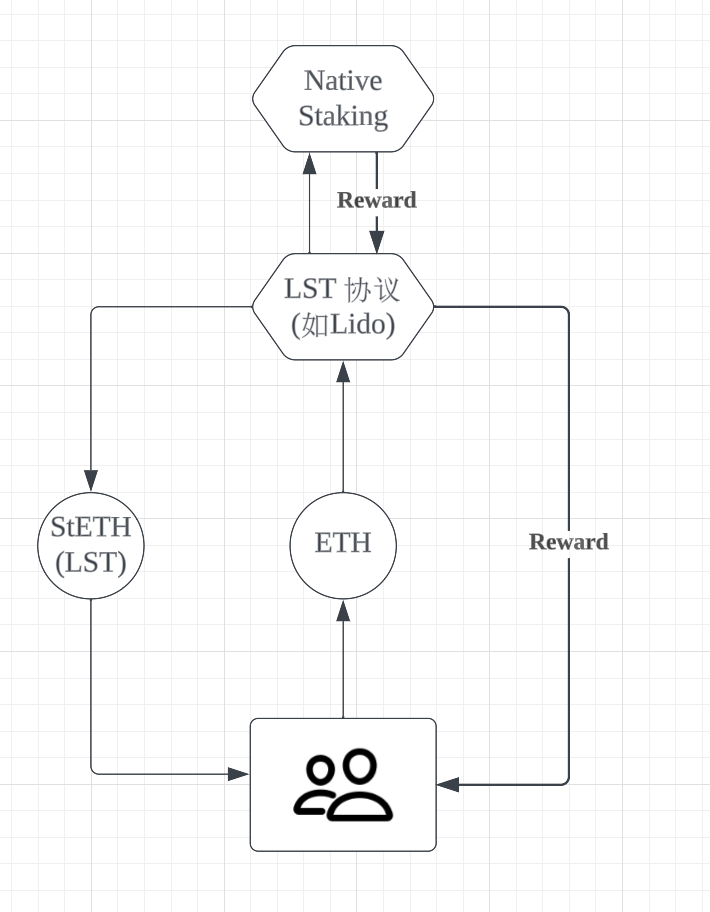
Since the official pledge requirement is at least 32 ETH, and withdrawals cannot be made for a long period of time, under this background, pledge platforms have emerged. They mainly solve two problems:
1. Lower the threshold : For example, Lido can pledge any amount of ETH and has no technical threshold.
2. Release liquidity : For example, staking ETH on Lido can obtain stETH, and stETH can participate in Defi or exchange for ETH of approximately equivalent value.
In layman’s terms, it’s “group-building.”
Phase 3: The birth of the Restaking protocol
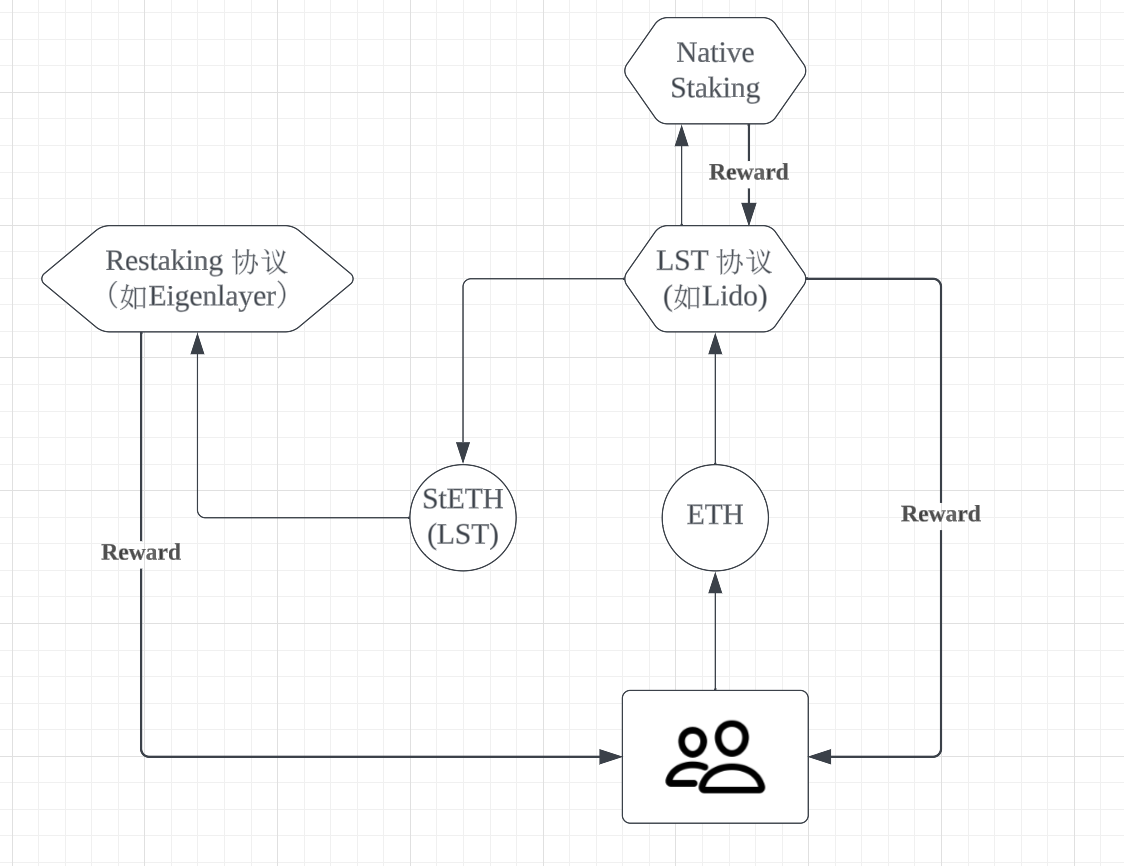
With the development of the Ethereum ecosystem, everyone has discovered that liquid staking token assets (LST) can be pledged on other networks and blockchains to obtain more benefits while still helping to improve the security and decentralization of the new network. behavior.
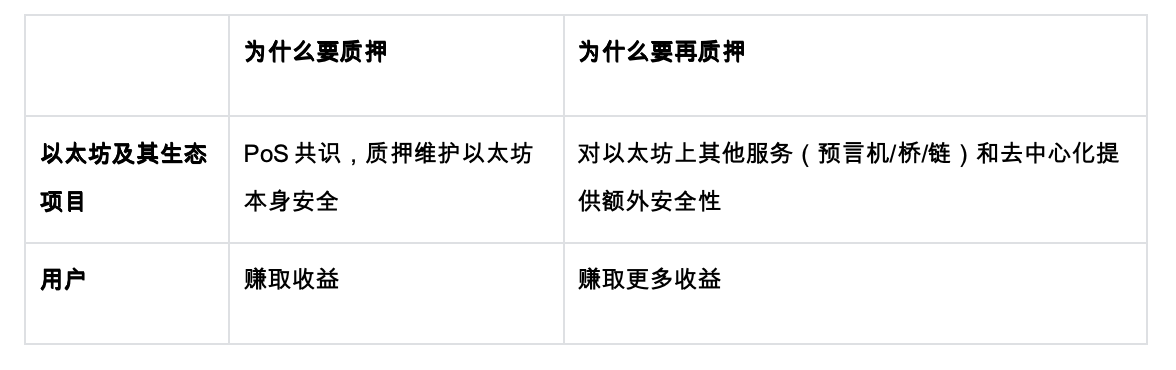
The most representative project among them is Eigenlayer, and the logic behind its re-pledge is mainly divided into two parts. One is the shared security of the ecosystem within ETH, and the other is users’ demands for higher returns.
● Re-pledge can share security with side chains and middleware (DA Layer/Bridge/Oracle, etc.) to further maintain the network security of Ethereum. Secure sharing allows a blockchain to enhance the security of its own blockchain by sharing the value of another blockchain’s verification nodes.
● From the user side, staking is to find income, and staking is to find more income .
Phase 4: The birth of LRT
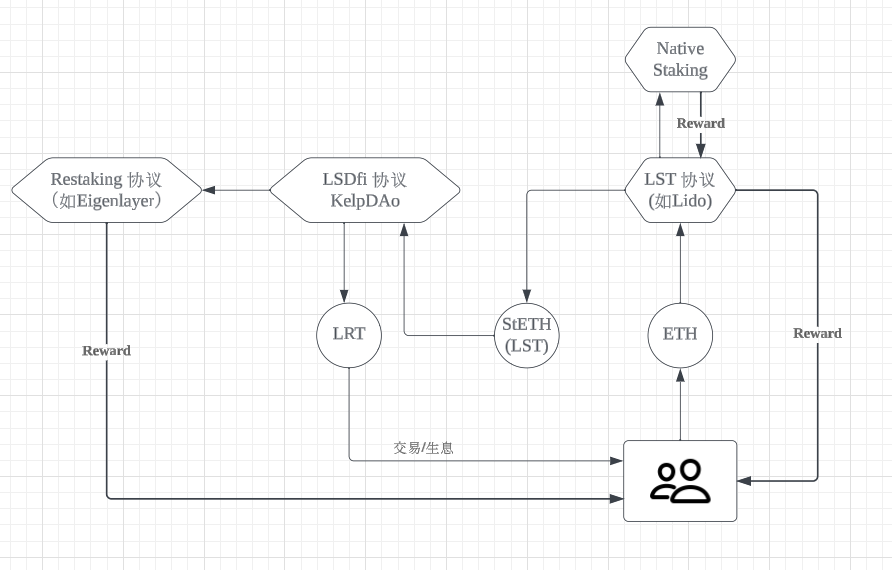
After the Restaking protocol was established, everyone discovered that LST could be re-pledged to earn interest, but after the LST tokens were put in for pledge, the liquidity seemed to be locked. At this time, some projects discovered the opportunity. They helped users put LST assets into the Restaking protocol for re-pledge to obtain a profit. At the same time, they issued a "Re-pledge Voucher" to the user. Users can use this "Re-Pledge Voucher" "Carry out more financial operations, such as mortgages and loans, to solve the liquidity lock situation in re-pledge. The “re-pledge certificate” here is LRT.
Phase 5: Pendle protocol supports the outbreak of LRT
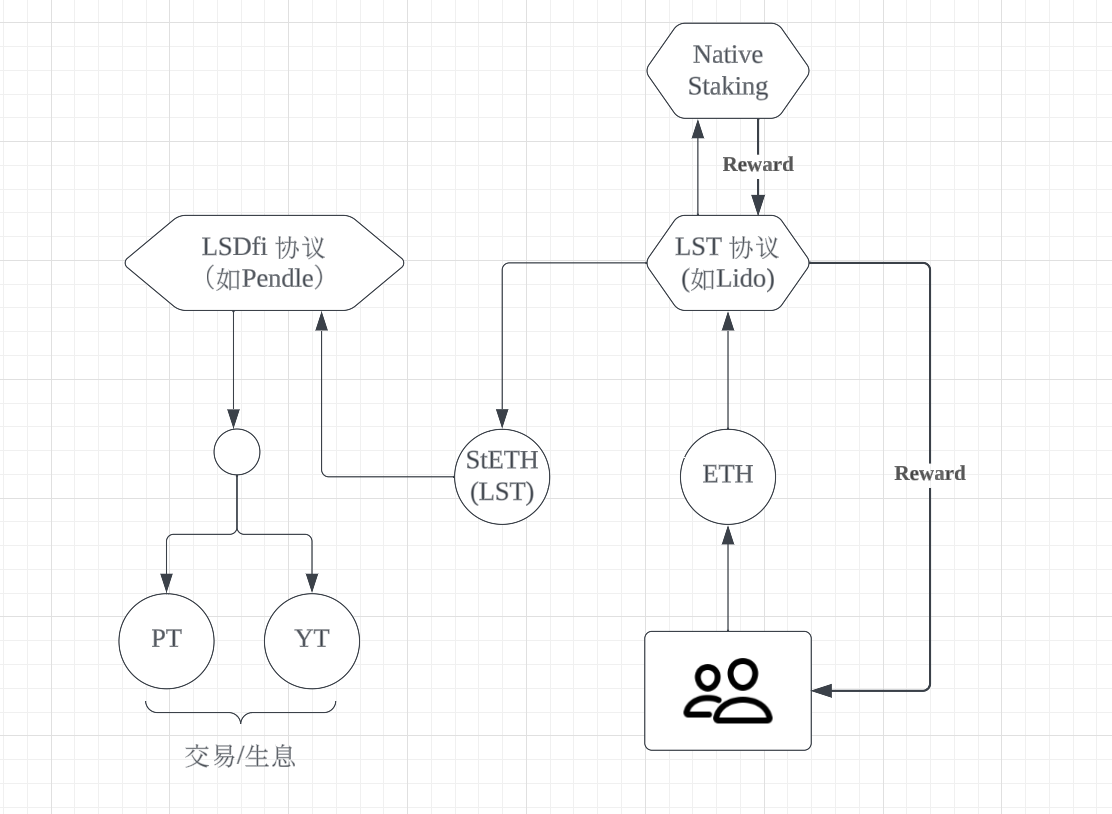
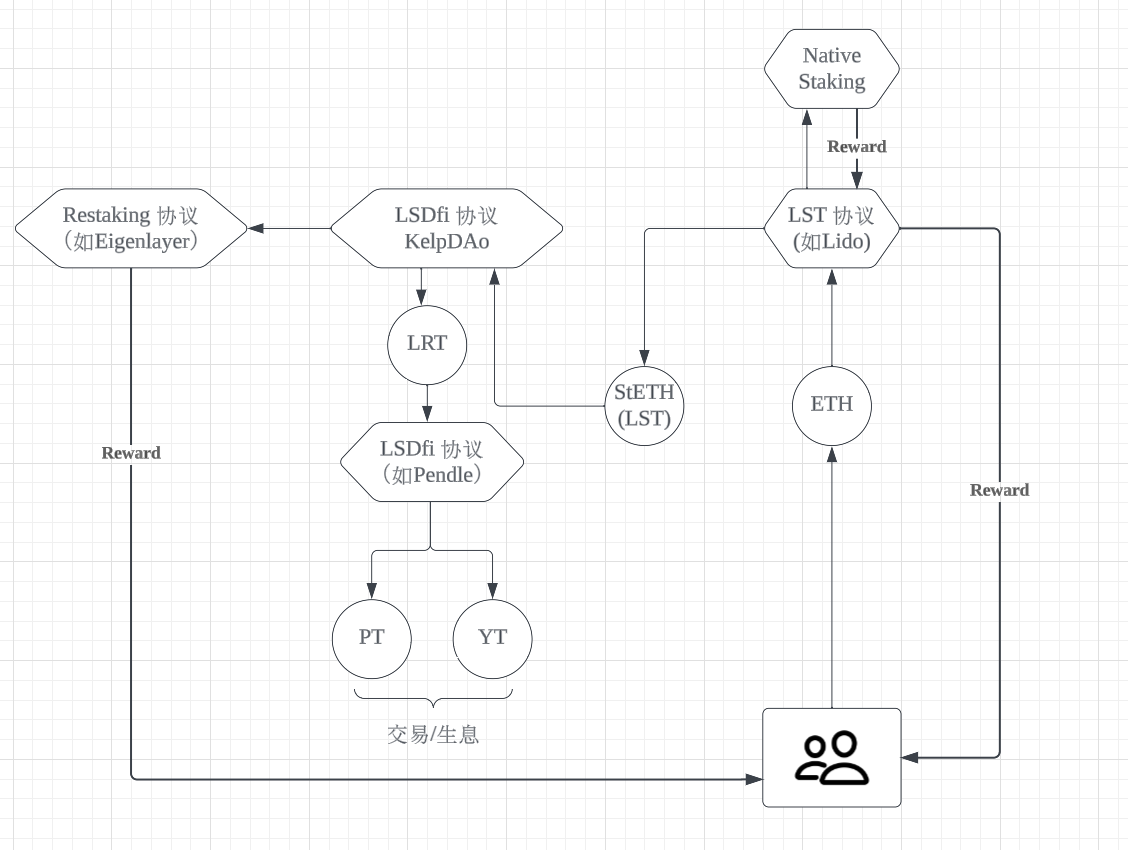
After a user obtains LRT and wants to perform a series of financial operations, where should these LRTs go and what financial operations should they perform? At this time, Pendle provides a very elegant solution.
Pendle is a decentralized interest rate trading market that provides transactions of PT (Principal Token, principal token) and YT (Yield Token, income token).
As the variety of yield tokens expands with the emergence of yield-based USD and, more recently, Liquidity Recollateralized Tokens (LRT), Pendle is able to continue to iterate and support yield trading in these cryptocurrencies. Pendle’s LRT marketplaces have been particularly successful as they essentially allow users to pre-sell or lay out long-term airdrop opportunities (including EigenLayer). These markets have quickly become the largest on Pendle by a wide margin:
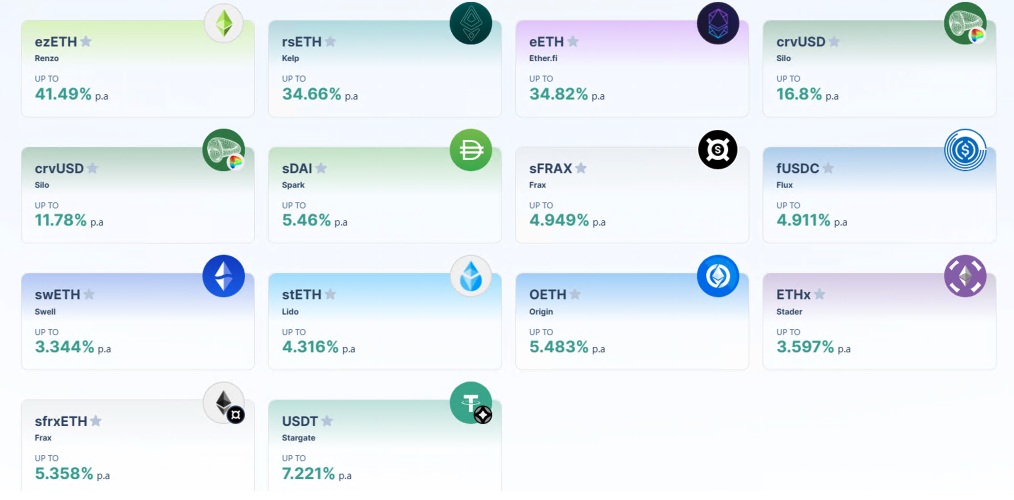
● Through custom integration of LRT, Pendle allows Principal Token to lock in base ETH earnings, EigenLayer airdrops, and any airdrops related to the Restaking protocol that issues LRT. This creates an annual rate of return of more than 30% for Principal Token buyers.
● On the other hand, Yield Token allows for some form of "leveraged point farming" due to the way LRT is integrated into Pendle. Through the swap function in Pendle, we can exchange 1eETH for 9.6 YT eETH, which will accumulate EigenLayer and Ether.fi points just like holding 9.6 eETH.
● In fact, for eETH, Yield Token buyers can also get 2 times the points of Ether.fi, which is actually "leveraged airdrop farming".
Using Pendle, users can lock in ETH-denominated airdrop earnings (based on market airdrop expectations for EigenLayer and LRT protocols) and leveraged liquidity mining. With speculation surrounding a possible airdrop of AVS to LRT holders this year, Pendle is likely to continue to dominate this market segment. In this sense, $PENDLE provides good exposure to success in the LRT and EigenLayer verticals.
summary:
The above explains the process of how LRT was born, then,
From ETH -> LST -> LRT, is it a matryoshka doll as most people say?
The answer to this question needs to be discussed on a case-by-case basis.
If within a single DeFi ecosystem, staking LST generates re-staking certificates, and then pledges the certificates, and then issues a governance token in the name of locking liquidity, allowing the secondary market speculation to feed back the expected value of Restaking, this is Matryoshka doll. Because the incoming funds from the next level feed back the assets of the upper level, what is overdrawn is the market's expectations for a Token, and no real value growth occurs.
Then take a look at the classic re-pledge mode with Eigenlayer + Pendle as the core.
By Eigenlayer,
● Users repeatedly pledge LSD to EigenLayer.
● Duplicate pledged assets will be provided to AVS (Actively Validated Services) for protection.
● AVS provides verification services for application chains.
● Application chain payment service fees. The fees will be divided into three parts and distributed to stakers, AVS and EigenLayer as staking rewards, service income and protocol income respectively.
via Pendle,
● Users can lock in airdrop earnings denominated in ETH (based on market airdrop expectations for EigenLayer and LRT protocols)
● Leveraged liquidity mining
● As an interest-earning asset, LRT has excellent application scenarios
The essence of this model is to share the security of Ethereum, and projects that share security through this mechanism need to pay for the service. Positive funds enter the ecology. This is definitely not a nesting doll, but a very reasonable economy. Model.
To put it simply, the core driving force for the launch of this round of LRT narratives has the following two key conditions:
1. The interest-earning ability of LRT’s underlying assets
2. Application scenarios of LRT
First, the interest-earning ability of LRT’s underlying assets is provided by Eigenlayer, including Eigenlayer’s airdrops and its practical service income . Eigenlayer will be introduced in detail below.
Secondly, LRT application scenario Pendle gives a good example
So below, we will focus on introducing Eigenlayer, the core project of Restaking, and take stock of other LRT projects.
LRT track ecological situation (key introduction)
EigenLayer-re-pledge middleware
Introduction to EigenLayer
EigenLayer is a re-pledge collection of Ethereum, a set of smart contract middleware on Ethereum that allows stakers of the consensus layer Ethereum (ETH) to choose to verify new software modules built on top of the Ethereum ecosystem.
By providing an economic staking platform that allows any stake holder to contribute to any PoS network, EigenLayer effectively paves the way for expressive innovation in the L2 mining Cosmos stack by reducing cost and complexity. Protocols using EigenLayer are “renting” their economic security from Ethereum’s existing stakers, and this reuse of ETH provides security for multiple applications.
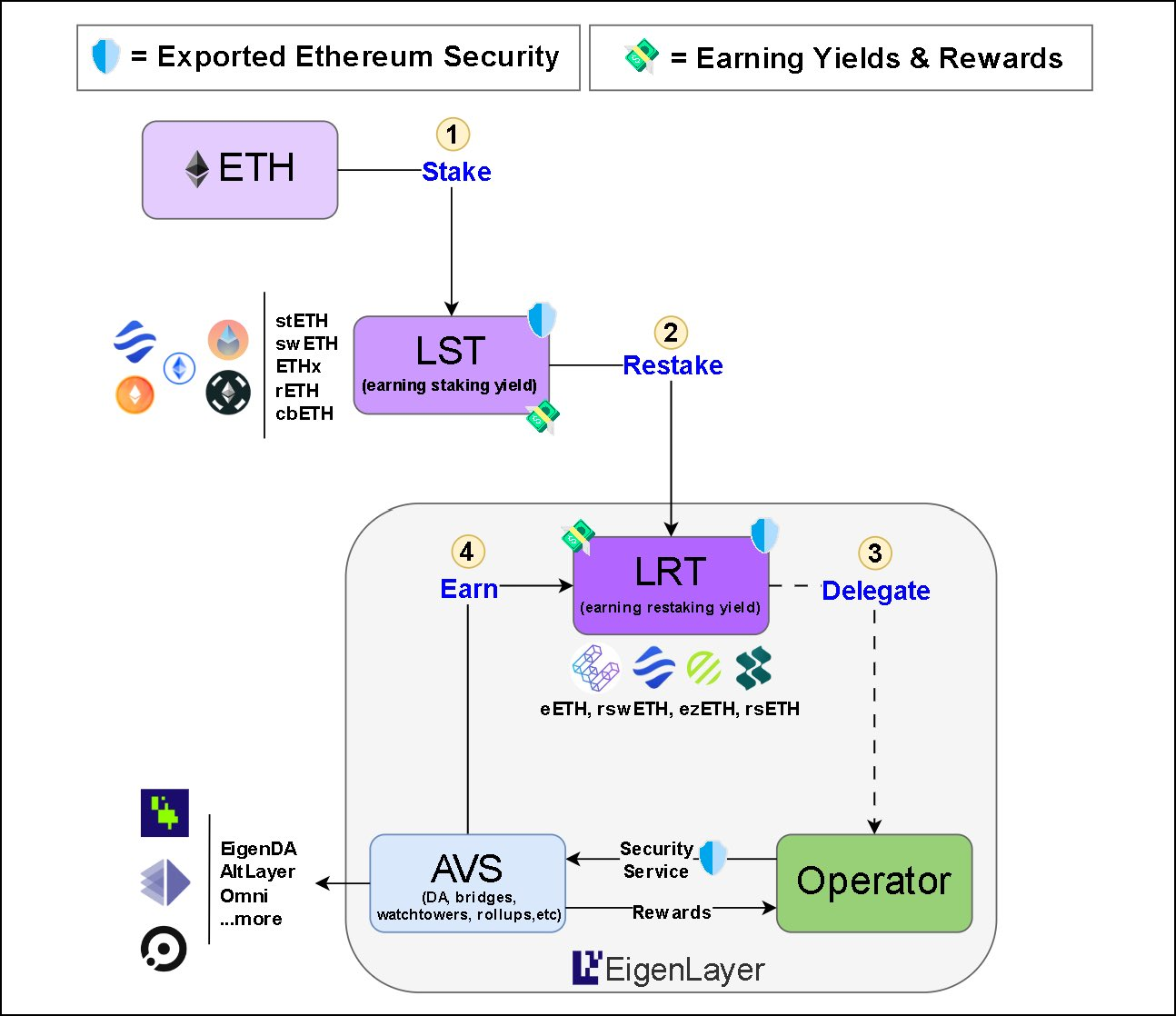
In summary: EigenLayer uses a set of smart contracts to allow re-pledgers to participate in the verification of different networks and services, saving costs for third-party protocols while enjoying the security of Ethereum, and providing multiple benefits and flexibility for re-pledgers.
Product mechanism
For middleware projects, EigenLayer can help them quickly cold-start the network. Even if they issue their own tokens later, they can switch to a mode driven by their own tokens. EigenLayer is like a security service provider. For DeFi, various derivatives can be built based on EigenLayer.
● EigenLayer ’s product logic in the entire LST/LRT
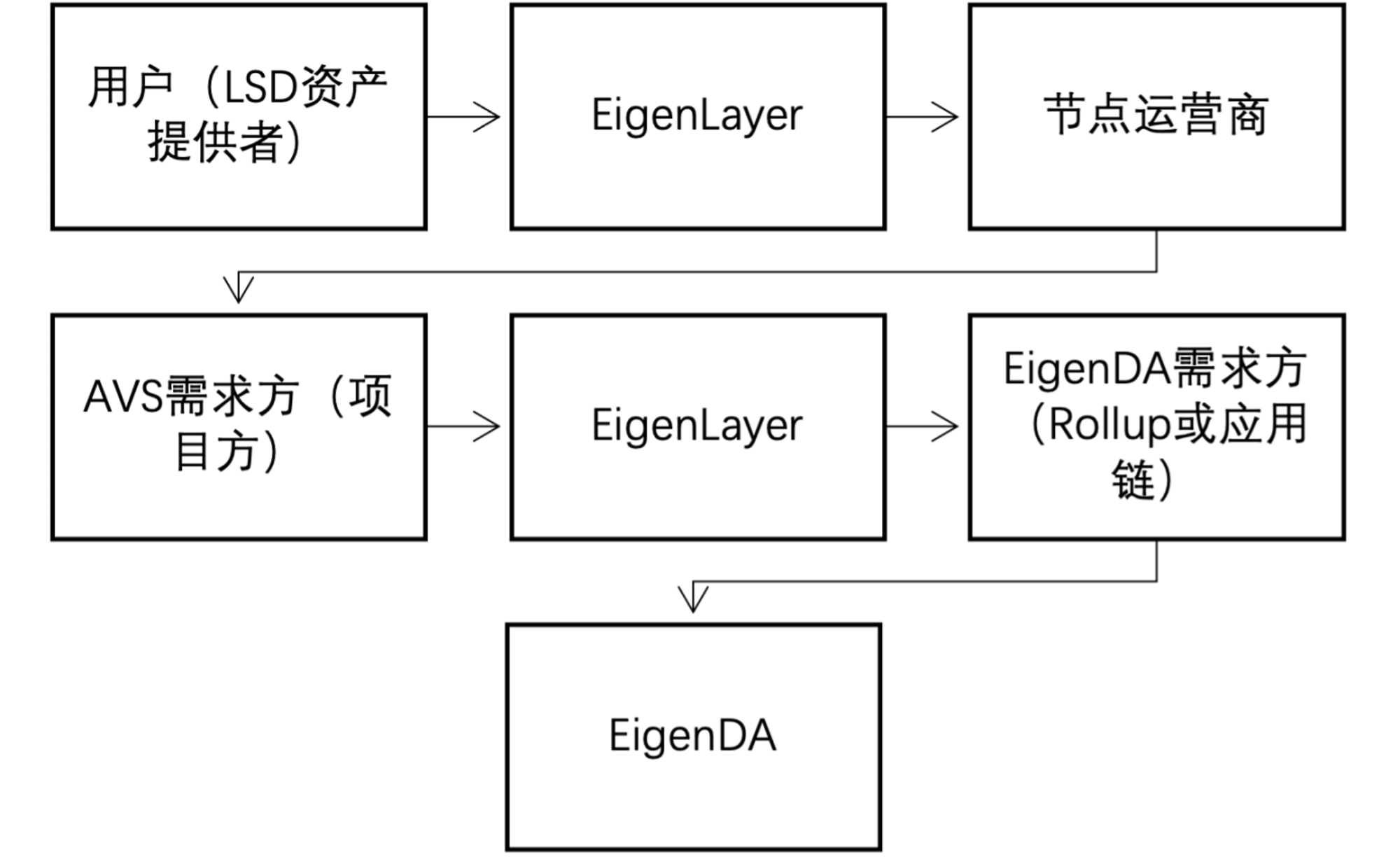
● User passes through EigenLayer flow chart
Detailed explanation of EigenLayer AVS
Another important new concept in EigenLayer is AVS (Active Verification Service).
Restaking is easy to understand, but AVS is a bit complicated to understand. To understand EigenLayer’s AVS, you need to first understand Ethereum’s business model. If we observe the relationship between the Ethereum mainnet and the Ethereum ecological Rollup L2s from a business perspective, Ethereum’s current business model is to sell block space to general Rollup L2s.
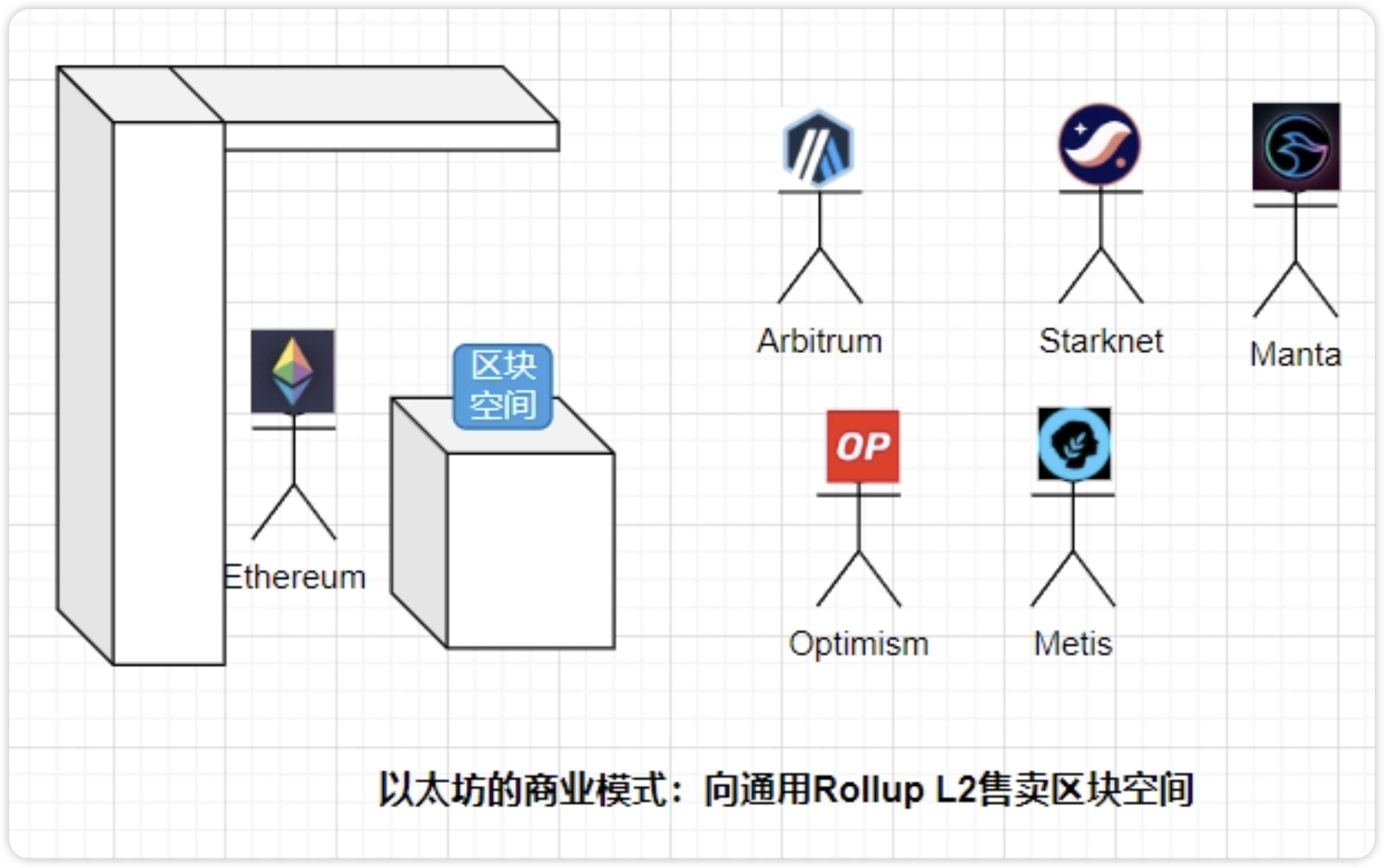
Image source: Twitter 0xNing0x
General Rollup L2s, by paying GAS, package L2 status data and transactions into smart contracts deployed on the Ethereum main network to verify the availability, and then save them in the form of calldata on the Ethereum main network. Finally, the Ethereum consensus layer will State data and transactions are ordered and included within blocks. The essence of this process is that Ethereum is actively verifying the consistency of Rollup L2 state data.
EigenLayer's AVS just abstracts this specific process into a new concept - AVS
Let’s take a look at EigenLayer’s business model. It abstracts and encapsulates the economic security of Ethereum's PoS consensus into a beggar's version (low-end model) through ReStaking, so that the security of the consensus becomes weaker, but the cost also becomes cheaper.
Because it is a beggars version of AVS, its target market group is not the general Rollup L2 that has very high consensus security requirements, but various Dapp Rollups, oracle networks, cross-chain bridges, MPC multi-signature networks, trusted execution environments, etc. and other projects that have lower consensus security requirements . Isn’t this just PFT (Product Market Fit)?
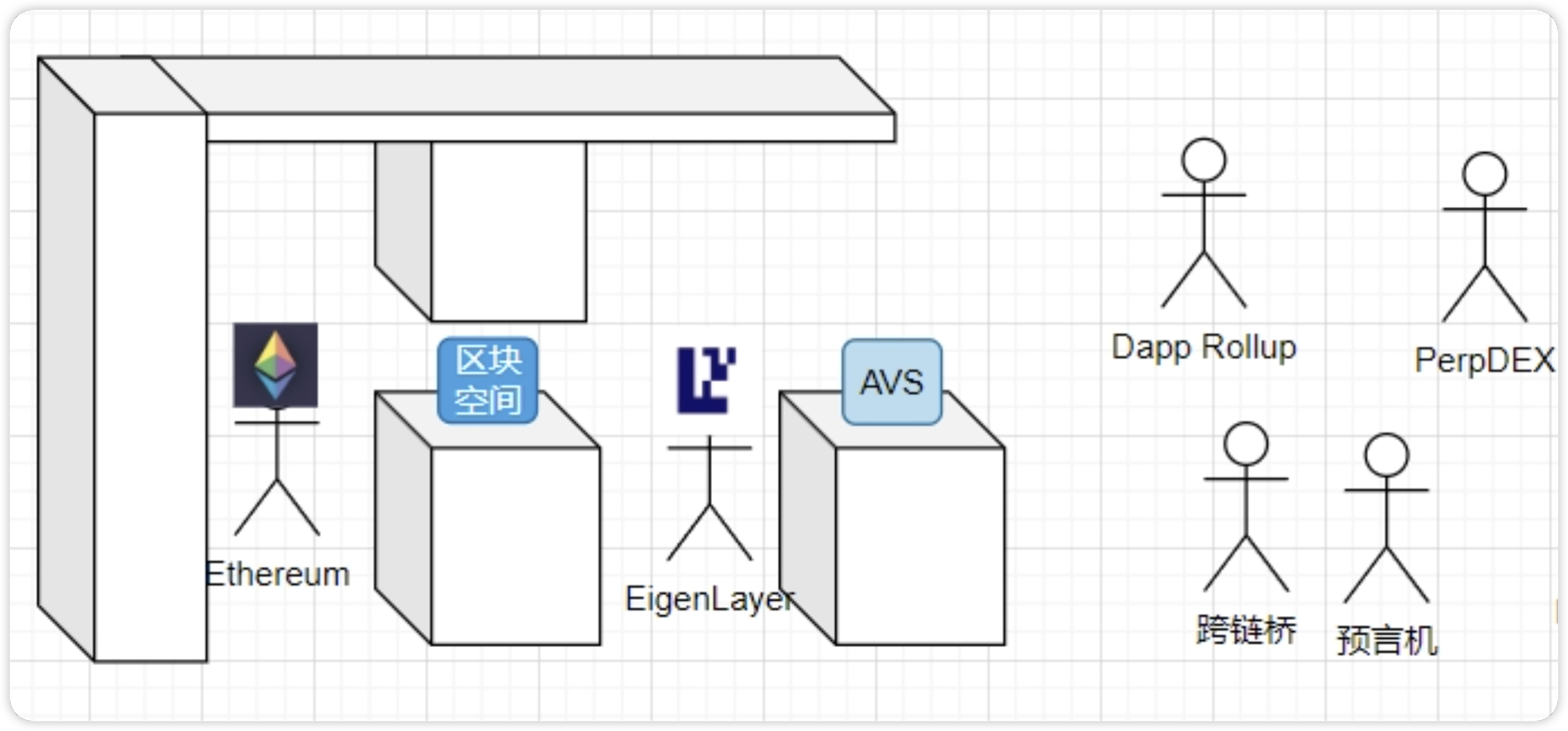
Image source: Twitter 0xNing0x
AVS proactive verification service provider project
There are currently about 13 AVSs included in EigenLayer, and more AVS service providers are joining AVS through EigenLayer's Dev documents. These projects are highly bound to the RaaS concept. Most of them serve the security, scalability, interoperability and decentralization of the Rollup project, and some also extend to the Cosmos ecosystem.
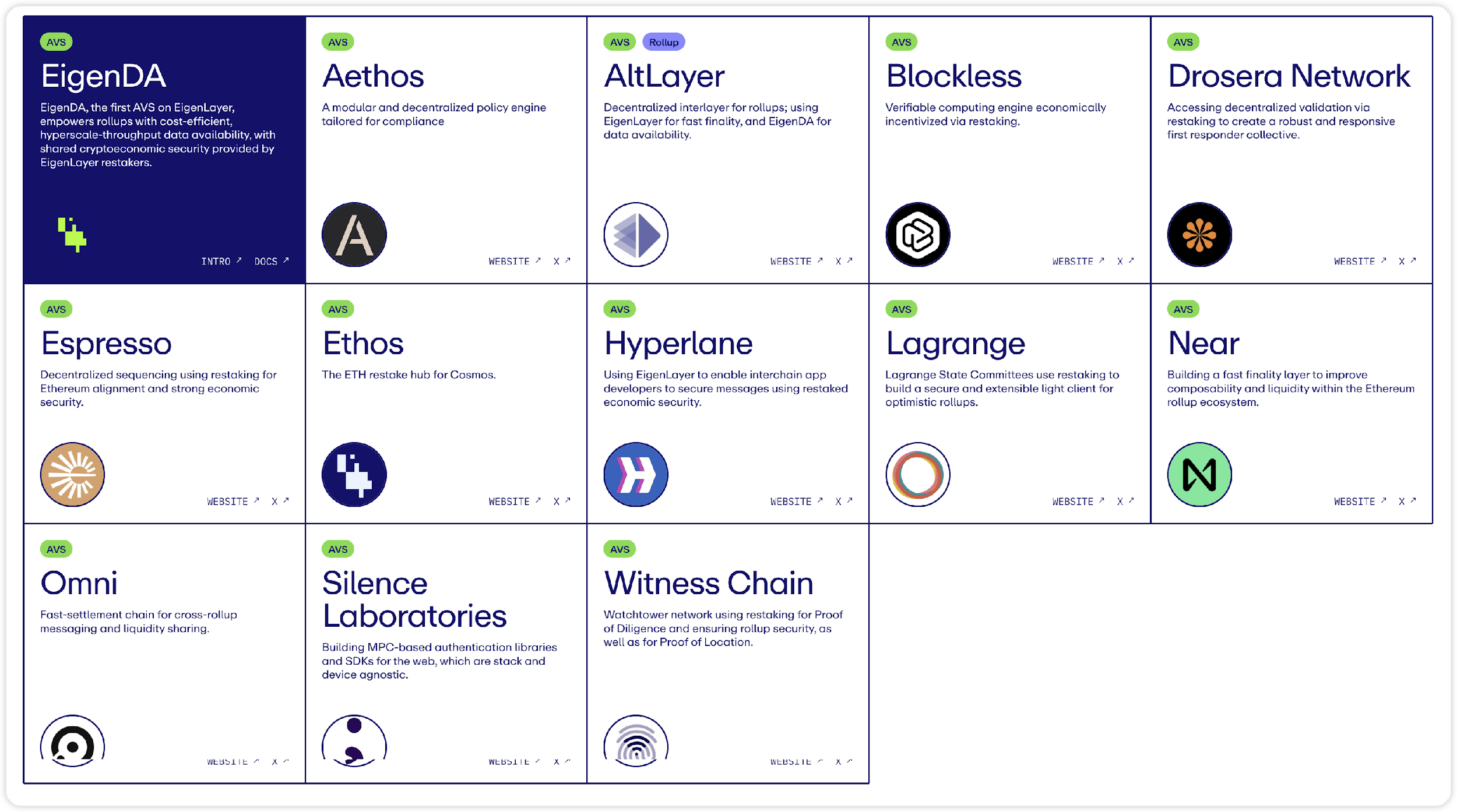
Among them, we are familiar with EigenDA, AltLayer, Near, etc. Below we list the characteristics of AVS-related projects.
● Ethos: Ethos mainly bridges the economic security and liquidity of Ethereum to Cosmos. The Cosmos Consumer chain usually stakes positions natively with tokens to ensure network security. Although ATOM staking provides part of the cross-chain security (ICS), Ethos is connecting the economic security and liquidity of Ethereum with Cosmos. Ethos was inspired by Mesh Security (which allows the use of staked tokens on one chain from another chain), thereby increasing economic security without the need for additional nodes. The benefit of this structure is that ETHOS will likely receive token airdrops (and revenue) from partner chains. At the same time, the ETHOS token itself will also be airdropped to ETH re-stakeholders on Eigenlayer.
● AltLayer: Restaked rollup, a new project launched in cooperation with Eigenlayer, is characterized by the introduction of three AVS: 1) fast finality; 2) decentralized sorting; 3) decentralized verification. The token economics of ALT are very clever, as ALT needs to be staked simultaneously with re-staking ETH to protect these three AVS.
● Espresso: Espresso is a sequencer focusing on decentralized Layer 2. AltLayer actually integrates with Espresso, so developers can choose to use AltLayer's decentralized validation solution and use the Espresso Sequencer when deploying on the AltLayer stack.
● Omni aims to integrate all Rollups on Ethereum. Omni introduces a "unified global state layer" protected through re-staking of EigenLayer. This state layer integrates cross-domain management of applications.
● The goal of Hyperlane is to connect all Layer1 and Layer2. Using Hyperlane, developers can build inter-chain applications, and Hyperlane Permissionless Interoperability allows Rollups to connect to Hyperlane themselves without the need for troublesome governance approvals, etc.
● Blockless uses a network-neutral application (nnApp), which allows users to run a node while using the application and contribute resources to the network. Blockless will provide networking for EigenLayer-based applications to minimize accidental slashing.
Other AVS projects worth watching:
● Lagrange : Another competitor to LayerZero, Omni, and Hyperlane, its cross-chain infrastructure creates universal proofs of state on all major blockchains;
● Drosera : "Incident response protocol" used to contain vulnerabilities. When a hacker attack occurs, Drosera's Trap will detect it and take action to reduce the vulnerability;
● Witness Chain : Use the re-pledge function for Proof of Diligence to ensure the security of Rollups, and Proof of Location to establish physical node decentralization.
Summary of EigenLayer product features
The product features of EigenLayer can be summarized as follows:
● EigenLayer is a “super connector” that simultaneously connects the three major sectors of Staking, infrastructure middleware and DeFi .
● EigenLayer plays the role of a bridge in Ethereum's re-pledge and is an extension of Ethereum's encryption economic security. The market demand and supply for EigenLayer is very solid.
● EigenDA is a pre-explored version of Danksharding, the expansion solution under Ethereum’s Rollup-centric Roadmap. Simply put, it is "the youth version of sharded storage"
EigenLayer ecological related projects
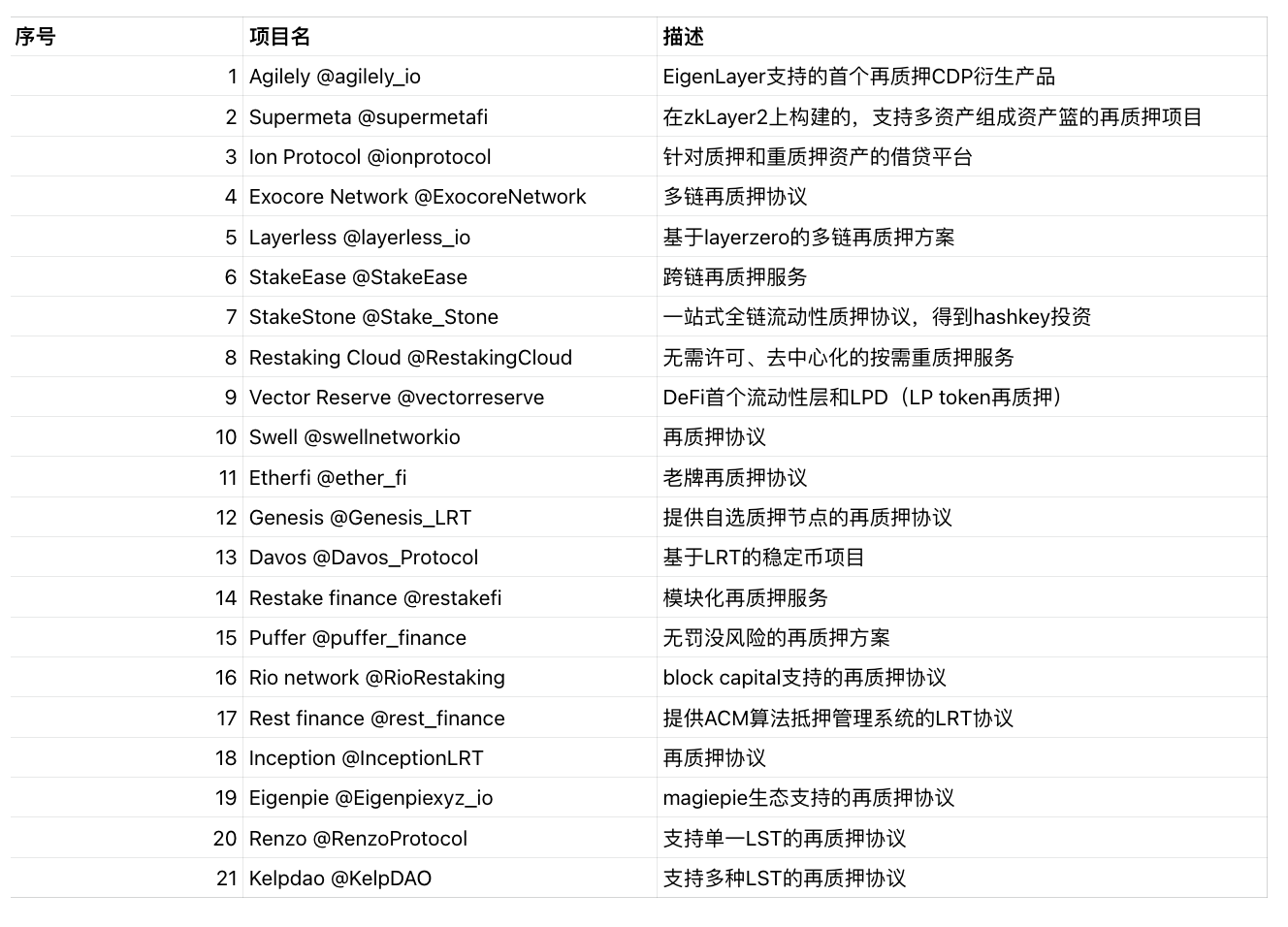
Ethereum LRT project review
There are currently about 15 LRT protocols on Ethereum, 9 of which are already online and 6 of which are still on the test network. Most of the LRT protocol still relies on Eigenlayer to obtain restaking income, which is mainly divided into three categories:
● Liquid-LSD Restaking: The unified management of users’ pledged LST is put into external Restaking protocols such as Eigenlayer, and users receive the mortgage token Liquid Restaking Token (LRT) (such protocols include KelpDAO, Restake Finance, and Renzo). This type of agreement is highly homogeneous and has limited technology and innovation.
● Liquid Native Restaking: Native liquid restaking refers to projects such as etherf.fi or Puffer Finance that provide small-amount ETH node services, and provide the ETH in the node to EigenLayer for re-staking.
● The protocol is optimized on the basis of the Eigenlayer protocol. It also provides security and verification services, and also carries out LRT business (such protocols include SSV). The development of this type of protocol mainly depends on the competition between the protocol itself and Eigenlayer, and a breakthrough point needs to be found. to attract nodes.
Most LRT protocols will start from three points in mechanism innovation:
1. Provides stronger security than Eigenlayer;
2. Eigenlayer has a distribution strategy problem: As the number of AVS increases, re-pledgers need to actively choose and manage the distribution strategy for operators, which will be extremely complex. The LRT protocol will provide users with the best solution for allocating strategies.
3. EigenLayer's LST deposits are available online. There is no limit on native ETH deposits, but it is difficult for most users to obtain it because it requires users to have 32 ETH and run an Ethereum node integrated with EigenLayer to run EigenPods. On some LRT protocols, this restriction will be lifted.
The specific projects and situations are as follows:
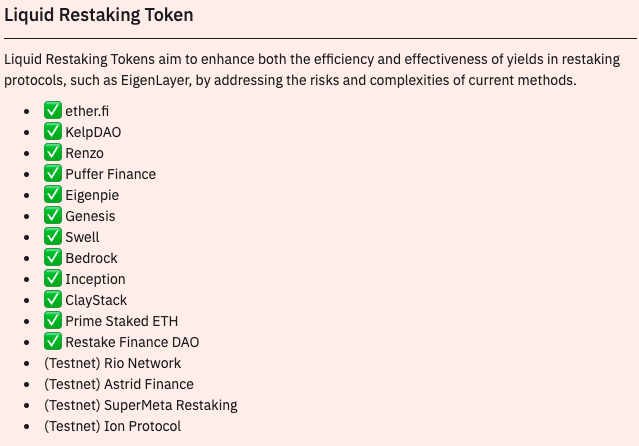
Renzo
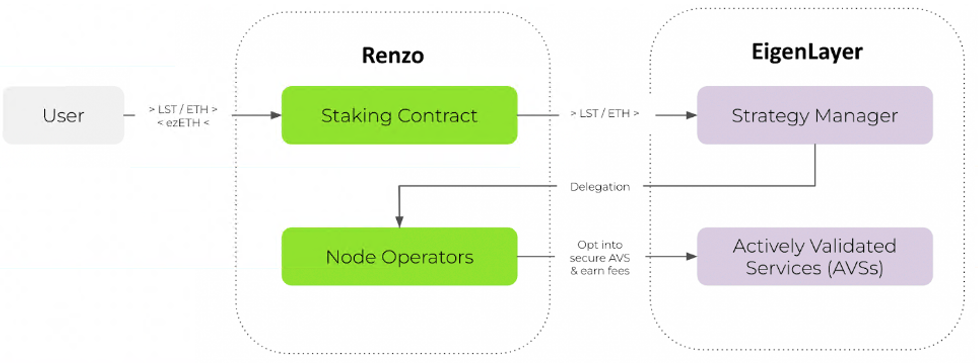
Renzo is optimized on Eigenlayer, which abstracts the complex process of restaking for end-users. Re-stakeholders do not have to worry about the active selection and management of operators and reward strategies. Help users build investment portfolios to invest in AVS allocation strategies with greater returns. Secondly, there is no upper limit for depositing tokens in Renzo, which has also become one of the main factors for the skyrocketing Renzo TVL.
Financing situation: In January, it announced the completion of a US$3.2 million seed round of financing, led by Maven 11, with participation from SevenX Ventures, IOSG Ventures, OKX Ventures, etc.
Business logic:
● Users pledge ETH or LST to the Renzo protocol, and users receive $ezETH of equal value;
● Renzo pledges LST to Eigenlayer's AVS node, but Renzo will adjust the weight of LST pledged on the node to obtain the best returns.
Current situation: Tokens have not yet been issued. $ezETH belongs to its LRT token. Since it obtains re-staking income, the price will be higher than ETH. Currently, 217,817 have been minted, with a TVL of $777.7m. Regarding the handling fee issue, appropriate charges will be made based on the re-pledge proceeds. Regarding the community situation, the current number of twi fans is 51.7K.
KelpDAO
KelpDAO is an LRT project supported by Stader Labs, and its business model is similar to Renzo. The difference from Renzo is the withdrawal method of rsETH, which takes more than 7 days for Renzo, while KelpDao provides an AMM liquidity pool that can redeem $rsETH at any time.
Business logic:
● Deposit LST such as stETH into the Kelp protocol and exchange it for rsETH tokens. The Node Delegator contract pledges LST to Eigenlayer's Strategy Manager contract.
● KelpDAO is linked with EigenLayer. Users can not only obtain EigenLayer points by staking again, but also can withdraw liquidity and use LRT to earn interest, and at the same time enjoy the interest-earning income of LST.
Current status: No tokens have been issued yet, TVL $718.76m, overall performance is better than Restaking Finance. The fact that the agreement does not charge any fees is also a major advantage of KelpDAO. In terms of social data, Twi has 23.6K fans and less interaction.
Restake Finance ($RSTK)
RSTK is the first modular liquidity re-pledge protocol on EigenLayer. It helps users place LST on the Eigenlayer project. The entire business logic is not innovative or competitive. There isn’t much new in the token economic model. The price performance of tokens has increased significantly for a period of time due to the popularity of the restaking concept and the Eigenlayer project, but it has performed poorly recently.
Business logic
● Users deposit the LST generated by liquidity staking into Restake Finance;
● The project helps users deposit LST into EigenLayer and allows users to generate reaped ETH (rstETH) as a re-pledge certificate;
● Users can use rstETH to earn income in various DeFi, and they will also receive points rewarded by EigenLayer (considering that EigenLayer has not issued coins yet)
Token function
● Governance
● Pledge and obtain dividends from the agreement income
Current situation: TVL reaches $15.5m, a total of 4,090 rstETH is in circulation, the number of unique addresses is more than 2500, and the number of users exceeds 750. In terms of social data, Twi has 12.8k fans and less interaction.
Puffer Finance
Due to Binance Labs’ investment, Puffer has become more popular recently. Puffer Finance is an anti-forfeiture liquid staking protocol, which is also a type of Liquid Native Restaking product. Puffer Finance has received a seed round of financing led by Jump Crypto, with a total of US$6.15 million in financing. Puffer will also develop Layer2 networks.
Advantage:
● Eigenlayer’s requirement for re-pledge nodes is 32 ETH, while Puffer’s re-pledge function lowers the threshold to 2 ETH in an attempt to attract small nodes.
● Security, secure-signer & RAVe (remote attestation verification on chain)
Business logic:
● Users pledge $ETH to obtain $pufETH. Puffer’s Node Operators divide $ETH into two parts, one part is pledged to Ethereum validators, and the other part participates in Eigenlayer’s re-pledge.
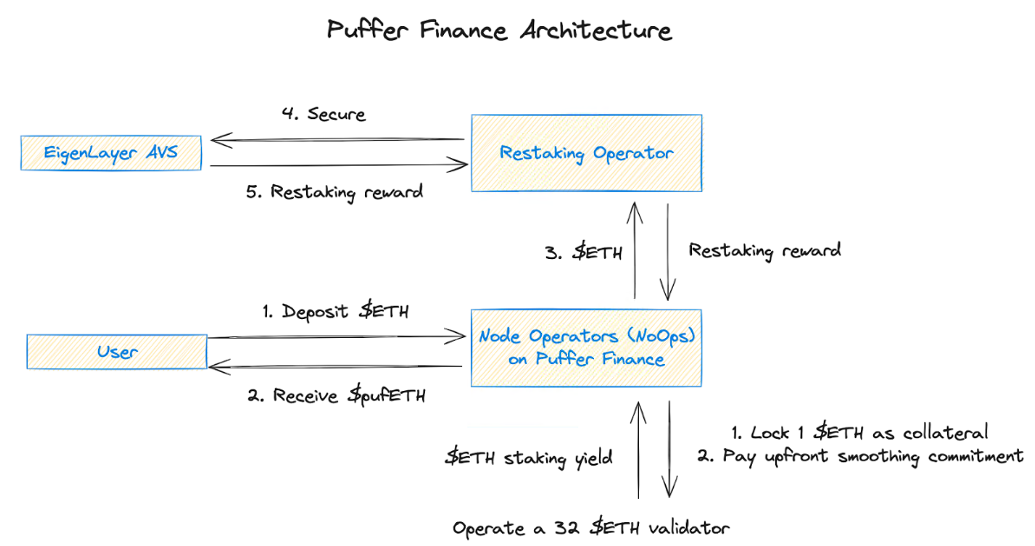
Current status: The staking function has been developed, a total of 365,432 pufETH has been minted, and the TVL has reached $1.40b. In terms of community status, it is currently the project with the largest number of twi fans in the LRT protocol, 213.7K.
Liquidity staking + re-staking service
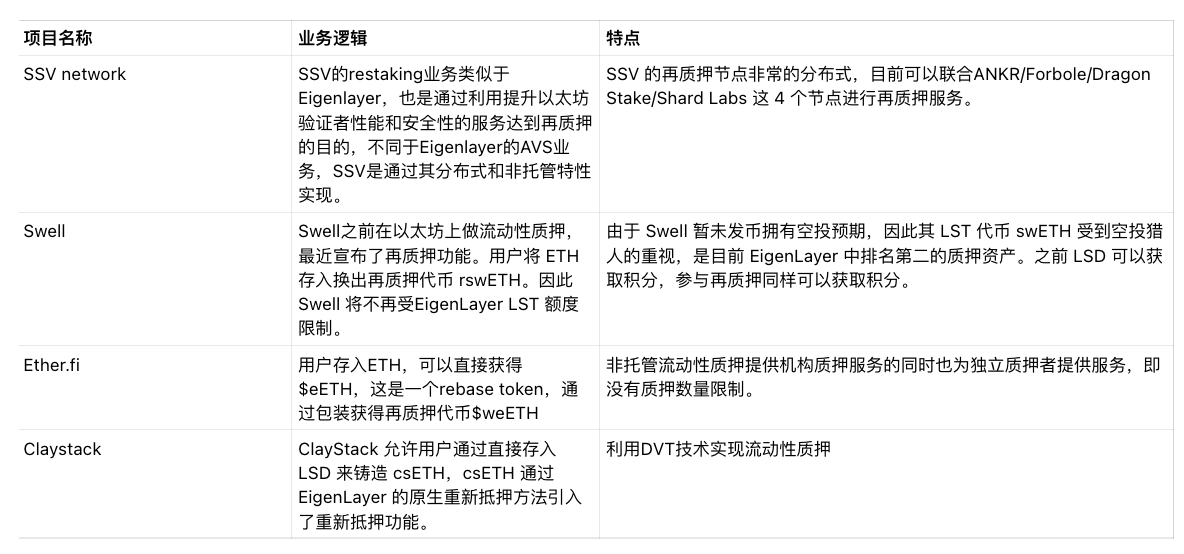
This type of project originally occupied a place in the liquidity staking track, and then switched to the re-staking track. The advantages are: 1. There is a large amount of ETH pledged in the protocol itself, which can be directly converted into re-staking tokens; 2. User group lock-in , users no longer need to look for the LRT protocol. Currently, Swell and Ether.fi have become the leaders in LRT projects on the Eignlayer network, taking the leading position based on the amount of deposits.
Other LRT protocols
Summarize
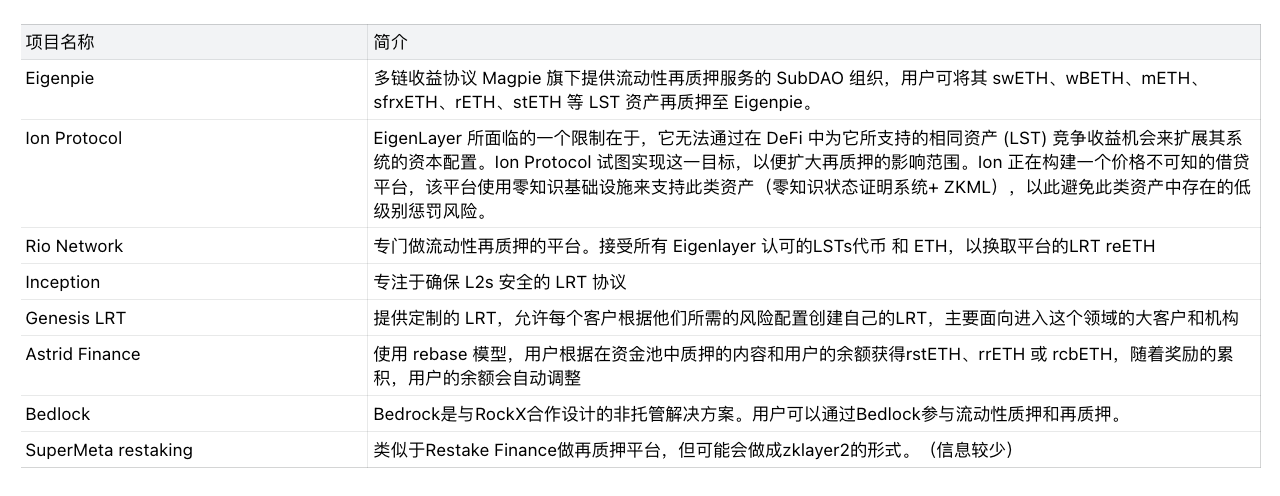
At present, many LRT protocols do not issue tokens, and the homogeneity of projects is serious. But the more optimistic ones are KelpDAO, Puffer Finance, and Ion Protocol. These three types of protocols have development routes that are obviously different from other LRT protocols.
According to the ranking of tokens issued by some LRT protocols, ether.fi has the largest number, followed by Puffer Finance and Renzo.
● From the perspective of actual benefits, LRT is more like a speculative leverage created for liquidity. Leverage means that there is still only one copy of the original asset, but through the mapping of tokens and the locking of equity, the original ETH can be used to continuously increase the leverage doll, and multiple derivatives certificates can appear.
● These derivatives certificates have greatly revitalized liquidity during the tailwind situation and are more conducive to market speculation.
● However, various protocols that issue derivatives are connected to each other because of liquidity. Holding A can lend B, and lending B can revitalize C. Once there is a problem with Protocol A itself and the scale is large, the risks will be chain-linked.
LRT track future predictions
Overall, the LRT track is a rapidly growing niche market. The LST track can provide a stable income of about 5%, which is indeed attractive during the bear market. The income of the LRT track still depends on the ability of Eigenlayer to provide re-pledge services, and the final income will attract users to continue paying attention and depositing funds to the LRT track. The LRT track is still in its early stages, but the projects are highly homogeneous and the track carries limited funds. It is predicted that only a few leading projects will come out in the future.
risk:
● Risk of fines: Increased risk of losing staked ETH due to malicious activity.
● Centralization risk: If too many stakers move to EigenLayer or other protocols, it may cause systemic risks to Ethereum.
● Contract risk: There may be risks in the smart contracts of each agreement.
● Multi-level risk superposition: This is the key issue of re-pledge. It combines the existing pledge risk with additional risks to form multi-level risks.
Future opportunities:
● Multiple combinations of LRT and other DeFi protocols, such as lending.
● Security improvement: Using DVT technology can help reduce node operation risks, such as SSV and Obel;
● Multi-chain expansion: Develop LRT protocols in multiple Layer2 or PoS chains, such as @RenzoProtocol and @Stake_Stone;
— — — — — — — — — — — -
about Us
This speech was written by the Research team of HTX Ventures. HTX Ventures is the global investment arm of Huobi HTX, integrating investment, incubation and research to identify the best and most promising teams around the world. As a pioneer in the blockchain industry for ten years, HTX Ventures promotes the development of cutting-edge technologies and emerging business models in the industry, providing comprehensive support for cooperative projects, including financing, resources and strategic consulting, to establish a long-term blockchain ecosystem. Currently, HTX Ventures has supported more than 200 projects across multiple blockchain tracks, and some of these high-quality projects have been listed on Huobi HTX for trading. At the same time, HTX Ventures is one of the most active fund-of-funds (FOF) investors, working with the world's top blockchain funds such as IVC, Shima, and Animoca to build a blockchain ecosystem.
references
1. SevenX Ventures: The pattern and opportunities of LRT liquidity re-hypothecation
https://foresightnews.pro/article/detail/51837
2. The Rehyping Token (LRT) narrative is rekindled: looking for high-potential project opportunities among the endless liquidity dolls
https://www.techflowpost.com/article/detail_15548.html
3. Liquid staking landscape
https://docs.google.com/document/d/1gtVgo9n2JbnZR-HFYbnsJ9nmPUGt4SYUdPXZdNHeQBY/edit
4. Behind Pendle’s surge: airdrops, leverage, EigenLayer’s re-staking narrative, the winner
https://www.techflowpost.com/article/detail_16101.html
5. An overview of the Restaking track. How much do you know about the projects that you shouldn’t miss in the “Staking Year”?
https://s.foresightnews.xyz/article/detail/52874
6. Is the spring breeze coming for the re-hypothecation market? Taking stock of potential projects on the track and then pledging them
https://www.odaily.news/post/5192591
7. Interpretation of LRT: https://twitter.com/0xNing0x
8. Interpretation of LRT (HaoTian): https://twitter.com/tmel0211
Disclaimer
1. HTX Ventures does not have any relationship with the projects or other third parties involved in this report that would affect the objectivity, independence, and fairness of the report.
2. The information and data cited in this report are all from compliance channels. The sources of the information and data are considered reliable by HTX Ventures, and necessary verification has been conducted on their authenticity, accuracy and completeness. However, HTX Ventures is not responsible for No guarantee is made as to its truthfulness, accuracy or completeness.
3. The content of the report is for reference only. The conclusions and opinions in the report do not constitute any investment advice on related digital assets. HTX Ventures does not assume any responsibility for losses caused by the use of the contents of this report, unless expressly provided by laws and regulations. Readers should not make investment decisions solely based on this report, nor should they lose the ability to make independent judgments based on this report.
4. The information, opinions and speculations contained in this report only reflect the judgment of the researchers on the day when this report is finalized. In the future, based on industry changes and updates of data and information, there is a possibility that opinions and judgments will be updated.
5. The copyright of this report belongs only to HTX Ventures. If you need to quote the contents of this report, please indicate the source. If you need to quote a large amount, please inform us in advance and use it within the permitted scope. Under no circumstances may any quotation, deletion or modification be made to this report that goes against the original intention.