Compliance has become the mainstream direction of DeFi
Over the past few years, global financial markets have witnessed the rapid growth of DeFi. DeFi brings unprecedented convenience to users by providing financial services such as transactions and borrowing without intermediaries. However, its anonymity and decentralized nature also bring regulatory and security challenges - DeFi projects' lack of transparency, vulnerability to hackers, and compliance risks have become the focus of regulatory agencies.
For example, regulatory agencies such as the U.S. Securities and Exchange Commission (SEC) and the European Banking Authority (EBA) are actively exploring the regulatory framework for crypto assets. According to the 2023 Global Cryptocurrency Supervision Report released by PwC, the global implementation of cryptocurrencies in 2023 The number of countries with market supervision has increased by 25%. Tighter supervision has imposed more compliance requirements on DeFi, but it is actually laying the foundation for the long-term healthy development of the cryptocurrency market.
In this context, the compliance of DeFi projects has become a mainstream direction. Many DeFi projects have begun to actively choose to embrace regulation. For example, Aave and Compound have launched institutional-oriented DeFi products with access standards. Uniswap limits some specific risk exposures on the front end. Celestia also blocked non-compliant countries and regions such as the United States when airdropping its TIA tokens. Users, these DeFi projects and cryptocurrency platforms choose to proactively make adjustments to their products and services to meet regulatory requirements as much as possible.
In fact, compliance can not only enhance the security and transparency of projects, but also attract more traditional financial players to enter the market. By introducing measures such as KYC and AML, DeFi projects can maintain their innovation and flexibility while complying with laws and regulations.
The combination of CeFi and DeFi: the rise of permissioned DeFi
Permission-based DeFi is a financial model that combines the openness and innovation of decentralized finance (DeFi) with the permission mechanism and regulatory compliance of traditional centralized finance (CeFi). This model aims to solve some of the challenges present in the pure DeFi model, such as compliance, security, and accessibility issues, by introducing a certain degree of centralized management and regulatory control, while retaining the core advantages of DeFi, such as transparency , permissionless participation and smart contract automation, etc.
As global financial markets increasingly demand regulatory compliance, the permissioned DeFi model heralds an important future development direction in the cryptocurrency and blockchain fields. The practices of pioneers such as NEOPIN not only demonstrate the potential of the permissioned DeFi model, but also point the way for the maturity and development of the entire cryptocurrency market.
Permissioned DeFi provides a way to balance innovation and compliance needs. The compliance and security of permissioned DeFi can attract more mainstream users and institutional investors to participate, accelerating the market acceptance process of cryptocurrency and DeFi, and has Help promote the healthy development and maturity of the entire industry.
How does NEOPIN lead the development of permissioned DeFi?
NEOPIN is committed to building a cryptocurrency usage platform that not only complies with the regulatory framework but can fully utilize the advantages of DeFi and CeFi, that is, permissioned DeFi, which NEOPIN calls "permissioned DeFi". Through this combination of advantages, NEOPIN aims to solve the problems faced by financial platforms in the past when they relied only on CeFi or DeFi, while leveraging the advantages of both to provide a platform that is both stable and secure, while also having regulatory compliance, transparency and Accessibility platform.
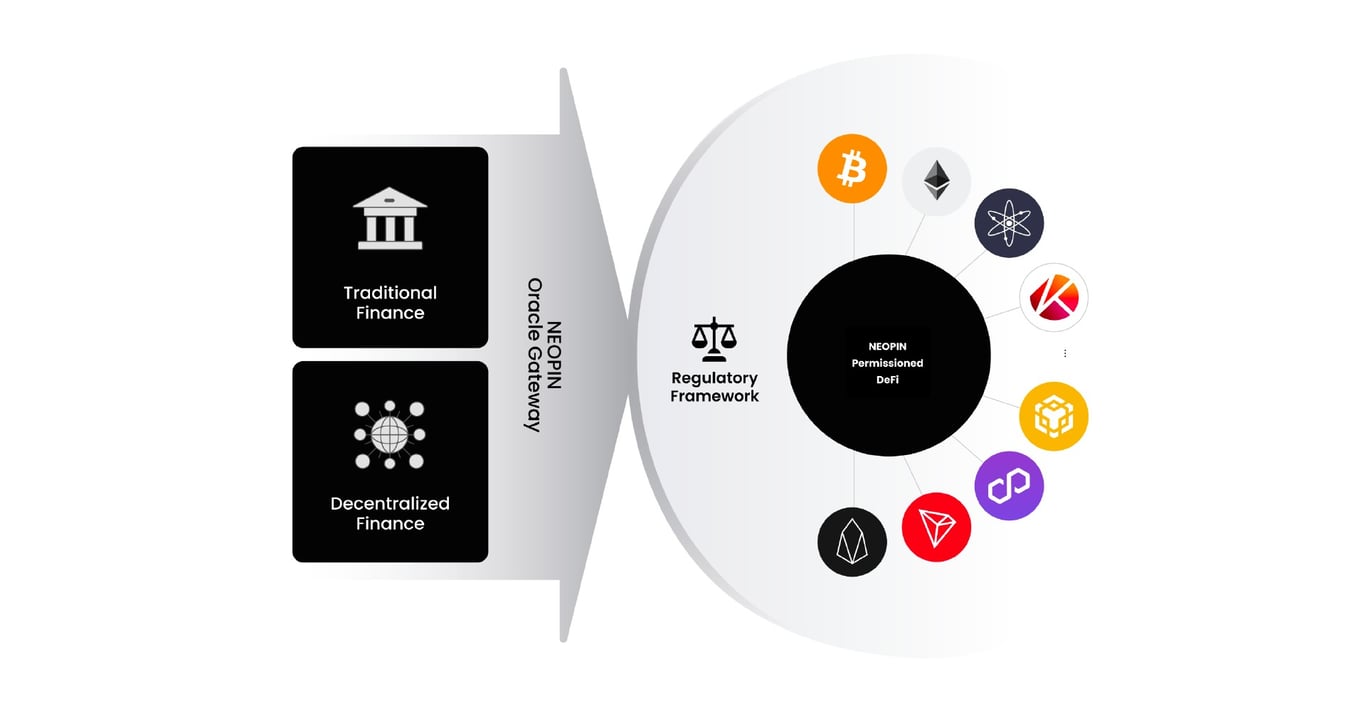
NEOPIN's goal is to become a decentralized crypto bank based on DeFi, which requires NEOPIN to not only provide users with comprehensive DeFi services, including decentralized wallets, liquidity trading pools, lending, liquidity staking, etc. In addition, it needs to meet the needs of the global regulatory framework like traditional finance, improve platform trust and stability, and provide low-threshold entry methods.
Compliance
NEOPIN is currently a member of the Abu Dhabi Investment Office’s (ADIO) Innovation Program and has developed the world’s first DeFi regulatory framework in partnership with the Abu Dhabi Global Market (ADGM). By establishing such a regulatory framework, NEOPIN has become the first DeFi protocol in the world to apply such a regulatory framework.
safety
In terms of security, NEOPIN provides users with a trustworthy DeFi environment by enhancing the security layer of its DeFi products and wallets. Especially in terms of cross-chain bridge technology, NEOPIN adopts advanced security technologies, such as dual KMS systems and a hybrid method of internal bridge verification signatures, to prevent internal and external malicious behaviors.
user friendliness
NEOPIN improves user accessibility and convenience by extending support for external wallets such as MetaMask, Kaikas, and DOSI Vault. In addition, NEOPIN also promotes users’ ability to interact with various blockchain networks by introducing diversified liquidity pools and enhanced bridging functions, thereby increasing the platform’s liquidity and users’ trading options.
Through these efforts, NEOPIN not only sets industry benchmarks in terms of compliance and security, but also makes significant contributions in improving user-friendliness, demonstrating its comprehensive strength as a leading decentralized crypto banking service and Commitment to future development.
Summarize
As the global financial regulatory environment continues to evolve, NEOPIN's proactive attitude toward regulatory changes enables it to navigate the complex regulatory landscape. This adaptability is critical to continued growth and innovation.
In addition, building on the solid foundation of permissioned DeFi and by addressing concerns about security, compliance, and usability, NEOPIN leverages its DeFi products and services to attract a broader user base, such as cryptocurrency novices and cautious institutional investors. This puts projects in a good position for increased adoption and continued growth.
NEOPIN's permissioned DeFi model provides a more inclusive, secure and regulatory-compliant possibility for all DeFi projects in the current market. In the future, the success of more and more permissioned DeFi projects like NEOPIN will create a development path for the encryption industry where encryption technology and traditional finance coexist and complement each other.
CC BY-NC-ND 4.0 Copyright Statement