Written by: Howe
Editor: Faust, geek web3
Introduction: On March 9, 2024, BRC-20, an experimental asset protocol, celebrates its first anniversary. In this short year, people have witnessed the birth of the Ordinals protocol and the release of the BRC-20 protocol. The subsequent Summer of Inscriptions and the continuous explosion of emerging protocols have brought vitality to the BTC ecosystem, which was like a desert.
From a technical perspective, the current asset issuance schemes in the BTC ecosystem can be divided into two factions: UTXO-bound and non-UTXO-bound. The main difference lies in whether the data of the inscription assets is directly related to the UTXO on the Bitcoin chain. Union. According to this distinction, BRC-20 is a non-UTXO-bound asset, while ARC-20 under the Atomics protocol is the first UTXO-bound asset.
This article will objectively analyze the history, current situation and future development of the Atomics protocol, mainly from the emerging concepts and technologies brought by the Atomics protocol, and the development direction of the entire Atomics ecosystem. Through this article, readers will more easily understand why we call the Atomics protocol "a unique BTC ecological revolution."
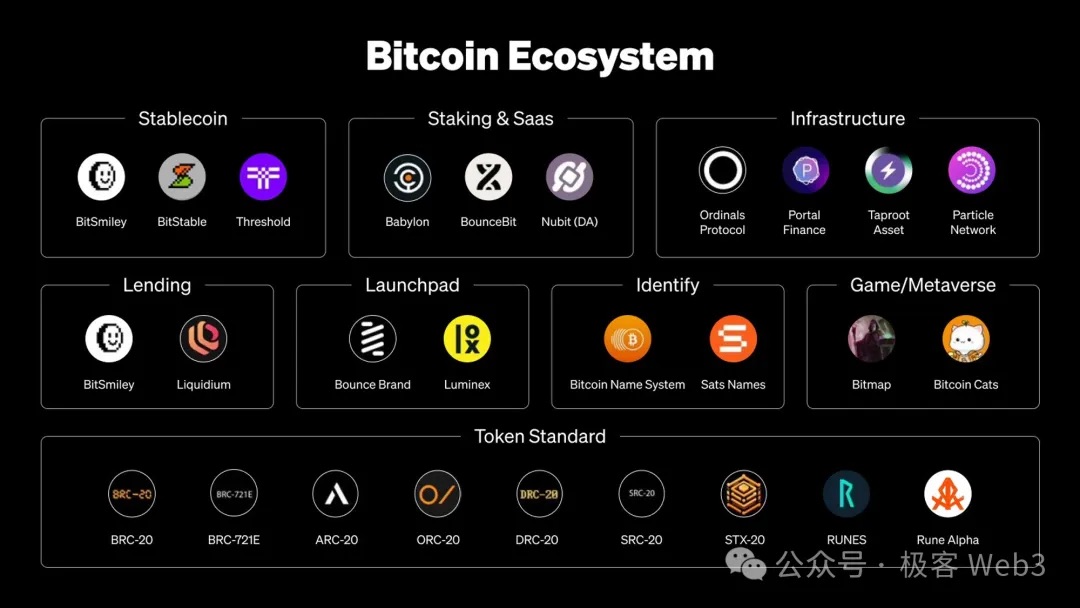
Source: https://twitter.com/okxweb3/status/1765967704282816873
Text: The birth of the Atomics protocol is quite dramatic. When the Ordinals protocol was first released, founder Arthur wanted to develop a DID project on top of it. However, during the development process, he found that the Ordinals protocol had many limitations, which was not conducive to supporting his ideas. Some features implemented.
So, on May 29, 2023, Arthur posted the first tweet about the idea of the Atomics protocol on Twitter. After several months of development, the Atomics protocol was launched on September 17, 2023.
Later, the Atomics protocol derived four major concepts such as Dmint, Bitwork, ARC-20, and RNS, and AVM and split solutions will be launched in the future. In the following, we will explain the principles of these typical product innovations to help everyone understand the innovation of Atomics more quickly.
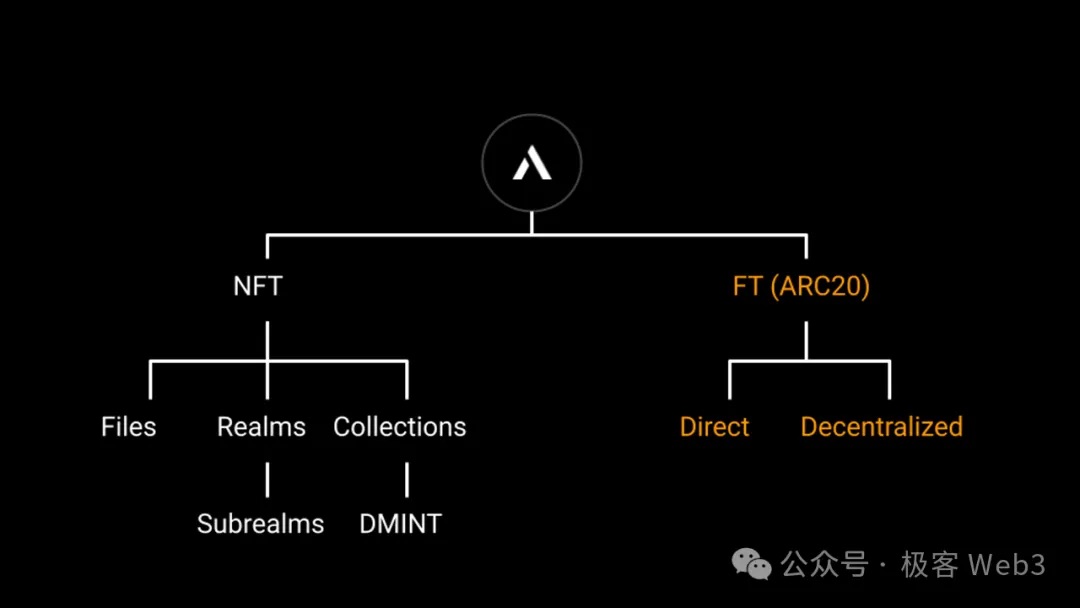
Image source: https://twitter.com/atomicalsxyz/status/1761738325176553535
Bitwork: Non-exclusive PoW
The Atomics protocol adds PoW to the token minting process. This link is called Bitwork. The principle is similar to Bitcoin mining. It is set up for current limit and anti-witch.
Let’s first look at the principle of Bitcoin mining: Miners continuously provide different input values to a given algorithm locally, trying to make the output value comply with the requirements of the Bitcoin protocol. A miner may get lucky and get a result that meets the conditions. At this time, the corresponding output value and input value are written into the block as a "voting certificate" and used as a bargaining chip to obtain mining rewards. Next, as long as the new block is recognized by the vast majority of nodes in the network, miners can obtain BTC rewards.
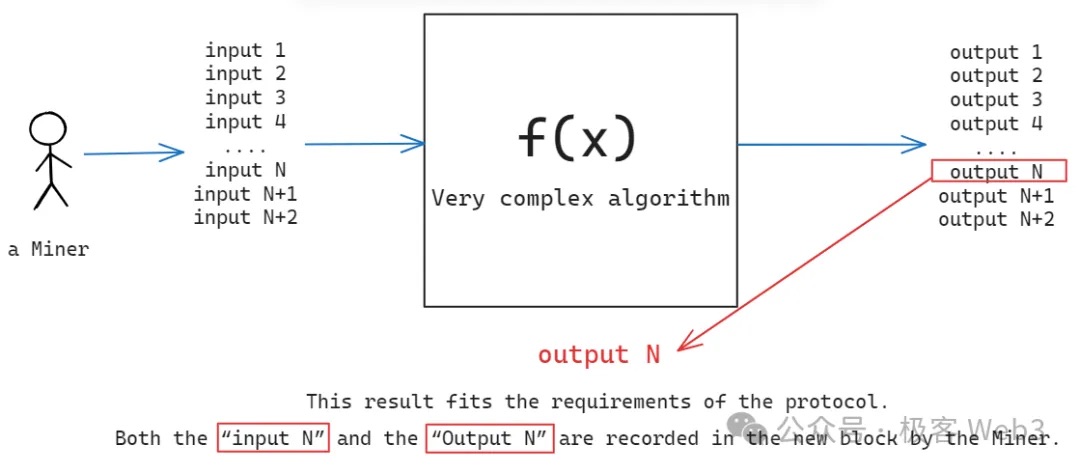
(Simple schematic diagram of Bitcoin mining)
In the Atomics protocol solution, you need to perform a similar process and obtain input and output parameters that meet the restrictions before you are eligible to mint tokens. Also similar to Bitcoin, Atomics can also dynamically adjust the mining difficulty. For example, the protocol can stipulate in advance:
Miners who want to get rewards need to find a set of parameters. After the parameters are input to a given algorithm, the output value meets the following conditions: the first 4 digits are all 6, and the 5th digit is greater than 10 (hexadecimal). At this time, The restrictions are relatively loose. However, the Atomics protocol can periodically change the restrictions, such as requiring that the first five digits of the output value are all 6, which tightens the restrictions and increases the difficulty of mining for miners.
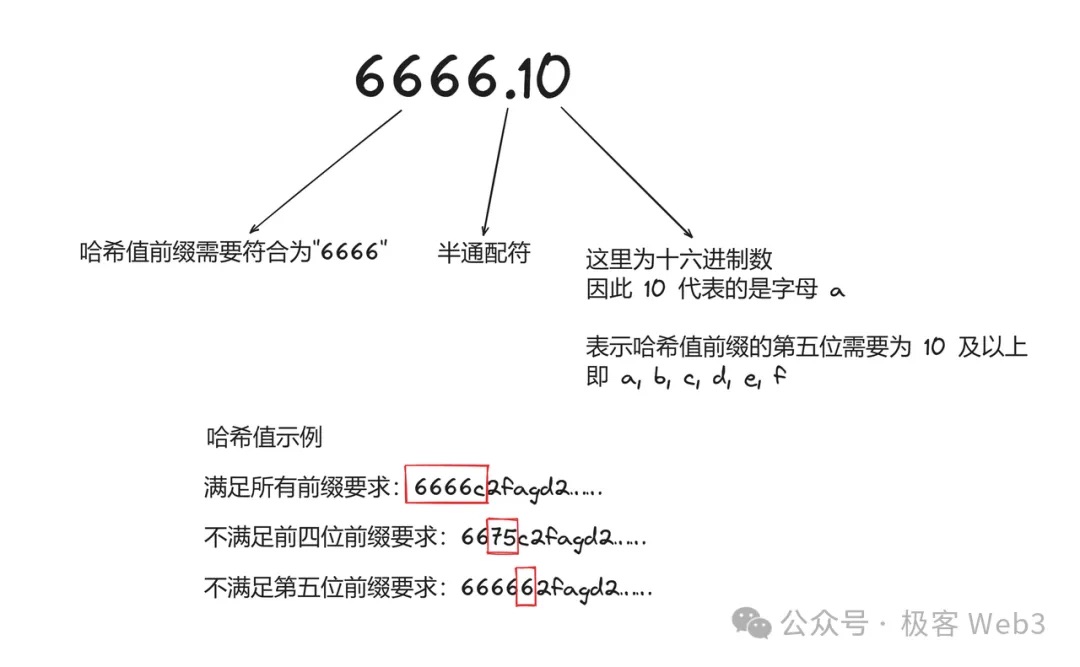
(Bitwork condition example diagram)
There is a fundamental difference between Bitwork and Bitcoin mining: Bitcoin mining is exclusive, Bitwork mining is non-exclusive. For example, suppose that after blocks No. 99 and No. 100 appear in the Bitcoin network, different mining pools compete for the accounting rights of the 101st block. In the end, only block No. 101 given by one mining pool will be used. The Bitcoin network recognizes that blocks submitted by other mining pools will be "invalidated". This is the exclusivity of Bitcoin mining.
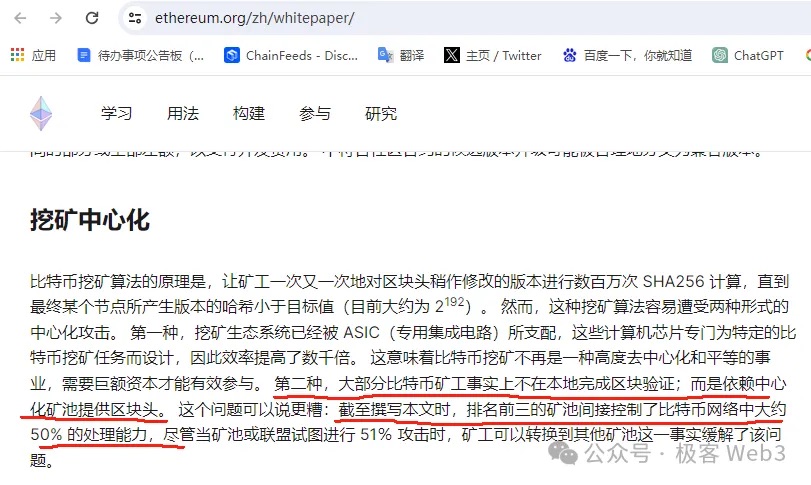
Obviously, cruel exclusive competition is not conducive to the survival of individual miners. Many small miners will eventually contribute their mining machines to large mining pools, and the latter will compete with other mining pools as a "whole" that gathers a large amount of computing power. There is no doubt that this will make the computing power within the Bitcoin network highly centralized, which is even clearly mentioned in the Ethereum white paper.
Completely different from Bitcoin mining, ARC-20 mining under the Bitwork protocol is non-exclusive, that is to say, there is no strict competitive relationship between different miners, as long as the current amount of Atomics assets minted does not exceed the specified total amount , the mining results (token minting statements) given by miners through the Bitwork mechanism will eventually be included in the history of the protocol.
Let us imagine the following scenario: Suppose there is an ARC-20 asset that follows the Bitwork protocol and starts to be issued, allowing users to mint in the form of mining. Some people give relatively low gas, but there are many people participating in asset minting, and the gas fee immediately skyrockets. , the casting request that previously gave low gas will always be stuck and cannot be uploaded to the chain. But as long as this ARC-20 asset has not been mined, then after the gas fee drops, the mint request will still be recognized and the minting behavior will be triggered.
To explain it in one sentence: Bitwork only looks at the remaining minting amount of the asset, not the order of minting requests. Under the Bitcoin mining protocol, miners who submit blocks late will most likely be eliminated by other miners.
There is no doubt that Atomics has lowered the participation threshold for miners/asset miners. The traditional PoW public chain is subject to huge mining difficulty. The right to produce blocks is basically monopolized by several major mining pools. Individual miners have only a very low probability of success. Mining, and Bitwork's improvement measures have greatly weakened the status of centralized mining pools, making it more conducive to the participation of individual miners and making asset distribution more fair.
Considering that PoW itself is a fairer asset distribution solution than PoS and ID0, the Atomics protocol further increases the fairness of asset distribution, with both the value injection of physical resources and the existence of random luck components (mining is collision). The process of great luck). This further promotes the development of the “Fair Launch” concept.
ARC-20: More like a colored coin than an inscription
In fact, many people have misunderstood the ARC-20 concept included in the Atomics protocol, thinking that it is also an inscription protocol. But in fact, ARC-20 is closer to a colored currency. It uses sat, the smallest division unit of Bitcoin, as the basic "atom." The number of Sats corresponding to each Bitcoin UTXO represents the amount of ARC-20 assets bound to it. 1 sat=1 Token.
Here we take an ARC-20 called "TEST" as an example to explain its operating principle.
First, the token issuer of TEST must determine which block of Bitcoin will be used as the "Genesis Block" of TEST, and record the initialization information in a certain Bitcoin UTXO transaction script in the Genesis Block. This initialization information includes Token symbol, total supply, etc. This process is actually equivalent to dyeing. The Sats in the existing Bitcoin UTXO is dyed into a form bound to ARC-20. How many sats balance does this Bitcoin UTXO have? Equivalent to how many ARC-20 assets there are.
The above-mentioned TEST token issuer can use the function of the Taproot locking script to set some restrictions. Only those who meet the restrictions can transfer part of the Bitcoin Sats controlled by the above-mentioned locking script. As we mentioned earlier, these Sats are dyed. If you take part of the Sats locked by the issuer, it is equivalent to acquiring the same amount of TEST tokens.
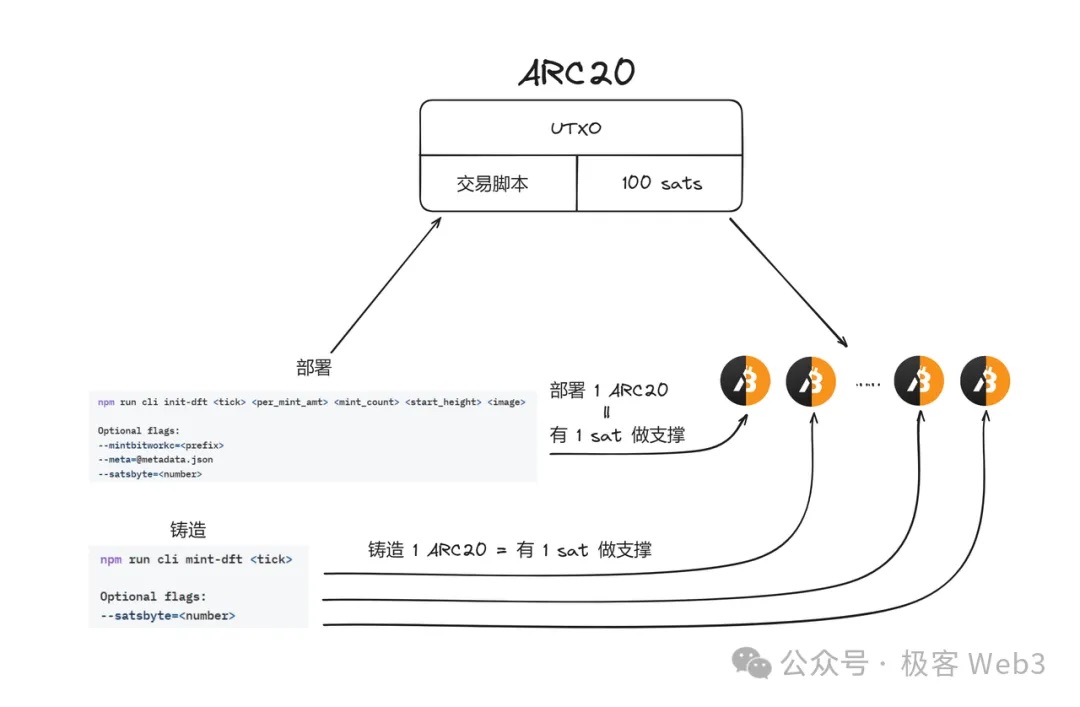
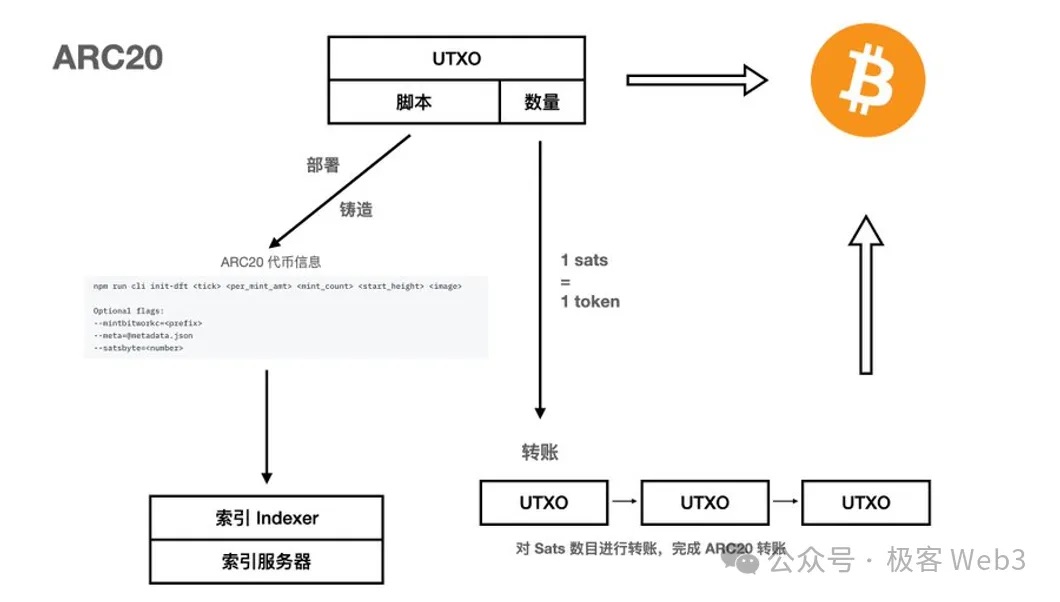
After the above-mentioned asset minters successfully obtain TEST tokens, they can directly transfer these ARC-20 tokens to others. This process is almost the same as the normal transfer on the Bitcoin chain, that is, the Bitcoin UTXO on the handle is divided, where If one or more copies are transferred to others, these divided Bitcoin UTXOs will correspond to the number of ARC-20 tokens corresponding to the Sats balance.
Based on this feature, the transfer of ARC-20 tokens does not need to be inscribed with the inscription information related to the Transfer command like BRC-20, which saves transfer costs and reduces the size of additional data generated on the BTC network.
To sum up, ARC-20 assets mainly have three operations: deployment, casting, and transfer:
When deploying ARC-20, the asset issuer needs to set the token name, total amount, difficulty setting, Genesis Block and other information, and configure the corresponding Taproot lock script.
When users mint ARC-20, they write the Claim information (the data that needs to be submitted to mint the token) into the aforementioned UTXO locking script, and then take out the corresponding ARC-20 assets (dyed sats).
When transferring ARC-20 later, users do not need to deposit any data to BTC. They only need to transfer the aforementioned UXTO to others. The recipient can confirm that it is associated with the ARC-20 asset by tracing the source of the Bitcoin UTXO.
Similar to the "one-time seal" featured by the RGB protocol, the security of ARC-20 transactions is completely guaranteed by the BTC mainnet. No one needs to follow the chain when tracking historical transaction records and calculating the current ARC-20 asset balance. To read data from the off-chain storage module, you only need to check those Bitcoin UTXOs related to ARC-20 dyeing. This is the biggest difference between it and the BRC-20 protocol. The latter often requires off-chain indexers and off-chain storage layers. There is a strong dependence.
Source: https://twitter.com/blockpunk2077/status/1725513817982136617
For ARC-20, we only need a lightweight indexer (or wallet client) to help us identify which ARC-20 assets are minted and transferred on the Bitcoin chain.
Of course, the one-coin-one-Sat design has flaws that cannot be ignored, because the Bitcoin mainnet has restrictions to prevent "dust attacks". A single transfer must transfer at least 546 Sats to the recipient at one time, that is to say , every time you transfer the dyed Bitcoin Sats, you have to transfer at least 546, which may be unacceptable to most people. In addition, since each ARC-20 token is bound to a Sats, the minimum split precision of the ARC-20 asset balance is 1 and cannot be subdivided to a smaller point.
At the same time, we have noticed that many people are still confused about the difference between the ARC-20 indexer and the BRC-20 indexer. Here is a brief explanation:
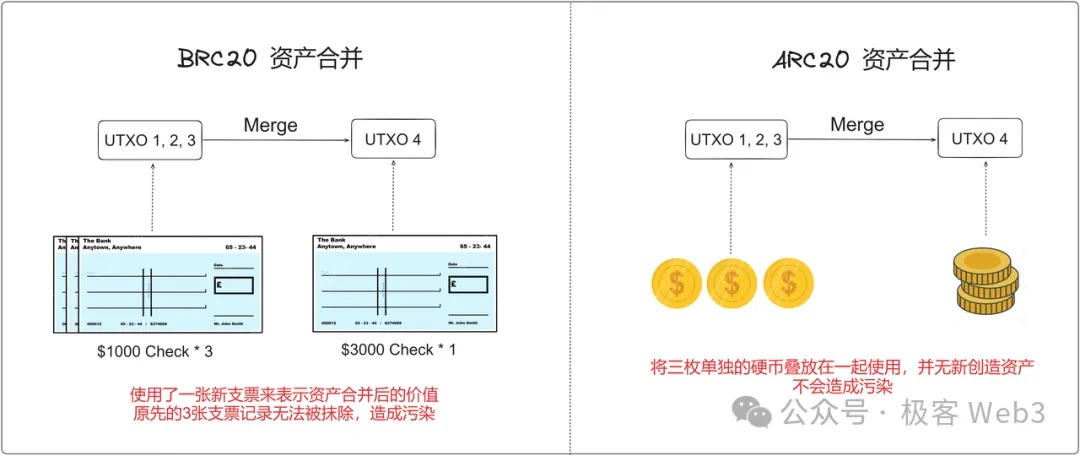
The ARC-20 indexer is simpler and lighter than the BRC-20 indexer. We can think of BRC-20 as a paper check and ARC-20 as a hard coin. The BRC-20 standard allows users to fill in any number of BRC-20 assets in this check, which is why the BRC-20 protocol uses 3 different index transactions to ensure the accuracy and security of BRC-20 assets; No matter how ARC-20 is traded, it is like directly transferring ready-made coins. When we calculate the balance of ARC-20 assets, it will be much easier than calculating the balance of BRC-20 assets. The ARC-20 indexer The workload will be much less than that of the BRC-20 indexer.
The ARC-20 transaction index is more convenient for asset consolidation than the BRC-20 transaction index. We can simply understand it as: BRC-20's asset merger is to replace three checks with a value of $1,000 with a new check with a value of $3,000. However, the original three checks should theoretically be destroyed, but because they have been It is recorded on the chain and cannot be erased directly, thus causing data pollution; many times when withdrawing coins from the exchange, you will encounter some inexplicable inscriptions.
The asset merger of ARC-20 is to package 3 coins and send them out in one transaction. Many times when withdrawing coins from the exchange, you will encounter some inexplicable inscriptions, but the ARC-20 transaction index will not pollute the sats data. , because his work process is different.
Dmint: A new way to issue NFT
In the Atomics protocol, NFT collections are called "Containers" and are issued using a decentralized method called "Dmint". The specific process of NFT issuance following the Dmint protocol is divided into four steps: NFT data preparation, container configuration, verification of NFT projects, and casting of NFT.
For NFT project parties, the focus can be on the preparation work before NFT issuance, which requires collecting all NFT data, configuring Dmint data, etc. At the same time, NFT issuers that follow the Dmint protocol will aggregate all NFT data into a Merkle Tree. The Merkle root of this tree will be published on the chain, and the complete NFT metadata will be stored off-chain.
When the NFT minter selects the NFT to be minted, it will learn its off-chain metadata. Then the minter will present Merkle Proof to the outside world to prove that the NFT data it has learned is indeed associated with the Merkle Tree originally built by the issuer, that is, It is said to exist in the NFT data set declared by the NFT issuer.
In the process of minting NFT, the Atomics protocol provides the project's founding team with advanced options, such as setting mint payment rules and allowing NFT minters to mint some limited edition NFTs. This not only requires minting through the aforementioned Bitwork method, but also requires Pay some tokens to the specified address to take effect.
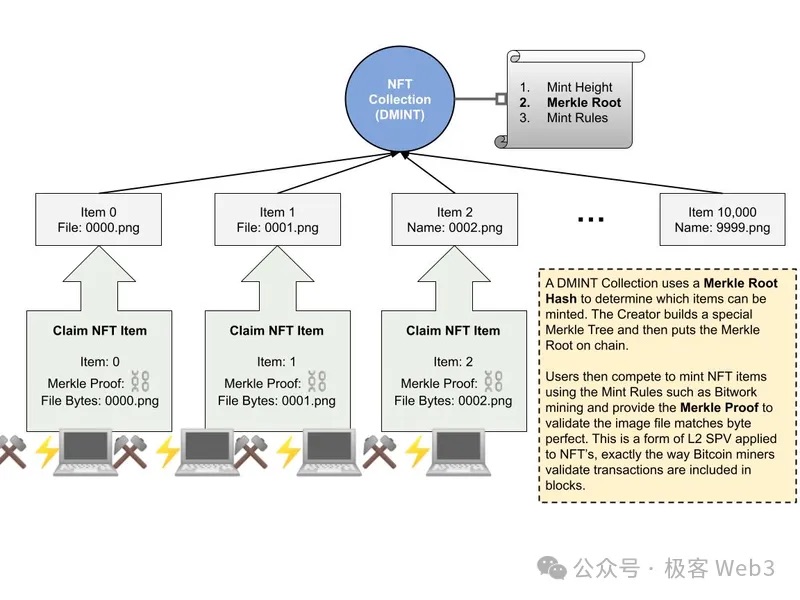
Source: https://docs.atomicals.xyz/collection-containers/dmint-guide
It can be said that after combining Bitwork, Dmint has introduced a decentralized casting mechanism for NFTs on the Bitcoin chain. At this time, all minters need to continue to participate in the NFT casting process in the form of lottery tickets through "mining" , it is difficult for script scientists to rely on automated code to initiate flood transactions.
With the combination of Bitwork and Dmint protocols, both fungible and non-fungible tokens in the Bitcoin ecosystem have the ground for Fair Launch.
Through Dmint, the Atomics protocol strengthens the security and uniqueness of NFTs, provides flexible management options, and projects can freely control their NFT collections on the Bitcoin blockchain. This not only opens up customized options for creators to meet diverse creative needs, but also provides convenient on-chain operation solutions for the casting, transfer and update of digital assets, greatly enhancing the flexibility of static and dynamic digital assets. .
In addition, the Bitwork mining mechanism introduced by Dmint provides everyone with an equal one-time casting opportunity, fundamentally eliminating the possibility of script-automated casting and market competition related to gas fees.
RNS: unlimited expansion of domain names
As mentioned before in this article, Arthur initially wanted to do a DID project on the Ordinals ecosystem. This project is RNS - Realm Name System, also known as Realm.
Realm names begin with the plus sign + and have at least one alphabetic character, such as +alice and +agent007, which are both valid DID identifiers. Compared with traditional domain names and ENS, Realm has higher scalability and flexibility while retaining decentralization.
Today's domain name services or DID projects have great limitations. Most of the domain names provided are used to refer to a single object (i.e. website/wallet address, etc.), and users cannot expand them deeper. For example, Alice owns the Alice.com domain name. The role of this domain name is limited to adding different prefixes such as blog.Alice.com to represent links to different websites or personal information. The domain name cannot be continuously extended downwards, such as Alice.com. .blog.text is a domain name form with more scenarios.
Here we will make a more in-depth comparison of two different domain names, Alice.com/blog/text and Alice.com.blog.text. For example, Alice.com/blog/text1 and Alice.com/blog/text2 refer to opening the first/second page of the blog diary in Alice's room;
Alice.com.blog.text1 and Alice.com.blog.text2 can correspond to two understanding methods:
1. Open two different blog notes in two different rooms
2. Open two different pages of the blog diary in Alice's room.
We can find that the traditional "/" mode limits the operating space very narrowly from the beginning, while the sub-domain mode used by Realm domain names does not have such restrictions.
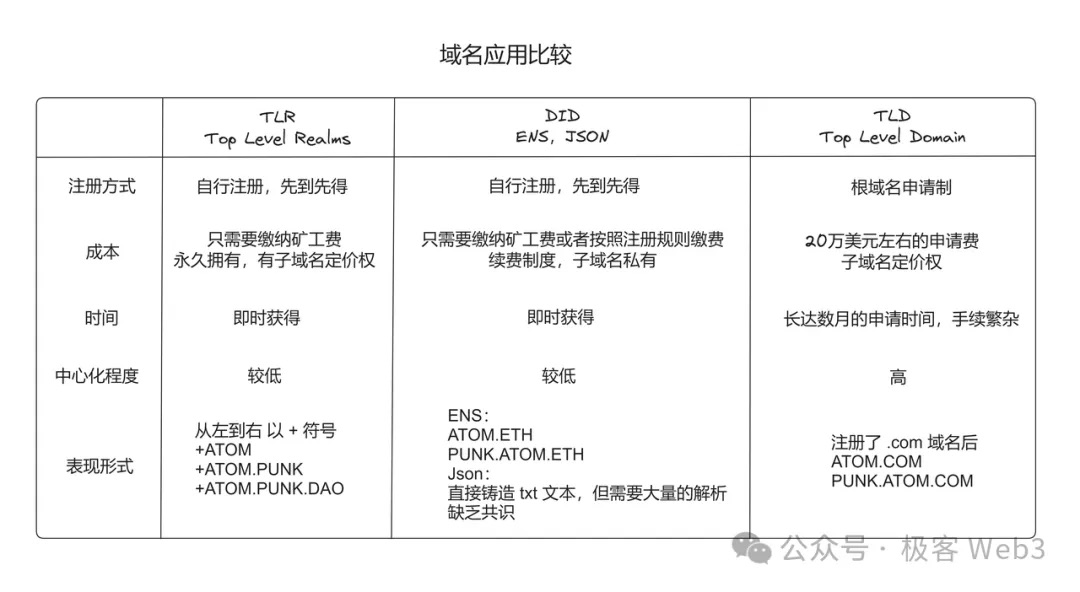
The Realm domain name protocol allows any user to issue subdomains (SubRealm) under any Realm domain name, manage the domain name ecology in a hierarchical/graded manner, and tokenize it. The specific rules are as follows:
Any Realm or SubRealm can publish SubRealm
All SubRealms can inherit the same characteristics and publish their SubRealms based on SubRealm
Everyone is the registrant of the Realm they own, and there is no centralized domain name management agency.
Theoretically, there is no limit to the number of extensions of SubRealm, which makes the imagination space of the Realm domain name system extremely huge. For example, we can treat the top-level Realm domain name as a Tieba community. The first-level SubRealm can be various types of posts, and the subsequent second-level SubRealm is the reply under the corresponding post... In this way, the Realm domain name system may bring A revolution in domain name applications that will empower domain name applications and bring higher scalability.
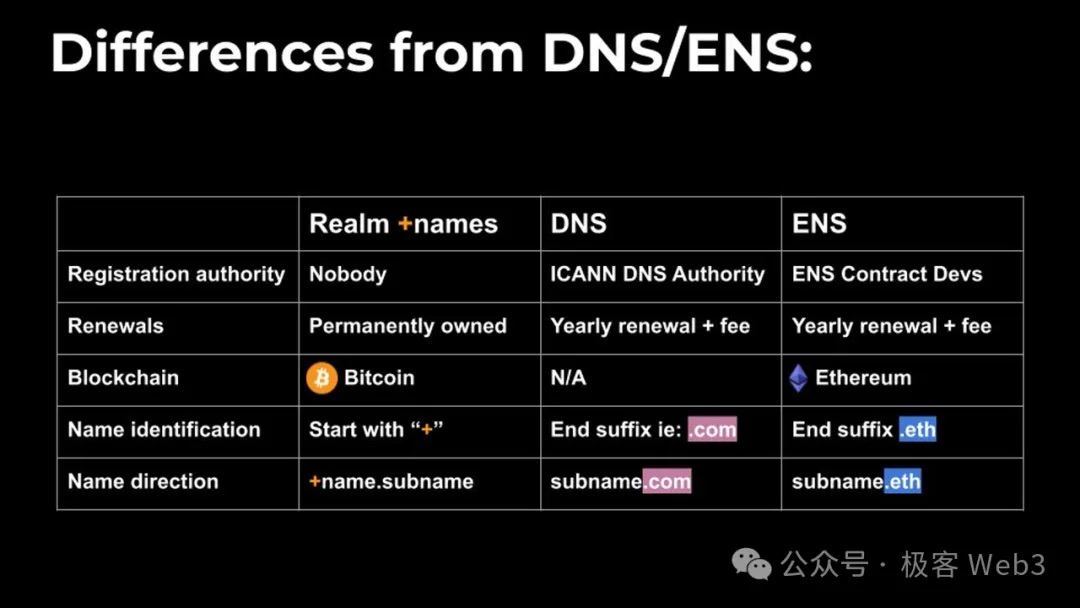
Source: https://twitter.com/atomicalsxyz/status/1761744365448274371
AVM: a potential dark horse
Since its inception, the Atomics protocol has had ambitions beyond asset issuance. After about half a year of development, more and more assets are compliant with the Atomics protocol, which has led to a new question - how to provide richer usage scenarios for assets to enhance their liquidity and do more in terms of functionality. expand.
As we all know, Bitcoin does not support Turing-complete programming languages, making it difficult to build complex DAPPs on top of it. Inspired by the ideas of BitVM and concerns about the development of the Atomicals protocol, Arthur proposed the idea of AVM. Although the specific details of AVM have not yet been announced, the market has high expectations for it.
According to Arthur, AVM is mainly to support the implementation of complex logic in the Bitcoin network, such as solving the problem that ARC-20's "one coin, one satoshi" cannot be split. In addition, there are basically various problems with the current Bitcoin expansion plans on the market. We hope that the release of AVM can bring more vitality to the BTC ecosystem.
According to Arthur, under optimistic circumstances, the first beta version of AVM can be released before the Bitcoin halving, and we will interpret it in further detail at that time.
Atomics Protocol Ecological Summary: Opportunities are about to emerge
Whether it is inscription protocols such as BRC-20 or the Atomics ecosystem, they have all fallen into a cooling-off period after experiencing several waves of climax. But we found that the asset issuance on BTC is very different from the previous asset issuance on Ethereum. The two ecosystems are more about the difference between decentralization and centralization.
The existing assets on BTC have made the concept of "Fair Launch" popular. The Atomics protocol increases market users' trust in project assets through Bitwork, Dmint, no pre-mining, and no distribution, and reduces the project party's reliance on assets. Direct manipulation. To a certain extent, this is actually the love-hate relationship between centralization and decentralization.
Centralized project parties are more efficient and responsive in the early stage of development, and can easily succeed if manipulated properly; while decentralized projects pursue higher fairness and decentralization, and require more efforts in project promotion, marketing, etc. The spontaneous actions of the community may cause great resistance to early development, but once the difficult period is overcome, centralized projects will soon be left behind.
The same is true for the Atomics ecology. The picture below shows the Atomics ecology projects that are currently online and under development. Even though the entire BTC asset market is relatively deserted now, the development of the Atomics protocol is still in its early stages, and many projects still choose to actively connect to the Atomics ecosystem. This stems from the strong confidence of community members in the Atomics ecosystem.
The source of these strong confidences comes from the "Fair Launch" craze caused by the Ordinals protocol and the BRC-20 protocol on the one hand, and the beautiful vision brought about by this overgrown decentralized experiment on the other hand.
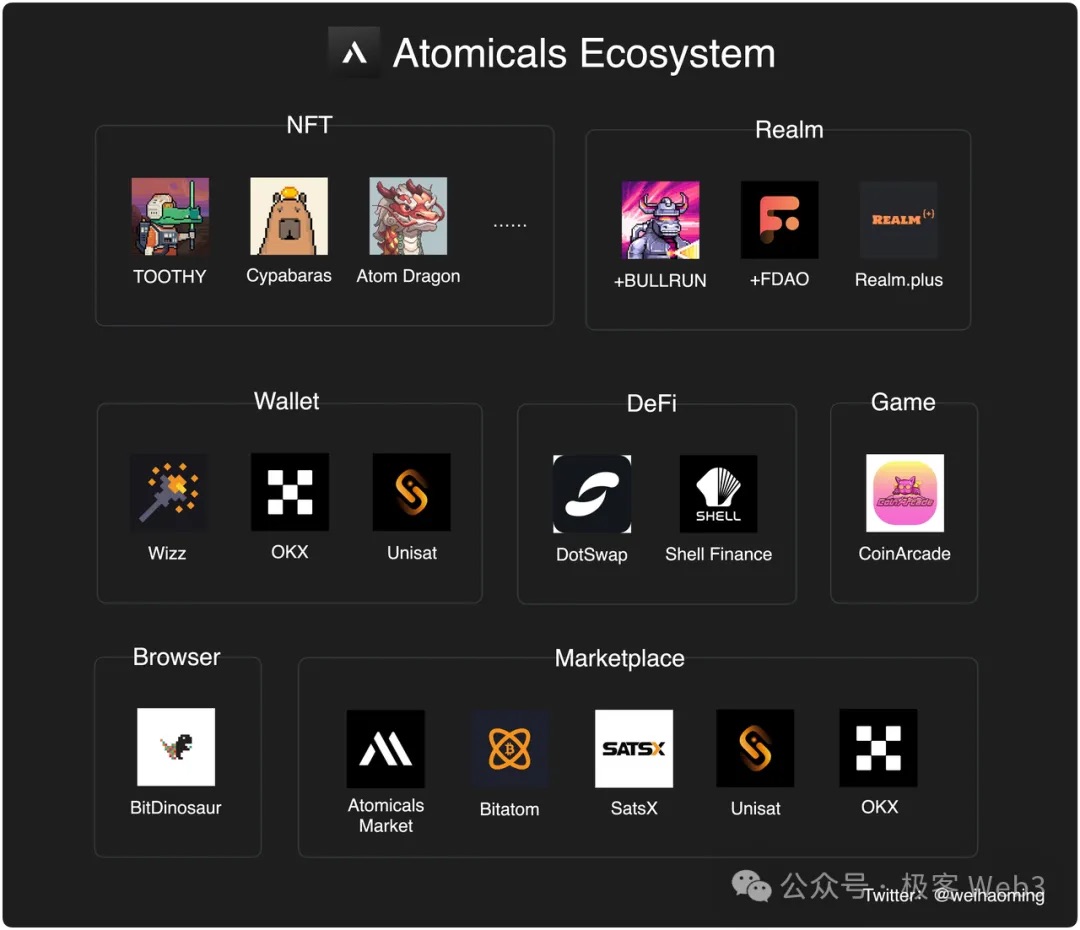
We believe that with the subsequent release of AVM, the Atomics protocol can achieve programmability on Bitcoin Layer1, develop more AVM-based applications, and write a new chapter for the entire Bitcoin ecosystem.