Author: Dilip Kumar Patairya, CoinTelegraph; Translated by: Baishui, Jinse Finance
1. What is liquidity staking?
Liquid staking allows stakers to maintain liquidity of their staked tokens by using alternative tokens, which they can use to earn additional yield through DeFi protocols.
Before we dive into the details of liquid staking, let’s first understand staking and the issues associated with it. Staking refers to the process of locking cryptocurrencies in a blockchain network to sustain it, which enables stakers to earn profits. However, staked assets usually become illiquid during the staking period as they cannot be traded or transferred.
Liquid staking enables cryptocurrency holders to participate in staking without giving up control of their holdings. This changes the way users do staking. Projects such as Lido have introduced liquid staking, providing tokenization of staked assets in the form of tokens and derivatives.
It allows users to gain the advantages of staking while retaining the flexibility to trade these tokens in decentralized finance (DeFi) applications or transfer them to other users.
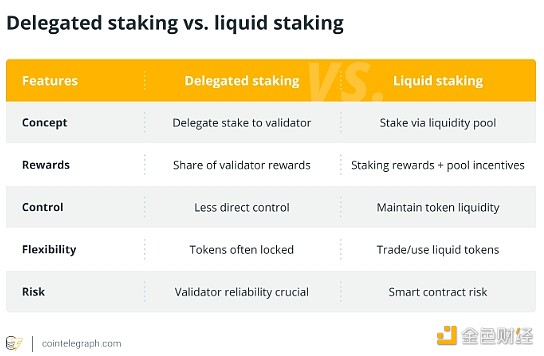
2. Is there any difference between delegated staking and liquidity staking?
Network users in Delegated Proof of Stake (DPoS) vote for their preferred delegators. However, the purpose of liquid staking is to allow stakers to circumvent the minimum staking threshold and the mechanism of locking up tokens.
Although DPoS borrows the basic concept of Proof of Stake, its execution is different. In DPoS, network users have the right to elect representatives called "witnesses" or "block producers" to perform block validation. The number of representatives participating in the consensus process is limited and can be adjusted through voting. Network users in DPoS can pool their tokens into a staking pool and use their combined voting power to vote for preferred representatives.
Liquidity staking, on the other hand, aims to lower the investment barrier and provide a way for stakers to circumvent the mechanism of locking tokens. Blockchains usually have minimum requirements for staking. For example, Ethereum requires anyone who wants to set up a validator node to stake at least 32 Ethereum (ETH). It also requires specific computer hardware, software, time, and expertise, which in turn requires a large investment.
3. What is Staking as a Service?
Staking as a Service is a platform that acts as an intermediary, connecting the consensus mechanism of a blockchain with cryptocurrency holders who wish to contribute to the functioning of the network.
Staking as a Service is a platform or service that enables users to entrust their crypto assets to a third party, who then participates in staking on behalf of the user, usually for a fee or a share of the rewards. JPMorgan Chase noted that by 2025, the staking services industry will grow to $40 billion. Cryptocurrency staking services will play an important role in this emerging economy, and liquid staking will become an integral part of it.
Staking-as-a-Service platforms can be categorized as custodial and non-custodial based on the degree of decentralization, which plays an important role in maintaining the best interests of stakeholders and maintaining transparency. To facilitate decentralized governance, key decisions are made by a Decentralized Autonomous Organization (DAO).
Custodial Staking as a Service involves extensive management of the staking process. The staking services provided by cryptocurrency exchanges are custodial. Rewards first flow to staking providers and then are distributed to stakers.
In a non-custodial staking-as-a-service model, validators charge a commission to anyone who wants to participate in staking. In PoS networks that support native delegation, stakers’ share of rewards is sent directly to them without validator participation.
IV. How does liquidity staking work?
Liquidity staking aims to eliminate the staking threshold and enable holders to profit from liquidity tokens.
Staking pools allow users to combine several small stakes into one large stake using a smart contract, which provides each staker with corresponding liquid tokens (representing their share in the staking pool).
This mechanism removes the barrier to becoming a staker. Liquid staking goes a step further and enables stakers to earn double returns. On the one hand, they profit from the staked tokens, and on the other hand, they earn profits using the liquidity tokens by conducting financial activities such as trading, lending, or any other activities without affecting their original staked positions.
Using Lido as a case study will help us better understand how liquid staking works. Lido is a liquid staking solution for PoS currencies that supports multiple PoS blockchains, including Ethereum, Solana, Kusama, Polkadot, and Polygon. Lido provides an innovative solution to the obstacles presented by traditional PoS staking by effectively reducing the barriers to entry and the costs associated with locking assets in a single protocol.
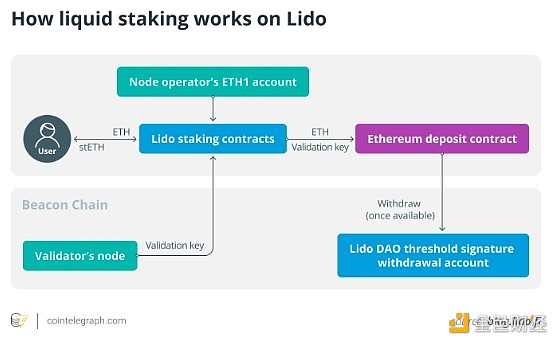
Lido is a smart contract based staking pool. Users who deposit assets into the platform will stake them on the Lido blockchain through the protocol. Lido allows ETH holders to earn block rewards by staking a fraction of the minimum threshold (32 ETH). After depositing funds into Lido's staking pool smart contract, users receive Lido Staked ETH (stETH), an ERC-20 compatible token that is minted upon deposit and destroyed upon withdrawal.
The protocol distributes staked ETH to validators (node operators) within the Lido network, who subsequently deposit it into the Ethereum Beacon Chain for verification. The funds are then protected by a smart contract that is inaccessible to the validators. ETH deposited through the Lido staking protocol is divided into pools of 32 ETH among active node operators on the network.
These operators utilize public verification keys to verify transactions involving user staked assets. This mechanism allows users’ staked assets to be distributed across multiple validators, thereby reducing the risks associated with single points of failure and single validator stakes.
Stakers who deposit Solana (SOL) tokens, Polygon (MATIC), Polkadot (DOT), and Kusama KSM in Lido through a set of smart contracts will receive stSOL, stMATIC, stDOT, and stKSM, respectively. stTokens can be used to earn DeFi yields, provide liquidity, trade on decentralized exchanges (DEX), and many other use cases.
5. Are there any risks in the liquidity staking platform?
As with any product or service in the cryptocurrency space, there are technological threats and market volatility that need to be considered when dealing with liquidity staking.
Technical threats
PoS blockchains are still relatively new, and there is always the possibility that protocol errors or vulnerabilities could lead to assets being lost or exploited. Relying on validators for staking also introduces counterparty risk.
Market Risk
Liquidity staking unlocks staked assets, enabling stakers to earn rewards from DeFi applications. However, this also brings the risk of losing both sides during market downturns.
Keeping the liquidity staking platform open source and auditing it regularly can help prevent threats to some extent. Having a bounty program for the platform can also help minimize bugs.
Conducting thorough due diligence is essential to managing the risks associated with market volatility. This includes studying historical market data, assessing the financial health of potential investments, understanding the regulatory environment, and developing a diversified investment strategy.