 |
Covalant (CQT), a blockchain API (Application Programming Interface) provider, announced the addition of five new Block Spectrum Producer (BSP) operators to decentralize its network infrastructure. The aim is to promote protocol evolution to foster a community-centric, inclusive, and decentralized ecosystem.
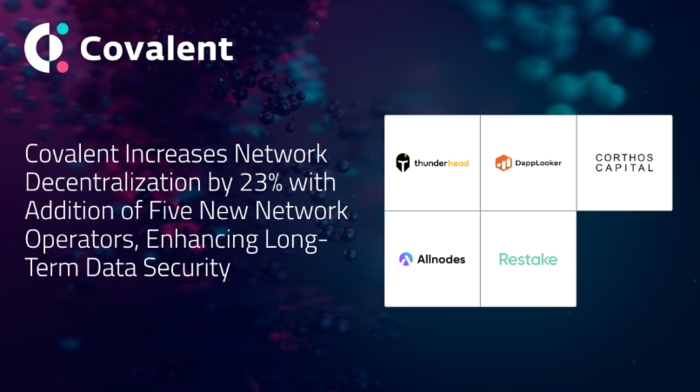
The five new operators joining the Covalant Network are Thunderhead Labs, Restake, DappLooker, Corthos Capital, and Allnodes. With this, the Covalant Network consists of a total of 26 operators, including Block Result Producers (BRPs) and Block Spectrum Producers (BSPs).
Operators of the Covalant network play a pivotal role in maintaining the network's security and functionality. They also contribute to increasing the network's level of decentralization. By integrating these groups, Covalant is striving to effectively leverage their expertise and strengthen the ecosystem.
Virgil Chan, Managing Partner at Cortos Capital, commented, "Covalant has built critical data infrastructure essential for data availability in a multi-chain world."
Covalant plans to add Olympic Light Clients later this year to serve as new light client operators. This will enable lightweight operators to participate in and contribute to the network on hardware similar to mobile devices, without the large capital investment required for BSP nodes. Details regarding this will be released soon.
Furthermore, Covalant has recently garnered attention for migrating to Ethereum staking. As a result, operators and representatives are now able to stake directly on the Ethereum platform. This is expected to streamline the process of earning issued interest.
It can also be defined as an important step supporting the launch of the Ethereum Wayback Machine (EWM), scheduled for the end of this year. The EWM provides efficient and structured historical on-chain data. It also introduces long-term data availability solutions for various use cases.
Meanwhile, Covalant has increased the maximum number of operators from 29 to 40 to facilitate the expansion of its global network and respond to network growth. The aim is to strengthen the future of the network by enhancing security and enabling more effective responses to the evolving requirements of the ecosystem.