avatar
Fiona ❤️& ✌️
38,770 Twitter followers
Follow
NFA——Fiona's daily news: https://t.co/GJr2Qy5lAb Join Bybit with: https://t.co/S0qSBUoHig Join OKX with:https://t.co/i66xzml0MI
Posts
Signal Clone Analysis
avatar
Fiona ❤️& ✌️
$MRVL Conference Call Highlights: 1️⃣ The upward revision of revenue expectations is primarily driven by the data center business, which is projected to grow by approximately 50% this fiscal year. Specifically, the interconnect business is expected to grow by over 70% year-over-year, significantly higher than the previous forecast of 50%. 2️⃣ Interconnect business growth will continue to outpace cloud CapEx, primarily benefiting from strong demand for 1.6T from scale-out networks and greater contributions from scale-up and scale-across networks. 3️⃣ Collaboration with NVIDIA: - Optical Collaboration: Expanding from DSP, TIA, and drivers to silicon photonics technology - NVLink Fusion Integration: Supporting Marvell in developing custom chips that seamlessly interconnect with NVIDIA - AI RAN: Integrating AI with wireless infrastructure 4️⃣ Key Strategies: Increased AI investment Locked-in capacity (approximately $1 billion in upfront payments) Continued share buybacks 5️⃣ Custom business is the next growth driver: 2027 growth >20% 2028 growth >100% Expected revenue >$10 billion in FY2029 The earnings report for $MRVL further confirms the growth in network demand and the certainty of demand for optics. Interconnect + optics is the fastest-growing and most frequently highlighted segment in Data Center. This corroborates yesterday's earnings report for $SMTC. What's unique is the growth of XPUs; currently, they're only a part of the Data Center ecosystem. However, if they accelerate as management expects (>100% year-on-year growth) and reach $10 billion by FY29, they could become the next growth engine. Additional research data: - In the 1.6T optical module market, Marvell holds approximately 60% market share in DSP, TIA, and driver chips. - In the 800G market, Marvell holds approximately 70% market share in DSP, TIA, and driver chips (primarily because Broadcom prioritizes resources in the 1.6T DSP market, leading to a relatively conservative approach in 800G).
TIA
7.93%
avatar
Fiona ❤️& ✌️
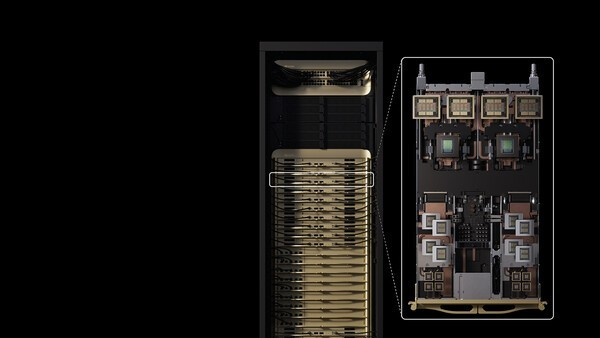
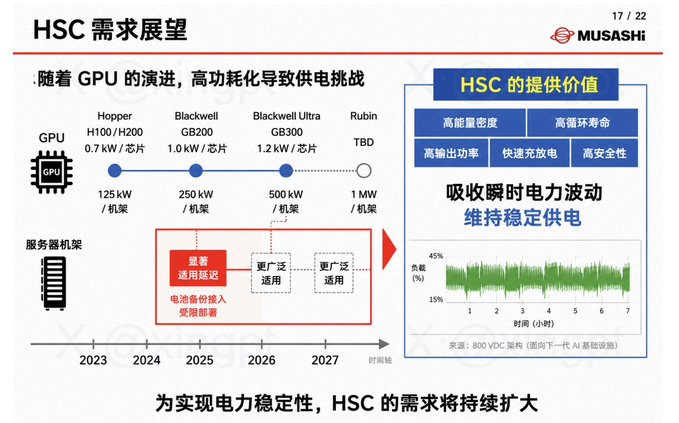
Japan truly has many seemingly unremarkable companies that produce small components that become monopolistic products, capable of holding the global AI industry hostage. Recently, Musashi Seimitsu (7220.T), a precision component manufacturer from Aichi Prefecture, Japan, unexpectedly rode this wave, with its stock price surging over 250% in a year, pushing its market capitalization above 490 billion yen. Founded in 1938, Musashi has been manufacturing automotive parts for nearly 70 years and is Honda's largest supplier of transmission gears. The real turning point came in 2020 when it acquired JM Energy, a small company specializing in hybrid supercapacitors (HSCs), for approximately 3 billion yen. Four years later, this acquisition became Musashi's most valuable asset. HSCs fall between traditional capacitors and lithium batteries, offering millisecond-level charge and discharge capabilities, over 1 million cycles, and inherent safety. When NVIDIA's GB300 racks push single-rack power to 155kW and GPU loads fluctuate wildly, traditional batteries simply cannot keep up; HSCs become the only solution. GB300 standard changes supercapacitors from an "optional" to a "standard" requirement, necessitating over 300 units per rack. Global demand is projected to exceed 15 million units by 2026, while Musashi's capacity is only 6.5 million units, leaving a significant gap. Financially, HSC currently accounts for only about 3% of revenue, but management is aggressively expanding production, building a new Southern Alps plant that will increase capacity 32-fold within three years. Analysts predict a 41% CAGR for EPS over the next three years. Short-term FY2026 profitability will remain under pressure, as traditional automotive parts sales are shrinking and depreciation at the new plant is ramping up. If 800VDC architecture becomes the standard for next-generation data centers, this company could transform from a ¥350 billion annual revenue parts manufacturer into an indispensable part of AI infrastructure.
loading indicator
Loading..