Leveraging Momentum: Finding People, Funding, and Growth
Many project management and operations teams are actually too far removed from the market. They only focus on their own small territory, and when the market turns bad, they start acting erratically. It's not that there aren't opportunities, but rather that many ecosystems and projects don't know how to leverage momentum.
I suggest that ecosystems and projects that haven't yet partnered with WLFI (@worldlibertyfi) on USD1 should talk to WLFI. The core idea is to use the current momentum of WLFI promoting USD1 to simultaneously boost their own business data. User transaction volume, TVL, and activity can all be increased simultaneously.
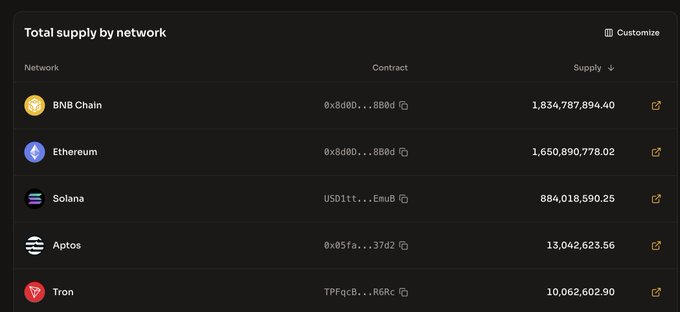
USD1 is already quite large: I looked at DefiLlama, and among stablecoins with a TVL exceeding $4 billion, only USDT, USDC, USDS, USDe, DAI, and USD1 are mentioned. USD1 ranks 6th with a market capitalization of $4.4 billion and has already been deployed on 10 chains.
More importantly, it's still growing. For example, two months ago, the USD1 supply on the Solana chain was only $160 million, but now it has reached $855 million. Lending protocols within the ecosystem, such as Kamino, Bonk, and Ray, have provided support from the outset, and all data points show significant growth. This demonstrates that WLFI is not just a name; it is genuinely pushing resources, liquidity, and subsidies.
Following the collaboration between Aster Chain and WLFI in the first two weeks, 16 spot and perpetual trading pairs were launched immediately upon release. Trading with USD1 has significantly lower fees than USDT; the order book fee for USD1 is only 0.5 bps, while USDT is 4 bps. The user experience is very direct, resulting in a trading volume of $2.7 billion in the first week.
Furthermore, WLFI provides substantial incentives: USD1 perpetual trading earns WLFI based on trading volume, with a maximum of 2.5 million WLFI distributed weekly per month; even holding USD1 on Aster without trading also earns proportional rewards. For active users like myself, I'm willing to go wherever there are rewards, profit potential, and safety.
The most interesting and direct aspect of this type of collaboration is its win-win nature. On the surface, it's helping WLFI promote USD1, but in reality, the project teams are using WLFI's subsidies to drive their own growth. Simply put, they're using other people's money to attract their own users, build their own data, and promote their own business.
My advice is straightforward: ecosystems/project teams that haven't yet partnered with WLFI's USD1 should approach them more often. This isn't just about acquiring a stablecoin; it's about acquiring a ready-made growth tool.
Project teams should really be thinking about how to find people, funding, and growth, and how to create a wealth effect. Instead, when the market is bad, they should only think about how to sell tokens, how to profit, and how to shift the pressure onto users.