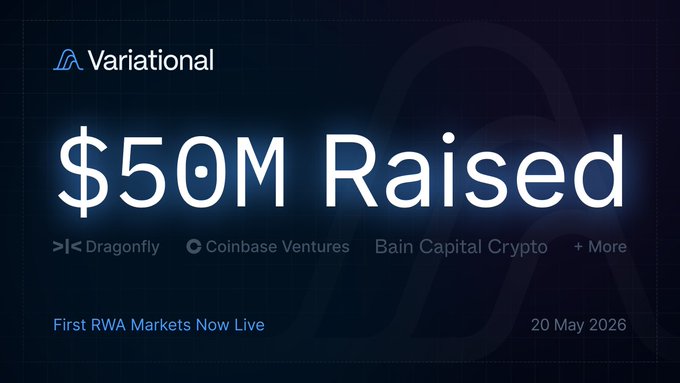
Variational raised $50M to develop an RFQ-based perp DEX for RWAs.
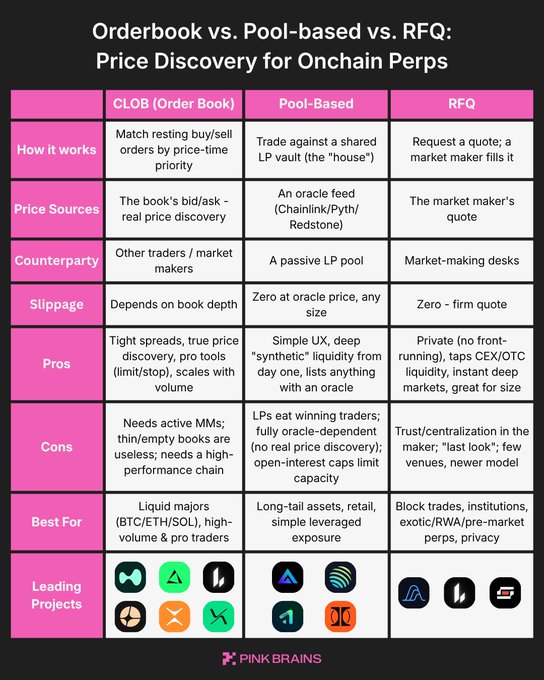
Now some are debating which model works better for onchain perps: CLOBs, pool-based, or RFQ.
Orderbook (CLOB)
You trade against other people's resting bids and asks. The book itself discovers the price. Makers compete on spread.
Tightest pricing and real price discovery on liquid markets, but only when pro market makers show up, and it needs a fast chain to run. A thin book is a dead market.
→ Top projects: @HyperliquidX, @edgeX_exchange, @Lighter_xyz, @Aster_DEX, @PhoenixTrade, @risextrade
Pool-based
You trade against a shared LP vault, aka the house. No book. The price is fed by an oracle, so you get zero slippage at any size, and almost anything with a price feed can be listed. It also carries oracle risks.
The LPs are your counterparty, so your profit is their loss, and a single whale on a run can bleed the pool.
→ Top projects: @GMX_IO, @JupiterExchange Perps, @GainsNetwork_io, @Ostium, @gmtrade_xyz
RFQ
You request a quote, and a market maker (or competing hedgers) responds with a firm price that you either accept or reject. There’s no public order flow to front-run, and makers can source liquidity from CEXs or OTC desks to quote deep or exotic markets from day one.
The tradeoff is that you rely on the maker to quote fairly, and the model is still relatively young.
→ Top projects: @variational_io, @symm_io (AMFQ). @Lighter_xyz has also introduced RFQ for some RWA markets.
From the asset perspective:
- Orderbooks: liquid majors and high-volume assets with strong two-sided flow.
- Pools: assets with reliable oracles but limited natural liquidity, like long-tail alts, memecoins, and tokenized RWAs such as gold, FX, equities, and indices.
- RFQ: exotic or bespoke markets like pre-market tokens, vol indices, illiquid assets, RWAs, and large block trades that makers can hedge elsewhere.
From the user perspective:
Retail traders usually prefer pool-based perps and CEX-like orderbooks: simple UX, high leverage, low minimums, and easy access to long-tail pairs. On pool-based perps, small trades often fill near the oracle price without needing to read market depth.
Institutions prefer orderbooks for liquid majors and RFQ for size. CLOBs provide real depth, limit orders, APIs, and genuine price discovery. RFQ is better for block trades, private fills, and minimizing market impact. Most institutions avoid pool-based systems because OI caps and LP-backed liquidity struggle with large, sharp flows.
RFQ comes with tradeoffs. The maker sees who’s requesting the quote, so pricing can be tailored to the trader profile, and “last look” mechanisms may allow makers to pull quotes.
On CLOBs, flow is more anonymous and permissionless. Your order are matched by whether a market maker or another user. Counterintuitively, smaller traders can sometimes face less adverse selection on a book than through an RFQ quote designed specifically around them.
The same question in 3 models: who absorbs toxic flow?
- CLOBs: priced into the spread
- Pool-based: absorbed by LPs
- RFQ: makers can widen or refuse quotes
None of them truly “wins.” They specialize in different asset types and user profiles.
twitter.com/PinkBrains_io/stat...