This is actually an extended topic. Just as BTC is currently the creator of blockchain technology, various agents' autonomous payments also urgently need a unified currency and payment standard. Who will become this currency and standard?
First, it is important to clarify the relevant characteristics of this currency.
1. It's definitely a cryptocurrency with high consensus. Only a few mainstream cryptocurrencies like BTC/ETH have a chance, since in every bull market, even the top 10 tokens by market capitalization will see more than 50% replacement.
Such unstable tokens clearly cannot serve as proxy currencies.
2. The on-chain independent agent must be final, and there should be no possibility of human intervention. For example, the ETH theft incident, where ETH was rolled back under Vitalik leadership, was highly problematic.
3. No KYC & Permissionless. This is definitely included.
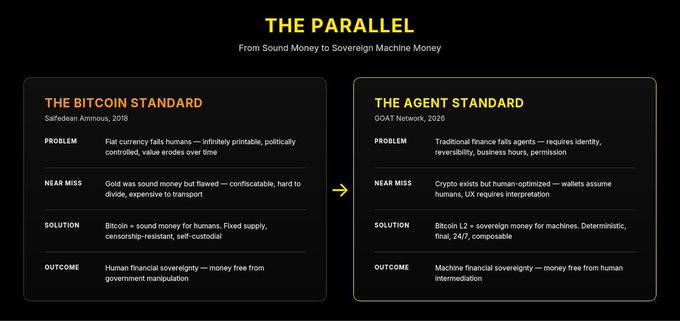
AI must, to some extent, operate independently of humans to achieve equality in the financial world. In conclusion, only Bitcoin (BTC) best aligns with the US dollar in this regard.
Agent World = BTC
Okay, let's move on to the next question: how to allow BTC to flow freely in the Agent world? In the human world, there's Swift...
What can be used in the Agent world?
@GOATNetwork took the lead, designing a specific set of technical components to make BTC and GOAT Network the necessary infrastructure for payments in the Agent world.
1. Giving AI its own digital proof (ERC-8004 identity standard): It's not just a wallet address, but a persistent identifier carrying a functional description, behavioral constraints, and historical reputation. This means the machine begins to possess "reputation," and this reputation cannot be escaped by canceling an account.
2. Integrating with machine payment protocols (x402 payment): x402 enables automatic negotiation and settlement between machines. It extends the HTTP protocol to the micropayment field, allowing machines to complete the closed loop of "payment and data retrieval" in milliseconds.
3. In the GOAT architecture, the machine must prove its innocence through zero-knowledge proofs, demonstrating absolute compliance with the execution process without revealing the core algorithm. (The last sentence appears to be unrelated and possibly a fragment from another context: "In the human world, people have US dollars and Swift.")
In the proxy world, people have BTC and GOAT Network.
twitter.com/one_snowball/statu...