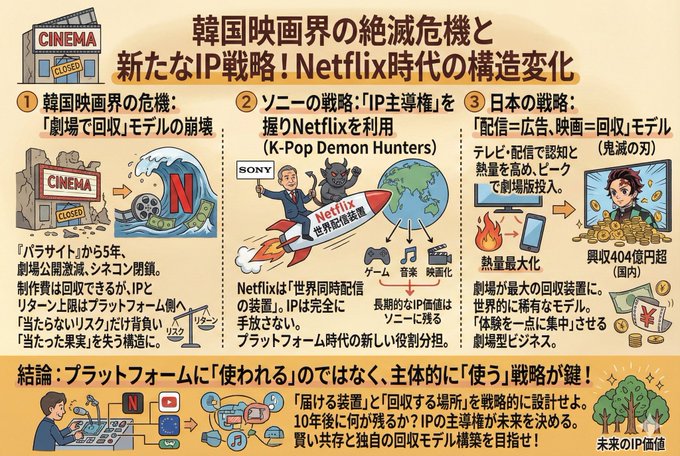
This is a very interesting article! It's been suggested that the Korean film industry is on the brink of extinction. The article argues that this isn't simply a matter of poor harvests or a temporary economic downturn, but rather the result of a shift in the industry's structure itself.
Five Years After the Glory of "Parasite," the Korean Film Industry is on the Brink of Extinction...Netflix's Disruptive Structure > Business Journal
Just a few years after the global success of "Parasite," the number of films released in theaters has plummeted, multiplex cinemas have closed or downsized, and movie theaters are no longer a place to screen movies. With fewer audiences and fewer screening opportunities, the cycle of "making a film and recouping the revenue at theaters" is no longer viable.
The underlying cause is the rise of OTT, centered around Netflix. For production companies, the Netflix model offers a "safe transaction" that ensures recoupment of production costs. Meanwhile, the IP and cap on returns have shifted to the platform, making it difficult to recoup explosive revenue even when a film is a hit. This suggestive observation suggests that the film industry has shifted to a structure where it only bears the risk of failure and loses the rewards of success. One example of this trend is the K-Pop hit Demon Hunters, which became a global hit on Netflix. What's noteworthy, more than the scale of its success, is its rights structure. While the work is a Netflix original, Netflix does not fully own the IP itself. Netflix handles distribution and global expansion, while Sony retains the long-term IP value of the characters, film adaptation, games, and music. While using Netflix as a "device for simultaneous global distribution," Sony retains control of the IP. This division of roles itself has become a new example of success in the platform era.
Meanwhile, Demon Slayer: Kimetsu no Yaiba demonstrated a completely different approach to "novelty." It maximized awareness and enthusiasm through television and streaming, then released a theatrical film at that peak. Moreover, the film wasn't a compilation, but a continuation of the main story. It was designed so that the story wouldn't progress unless viewers watched it.
As a result, it generated box office revenues far exceeding streaming revenues, demonstrating the model of "streaming = advertising, film = revenue" in real terms. In fact, the Demon Slayer: Kimetsu no Yaiba the Movie: Mugen Train grossed approximately 40.4 billion yen domestically and approximately 50 billion yen worldwide, proving that even in a streaming-centric era, theaters can be the largest revenue generators.
What's interesting is that this Demon Slayer model has hardly been replicated globally. Many Netflix dramas are designed to be binge-watched at any time, which decentralizes the experience and energy. This is the exact opposite of the theatrical business, which concentrates the experience in a single point. This is why Demon Slayer is exceptional and extremely new as a business.
K-Pop Demon Hunters demonstrated the novelty of "using Netflix without giving up IP," while Demon Slayer demonstrated the novelty of "turning streaming into the largest promotional device and recovering revenue in theaters." Neither is the traditional film business nor a model that Netflix completely dominates.
The problem isn't that Netflix is too powerful. The film industry will only begin to thin when it becomes impossible to design the "device for delivering to the world" and the "place to recover value" separately.
The success of K-Pop Demon Hunters and Demon Slayer: Kimetsu no Yaiba is a good example of how to confront giant platforms. Will you use the platform or be used by it? This difference will determine what will remain even if the same hit is released 10 years from now.