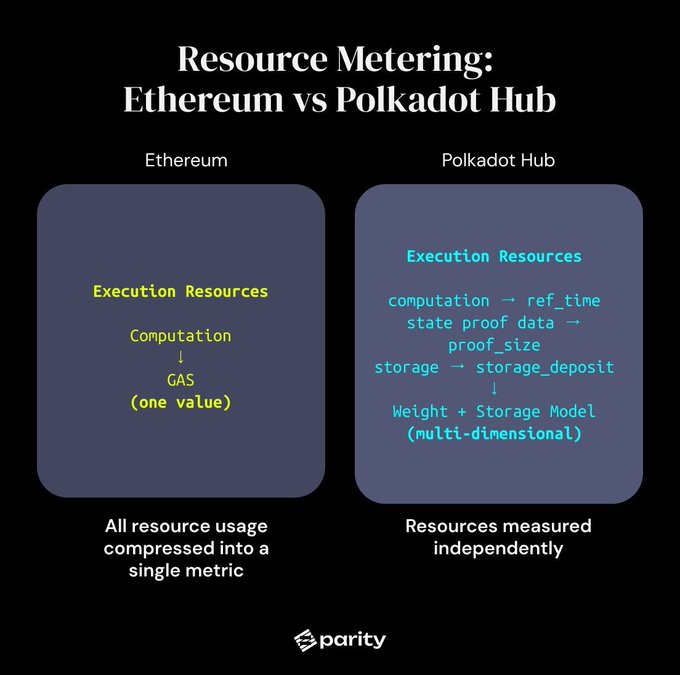
Ethereum measures execution with a single gas value.
Polkadot measures resources differently.
On Polkadot Hub, developers interacting through Ethereum wallets still see familiar gas values. Under the hood, however, the runtime tracks resources across multiple dimensions:
• ref_time → computational time
• proof_size → state data validators must verify
• storage → persistent on-chain state, requiring deposits to reserve space
Because Ethereum tooling expects a single gas value, exposing this model directly would break compatibility. Challenge accepted 🧑💻
Polkadot Hub solves this through gas mapping.
At the RPC layer, Ethereum-style gas is translated into Polkadot’s internal weight and storage deposit model. When a wallet calls eth_estimateGas, the system performs a dry-run of the transaction to measure:
• computation
• state verification
• storage footprint
These resources are then mapped to gas, presenting the user with a familiar value while developers use familiar Ethereum wallets and tooling. Meanwhile, the runtime tracks computation, state verification, and storage usage separately.
Ethereum compatibility on the outside.
Multi-dimensional resource metering underneath.