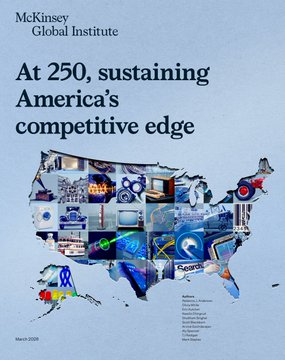
Why invest in the US, and specifically US stocks? This McKinsey report, "Maintaining America's Competitiveness at 250 Years' End," perhaps offers the best explanation!
I spent an entire day reading this report. I first had an AI read it through—it was brilliant!—then I translated the entire PDF myself using translation software. This "US health checkup report" is worth savoring!
The US is about to celebrate its 250th birthday, and many might ask: Is this country declining, about to "hand over the reins"? Faced with increasingly fierce competition from China, can it widen the gap again? Today, we'll set aside nationalistic sentiments and focus solely on the underlying logic analyzed by McKinsey from an objective and rational perspective.
1️⃣ A "Fundament" So Deep It's Almost Despairing
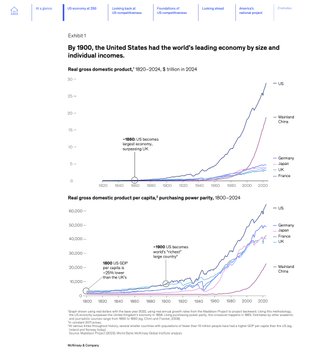
First, the sheer size of the US economy is astounding. With only 4% of the world's population, it generates 26% of the GDP. Moreover, since its total GDP surpassed that of Britain in 1860, and its per capita GDP surpassed Britain's in 1900, it has maintained its leading position for over 100 years.
Secondly, let's talk about manufacturing. We often hear the media say that American manufacturing has declined, and the data does look bad. Manufacturing's share of GDP and employment has fallen from 20% 50 years ago to less than 10% today. However, it would be a huge mistake to conclude that the "hollowing out" of American manufacturing is beyond saving.
First, there's the invisible strength of the world's factory. Although the US's output is only a quarter of China's, it remains the world's second-largest manufacturing powerhouse. It has lost low-end assembly, but its foundational framework remains solid in core areas like semiconductors, robotics, and electrification.
Second, there's the terrifying efficiency of wealth creation. Of the top 100 companies by global market capitalization, 59 are American, 18 are European, 12 are Chinese, and 2 are Japanese. From General Motors and IBM in the past to Nvidia and Tesla today, we see that while the dominant players change, the vast majority are still American. This ability to "metabolize" is the most frightening thing.
Finally, there's the sheer scale of investment. In the current AI boom, American companies are incredibly dynamic, attracting 58% of global venture capital and 18% of foreign investment. Government and private investment in cutting-edge technologies far surpasses that of Europe. For example, in the AI industry, in 2024, private investment in AI in the US reached $1.09 trillion, nearly 12 times that of China. In the core AI models, 51% originated from the US, compared to 34% in China—a truly astonishing return on investment.
The overall labor productivity growth rate is also remarkable. Since 2019, the US growth rate has more than doubled compared to the previous decade. While lower than China's growth rate, it's far ahead of other developed countries. Therefore, among countries with a population exceeding 10 million, the US has the highest GDP per capita, even calculated using PPP. This explains why the US stock market is a global investor's market; smart people from around the world flock to embrace the highest-quality assets. This ability to attract capital is unparalleled by any other country.
2️⃣ Why has the US been strong for 250 years?
McKinsey summarized two points that I think are very accurate. First, the US is blessed with abundant resources, coupled with a spirit of exploration, discovery, and hard work.
Firstly, the US is a land of opportunity. If you compare the G7 countries and China in terms of resources, the US's arable land, oil and gas, coal, water resources, and inland waterway transportation are almost always in the top three. Especially energy and food, which are truly guaranteed regardless of drought or flood.
Secondly, there's an atmosphere of not accepting fate. Many people think "entrepreneurial spirit" is mystical, but it's really just one sentence: "Only by striving can you win, and if you win, the whole society will respect you." One thing the US and China have in common is that people don't believe in fate, and there's no deep-rooted class burden. The story of starting from scratch still has fertile ground today. This kind of atmosphere is something Europe, India, and Japan simply can't match.
3️⃣ The Evolution of Four Eras: AI is the Next Era of Competition
The report reconstructs American history into four stages:
Agricultural Era: Relying on vast land and abundant resources and harvesters.
Industrial Era: Relying on standardized scientific management and industrial laboratories.
The technological age relied on the explosive growth of industry-academia-research collaboration during the Cold War.
The digital age relied on venture capital and the internet ecosystem.
Now, we stand at the threshold of the AI era. McKinsey believes that to win this game, the US must address four critical weaknesses:
Engineer shortage: The US has only one-tenth the number of STEM graduates as China. The Semiconductor Industry Association predicts that nearly 60% of jobs may remain unfilled in the future. High-tech models without engineers to do the work are just castles in the air.
Electricity shortage: AI is an energy-guzzling beast. By 2040, electricity demand will increase by 60%. However, everyone knows the current inefficiency of US infrastructure; approving power plant construction can take years, which is far from keeping pace with the expansion of AI's computing power.
Where the money goes: Currently, US infrastructure is like a student with a "C" grade, leaking and experiencing power outages everywhere. It will take $3.1 trillion over the next 10 years to repair. If capital only plays the game of making money in finance and US Treasury bonds instead of flowing into real production, then the trouble will be immense. Supply Chain Achilles' Heel: China accounts for 45% of global manufacturing, and the US simply cannot supply many key commodities (such as rare earth elements, lithium batteries, and raw materials for pharmaceuticals) domestically. This "geosecurity" is its biggest current anxiety.
In summary, after reading the entire report, I found that McKinsey did not offer a simple "yes" or "no." Its focus is on "self-reform." The US's future advantage lies not in how it contains its rivals, but in whether it can regain the policy framework of "encouraging production, not speculation."
My feeling is that the US is not yet in decline; its financial depth, talent density, and institutional predictability remain formidable moats. However, it does feel unprecedented pressure, especially after the recent US-Iran war, which revealed the US's military weakness and the pressure to maintain dollar hegemony. But as long as the US holds its ground in this fifth AI revolution, another 50 years of glory should be within reach! 🧐
twitter.com/Rocky_Bitcoin/stat...