[How Will the Iran War Affect Your Investments? A Perspective from Someone with LNG Plant and War Zone Experience] I just finished reading a very insightful analysis. The author, @radigancarter, has five years of experience building LNG facilities in Qatar's Ras Laffan industrial city, has crossed the Strait of Hormuz multiple times, and has traveled to four war zones: Afghanistan, Ukraine, Haiti, and Africa. While writing this article, he was evacuating his family from Oman. This isn't the talk of a keyboard warrior.
His methodology can be summed up in one sentence: "I'm not predicting; I'm finding the most likely middle path so I can adjust accordingly."
Where are we now?
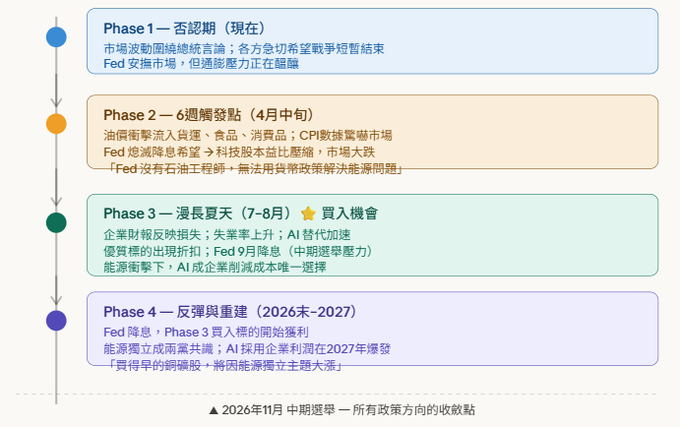
He divides the next phase into four stages. We're currently in Phase 1: The Denial Phase. Market volatility revolves around the president's rhetoric; everyone wants the war to end quickly. The Fed is still saying "this isn't stagflation"—but Israel has already bombed the world's largest gas field, South Pars, and Iran has retaliated by bombing Qatar's Ras Laffan LNG facility, declaring it force majeure. Qatar handles about 20% of the global LNG trade, with over 80% flowing to Japan, South Korea, China, and Taiwan; now it's all offline. He worked there for five years and put it bluntly: these LNG trains cost tens of billions, and repairs won't take months, but years.
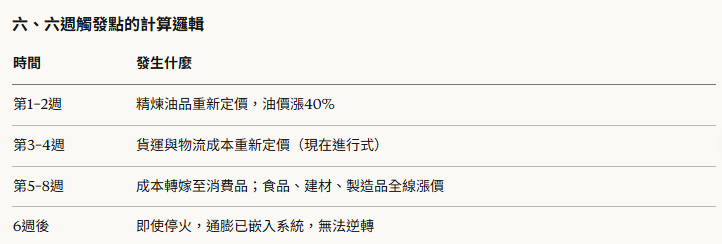
The most crucial concept: the 6-week trigger point. Oil price shocks take time to enter the system. Refined petroleum products are repriced in weeks 1-2; freight logistics costs rise in weeks 3-4; and it's only fully reflected in retail prices of food, building materials, and consumer goods in weeks 5-8. Even a ceasefire after 6 weeks cannot reverse the impact; contracts have been transferred, and CPI data will tell the truth. Mid-April is this trigger point.
Once triggered, Powell will have to officially extinguish his last hope for a rate cut this year. The fundamental difference between this and every correction in the past 15 years: past inflation was demand-side, which the Fed could suppress by raising interest rates. This time it's supply-side—energy facilities have been destroyed, and monetary policy cannot get the LNG trains running again. He said, "The Fed has a bunch of useless PhDs and a printing press, but no petroleum engineers in its basement."
There's also an underestimated second-order effect: Qatar LNG simultaneously produces sulfur (for fertilizer) and sulfuric acid (a key raw material for copper mining). When the LNG comes off the line, these byproducts will also be cut off. Food and industrial metal costs will follow suit, it's just a matter of time.
Why won't this war be quick? The core narrative of Shia Islam is the martyrdom of Karbala: Hussein, knowing he would die, still led 72 men against thousands of enemy soldiers because in Shia theology, surrendering to overwhelming injustice is true defeat, and death and suffering are confirmation of walking the path of justice. Israel and the US assassinating Khamenei simultaneously with the announcement of a diplomatic breakthrough—this is almost a perfect reenactment of the Shia origin myth. No matter how many more precise assassinations Israel carries out, within Iran's theological framework, it is merely an reinforcement of obligation, not a reason for surrender. The Western logic of "negotiations will happen when the pain is enough" simply doesn't apply in this framework.
There is an even more severe reality: over 90% of the freshwater in the Persian Gulf region comes from desalination plants, with Kuwait and Bahrain relying on 90%, Oman 86%, and Israel 80%. Both sides have begun attacking each other's desalination plants. In areas where summer temperatures exceed 45 degrees Celsius, losing freshwater is a threat to survival. Iran holds the initiative in both energy and freshwater upgrades.
So what should we do?
Right now: Hold off. Observe whether the six-week trigger point is triggered, allowing the market to fall to a genuine discount.
Summer is the buying opportunity (Phase 3). Corporate earnings begin to reflect actual losses, unemployment rises, and when sentiment is at its worst, quality stocks will see a real discount. His plan is to be patient at the beach and gym, and then start serious screening at the end of August.
One counterintuitive point is worth noting: AI adoption will accelerate significantly in this environment. Faced with profit compression, companies are not "choosing" to use AI, but are "forced" to use AI to replace human labor for survival. Tech stocks will fall, but the long-term narrative of AI will be stronger—companies that adopt AI are the ones that survive the recession, while those that don't go bankrupt. "The long-term argument is most convincing when stocks are cheapest." This is the part of his entire analysis that I agree with the most.
Late 2026 to 2027 (Phase 4): Fed rate cuts, energy independence becomes the biggest bipartisan political theme, energy assets in the US and Western Hemisphere enjoy a geopolitical premium, and profits from companies using AI begin to appear in their financial statements.
However, he has a caveat: "If a real peace agreement emerges—not when Trump tweets that the war is over, but when the Strait of Hormuz actually reopens—I will immediately adjust my framework. The core of investing is not prediction, but building a framework and keeping it updated."
twitter.com/shawnchen_eth/stat...