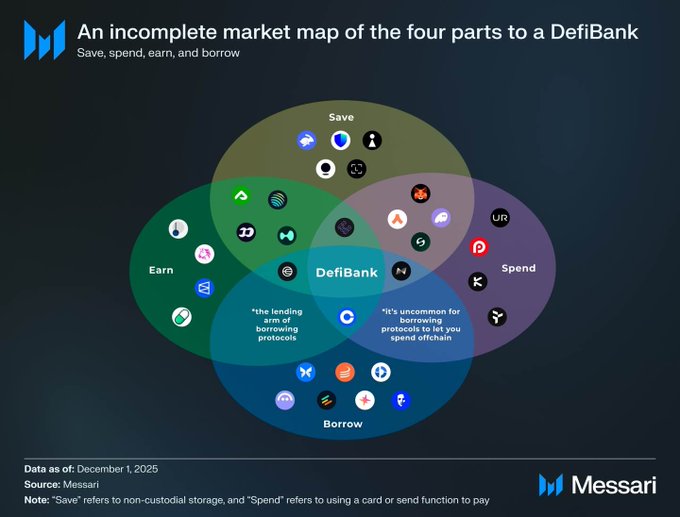
This is probably the most insightful article on stablecoins I've seen recently. The stablecoin market is seeing many new concepts emerging, including Neobank and Defibank, which are particularly interesting and all point to one core issue: USD stablecoins. There's also been a lot of discussion recently about whether #Circle is worth investing in, and I'll share my thoughts based on this article. 🧐 USD stablecoins, especially USDC issued by Circle, appear to be synonymous with "safety, transparency, and compliance." However, if you delve into the underlying logic of the financial system, you'll find that it actually treads on a very dangerous policy minefield, one that could explode at any moment.
First, let's clarify one thing: stablecoins are not bank deposits, but they increasingly function like them. Ordinary people deposit dollars in banks, and banks use them for lending, investing, and earning interest spreads, while keeping only a small amount as reserves—this is the "fractional reserve requirement" system. Through this mechanism, the Federal Reserve can control the "money supply" in the economy by adjusting interest rates and reserve ratios. This is the lifeblood of the modern monetary system.
But now, stablecoins bypass this system. For example, if you exchange $100 for USDC, this money is theoretically deposited 1:1 into cash or short-term US Treasury bonds, but it no longer enters the banking system for lending. In other words, this $100, which could theoretically "conjure" $500 or even $800 in credit money within the traditional banking system (because banks can lend out 90%, and others deposit and lend again, etc.), is now "dead" in a stablecoin account. It simply lies there quietly, offering low risk, high liquidity, and high interest returns. (This is the difference between M0 and M1, and M1 is often several times larger than M0; the monetary and credit system is one of the cornerstones of modern economic prosperity.)
This might sound wonderful about USDC, but the very "wonderfulness" is the biggest problem.
What happens if everyone thinks "USDC is safer and more convenient than bank deposits" and massively transfers money from banks to stablecoin wallets?
The answer is: the bank's deposit base is drained (long-term assumption), lending capacity shrinks, and the money multiplier collapses. The Federal Reserve wants to lower interest rates to stimulate the economy? Nobody goes to banks to borrow money anymore. Want to raise interest rates to curb inflation? Stablecoin interest rates might be even higher, and money doesn't really obey central bank commands.
This is why the Federal Reserve is adamant about not opening master accounts for stablecoin companies. A master account means direct access to the Fed's payment and clearing system, essentially acknowledging you as a "quasi-bank." Once opened, stablecoins would truly become "digital banks" parallel to traditional banks, but without fractional reserve requirements and wouldn't participate in monetary policy transmission. This is equivalent to creating a separate "pure reserve" monetary system outside the central bank system, which, while highly efficient, would fragment the central bank's control over the money supply.
#Circle currently appears compliant and glamorous, but it has hidden core problems, which are the main contradictions in the financial industry. Although it currently has deep cooperation with JPMorgan Chase and BNY Mellon, the Federal Reserve is the judge who holds the power of life and death over the dollar and the banking industry. Therefore, I don't recommend many partners invest heavily in it, but appropriate allocation is acceptable. There are three reasons for this:
1️⃣ Extremely high policy risk: Once USDC's size approaches 5% or even 10% of M2 (currently, the overall stablecoin size is less than 1%), the Treasury and the Federal Reserve will definitely intervene to restrict it. Possible methods include: mandating stablecoin issuers to obtain banking licenses, limiting individual holdings, or prohibiting stablecoins from being used for payments and savings. Any of these could significantly undermine Circle's business model.
2️⃣ It's essentially a "government debt channel": Most of Circle's money is invested in short-term US Treasury bonds. While this sounds safe, it also means it's indirectly financing the US government; for every dollar of USDC issued, an additional dollar flows into US Treasury bonds. While this helps the US treasury in the short term, in the long run, if stablecoins become a hidden government debt tool, it will trigger regulatory vigilance, fearing it will become an "uncontrolled fiscal tool."
3️⃣ Limited growth ceiling: Circle wants to build "digital dollar infrastructure," but true infrastructure requires authorization from the central bank. Furthermore, major banks are currently issuing their own stablecoin systems internally, creating significant competition that will inevitably erode the market share of Circle's compliant stablecoin. It's possible that USDC might be "co-opted" into a restricted payment tool in the future, losing its current high-growth potential.
Finally, let's be a bit self-deprecating, which is quite ironic. We cypherpunks initially entered the cryptocurrency market for "decentralization, censorship resistance, and freedom from central bank control"—a rationalist vision. The most successful stablecoin, however, has become one of the largest buyers of US Treasury bonds, helping the Federal Reserve lower interest rates and the Treasury issue bonds, becoming the system's most loyal assistant. 😂 It's quite frustrating!
twitter.com/Rocky_Bitcoin/stat...