avatar
Followin 華語 - 熱點風向標🫡
23,523 Twitter followers
Follow
🌍 AI驱动的Web3信息枢纽,和Followin一起,开拓全球视野,寻觅早期机遇。 👉 英文 @followin_io| 💬 讨论群:https://t.co/WDIQxlZT4N| ⚡️闪电快讯:https://t.co/Lp4O6anQgr
Posts
avatar
Followin 華語 - 熱點風向標🫡
Thread
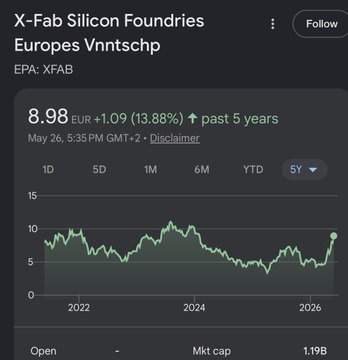
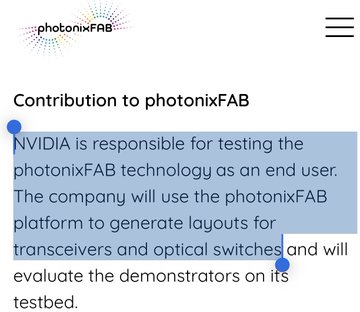
New stock market guru serenity (@aleabitoreddit) just disclosed his new investment in $XFAB, a German-based professional foundry with a market capitalization of $1.28 billion, specializing in analog chips, SiC, and silicon photonics. Let's break down his investment rationale: Core argument: The market is underestimating a potential NVIDIA manufacturing partner. X-FAB leads the EU-funded photonixFAB consortium project (€48 million), with NVIDIA participating as an application development partner, currently evaluating the high-volume manufacturing feasibility of its silicon photonics platform. In June 2025, NVIDIA hosted the consortium's fifth meeting in Denmark. This relationship has not yet been incorporated into valuation models by mainstream sell-side analysts. Valuation at a historical low. Currently, the P/B ratio is approximately 1.29x, and the P/S ratio is approximately 1.6x, significantly lower than comparable professional foundries with growth catalysts (typically 3-5x). The valuation discount primarily stems from the automotive business accounting for approximately 61% of revenue, which is affected by industry cycles. Two other growth drivers: > XFAB is currently the only high-volume SiC foundry in the US, and POWI has a wafer supply agreement with it that is filed with the SEC. > The EU Chips Act has allocated €128 million, and the US Chips Act has added $50 million; EU Chips Act 2.0 is underway, with photonics as a key focus, and XFAB is already a member of the European Photonics Chip Industry Steering Committee. Key risks: The collaboration with NVIDIA is still in the evaluation stage and has not yet entered mass production confirmation. The duration of the downturn in XFAB's automotive business is uncertain. The core issue is whether the growth rate of the photonics and SiC businesses can outpace the drag on cash flow from the automotive business. twitter.com/followin_io_zh/sta...
avatar
Followin 華語 - 熱點風向標🫡
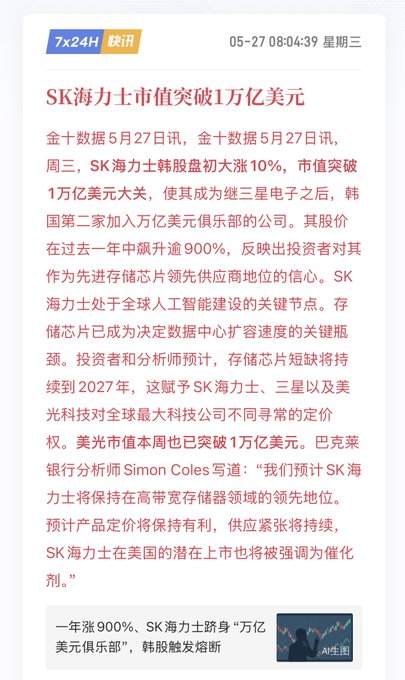
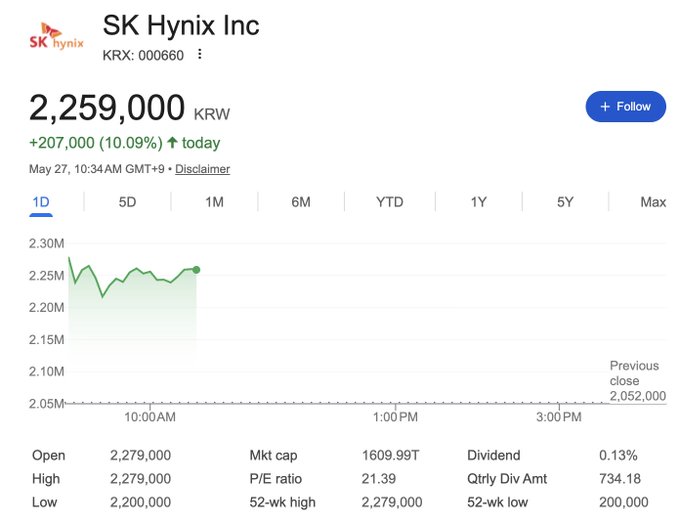
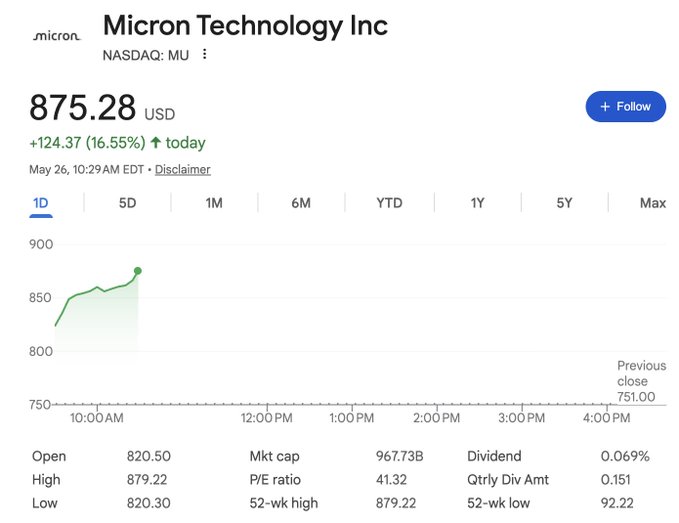
Storage stocks are breaking free from cyclical patterns and becoming infrastructure stocks for the AI era. This could be the second time, after cloud computing, that a "commodity → infrastructure" asset revaluation has occurred. In the 50-year history of the storage industry, no pure storage company has ever entered the trillion-dollar club. Now, Micron ($MU) and SK Hynix have both surpassed a trillion-dollar market capitalization in a single day. Why now? For decades, memory has been a typical commodity. Prices fluctuated with supply and demand cycles. Samsung, Micron, and SK Hynix engaged in decades of price wars, winning by "losing less than their competitors," without any pricing power. HBM changes the underlying logic. Physically stacked next to GPUs, it serves as a dedicated bandwidth interface for AI chips, with no alternatives. NVDA directly locks in the supply chain, with only three suppliers globally. Yields are extremely difficult to improve, and new capacity can take at least 18 months to come online. This isn't a boom-bust cycle; this is a textbook example of an oligopolistic structure. The fact that both companies simultaneously surpassed a trillion-dollar market capitalization indicates that market pricing isn't based on the execution capabilities of any single company—it's based on the structural scarcity of the entire HBM sector. When supply is locked down and demand is driven by the AI arms race, the analytical framework for cyclical stocks becomes ineffective. The only real question that needs answering is: Where is the ceiling for AI computing power expansion? If you believe this arms race will last another 3-5 years, the revaluation of storage has only just begun. If you believe it's already overheated, then this is the biggest cyclical stock trap in history. Which side are you on? twitter.com/followin_io_zh/sta...
avatar
Followin 華語 - 熱點風向標🫡
From Uber burning through its entire annual multi-billion dollar AI budget in four months to Microsoft internally revoking the Claude Code license, everyone is calling it an AI cost overrun crisis. No. This is a measurement crisis. Uber engineers are saving three hours a day using AI—that value is real. But it doesn't appear on any financial statements. The CFO opens the system and sees only one thing: AI spending increased by 300% this quarter. Engineering delivery speed? Code quality? Decision-making efficiency? No numbers, no dashboards, nothing. Without measurement, value is nonexistent. This is the crux of the problem: Before establishing any system to measure AI output, the company distributed tools to thousands of engineers. In good times, no one asks about ROI—high adoption rates, everyone thinks it's useful, and budgets are approved year after year. When bills skyrocket, the CFO storms in, and the tech team has no numbers to refute him. This conversation was lost from the start. So what Microsoft and Uber are cutting isn't AI. It's an expenditure whose value cannot be proven. Any CFO would make the same decision. This isn't a denial of AI capabilities, but an exposure of the company's internal management shortcomings. The core of the next AI arms race isn't whose model is stronger. It's about who first builds a metric system that CFOs can understand—what decisions AI intervened in, how many man-hours were saved, and how many percentage points delivery speed was improved. Companies that can answer these questions will only see their AI budgets increase. Those that can't will eventually repeat Uber's scenario. Following this logic, what AI tool vendors should really be selling has changed. It's not just about stronger models, but about ROI visibility. Whoever can get the VP of Engineering to the board and clearly explain "what we got for every dollar we spent" with a single chart truly solves the core pain point of enterprise procurement. No one has answered this question yet. In short: The AI billing crisis exposes the fact that technological tools are moving too fast, while management tools are completely lagging behind. What businesses truly lack isn't cheaper AI, but the ability to demonstrate its value. Does your company currently have a system for measuring the return on investment in AI? Or are you still relying on gut feeling to decide whether to continue investing?
Vivek Sen
@Vivek4real_
05-25
BREAKING: MICROSOFT JUST ANNOUNCED TO BAN ITS OWN ENGINEERS FROM USING AI DUE TO THE COST OF USING IT. VP OF NVIDIA SAID, “THE COST OF AI FOR MY TEAM WAS MORE THAN HUMANS” “AI CAN COST MORE THAN HUMAN WORKERS NOW”
avatar
Followin 華語 - 熱點風向標🫡
05-25
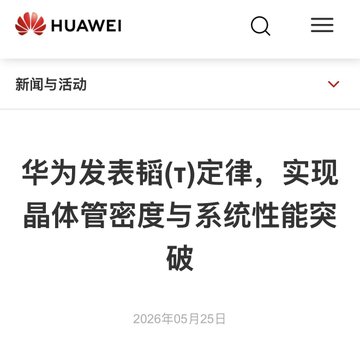
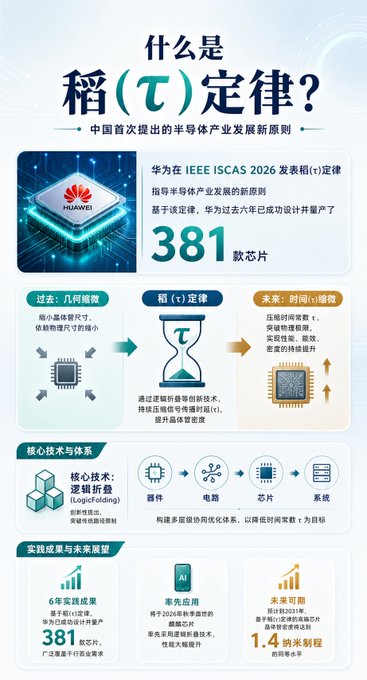
Huawei's "Tao Law" has sparked bearish sentiment towards Nvidia and AMD? My assessment: this bearish logic is flawed. Tao Law refers to design architecture innovation, not manufacturing process breakthroughs. These two things are completely different in the semiconductor value chain. Let's dismantle the biggest misconception first. Huawei's claim of "equivalent 1.4nm density by 2031" is not equivalent to process technology. So-called "logic folding" involves vertically stacking planar circuits and compressing signal distances; its essence is optimization at the packaging and architecture levels, not a breakthrough in lithography. TSMC has already mass-produced 2nm, its 1.4nm is projected for 2027-28, and its sub-1nm for 2030+. Huawei's 2031 target is TSMC's 2027 position, and the gap will still exist then. No matter how advanced the design, it's useless if you can't manufacture it. China cannot obtain ASML's EUV lithography machines, and SMIC's mass production ceiling is still at the 7nm level DUV. Tao's Law can only optimize on existing equipment—like top-tier driving skills in a speed-limited car, the physical limits are there. There's another easily overlooked layer: the EDA ecosystem. Cadence and Synopsys together control over 75% of the EDA market, deeply tied to US export controls. ARM architecture is penetrating data centers, and TSMC's OIP integrates over 110 partners; these certifications require at least five years of accumulation, not something a single paper can bypass. Look at the market structure. Huang himself said the Chinese AI chip market has basically been ceded to Huawei—this isn't news, it's already priced in. After export controls, China accounts for about 15-20% of Nvidia's revenue; the real growth isn't there. Global cloud vendors' AI capex is still skyrocketing, all flowing into the NVDA/AMD/TSMC supply chain. CUDA has over 5 million developers, over a decade of code accumulation, and a deeply locked global AI training pipeline. Huawei dominates the Chinese market, Nvidia dominates the global market; they're not mutually exclusive in the short term. Financially, there's no support for a bearish outlook. NVDA's latest quarterly data center revenue was $75.2 billion, with total revenue of $81.6 billion. The real concern is macroeconomic inflation leading to a Fed shift, or AI inference demand falling short of expectations—this isn't a design methodology geared towards 2031. Tao's Law is a significant milestone in China's semiconductor self-sufficiency and deserves respect. However, technological narratives ≠ financial catalysts; confusing these two is the most dangerous thing. Do you think Tao's Law will have a substantial impact on the US semiconductor stock market? 👀 twitter.com/followin_io_zh/sta...
avatar
Followin 華語 - 熱點風向標🫡
05-25
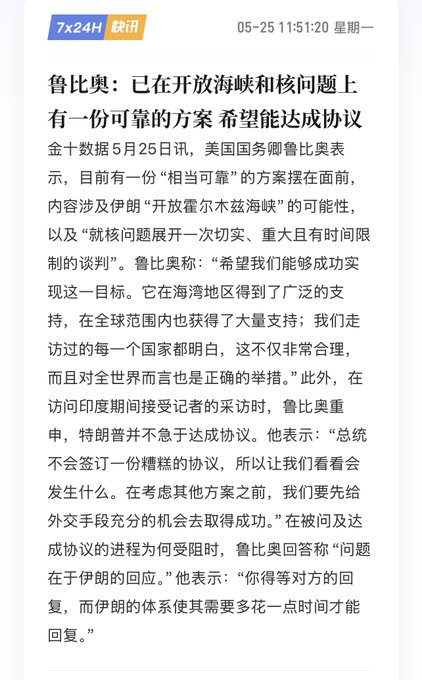
The situation in Iran has suddenly changed, and there are essentially three possible outcomes: 1. A deal is reached (even a short-term one) → Oil prices break $90, risk assets take off 2. The stalemate continues → Oil prices fluctuate between $95 and $105, the most agonizing scenario 3. Trump overturns the agreement → Oil prices reach $120+, a complete collapse However, the market is clearly heavily betting on an imminent agreement, and three signals this morning do indeed point in this direction: 1/ The oil tanker that had been stuck in the Strait of Hormuz for nearly three months quietly sailed away last night. 2/ Brent crude oil plunged 5%, hitting $98. 3/ The 225 index broke through 65,000 points, surging 3%. But here's the contradiction—Rubio said there's a credible plan and he hopes to reach an agreement, with a signing as early as Monday. Trump, however, stated that the US-Iran agreement is "not yet fully agreed upon." But Iran says that a final memorandum of understanding has not yet been reached, and some terms are still disputed. Iran's Supreme Leader is currently hiding in a secret location and communicating through messengers. It's 2026 and they're still using the old-fashioned relay system; the substantive progress in negotiations is practically zero. So the situation is really awkward: oil prices are already trading according to a peaceful script, but nothing has been agreed upon on the surface. The market is heavily betting on a deal, but frankly, the biggest variable has never been Iran—it's Trump's next tweet. This guy can go from "deal is close" one second to "bomb bomb bomb" the next; his mental state is far ahead of the curve. Which script are you betting on?
avatar
Followin 華語 - 熱點風向標🫡
05-25
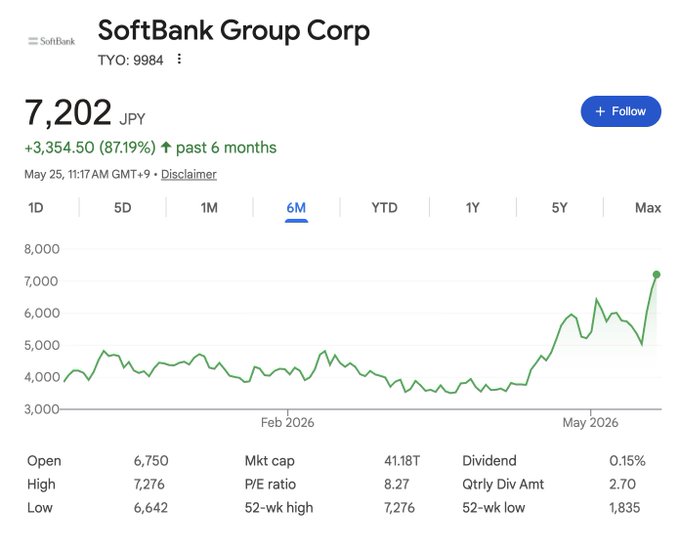
The Nikkei 225 rose over 3%, and SoftBank continued to hit record highs, gaining 40% in three trading days. However, this isn't just a simple sentiment-driven rally; the market is actually revaluing Masayoshi Son's two trump cards: ARM and OpenAI. Let's look at how explosive ARM's performance has been. Its stock price has surged 46% in the past five trading days, directly boosting SoftBank's asset value. The acquisition of ARM cost approximately $31 billion, and based on current market capitalization, the unrealized profit is close to $250 billion. From $31 billion to $250 billion, a textbook example of a successful investment! 😂 Now let's look at OpenAI. SoftBank officially disclosed a cumulative investment of $34.6 billion, with a fair value of $79.6 billion according to financial statements, resulting in a book profit of approximately $45 billion. However, if we roughly calculate based on OpenAI's latest valuation of $852 billion, the unrealized profit has already exceeded $58 billion. Here comes the most outrageous part: A rough calculation shows that the ARM and OpenAI holdings alone are now worth over $370 billion—but SoftBank's entire market capitalization is only $250 billion. In other words: these two investments alone are already worth more than the entire SoftBank company. The rest of the business is practically free or even a loss. But rather than marveling at SoftBank's record highs, we should be more concerned about what Masayoshi Son will do next. Everyone knows his style—when he has money, he wants to do big things. Last time, with too much cash, he directly acquired ARM. This time, with over $300 billion in unrealized gains as leverage, he's already pushing Stargate and sweeping up AI infrastructure everywhere. If he uses the paper profits from ARM and OpenAI to further leverage and go all in on next-generation AI infrastructure, SoftBank might not just be a stock issue—it's becoming the Berkshire Hathaway of the AI era. Of course, it could also become the next, enlarged version of WeWork. Masayoshi Son, for him, is either a legend or a flop; there's no middle ground. Therefore, SoftBank's record high is not essentially "rising along with the AI concept," but rather the market is betting on one thing: whether Masayoshi Son will become the biggest winner in this AI cycle.
loading indicator
Loading..