How Does Psy Protocol Reach 1 Million TPS?
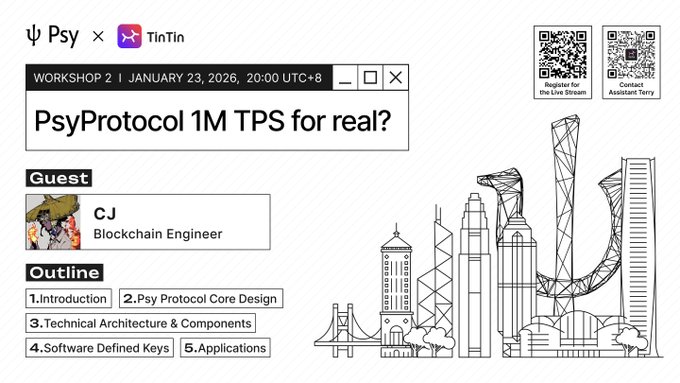
On January 23rd, Blockchain Engineer CJ took us deep into the @PsyProtocol architecture, revealing the technical design behind million-scale TPS.
⬇️ Key takeaways below:
📊 Background: Why 1 Million TPS Matters
Psy, rebranded from QED Protocol, has raised $10M+ at a ~$100M valuation.
With growing on-chain applications and the emergence of AI Agents, blockchains must deliver high concurrency, low latency, and verifiability simultaneously.
"1 Million TPS" isn't a marketing metric — it's an engineering benchmark to validate horizontal scalability.
🔑 Five Core Design Principles
【Local Proving: Execution & Proving at User-Side】
In traditional blockchains, transactions are re-executed across all nodes. In Psy, users execute transactions locally and generate zero-knowledge proofs along with state deltas.
Nodes only verify proofs (~5ms) and write state changes—no re-execution needed.
This preserves privacy, socializes proving costs across users, and eliminates the global VM bottleneck.
【Sharding: Breaking Single-Node Write Limits】
Psy introduces a sharding design with one coordinator and multiple realms. Each realm independently processes user-submitted data and proofs.
TPS scales not through single-node performance, but by adding realms and workers—achieving near-linear horizontal scaling.
【State Model: No Shared State, Zero Read-Write Conflicts】
Psy adopts a “write-only-your-own-state” model. Each user’s state within a contract is isolated and cannot be written by others.
Users can read finalized states from others but have write permissions only to their own state — enforced by contract logic.
This structurally eliminates read-write conflicts from global shared state, enabling massive parallelism.
【Pipeline: Parallel Block Processing, Zero Idle Time】
Psy uses pipelining to maximize node utilization. The Block Processor handles current block state updates while Gatherers simultaneously collect next-batch transactions and maintain in-memory state.
When the previous block completes, these results flow directly into the next stage without waiting for prover completion—minimizing system idle time.
【PoUW: Decentralized Proof Aggregation】
For proof generation and aggregation, Psy doesn't rely on single nodes.
Instead, it uses a PoW-like mechanism to bring external computing power into the network, making the proving process itself decentralized and scalable—essential for high-concurrency scenarios.
📌 Summary
Psy Protocol's high TPS doesn't come from isolated optimizations, but from the synergy of Local Proving, Sharding, State Model, Pipeline, and PoUW.
Through this architecture, the system achieves true horizontal scalability while maintaining verifiability.
📺 Workshop Replay: youtube.com/watch?v=Tz208f_CL5...…
💡 Join "Psy: Ascend Hack 2026" global hackathon to win $9,000 & physical prizes!
👉 Registration: luma.com/1xcmlv3v
🕹️ For more details, add Terry on WeChat (🆔 TinTinland_basedZH)
#PsyProtocol #TinTinLand #Web3 #Workshop