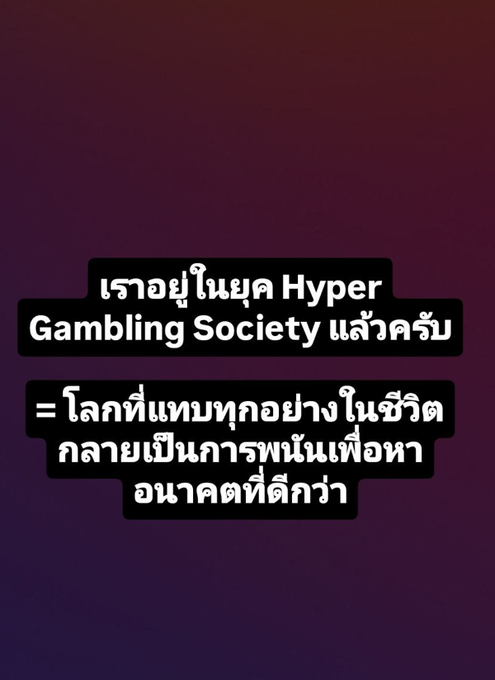
Before I wrote about the Hyper Gambling Society in early 2026, I reviewed my own portfolio and the overall crypto market situation. I felt that the Web3 world was changing.
Previously, many Cypherpunks were shifting from Fundamental Play to Ideology Play.
In the traditional stock market, the analysis game was quite clear. For example, you would look at:
>Revenue
>Profit
>P/E
>ROE
>Free Cash Flow
>and others.
If the numbers were good = buy.
If the numbers were bad = sell.
But now, people in crypto are looking at every project through the lens of Web2 analysis. They're considering revenue, user growth, tokenomics like typical startups, TVL, DAU, and so on. This is making the new era of projects... It's becoming much harder because opportunities aren't being given.
Honestly, it's incredibly easy to fake traction in crypto, whether it's TVL, DAU, Volume, on-chain revenue, etc.
You can see those events; there are tons and tons of instances of price pumping. An example I often use in this case is Berachain. From a TVL of $3,000 million, after a year it dropped to $90 million. [OMG, what the hell, such a huge drop!]
Right now, I see crypto not as a war of numbers, but as
a war of belief and ideology.
Let's look at a simple example:
1.Bitcoin
> There are no business metrics. If you look at it using stock logic, you can barely analyze anything.
But what Bitcoin has is the narrative of sound money and resistance to government inflation, which is a very strong narrative. Strong enough for the whole world to hold onto it for decades, regardless of volatility.
.
2.Zcash
Suddenly, it became a hot topic on Twitter, with people talking about the Privacy meta, which is similar to Bitcoin. It doesn't have any revenue or business metrics, but its community believes in privacy very seriously, causing the price to increase 20x in just 1-2 months.
.
Both of these coins are clearly more about ideology than investment.
.
Thinking like this, I'm starting to feel that analyzing crypto with just numbers isn't enough, because the numbers in this world are actually very easy to manipulate, as I said. But there's one thing that's hard to manipulate: "belief."
.
You can fake volume, but it's very difficult to fake the conviction of the community. Otherwise, memes like Doge and PEPE wouldn't have gone this far.
.
Another reason I feel that... Many people are starting to explore Ideology more, which is the complexity of DeFi.
I can say that DeFi systems are becoming increasingly complex, such as:
> Multi-layered smart contracts
> Increased price-related risks from oracles, such as the AAVE incident where the price update wasn't current, resulting in a $21M loss.
The events we see regularly every week in DeFi are:
> Hacks
> Rugs
> Errors
I don't think DeFi is failing, but I think it's a good example of how the more complex a system becomes, the more the ideology fades.
So what am I doing these days?
1. Working on a new product, close to launch. Please follow for updates.
2. Doing research in Ideology meta to find alpha. I'm becoming more interested in assets with these characteristics, such as:
> Clear ideology
> Strong community
> People hold them because of belief, not just yield
The metrics I'm looking at now... It's not like trading stocks anymore. I look at things like:
1. Are people holding it long-term?
2. How much community is defending the project?
3. Does the narrative still have momentum?
4. Are people outside of Web3 using or talking about it?
5. Sometimes I even look at the culture more than the dashboard these days, lol.
And in a world that's becoming a hyper-gambling society, maybe the most valuable thing isn't the numbers, but conviction.
As always, this article is not investment advice, because investing is incredibly risky.