Today
Intel
Market
Earn
Settings
Account
Theme Selection
Light
Dark
Language
English
简体中文
繁體中文
Tiếng Việt
한국어
Followin APP
Mine Web3 Possibilities
App Store
Google Play
Log in
Timo
47,583 Twitter followers
Follow
I Ex-VCer (AI) I http://gmgn.ai I AI&MEME I TG Channel: https://t.me/+mRk9EqehUHNjZWFl
Posts
Timo
03-25
Thread
#Thread#
If the underlying logic remains unchanged, over a 20-year timeframe, choosing the Nasdaq 100 is better than holding Bitcoin. The simplest logic is that the future belongs to AI, and the best AI companies will be found in the Nasdaq 100. Just like the most powerful social networks, mobile search, e-commerce, operating systems, autonomous driving, cloud services, and graphics cards are all in the Nasdaq 100. With an annualized return of 15.2%, the Nasdaq 100 will be 17 times its initial value after 20 years. This means Bitcoin would need to reach $1.2 million to outperform the Nasdaq. Will Bitcoin reach $1.2 million? Most likely not. And most importantly, your holding experience will be far, far better than holding Bitcoin.
Timo
@timotimo007
03-20
绝大多数人买纳指/标普是最好的投资方式,90%的基金经理长期都跑不过指数年化收益,这个长期是 20 年及以上。买纳指是底层逻辑很简单:1)美国科技一直领先;2)美元一直增发;3)世界和平。
BTC
0.32%
Timo
02-24
Thread
#Thread#
One of my tasks for 2026 is to continuously look for businesses that are unlikely to be affected or disrupted by AI (relatively low-growth, monopolistic cash flow businesses), aiming for a high win rate and low returns in this part; another part is to find high-growth companies that AI can replace or disrupt, aiming for a high payout ratio in this part.
Timo
02-21
Thread
#Thread#
Minimax and Zhipu have both reached a market capitalization of HK$300 billion. Short-term speculation is a way to make money, and this exists in every market. Strong control, low circulation, good concepts, decent products—speculative funds rush in. My friend asked me how much I'd seen; how would I know? I haven't bought any. It depends on when the speculation stops. I just wonder who will get trapped at the peak? Kuaishou once reached a market capitalization of 2 trillion, now it's 300 billion. Those who bought Kuaishou at the peak will never recover their losses because they mistook short-term speculation for value investing. This is the most dangerous way to make money—you make money using the wrong methods and attributions, and you'll always give it all back later.
Timo
02-18
Thread
#Thread#
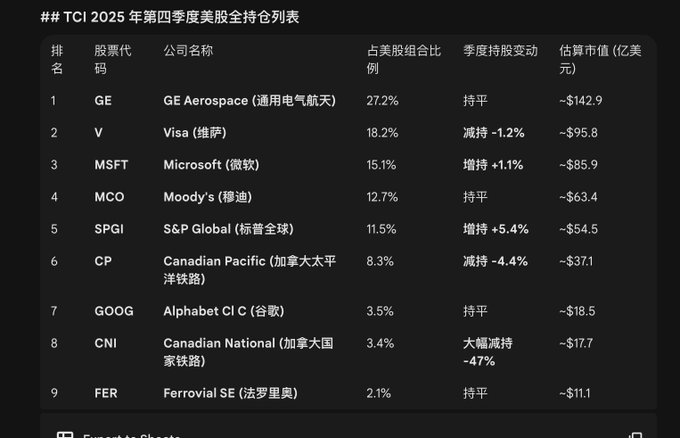
Everyone knows that Berkshire Hathaway and Duan Yongping's portfolios are highly concentrated (in terms of the number and percentage of their top holdings), and their excess returns stem from this concentrated portfolio. Another lesser-known hedge fund, TCI Fund Management, managed by Chris Hohn, also has an extremely concentrated portfolio. It holds only nine US stocks, with the top six holdings accounting for 93% of its portfolio. With over $50 billion in assets under management, it achieved a return of $18.9 billion in 2025, setting a record for the highest single-year profit in hedge fund history. Since its inception in 2004, this fund has achieved an annualized return of 18%. Thanks to its explosive growth over three consecutive years from 2023 to 2025 (accumulating $40 billion in profits), TCI jumped from 14th to 5th place on the list of "Most Profitable Hedge Funds of All Time" (LCH Investments ranking), trailing only Citadel, Bridgewater, D.E. Shaw, and Millennium. Because Hohn's portfolios are extremely concentrated (usually only around 10 stocks), his performance is often highly volatile, with holding periods generally exceeding 8 years. You don't even need to analyze it closely to find that his holdings are primarily "leading" monopolistic companies in their respective industries, possessing very strong competitive advantages and pricing power. GE Aerospace (GE): The global "tax collector" of civil aviation engines, generating long-term cash flow through monopolistic engine sales and decades of high-margin after-sales maintenance and repair. Visa (V): The tollbooth of global digital payments, extracting a very small percentage of clearing fees from every cross-border and domestic transaction passing through its network. Microsoft (MSFT): The underlying operating system for enterprise productivity, building a highly sticky subscription ecosystem through irreplaceable Office software, Azure cloud computing, and AI interfaces. Moody's (MCO): "Entry permits" in the financial markets, charging credit rating fees to bond issuers through franchise rights; a typical asset-light, high-pricing-power business. S&P Global (SPGI): A goldmine of financial data, charging hefty licensing fees to global asset management firms not only for credit ratings but also for compiling indices (such as the S&P 500). Canadian Pacific (CP): North America's only transnational rail transport artery, leveraging scarce land use rights and infrastructure to possess an absolute cost advantage in long-distance commodity transportation. Alphabet (GOOGL): The gatekeeper of global internet traffic, converting user attention into highly targeted advertising revenue through its monopolistic search engine. Canadian National (CNI): A rail network connecting three oceans (Atlantic, Pacific, and Gulf of Mexico), possessing a natural transport monopoly in specific geographic regions. Ferovial (FER): A global franchised infrastructure operator focused on investing in and managing toll roads, airports, and energy infrastructure with high cash flow returns.
AZR
0%
Timo
02-13
Thread
#Thread#
I don't want to mislead anyone; I want to systematically explain the logic behind my overall stock position building. Perhaps I just bought 5% of my total position, but you blindly All In. 1. Buying stocks is essentially buying a company's future cash flow, which I won't elaborate on. My stock holdings are primarily for the medium to long term; I don't currently engage in short-term speculation, mainly due to a lack of time and energy. However, I might dedicate more time to this area in the future, given that the only viable strategy in the crypto right now is to short altcoins. 2. Individual stock positions should not exceed 30%. This is the maximum position size to avoid excessive drawdowns/losses caused by incorrect judgments or extreme situations, which could negatively impact the overall portfolio's profitability and mindset. 3. My strategy for building a position is to build it in batches, usually 1/3, 1/3, 1/3. Building a 1/3 position on the left side occurs when a company is in a phase where it is "not favored by the market" for various reasons, directly reflected in a falling stock price. As for when something is considered "reasonable," that's subjective; I estimate it based on future cash flow and the P/E ratio. The next third usually occurs during extreme market crashes, sometimes due to overall market factors (pandemic/escalating US-China relations). Those who experienced the 2022 crash understand this. The last third was added on the right side (due to a significant improvement in performance). The advantage of this is that if you buy too early, you won't feel too bad because you've controlled your position size (like with Meituan). The downside is that sometimes the price goes up quickly before you've bought enough (like Pop Mart). You can All In starting a business, but neither investing nor speculating is acceptable.
PE
0%
Timo
02-07
Thread
#Thread#
In a bear market, learn to manage your finances conservatively. OKEx USDG stablecoins offer approximately 4% annualized return, and combined with continuous flash sale promotions, you can potentially earn over 10% annualized return annually. The latest flash sale is for Zama, offering around 10% annualized return; conservative investors might consider it.
OKX中文
@okxchinese
02-06
OKX 闪赚将上线 ZAMA (Zama)! 今天傍晚 18:00 至 2月11日下午 18:00 (UTC+8),锁仓 OKB、USDG、BTC、ETH 或 ZAMA,即可瓜分 18,000,000 ZAMA 空投奖励~ 参与方式👉:APP左上角——赚币与奖励——闪赚
USDG
0.01%
Timo
01-25
Thread
#Thread#
I've been seeing some groups for young BSC players lately, and they're jokingly calling BSC the "farmer's chain" because of its daily settlements and no upper limit. Actually, Binance's operating model was very effective initially because it was backed by the liquidity of the largest exchange and the interaction between Heyi/CZ. However, the backlash has recently become apparent. Because the model is too fixed, in the financial field, once a strategy and model are known to most players, it becomes ineffective. The spread path of BSC's meme is simple: CZ/Heyi texts to find the meme/or other hot topics - interaction between the two (pump and dump) - ambush and pump - more interaction and pump - alpha listing (pump) - futures listing - spot trading (pump). Memes that haven't escaped this path, like Hakimi, have a strong community and have been trading sideways at high levels for months, but Binance hasn't even given them a single futures contract. With "I'm coming!" on the list, it's easy for those below to explain to their bosses: "Look, 'I'm coming!' is very popular; even negative publicity is still publicity, and being down-to-earth is relatable." Then, presenting a bunch of data to the boss proves it's "community-driven" while also pleasing the boss's aesthetic sense—why not? After all, most people are just employees, driven by short-term KPIs and upward management, not long-term vision. This situation isn't unique to Binance; it's common in any company. How to resolve this dilemma? Simply listing a non-Binance-based meme for spot trading might be difficult, as Binance fears it will crash like other memes, leaving them in a difficult position. Binance Life hasn't had its cap removed; other BAC memes have only reached tens of millions at most, and people don't have higher expectations. If Giggle/Binance Life could be listed on 1B, and a non-Binance-based meme for spot trading could be listed to continue the pump, everything might be different. But Binance can't fund a pump; it's all about retail investors' wishful thinking, or at most, close associates of Binance, but even they need to make money. Everyone's here to make money; they're not doing charity. In this market, only retail investors are truly doing charity; the poorest group is doing "charity."
GIGGLE
1.71%
Loading..