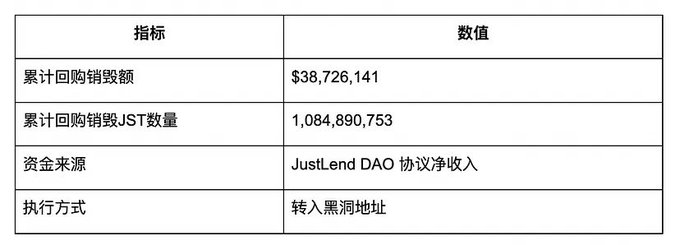
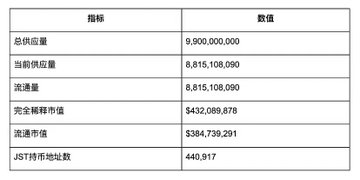
As the buyback and burn program begins, JST's value logic is being rewritten.
If we break down the JUST ecosystem, JST's role is quite clear: it's the token directly anchored to cash flow and governance rights.
JST is the only governance and value-capturing token in the JUST ecosystem. JustLend DAO's interest rate parameters, asset list, risk model, and fund usage are essentially determined through proposals and votes from JST holders. In other words, how the protocol makes money and how it uses that money ultimately revolves around JST.
The fourth quarter of 2025 marked the first time this logic was systematically "implemented."
One thing to clarify: this buyback is not just a verbal promise.
In October 2025, the JustLend DAO community officially approved the JST buyback and burn proposal and quickly completed its first implementation.
From a timeline perspective, this was a very direct action:
1/ Two rounds of buybacks and burns have been completed.
2/ A total of 10.96% of the total JST supply has been burned.
3/ The total number of JST burned exceeds 1.08 billion.
4/ The actual investment was approximately $38.7 million.
The first round was completed in Q4 2025, and the second round was implemented in January 2026. The funding source is clear: it comes from JustLend DAO's actual net income plus historical carryover profits, not external subsidies or temporary funding.
This means that the value return of JST has moved from the "design mechanism" stage to a continuous execution stage.
The market isn't incapable of understanding; it's just waiting for the results.
Returning to the price performance itself:
From late October 2025, JST's price movement has actually been highly synchronized with the governance progress:
Proposal passed → Buyback implemented → Burn completed → Market repricing.
In Q4, JST primarily traded between 0.03 and 0.045 USDT.
After the proposal was passed, the price steadily rose from 0.032 USDT, reaching 0.045 USDT in early December, a gain of approximately 40%.
This is not surprising. When a token begins using verifiable protocol revenue for buybacks and burns, the market naturally reassesses its long-term model, not just short-term sentiment.
Transparency is an underestimated variable this time.
More than "how much was burned," I personally value another important aspect of Q4: the systematic disclosure of the vault and buyback/burn reserves.
JustLend DAO and USDD have launched a unified disclosure page, placing several key information on-chain:
1 / Protocol Vault Asset Structure
2 / JST Buyback/Burn Pool Balance
3 / Executed Buyback Amount
4 / Corresponding On-Chain Transaction Records
You can clearly see: where the money came from → which address it went into → when it was used → where it went after burning.
This step is essentially establishing a long-term trust anchor for JST: It's not about "disclosing only after something goes wrong," but about continuous transparency even when nothing goes wrong.
Why is JustLend DAO the underlying pillar of JST?
If you only look at the tokens, it's easy to overlook the truly important aspects: JustLend DAO's size and cash flow capabilities.
As of the end of Q4:
1 / TVL approximately $6.81 billion
2 / Over 480,000 cumulative users
3 / Covering multiple stable revenue modules including lending, SBM, TRX staking, and energy leasing
Especially the three core sources:
1 / SBM market: Deposits exceed $4 billion, with utilization remaining relatively stable.
2 / sTRX staking: TVL exceeds 9.3 billion TRX, a crucial engine for the protocol's continuous net revenue generation and a significant source of funds for JST buybacks.
3 / Energy leasing: Effectively solves the on-chain cost problem for TRON users, with continuously lowered barriers to entry, strengthening its infrastructure attributes.
Structurally, JustLend DAO is no longer a "single business protocol," but a financial hub that stably generates cash flow.
JST is positioned precisely at the value exit point of this hub.
Looking ahead, pace is more important than scale.
According to currently disclosed information, the JST buyback and burn is expected to invest approximately $21 million in the next quarter, primarily from:
1 / Projected revenue from sTRX business
2 / Existing revenue
3 / Last quarter's surplus
The key is not "how much to burn at once," but whether it can be consistently, rule-wise, and verifiablely executed in a complex market environment.
If this pace is maintained, JST's value logic will increasingly resemble a long-term model driven by protocol cash flow, constrained by governance mechanisms, and backed by transparency.
JST is no longer a token that "may be bought back in the future," but has already begun using data and on-chain behavior to prove to the market that it is truly returning value and intends to do so long-term.
@justinsuntron @DeFi_JUST #TRONEcoStar