Today
Intel
Market
Earn
Settings
Account
Theme Selection
Light
Dark
Language
English
简体中文
繁體中文
Tiếng Việt
한국어
Followin APP
Mine Web3 Possibilities
App Store
Google Play
Log in
DukeD | Defi
10,961 Twitter followers
Follow
Posts
DukeD | Defi
03-30
Thread
#Thread#
Do you still remember $NEAR and $ICP? both were once among the hottest names at launch ,positioned as next-gen infrastructure, backed by large funding rounds, strong narratives, and expectations to become the foundation for the next generation of applications. $ICP created a major wave with the “Internet Computer” vision ,full-stack on-chain, with extremely ambitious goals. $NEAR took its own path, focusing on scalability, developer experience, and onboarding Web2 users. After the initial hype phase, both entered a longer cycle ,building, iterating, and searching for product-market fit quietly. Lately, I’ve been paying attention to a group of projects that the market often overlooks… $NEAR and $ICP both fall into the category of long-term builders, heavy tech, long development cycles ,yet sentiment around them remains relatively weak. What’s interesting is that both are focusing on the same layer: compute + infrastructure + environment for applications to actually run. While most of the current AI narrative sits at the application layer, demand for the underlying infrastructure continues to grow alongside adoption. $ICP is pushing toward a full-stack on-chain approach, where applications can run directly on the network. $NEAR is focusing on abstraction and distribution, making the ecosystem easier for users and developers to access. These are difficult directions, with long build cycles ,and they rarely generate immediate attention. The market usually prioritizes simple narratives first, and only returns to pricing infrastructure once demand becomes more visible. Personally, I rate $NEAR higher at the moment, thanks to its clearer direction around UX and distribution. $ICP still has its own thesis, but I see it as a case that needs further observation ,particularly in terms of execution and its ability to attract real users....
ICP
0.7%
DukeD | Defi
03-21
Thread
#Thread#
Gm guys! Sharing 6 tools I usually use to track data,either to research projects or monitor market conditions… before making investment decisions, or simply to get a sense of where the market trend might go. @Dune Analytics + Core use: extracting raw on-chain data + Custom dashboards (tx, users, contracts, flows) +Very strong for validating new narratives + Very strong for validating new narrativesds. → If you’re not checking Dune, you’re reading “second-hand” narratives. @nansen_ai + Core use: tracking smart money flows + Smart money tracking + Wallet labeling (funds, whales, insiders) + See who’s entering / exiting before the market. → This is where narratives get front-run. @arkham + Core use: breaking down wallets & entities + Track specific wallets (team, MM, funds) + Real-time alerts on large movements + Very useful for detecting distribution / accumulation. → Not just “who is buying”, but “who is behind it”. @tokenterminal + Core use: measuring real value + Revenue, fees, valuation (P/S, P/E) + Compare protocols based on fundamentals + Clean data, widely used by funds. → A narrative only lasts if there’s real cash flow behind it. @DefiLlama -Core use: liquidity & TVL -TVL, stablecoin flows, yields -Track capital rotation across chains -Fast updates, easy to read → This is the “macro dashboard” of DeFi. @flipsidecrypto -Core use: user behavior analytics -Cohort, retention, user growth -More structured datasets than Dune -Great for deep-diving into adoption → Helps distinguish real users vs farming. And if you combine these tools together, complementing each other, it works extremely well: - Dune / Flipside → read raw data (what is happening). - Nansen / Arkham → read money flow (who is doing it). - DefiLlama → read liquidity (where capital goes). - Tokenterminal → read value (is it sustainable). Of course, there are many other tools and websites that are fast, free, and fairly accurate for checking data. But honestly, I think sometimes just mastering one tool is already enough,it really depends on your personal use case. …As long as you clearly understand what you’re looking for in the data, and where that tool’s limitations are.Because in the end, tools don’t create edge,how you read the data does.
ARKM
0%
DukeD | Defi
03-19
Thread
#Thread#
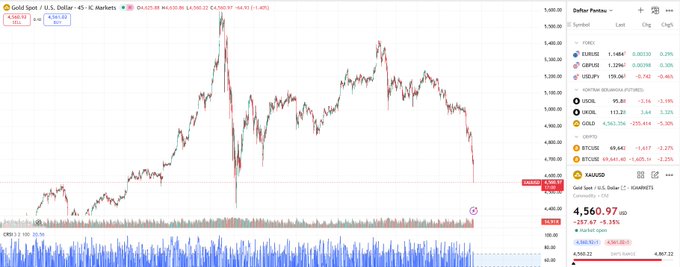
#Gold: “safe haven” 🛡️ also gold: doing what it always does nothing new ,even “safe” assets have their moments I stopped taking narratives at face value a while ago just watching where liquidity flows fina, incentives stay consistent… everything else is just a story..
FINA
0%
Loading..