avatar
Benson's Trading Desk
Follow
Posts
avatar
Benson's Trading Desk
02-07
This bear market is behaving at a completely different pace than previous ones. Bitcoin has fallen 50% from its high, but the S&P 500 has only retreated less than 3% from its all-time high. How unusual is this? Let's take a look back at history. December 2018: Bear Market Bottom BTC retreated 84% from its high, while the S&P 500 retreated 20% from its high, just hitting the threshold of a bear market. The panic selling on Christmas Eve was the most panicked moment since 2009. November 2022 Bear Market Bottom BTC has retreated 78% from its high. At that time, the S&P 500 retreated 25% from its high, marking its worst year since 2008. Have you noticed the pattern? In the two previous Bitcoin bear markets, the S&P 500 had already fallen by 20-25%, reaching a relatively low point in the long term. But this time, Bitcoin has already halved in value, while the S&P 500 has only retraced 3% from its recent high. This level of deviation has never occurred before in history. If you look closely at Bitcoin's chart, you'll notice something very strange. Since October of last year, Bitcoin seems to have lost its magic. When US stocks rise, BTC doesn't follow. When US stocks dip slightly, BTC plummets. So what exactly happened in October? Looking back, there were two major events. First: The 1011 Incident On October 10th, Trump announced a 100% tariff on China. The cryptocurrency market saw a $19 billion liquidation overnight, with 1.6 million accounts liquidated. BTC plummeted from $120,000 to $100,000. This was the largest single-day liquidation in cryptocurrency history. Second: In the "Double Zhi Case," Chen Zhi and Qian Zhimin were arrested almost simultaneously. The US government confiscated 127,271 BTC from Chen Zhi. The British government seized 61,000 BTC from Qian Zhimin. In total, nearly 190,000 Bitcoins were deposited into government cold wallets. What does 190,000 units mean? In July 2024, the German government sold 50,000 BTC, which drove the price of BTC down from 70,000 to 50,000 within three weeks. The total amount involved in this Shuangzhi case is nearly four times that of Germany. Given the precedent of Germany's cryptocurrency sell-off, the potential selling pressure of these 190,000 BTC is a ticking time bomb hanging over the market. The Huione exchange behind Chen Zhi was crucial to the liquidity of the entire crypto market. When this empire was taken down, it was equivalent to a huge liquidity provider in the altcoin market suddenly disappearing. The fact that Memecoin's total market capitalization halved from $80 billion to $47 billion after 10/11, and has not recovered to this day, is a microcosm of this event. Over the past few months, we have generally heard the following sentiment: Bitcoin's market capitalization is already very large, and with the existence of ETFs, volatility will be relatively low, so the pullback in the bear market should not be as severe as in the past. But now it seems that the impact of 1011 and the Shuangzhi case may be greater than we imagined. So, back to the original question: Has it bottomed out? Is it time to buy the dips? I don't know. But I do know one thing. If history has any reference value, the bottom for Bitcoin usually doesn't appear until the US stock market also acknowledges its mistake. Right now, the US stock market is still in the party. The music hasn't stopped.
BTC
1.32%
avatar
Benson's Trading Desk
02-06
This morning's BTC drop, calculated over a 200-day retracement period, reached -5.65σ. You might ask: what exactly does 5.65 standard deviations mean? Let's start with something you might have heard of: Six Sigma. This is the highest quality control standard in global manufacturing. Companies like Toyota, Intel, and Samsung have spent decades striving to achieve a quality control level of six standard deviations. In industry, six standard deviations means allowing only 3.4 defects per million iterations. In other words, this is the definition of "almost impossible" in industrial civilization. Yesterday's BTC volatility was only 0.35 standard deviations away from this "industrially impossible" scenario. If we use a normal distribution, the probability of a -5.65σ event occurring is approximately one in a billion. Of course, financial markets don't perfectly conform to a normal distribution; the fat-tail effect makes extreme events more frequent than theoretically possible. Even considering this, since the inception of BTC (July 14, 2010), this level of volatility has only occurred four times, accounting for a mere 0.07% of all trading days. If you were present yesterday, congratulations. You witnessed an event that is statistically "almost nonexistent." Even the deep bear markets of 2018 and 2022 didn't see such a rapid decline over a 200-day rolling period. This is a fatal test for all quantitative strategies. Because the essence of quantitative trading is to build price prediction models based on historical data. BTC's truly active trading volume and sufficient data for modeling only began around 2015. The vast majority of quantitative models on the market are based on data from this period. No one can predict what hasn't happened. A drop exceeding 5.65 standard deviations, excluding this instance, has only occurred three times in history. One of them was the flash crash on March 12, 2020, which was considered an outlier. The other two occurred before 2015, in the prehistoric era when quantitative models couldn't yet model them. In other words, after Bitcoin became a trillion-dollar asset, this level of volatility is almost unprecedented. CoinKarma's quantitative strategy is no exception; this time, there's a significant floating loss on paper. But we're still alive. Because our leverage has always been kept very low, only 1.4x, the drawdown has reached 30%. A 30% drawdown is painful. But at least we're still in the game. Every extreme market condition is tuition. But the prerequisite is that you're still alive to be eligible to pay this tuition. This absolute outlier market condition, contract data, and on-chain data are all the best nourishment for future risk control models. Only by surviving can we evolve.
BTC
1.32%
avatar
Benson's Trading Desk
02-03
If one day there's a run on gold, and investors find that their paper gold can't be exchanged for physical gold, Bitcoin will surge if this happens even once. Why? Because most people's "paper gold" purchases—whether in ETFs, futures, or bank gold accounts—have no legal obligation to be converted into physical gold. At maturity, they can settle directly with cash, without giving you physical gold. You think you're buying gold, but you're actually buying a price tracking tool. This system works because the vast majority of people don't want physical gold; they only want price exposure. They close out or roll over their positions before maturity; less than 1% actually demand delivery. But what if one day everyone really wants to exchange it for physical gold? In 2011, hedge fund manager Kyle Bass, while researching COMEX, found that there were approximately $80 billion in open contracts, but only $2.7 billion in deliverable gold in warehouses. He asked the head of the settlement department, "What if 4% of people request delivery?" The reply was, "That never happens; we rarely exceed 1%." Kyle Bass pressed, "But what if it did?" The reply was, "Price will solve everything." Kyle Bass said, "Thanks, give me the gold." Then he actually helped the University of Texas endowment withdraw $1 billion in physical gold. Because he knew that rights on paper and actually having it in hand were two different things. This incident has recently resurfaced. In February 2025, Elon Musk questioned on X whether Fort Knox's gold reserves still existed. He was told that the last complete public audit was in the 1950s, and there hadn't been one since 1974. Musk said he wanted to do a live-streamed visit: "This is the American people's gold, and the American people have the right to see their own gold." Senator Rand Paul responded, "I've tried for ten years and can't get in. Come on." Even the authenticity of the US government's gold reserves is being questioned. How reliable do you think the gold behind those ETFs and futures is? As precious metals enter a supercycle, and with the world becoming increasingly chaotic, user demand for physical gold will only grow stronger. One day, someone will expose this facade. And when the world discovers that those financial products "representing gold" don't actually have sufficient gold backing, trust collapses, and there's no going back. Bitcoin has 21 million coins, verifiable on the blockchain; no one can print more out of thin air. What you hold is what you hold; there's no leverage, no paper contracts. It might take 5 years, it might take 10. But I believe we will definitely see this scenario. That will be the true supercycle for Bitcoin.
BTC
1.32%
avatar
Benson's Trading Desk
02-02
Recently, rumors about Brother Sun have been flying everywhere. Here, I'd like to share my personal experience of being "ripped off" by Brother Sun. At that time, I had two accounts on FTX, a main account and a secondary account. Let me start with my main account. At that time, I had an extremely high level of faith in FTX, so I buy the dips. The official explanation was later that FTT was essentially an equity concept, meaning there would be no compensation. So my main account went to zero. Now let's talk about the trumpet. The smaller account held approximately $2 million. At that time, I believed what Justin Sun said: he was willing to provide a 1:1 guarantee on TRX from FTX. After withdrawals were closed, FTX had become a "Happy Beans" exchange, and many people, because of Sun's statement, went on a buying spree of TRX on FTX. The price of TRX skyrocketed to six times its off-exchange price. I also bought it without really understanding what was going on, and ended up with almost a ton of TRX. Later, when FTX filed for bankruptcy, Sun said: "The promise of guaranteed repayment will never be broken." Then what? And that was it. He never came out to explain again. This resulted in a significant decrease in the book value of the account when I finally sold it. When I sold it, the market price was about 62%, so theoretically I could have sold it for around $1.2 million. However, because I bought TRX at a premium, the bond buyers only accepted the off-exchange TRX price, so in the end I only sold it for around $150,000. 1.2 million turned into 150,000. All thanks to Brother Sun. When people are desperate, they really will do the most extreme things. I should have known that Brother Sun's behavior had always been very shrewd; he would never do anything that would be detrimental to himself. But I did not condemn him because of this. For me, trusting Brother Sun and then getting scammed is my own problem. I won't blame anyone else for my own mistakes. In the crypto, every time you get scammed, it's a lesson. Whether the tuition is expensive or not depends on whether you actually learn something.
TRX
0.29%
avatar
Benson's Trading Desk
02-01
Over the past three months, if there's one person in the Chinese-speaking world who's the most notorious Binance hater, I think I'm definitely one of them. Why am I speaking up for Binance now? Because the current state of the industry doesn't allow Binance to collapse. They've achieved their current position through both merits and demerits. It's impossible for them to have done everything wrong and still be standing here. Think about what happened after FTX collapsed. The damage to the industry wasn't just the price crash. The outside world's perception of the entire industry completely changed, and this impact continues to this day. If Binance were to collapse, I can foresee the worst-case scenario: The market share of the entire offshore exchange sector would shrink dramatically, making the entire industry even more difficult. Frankly speaking, FTX had a very significant impact on my life. If FTX hadn't collapsed, my net worth would definitely be more than 20 times higher now. If anyone has a reason to hate Binance, I think I'm the one with the most reason. I could harbor personal grudges and constantly criticize and attack Binance. But I've long since let go of those feelings. Believing in FTX is my own stupidity, and I shouldn't blame others for it. Regarding the victims of the 10/11 attacks, I will try my best to support them and encourage them to fight for their rights through legal proceedings. But on the other hand, I don't want Binance to collapse, because when the nest is destroyed, no egg remains unbroken. These two things may seem contradictory to many people. How can you support the victims while simultaneously not wanting Binance to collapse? But I don't think it's contradictory. Because there are no absolutely good people in this world. The more you do your duty, the more you might be seen as a bad person by others. An excellent business owner might be seen by the wives of employees as a scoundrel who deprives husbands of family time. A manager who strictly demands quality might be seen by subordinates as a difficult and fussy control freak. A war hero who fights for his country might be seen by the people of an enemy nation as an executioner who killed their loved ones. The same person, viewed from different perspectives, will appear completely different. The same applies to businesses. You can argue that Binance has done poorly in some areas, while also acknowledging their contributions to the industry. You can support victims in fighting for their rights, but also not want the entire industry to be dragged down with them. Everything has two sides, and the world isn't simply black and white.
avatar
Benson's Trading Desk
02-01
The fact that the top two offshore exchanges are arguing like this is really not a good thing for the industry. If Binance weren't an offshore liquidity hub, the 1011 crash wouldn't have caused such significant damage. Binance is like the main highway; if it gets congested, the entire transportation network is paralyzed. Normally, it's only right to compensate one's own users when something goes wrong. But Binance is too important; if something happens to it, the entire industry is affected. Binance certainly bears some responsibility, but this is also a structural problem within the industry. It's so big that it can't afford to make even the slightest mistake. However, anyone in the software industry knows that a system with 100% availability doesn't exist. Under extreme market conditions, the latency caused by high-concurrency transactions is almost the physical limit. Expecting Binance to "never make a mistake" is unrealistic; even Google and Amazon's uptime can't be 100%. And this time, it just happened at the worst possible time. CZ retweeted Dragonfly's post, which can be seen as an indirect admission that Binance API was delayed at the time. Let me reiterate my point: Binance bears responsibility in this matter, and has already taken some responsibility (by compensating its own users). If any users feel the compensation is insufficient and wish to pursue their rights, I fully support them. They should fight for what they deserve, and let the judiciary decide. But if exchanges start fighting amongst themselves, it won't benefit anyone. Instead of arguing, we should think about whether there are backup roads next time the main road is congested, and whether there are better solutions. If offshore firms cannot unite to establish a common risk control mechanism, the same thing will happen again. Last December, He Yi and Lao Xu were still able to take photos together and even talk about the issue of talent mobility, which proves that the two can communicate. The current state of the conflict is largely driven by public opinion. Humans are inherently bloodthirsty and love a spectacle; some are praising, some are criticizing, and both sides have their share of instigators. Hopefully, the bigwigs can set aside past grievances and work together to establish risk control mechanisms for offshore offices, instead of being swayed by online sentiment.
avatar
Benson's Trading Desk
02-01
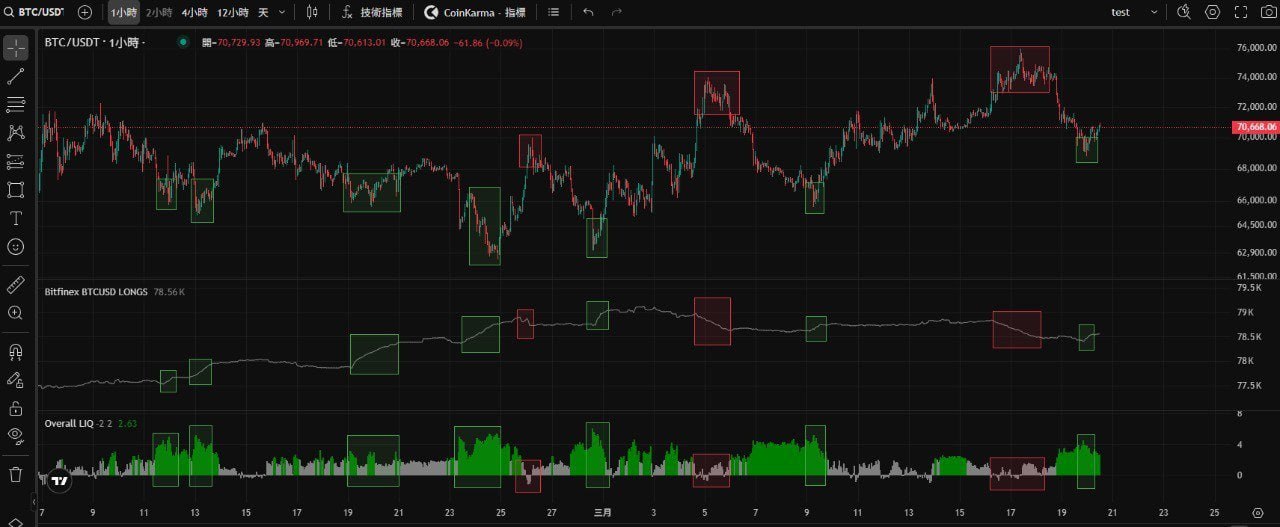
The 1011 insider whale on HL has been exposed, and $200 million has vanished. ETH has been significantly weaker than BTC since yesterday, and only started to rebound after hitting the liquidation line of whale early this morning. It's clearly targeting the liquidation of whale. Meanwhile, BTC spiked to 75K, and Binance's BTC perpetual contract open interest plummeted by 10,000 BTC, essentially releasing all the positions accumulated over the past month. LSUR also rapidly declined from its high. This pattern of "open interest rising in sync with LSUR during the decline" followed by "open interest and LSUR falling rapidly" is a typical example of short sellers gaining an advantage and then adding to their positions, causing a large-scale liquidation of long positions before withdrawing their selling pressure. I think there's a need for a rebound in the short term. First, the cost line of micro-strategies will provide psychological support. Secondly, there are no larger leveraged positions available for targeting. Unless there is another macroeconomic crisis, judging from the market's shareholding structure, most of the long positions have already been liquidated, and the short positions have no incentive to continue pushing the price down. My long position was stopped out at 84.5K, so I re-entered some long positions below 80K, and the current average price is around 78K. We've profited handsomely from this pullback, but having been making money since the end of November last year, the headwinds were bound to come sooner or later; there's no escaping them. Since 1011, quantitative long positions have been halved and running, and the current drawdown is controlled at around 15%. We encounter this kind of headwind period about three or four times a year. Normally things go smoothly, but when it's headwind, we try to control the decline. The strategy will automatically exit long positions once prices rebound and the MPI rises. Stop-loss is also part of trading; just take it in stride. I've been through this many times before.
BTC
1.32%
loading indicator
Loading..