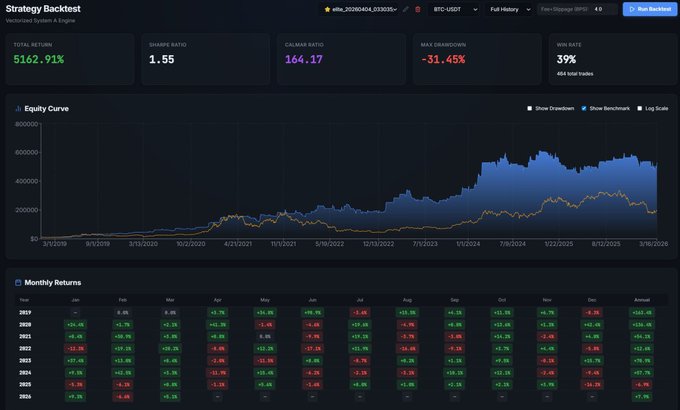
These past few days, after immersing myself in development, I've gained a new understanding of the market... that is, trading based on candlestick charts inherently has disadvantages... Candlestick charts are information output after market interaction, processing, and rendering; essentially, they are equivalent to an indicator. The true raw data exists at a much deeper level, which is why high-frequency quantitative trading only uses ticker data.
Although I've completely abandoned high-frequency trading, this understanding can be applied to the overall market: A single 4-hour candlestick chart contains an astonishing amount of information, but the chart forcibly reduces this multi-dimensional state to two dimensions...
This is similar to the difference between Newtonian classical mechanics and microscopic quantum mechanics. Low-frequency traders can still predict and bet on macroscopic price movements through minute market patterns, but the same strategy is completely useless at the microscopic level...
Therefore, given the extremely limited personal computing power, our trading is essentially a "classical mechanics" deduction leaning towards the macroscopic world. However, because this is so easy to calculate, stable profit alpha based on candlestick chart systems is almost nonexistent in the market...
Ten years ago, when computing power was insufficient, many simple quantitative strategies could make a lot of money, but now, they're a dead end...
So where does our way out lie?
Observing successful traders, one very difficult factor to quantify is "luck," and almost no strategy can clearly describe what this so-called luck is.
Perhaps this could be an interesting direction?
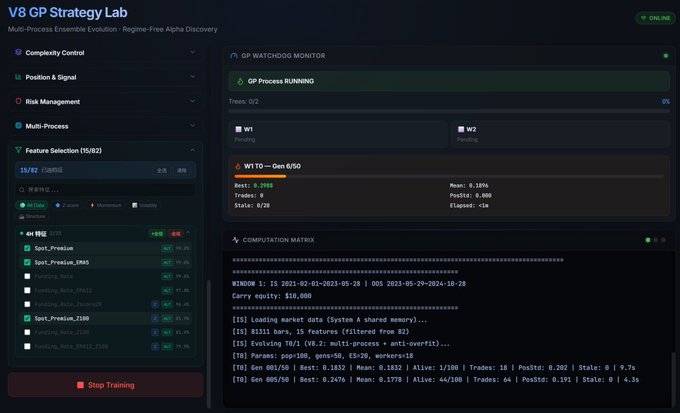
Once this genetic algorithm is finished, my next idea is to use pi as the random source for trading decisions, add a coefficient, and perform historical analysis to find the coefficient that performs well, thus finding a seed of market luck... I wonder if this is verifiable?
I'll have the agent quickly run a prototype for me first, and I'll update tomorrow~
twitter.com/CryptoPainter/stat...