avatar
캘빈의 감금원
Follow
Posts
avatar
캘빈의 감금원
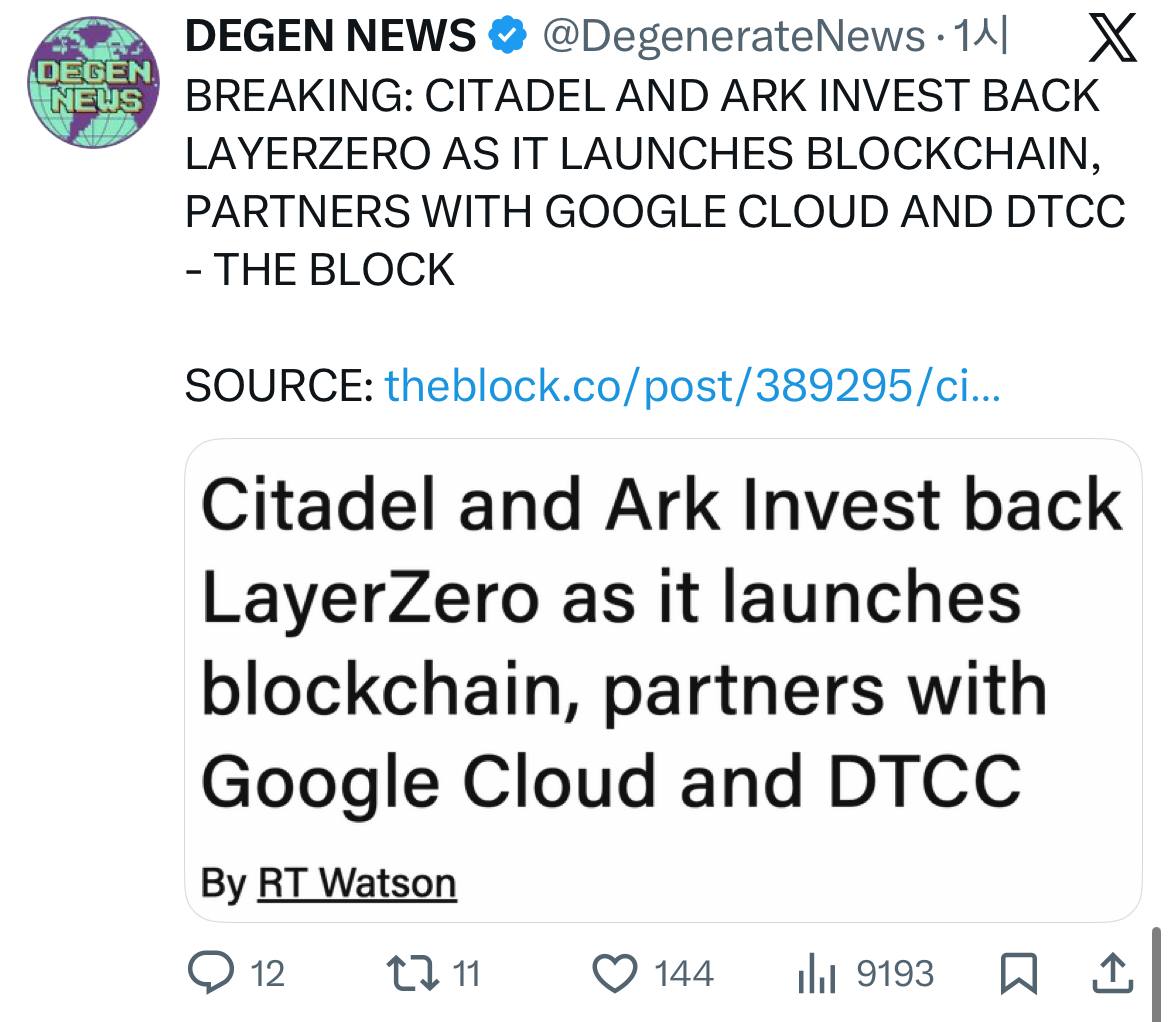
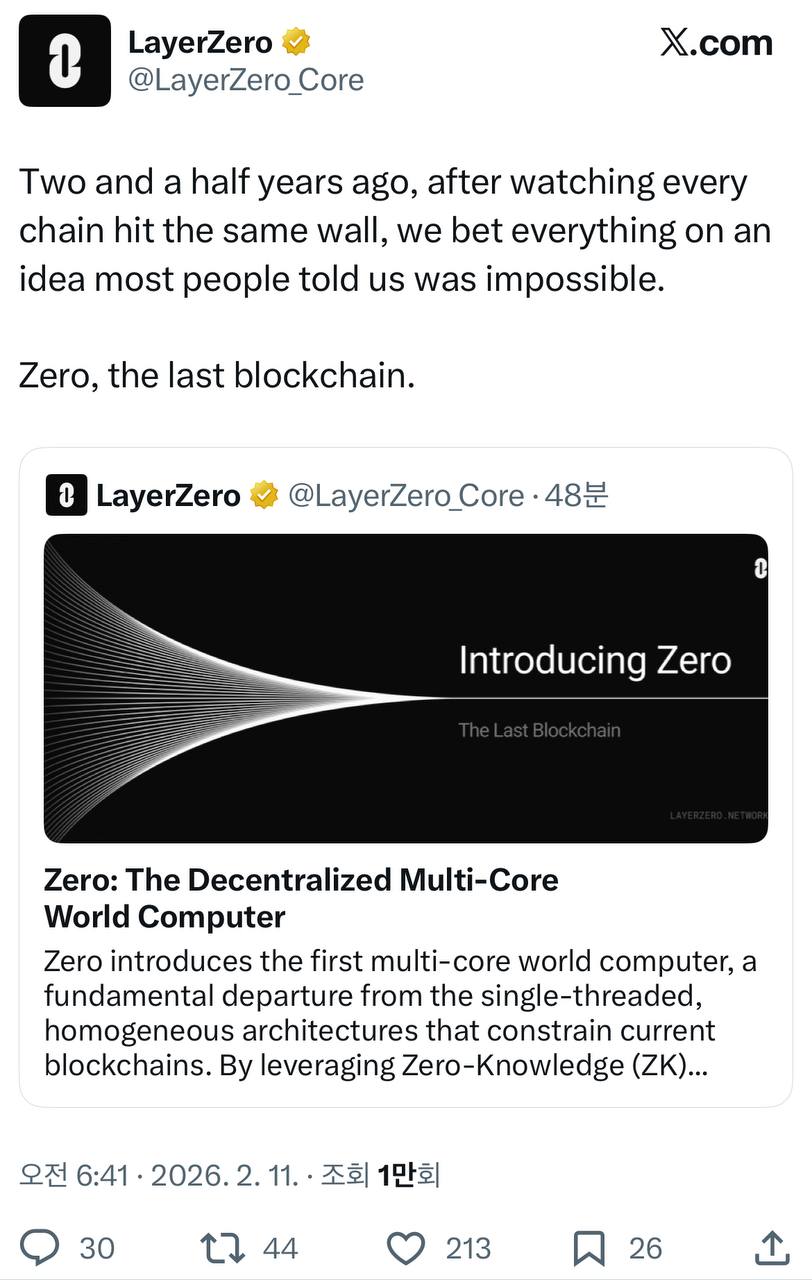
Layer Zero was supposed to launch a new chain, as leaked. I just read the lightpaper, and if implemented as is, it would be huge news in terms of infrastructure. The details are a bit complex, so let me summarize them as simply as possible: - Decentralization: Anyone can be a validator. There's no minimum delegation. While you can delegate to Senators, the higher-level governance participants, you can also participate directly in governance. ZKVM-based validator requires minimal performance. - Built-in L2: Zero has multiple execution shards called Zones, each handling different tasks. Zones can theoretically have arbitrary execution environments. Zone creation, modification, and upgrades must all go through Zero's on-chain governance. Zero serves as the settlement layer for Zone (verifying validity proof of computations). The various technologies Layer Zero has announced so far, such as QMDB, SVID, and FAFO, all seem to have been built for Zero. Zone will reportedly create three services: general smart contracts, global markets, and payments. Global markets will feature a completely self-built execution environment, while payments will feature privacy-focused features. Notably, the Day 1 partners for the global market zone include Citadel, DTCC, and ICE (parent company of the NYSE), and Cathie Wood has been appointed as an advisor. Based on the Lightpaper, the current token ZRO appears to be set to become Zero's native token. My personal impression is that this is what would happen if the lean Ethereum roadmap were frontrun. I'll be sure to follow up on CT today, as there will be a lot of discussion about this. Tech Blog: layerzero.network/blog/zero-te... Tweet: x.com/layerzero_core/status/20... Tweet 2: x.com/layerzero_core/status/20... * I am a ZRO holder
ZRO
20.89%
avatar
캘빈의 감금원
02-07
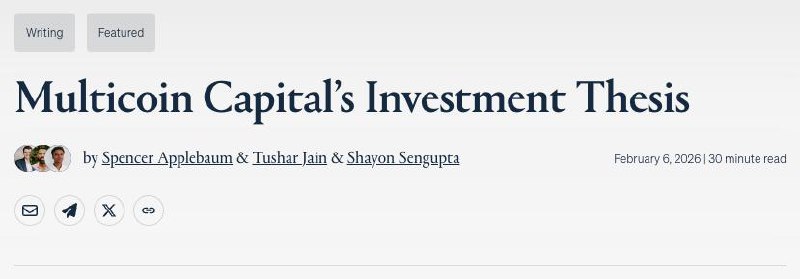
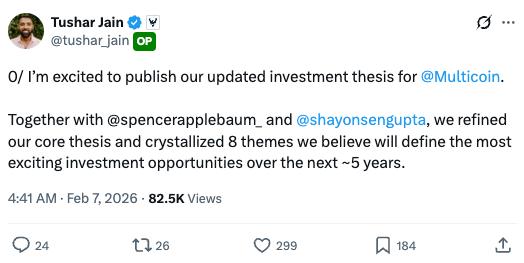
Multicoin's Investment Thesis Update. This is their thesis for their investment portfolio, so you can take a quick look and see what they're thinking. Full Text: assets.ctfassets.net/qtbqvna1l... 1. Fintech 4.0 • Specialized stablecoin fintech with better unit economics at lower costs • Covering most of the fintech stack (e.g., Altitude) • Companies providing stablecoin accessibility to global users/enterprises (e.g., p2p.me, El Dorade) 2. DeFi • Consumer-facing front-end (e.g., Phantom, Fuse Wallet, Robinhood) • DeFi-based company equity (e.g., Coinbase, Morpho) • DeFi middleware (e.g., Li.Fi, Fun.xyz, Yield.xyz) • DeFi protocols (e.g., Kamino, Drift, Aave, Ethena) 3. Financial globalization • Liquid market tokenization (e.g., Paxos) • Global accessibility of synthetic derivatives (e.g., Drift, Hyperliquid, Lighter) • Black market decentralization and efficiency (e.g., BAXUS, Triumph) • New markets (e.g., Kalshi, Sway) • On-chain microstructures (e.g., DFlow, Jito, FastLane) 4. More efficient borrowing/lending • Kamino, Aave 5. Entertainment economy • Cheddr, Novig 6. Programmable ownership • DePIN (e.g., Hivemapper, Render, io.net, Geodnet, Pipe, Gradient) • Internet labor markets (e.g., CrunchDAO, Fuse) • Virtual markets controlled by DAOs (e.g., Jito, Drift, Kamino) • Exploring the Equity 2.0 market 7. Trusted, neutral blockchains • Blockchains with corporate interests will struggle to attract third-party builders and liquidity • Currently, Aptos, Solana invested in Say. 8. Cryptographic Primitives • Zama, Fheniz, zkMe
FUSE
7.93%
avatar
캘빈의 감금원
02-05
In modern society, privacy is a fundamental right. However, in centralized structures, individuals lose control of their data and become the unprotected victims of numerous personal information leaks. While blockchain might offer a solution, existing protocols like Zcash and Monero are limited by their dependence on specific chains or their ability to provide privacy at the level of simple asset transfers. In particular, the technical limitations of requiring multiple parties to participate in computation make these chains particularly vulnerable to applications in DeFi models or AI. As an extension of this discussion, I've been researching new privacy chains, and I recently read Siwon's post about Arcium. Arcium is a project that adopts multi-party computation (MPC) as its core technology and attempts to overcome the limitations of existing privacy chains through distributed processing. Furthermore, I learned that Arcium is designed as a computation layer, rather than an independent L1, to provide privacy features as plugins across various chains, enabling use cases similar to Umbra. Ultimately, I believe Archium's goal is to make privacy a fundamental foundation, not a special feature. If it can serve as a universal computing layer between fragmented chains, it could accelerate institutional-grade on-chain finance and private AI learning. It will be interesting to see how general-purpose solutions like Archium address this structural flaw. In particular, it will be fascinating to see whether Archium can move beyond being a standalone solution and work in complementary ways with various emerging privacy chains, ultimately raising privacy standards across the entire ecosystem. The original article can be found here. The ecosystem section is worth a look! Full issue article (post) | Full issue article (website)
MPC
4.75%
loading indicator
Loading..