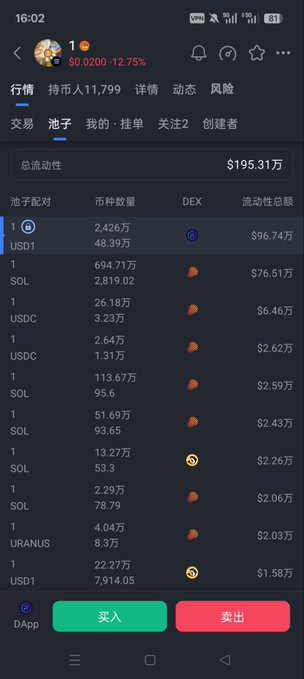
This is a sharing of experience from our community member on how to judge whether a pool has market manipulation. Our community is truly full of hidden talents; we're seeing more and more members like this recently. Since his Twitter account was recently suspended, we'll tag him again next time.
I. Basic Pool Analysis:
On the SOL chain, the key to determining whether a coin has market manipulation and the strength of that manipulation is to look at its pools.
Tools: Download AVE (or a similar DEX tool), copy the contract address, paste it into the search bar, and enter the token's page.
After entering the page, click on the Pools or Liquidity section to view all trading pairs.
II. Understanding Pool Structure:
The first pool is usually the project's initial pool, mostly created and locked by the platform, so it's not very relevant. Focus on observing the second and subsequent pools, as these reflect real market behavior and are key to determining whether there is market manipulation.
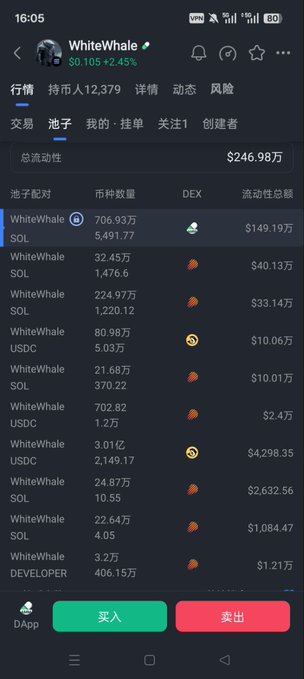
III. Analyzing Pool Trends: Based on the WhiteWhale pool information in the image, you can analyze it as follows:
Observe the pairing ratio: If the SOL quantity > the token quantity (as shown in some pools with a large SOL quantity), it indicates that funds are flowing in, possibly indicating an accumulation phase;
If the token quantity > the SOL quantity, or a one-sided pool appears, it may indicate that holders are selling to cash out;
Observe the liquidity scale: As shown in the image, the total liquidity is $2.4698 million, indicating that the project has a certain amount of capital accumulation and market depth, making it difficult to be easily manipulated;
Observe the pool creation time and new additions: If new pools appear early in the token's listing period (especially with a large SOL proportion), it often means that investors are entering the market, indicating significant upside potential;
Continuous new liquidity injections indicate increasing project popularity or investor attention;
Continuously monitor pool changes: Changes in pool funds and pairing ratios can reflect investor intentions. It is recommended to check regularly to help determine buying and selling opportunities;
IV. Simple Summary:
Operation: Use AVE to check the token → View "Pools" → Focus on the second and subsequent pools;
Judgment:
High SOL content → Potential accumulation;
High coin content → Potential distribution;
Early pool additions → Watch for takeoff opportunities;
Example: As shown in WhiteWhale, it has high liquidity and multiple SOL pairing pools. Further observe which pool has an increasing SOL percentage;
The above content is for learning and reference only and is not guaranteed to be 100% accurate. We hope everyone will summarize their experiences in practice.