It's great to have the opportunity to discuss the liquidation issue of $IBIT with Professor Jiang.
First, we need to clarify a few details.
1. The Bitcoin spot ETF trades the ETF itself, not $BTC.
2. The secondary market trading of the BlackRock spot ETF is for $IBIT, and only IBIT.
3. The only instances of Bitcoin in the spot ETF involving Bitcoin are in the primary market buying and redemption, which are provided to BlackRock by various APs (although not market makers, they can be understood as such).
4. When users in the primary market need to issue new IBIT, BlackRock requires APs to provide spot BTC as "certificates" for the corresponding new IBIT issuance. This BTC is held in custodial wallets and cannot be used or traded by BlackRock or any other organization; it is regulated. Currently, the custodian is Coinbase.
5. When users in the primary market need to redeem IBIT, BlackRock needs to transfer BTC to AP. AP then sells the BTC and transfers the funds to BlackRock, which then completes the redemption.
6. Here's the key point: please note that AP's provision or sale of BTC may not be through the market, especially not through the secondary market. AP may even be holding BTC itself. For AP, it only needs to complete the transaction within T+1 timeframe with the required BTC or USD. Therefore, the less than 6,000 BTC sold across the US on Thursday represents all the BTC sold by the ETF. This portion may not all enter the market; even if it does, the maximum is only 6,000 BTC.
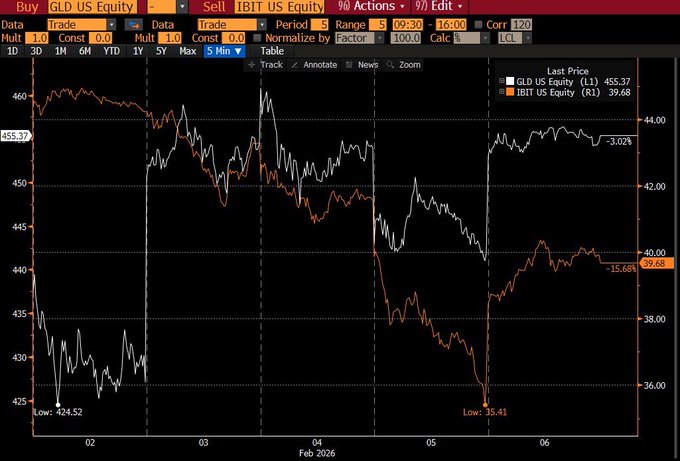
7. IBIT itself tracks the price of Bitcoin, which is also very important!! ETFs track price, not BTC itself. This is similar to $MSTR (only the presentation is similar, the structure is different). Does a rise in MSTR necessarily mean a rise in BTC, or a fall in MSTR necessarily mean a fall in BTC? Nobody believes that. And does the price change of MSTR itself affect the price of BTC? There's definitely no direct transmission, because MSTR is an independent asset. The same applies to IBIT.
IBIT tracks the price movement of BTC. If BTC rises, IBIT will rise 99.99% of the time. But if BTC rises by 20% today, and BlackRock suddenly announces that its stored BTC has been stolen and cannot be compensated, then IBIT will definitely fall. That's the logic.
8. Will IBIT's secondary market affect the spot price of BTC? There's no direct transmission. Jiang mentioned that the secondary market received sell orders from market makers, which is possible, but at most 6,000 BTC—that's the upper limit. Furthermore, it's almost impossible for AP to sell any more BTC to the market. The only BTC AP can obtain is from transfers from all ETF institutions, including BlackRock. On Thursday, less than 4,000 BTC were transferred out of IBIT, so I don't believe the sharp drop was due to those 4,000 BTC.
9. It's possible that AP itself has other BTC to sell, but this is unrelated to IBIT. AP is independent and has its own BTC reserves and trading. However, the only BTC AP can obtain from IBIT is from the primary market exits; not even 0.01 BTC more.
10. All the pressure in the IBIT secondary market is concentrated on the IBIT stock itself. Buying and selling IBIT is equivalent to buying and selling BTC (price fluctuations), and it doesn't actually affect BTC itself.
The above is open for friendly discussion between Mr. Jiang (@Jiangzhuoer2) and everyone else.