Have you ever imagined a world where all the information you collect and transmit must pass through the hands of one or a few "big guys" to be able to operate? That is the current state of the internet today, where giants like Google, Facebook or Ebay hold sway. What are the consequences? High costs, expensive processes and lack of competition.
The birth of DePIN promises to completely change this picture. What is DePIN? How does it work? And why is DePIN XEM the new “narrative” for the cryptocurrency market in the 2024-2025 growth cycle?
Let's explore in this article!
What is DePin?
DePIN, short for Decentralized Physical Infrastructure Networks, is a decentralized physical infrastructure network that uses blockchain technology for management and operation. Unlike the current centralized model controlled by large corporations such as Google, Facebook, or Amazon, DePIN opens up opportunities for everyone to participate in building and maintaining infrastructure. DePIN is Chia into three main categories, each consisting of many smaller arrays suitable for specific purposes:
- Cloud storage network (Server Network): Used to store files, databases, CDN and VPN networks, cloud rendering, etc. For example: Filecoin, Arweave, STORJ, Render Network.
- Wireless Network: Includes technologies such as 5G, LoRaWAN. For example: Helium.
- Sensor Network: Connects devices to collect real-time data from the physical world, like Hivemapper's mapping system or Arkreen's energy fusion system, React.
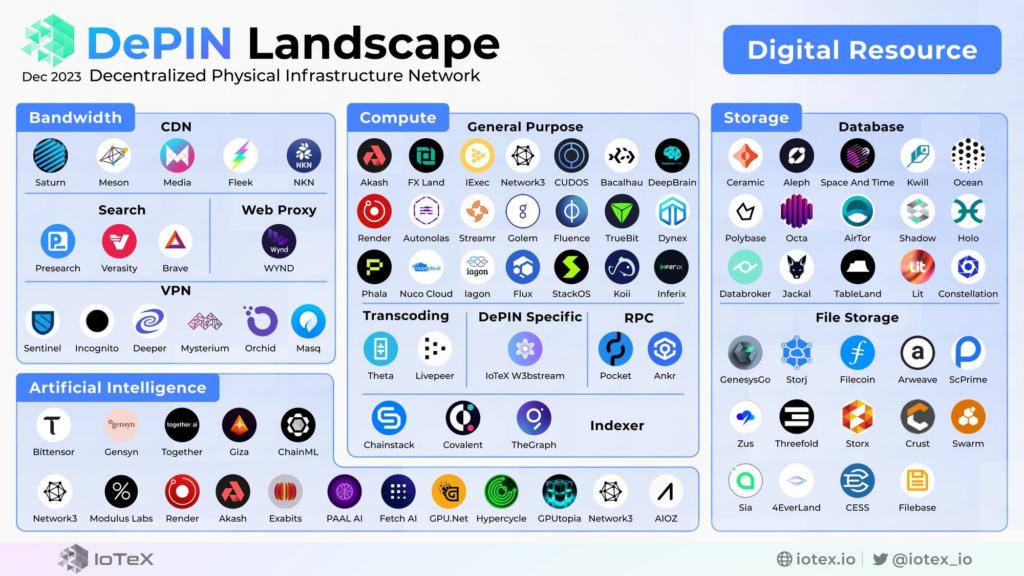
DePIN has evolved into a new trend in the cryptocurrency market, with the potential to change the way global physical infrastructure operates, bringing innovation and competition over traditional models. system.
DePin's formation history
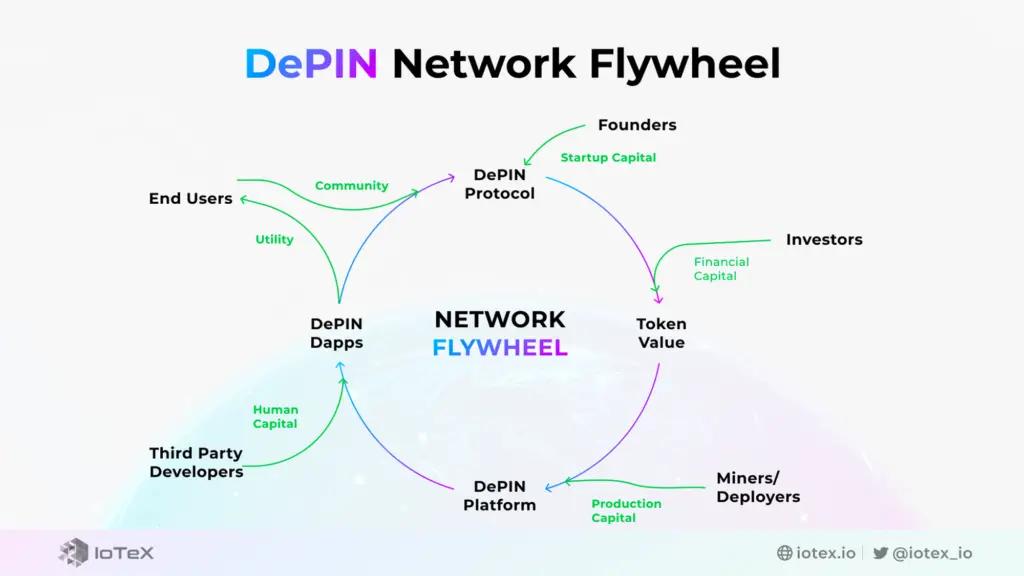
The idea of DePIN originates from the belief of Web3 developers that people around the world can come together to build an infrastructure network without the intervention of third parties and without the need for trust. think of each other. Once this network is built, it will attract users to participate and contribute to its growth. Those participating in building and operating the network will Chia rewards in the form of Token from user fees. This will create a "vicious cycle" in which increased demand drives stronger development of the network.
In November 2021, IoTeX – a blockchain project serving the Internet of Things, launched the idea of MachineFi. MachineFi is the financialization of smart device and artificial intelligence resources, bringing value and ownership to everyone through the integration of blockchain technology.
In 2022, a series of ideas about building a decentralized physical infrastructure network were born:
- April 2022: The Proof of Physical Work (PoPW) consensus mechanism is launched, incentivizing participants to build hardware networks, including wireless, mobile, environment, computing and storage.
- July 2022: TIPIN is introduced as a network that uses Token incentives to motivate users to contribute to the deployment and operation of physical infrastructure, creating an efficiency model and more fair.
- September 2022: EdgeFi appears, focusing on deploying hardware resources close to end users at the edge of the network, prioritizing edge computing – close to the source of data and requests most processed.
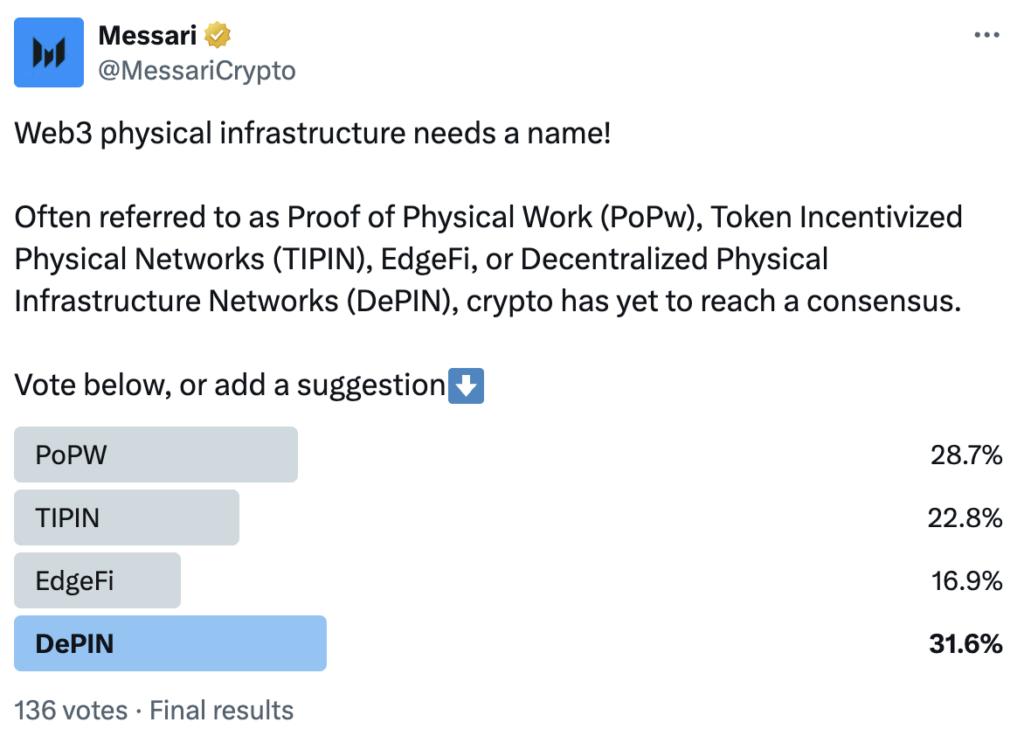
By November 2022, realizing there were too many terms related to Web3 physical infrastructure, Messari decided to give the concept a common name by opening a poll on Twitter. The community voted between PoPW, TIPIN, EdgeFi and DePIN, with DePIN winning with 31.6% of the votes.
DePin's difference compared to traditional models
The traditional operating model similar to DePIN is Chia Economy, in which one party provides resources and goods, and the other party Chia information networks and customers. Both parties then Chia the profits. This model is applied on famous platforms such as Airbnb, Shopee, eBay...
However, the disadvantage of Sharing Economy is decentralization. The provider's benefits depend entirely on the party Chia the network. For example, in the case of Grab, according to Vietnamnet newspaper, Grab increased the discount from 22% to 25% and even reached 28% at the end of 2018 - 2019. This reduces the monthly profit of drivers to 50%, greatly affecting their income.
DePIN was born to bring decentralization to the Sharing Economy model, by using Token governance to ensure fairness for both providers and Chia .
For example, if Grab uses the DePIN application, drivers can receive Grab Token through passenger activities. These Token have the value of being converted into cash, and at the same time allow drivers to participate in voting and project management of the party Chia the application and information. This creates a fairer ecosystem where both sides have a voice and balanced interests.
How DePin Works
DePin operates based on the following basic structure:
Physical infrastructure
- Hardware: The physical components that connect the network to the physical world, such as hotspots for wireless networks, servers for cloud networks, and other devices such as solar panels or vehicles.
- Hardware Miner: Users who buy or lend hardware and connect to the respective network, play an important role in maintaining and growing the network.
Off-Chain -chain infrastructure
- Middleware: Intermediary components connect data from the real world to the blockchain. Data from real-world user activity is recorded and the fees they pay are distributed to hardware vendors via blockchain.
- Oracle services: Helps collect and transform data from physical infrastructure into blockchain systems, ensuring data transparency and accuracy.
Token Incentives ( Token incentives)
- Token: Used to reward individuals who contribute to the system. Hardware miners receive Token for participating in building and operating the network. These Token can be converted to cash or used to participate in project governance.
- Token Governance: Users can use Token to participate in voting and project governance, ensuring fairness and transparency in the system.
End user:
- Infrastructure users: Once the network is established, end users can start paying to use DePIN's services in the real world. This fee is redistributed to hardware miners and contributes to the system.
For example, in the case of Helium, a DePIN WiFi hotspot project, hardware miners are incentivized through receiving HNT Token for providing hotspot services. This attracts many people to join the network, helping the network expand quickly. As a result, a hotspot costs about 500 USD but can bring in 4.82 HNT/day, allowing miners to recoup Capital in just 25 days.
Pros and cons of DePin
Advantage
- Bringing high efficiency to suppliers : DePIN brings outstanding efficiency to suppliers through the Token incentive mechanism. This mechanism has proven effective in many different areas of the crypto market such as DeFi, GameFi with outstanding projects such as STEPN, Lido Finance or Curve Finance.
- Create opportunities to earn income : According to Statista, the number of Internet users has always grown strongly over the years. As demand for infrastructure increases, the ability to make money from contributors also increases.
- Reduce service costs : DePIN helps reduce service costs by breaking the monopoly of large Web2 providers. This helps lower service costs and reach more users.
- Robust development speed : DePIN is capable of scaling and building much faster than Web2-only resources. According to many sources, DePIN's growth rate can reach 10-100 times that of Web2.
- Decentralization : DePIN uses blockchain technology, making transactions between users and customers transparent, while increasing decentralization in the network. This is DePIN's biggest strength when converting from centralized to decentralized.
- “ Chia Economy” model : DePIN applies Chia economy principles, distributing costs and responsibilities for infrastructure construction among participating parties, creating a more equitable and efficient model of expense.
- Low Cost : DePIN users can enjoy lower costs compared to traditional models. For example, in data storage, they can choose services like Filecoin or STORJ with more affordable prices and opportunities to earn Token.
- Expanding the scope of innovation : DePIN removes barriers to entry, encouraging competition from new players in markets that were previously dominated by large players.
Defect
- Time consuming to build and deploy : DePIN apps require a longer period of time to build and deploy than typical consumer apps, making it difficult to earn initial income .
- Fierce competition : DePIN must compete with giants in the Web2 field such as Amazon, Microsoft and Google. The dominance of these names creates huge barriers and requires professionalism and continuous innovation to compete effectively.
- Increasing storage costs : Increasing node requirements may lead to increased storage costs in the future. DePIN needs to make efforts to improve infrastructure to meet the needs of hundreds of millions, even billions of users.
- Poorer user experience : User experience on current DePIN platforms is still inferior to Web2 platforms. Users often prefer to use the service in places where they feel safe, which makes it unlikely that DePIN will achieve mass adoption in the near future.
- Legal and technological barriers DePIN is facing development barriers in its operating model, has not yet achieved sustainable revenue and may encounter legal and technological barriers.
Top 5 outstanding DePin projects
Filecoin (FIL)
Filecoin is a cutting-edge project in the field of decentralized data storage, using blockchain technology to provide a secure and reliable storage network. Users can store and retrieve data on the platform, with incentives created through economic incentives. The FIL cryptocurrency is not only used to pay for storage but also extends its utility by providing services to other platforms. The Filecoin network also promotes interoperability with other blockchains, facilitating interoperable and seamless transactions.
IoTeX (IOTX)
IoTeX envisions an open, secure and human-centric ecosystem, uniting autonomous devices and users in the “Internet of Trusted Things”. The platform ensures that users' data, identity, and privacy are always under their control. In an era of rising data and privacy concerns, IoTeX provides users with a safe place to protect their personal information.
Helium (HNT)

Helium is a decentralized peer-to-peer wireless network built on a blockchain platform. This project provides a secure and cost-effective solution for IoT devices, allowing them to interact seamlessly with the Internet. Helium's wireless network uses blockchain technology to create a decentralized infrastructure, ensuring reliability and efficiency for IoT devices. This approach improves scalability and reduces operating costs compared to traditional centralized networks.
Render Network (RNDR)
Render Network is an advanced platform that supports Chia of idle Graphics Processing Units (GPUs) between users. This system allows the power of the GPU to be exploited for rendering purposes, especially in products such as 3D effects in movies and graphics. Users can register their idle GPUs on the network, become node operators, and earn RNDR Token through rendering work. Render Network is chosen by many people because of its usefulness and income opportunities it brings.
Arweave

Arweave is a groundbreaking platform for storing data on decentralized computer networks through the “blockweave” storage model. This platform allows for permanent data storage, even when the storage computers are offline. Arweave uses the Proof of Access algorithm to establish the world's first permanent data storage system. The AR coin operates on its own blockchain protocol, providing a comprehensive ecosystem for users looking for secure, long-term and cost-effective data storage solutions.
summary
With the continuous development of blockchain technology and cryptocurrency, DePIN has strong development prospects in the future, aiming to compete fairly with giants in the Web2 field. While becoming a long-term trend is a major challenge and may depend on market drivers, DePIN opens up opportunities for breakthroughs in the way physical infrastructure is managed and operated. matter.
Hopefully the information about DePIN in this article will be useful for your research and investment process. Wishing you successful investing and gaining insight into this potential industry.
Follow CoinMoi to update the hottest issues of the crypto market Please!!!
The article What is DePin? Top 5 outstanding DePin projects today appeared first on CoinMoi day.