Author: Jordan Yeakley, CFA @Delphi Digital Leia Translation: TEDAO
TL;DR
1. Ethena’s USDe grew from zero to over $2.2 billion in less than a month, becoming the fastest growing “stablecoin” in history.
2. USDe is backed by a delta-neutral ETH position, balancing risk through collateralized ETH and corresponding ETH perpetual futures short positions.
3. Ethena introduces BTC as additional collateral, enhancing its scalability and yield.
4. This approach makes USDe more capital efficient than traditional stablecoins and leverages the high yields of stETH and perpetual futures.
5. Ethena’s architecture is based on minting and redemption through liquidity pools, and authorized participants (APs) are responsible for balancing liquidity.
6. The main risks include counterparty risk, negative funding rate risk and automatic deleveraging risk. Ethena takes a number of measures to mitigate these risks.
7. Currently, USDe can expand to a market size of US$7.2 billion, and in the future it can expand to US$12 billion if the prices of ETH and BTC rise.
8. Ethena effectively adjusts DeFi and CeFi interest rates and leads a new paradigm for interest rates. More projects will be integrated with its benchmark yield in the future.
Friendly reminder: The market is risky, so be cautious when investing. The content of this article is for reference only and does not constitute any investment advice.
introduction
The stablecoin duopoly is being challenged. In less than a month, the supply of USDe has rapidly grown from zero to over $2.2 billion, making it the fastest growing “stablecoin” ever. The fundamental reason for this early achievement is that Ethena takes a completely different approach from the “synthetic dollar” in the market concept.
In addition, Ethena found product-market fit early on by popularizing the opportunity of Delta-neutral basis trade, making it seamlessly integrated with other DeFi services and products, and meeting the market's huge demand for returns. At the same time, building USDe as a "synthetic dollar" enables Ethena to take full advantage of the network effects inherent in being a monetary asset.
In this report, we will explore the Ethena opportunity and dissect how USDe and sUSDe work. We will also point out why Bloomberg's call it "the closest thing to a risk-free bet" is not completely risk-free. Finally, we will explore the second-order impact of Ethena on other parts of DeFi.
Stablecoin opportunities
Stablecoins are one of the few cryptocurrency use cases that have found meaningful product-market fit. Not only have they demonstrated their advantages as an effective monetary safe haven, they have also played a key role in connecting decentralized finance (DeFi) with centralized finance (CeFi), driving the smooth integration and collaboration between the two.
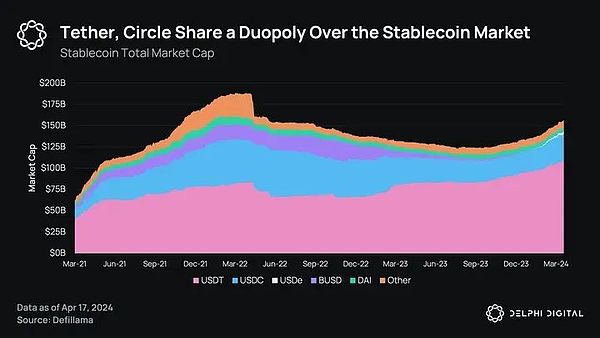
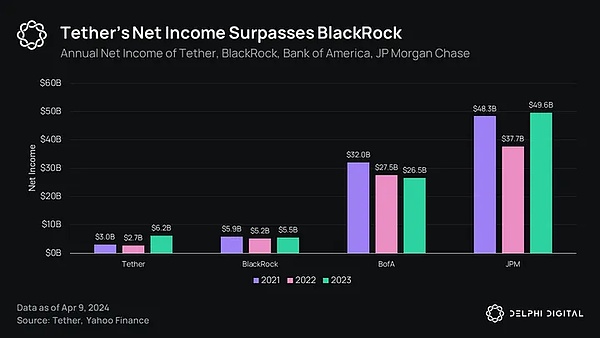
Currently, Tether and Circle dominate the stablecoin market, accounting for a combined 90% of the market share. Tether alone achieved $6.2 billion in net revenue last year, exceeding the net revenue of Blackrock, the world's largest asset issuer. However, it is worth noting that this value is not returned to stablecoin holders.
While in a more dynamic market structure, new entrants could erode Tether’s margins by redistributing profits through native yields, the stablecoin market is not a perfectly competitive market. Emerging alternatives face high barriers to entry due to inherent liquidity network effects and the trend of stablecoin standards becoming increasingly embedded in DeFi and CeFi structures.
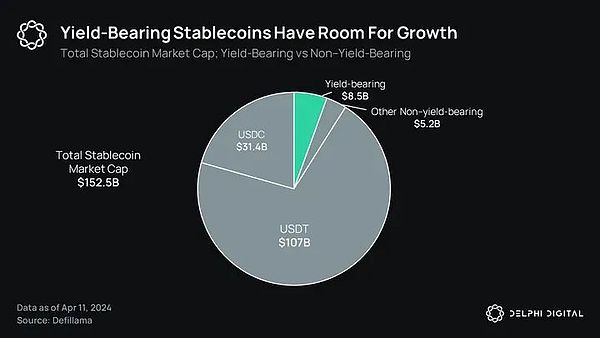
Therefore, the market demand for a sufficiently liquid yield-generating stablecoin remains unmet. Yield-generating stablecoins currently only account for 5.6% of the total stablecoin market capitalization, which clearly shows that the existing stablecoin model is insufficient in meeting market demand.
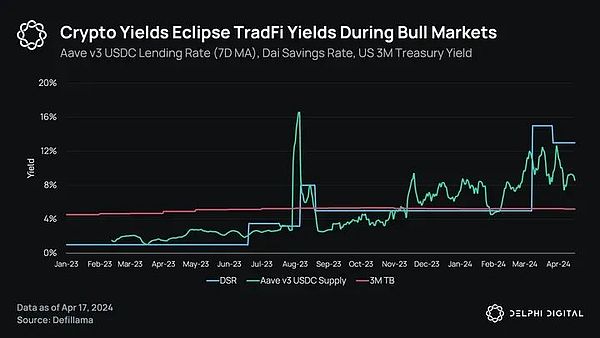
On the one hand, RWA-backed stablecoins appear to be betting on the wrong horse. Bringing traditional finance (TradFi) rates to cryptocurrencies may be an attractive value proposition during a bear market, but once crypto-native yields exceed Treasury yields, these products will become increasingly unattractive to users.
In contrast, Collateralized-Debt-Position (CDP) stablecoins have the opposite problem. While this model leverages “crypto-native” interest rates to some extent, capital efficiency quickly becomes its limiting factor. In other words, the scalability of CDPs like DAI is undermined by the need to collateralize 1 DAI, whose debt is worth far more than 1 USD.
In light of the above, now is an appropriate time to explore how Ethena is taking a completely different approach to breaking the Tether and Circle duopoly.
Ethena’s approach
Unlike existing stablecoin models that use RWA or CDP as collateral, Ethena's USDe is backed by a "Delta-neutral" ETH position. In other words, each USDe is collateralized by a long staked ether (stETH) position and hedged by an equal value of a short position in an Ethereum perpetual futures contract (ETH-PERP).
Positive Delta (stETH) + Negative Delta (short ETH-PERP) = Delta Neutral (USDe)
Therefore, if the ETH price moves from $3,000 to $2,500, the short ETH-PERP position will offset the price movement by $500. Similarly, if the ETH price rises to $3,500, the short ETH-PERP position will be reduced by $500.
Recently, Ethena also added BTC as additional collateral. Similarly, BTC will be paired with an equal value of empty BTC-PERP position to design the same delta neutral support. The only difference is that ETH collateral can be staked to earn additional yield, while BTC cannot. Therefore, regardless of liquidity constraints, Ethena may tilt more on stETH allocation.
Given that the Ethena model presents fundamentally different risks than CDP- and RWA-backed stablecoins (which we will discuss later), the market quickly labeled USDe as a “synthetic dollar” rather than a true stablecoin. While this classification seems reasonable, it is worth noting that the USDe model has two structural advantages over existing yield-based stablecoin designs.
First, Ethena is more capital efficient than CDP. USDe’s Delta neutrality means that only $1 of collateral is required to mint 1 USDe. Therefore, Ethena is able to scale more efficiently than CDP stablecoins such as DAI.
Second, USDe is able to leverage two of the highest-yielding crypto-native yield streams:
Profits from staking ETH
Perpetual Futures Funding Rate
For context, the return on staking ETH has historically averaged about 4-5% annualized, with recent data showing about 3.4%. Ultimately, this return is determined by three factors: (1) inflation rewards at the consensus layer, (2) execution layer fees paid to Ethereum stakers, and (3) miner extractable value (MEV) paid to Ethereum stakers.
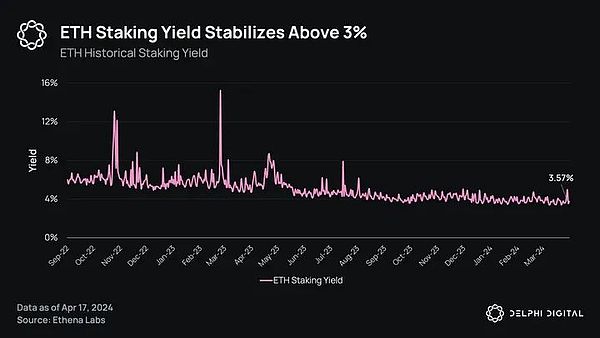
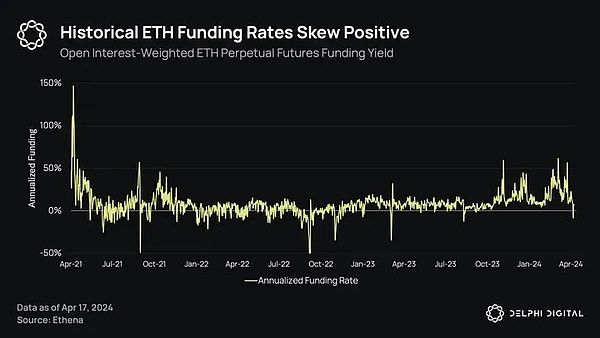
While the returns from staking ETH have historically averaged higher than Treasury yields on a standalone basis, the majority of USDe’s returns come from the second part of the Delta-neutral trade. Given that the natural state of funding rates for ETH and BTC perpetual futures has always been long, market participants who short this Delta exposure have historically enjoyed generous funding rates.
Ethena finally combines the above two sources of income into a unified fungible token. Backtesting this strategy shows that USDe will generate substantial returns.
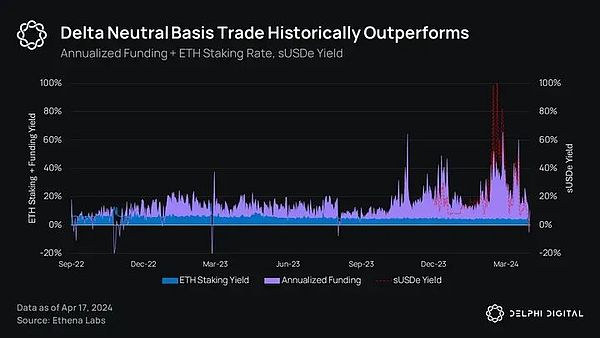
It is also worth noting that BTC’s funding rate almost directly mirrors ETH’s funding rate. Therefore, while the yield generated by BTC collateral may only involve the short portion of the trade, this is where the majority of the yield comes from. Therefore, BTC’s yield will be competitive with ETH, especially when the funding rate is high.
Ethena’s Differentiation
So while existing models attempt to overthrow the Tether/Circle duopoly by bringing traditional finance (TradFi) rates on-chain or leveraging DeFi rates through the less capital-efficient CDP model, Ethena takes a fundamentally different approach.
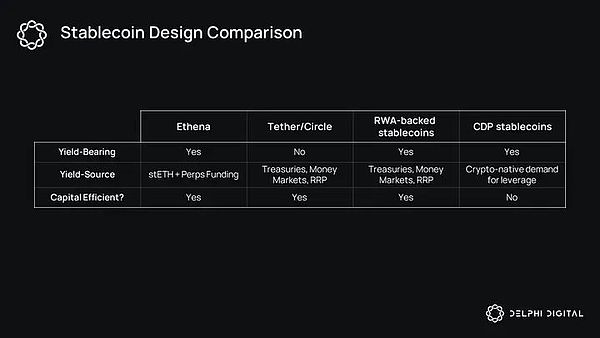
Essentially, Ethena arbitrages the uniquely high funding rates in the perpetual futures market through a fungible product that can be combined with other DeFi products and services. Therefore, structuring the product as a USD-denominated product is intended to take advantage of the inherent network effects that come with being a "stablecoin."
In theory, the adoption of USDe should result in funding rates eventually converging to a level that simply reflects the risk-free rate plus a risk premium, which is the goal. Assuming Ethena can achieve scale, this goal is expected.
Ethena’s Architecture
Now that we have a general understanding of Ethena’s design, let’s dive into how USDe and sUSDe work. From an architectural perspective, Ethena can be understood through three core mechanisms: 1. Minting 2. Redemption 3. Staking USDe.
Ultimately, end users will not handle minting and redemption operations directly. Instead, they will do so directly through liquidity pools or indirectly through Ethena's front-end interface, and then these transactions will be carried out through liquidity pools.
Each swap creates arbitrage opportunities for whitelisted authorized participants (APs) to rebalance these liquidity pools. Importantly, only APs can mint and redeem USDe, thereby capturing these short-lived market dislocations.
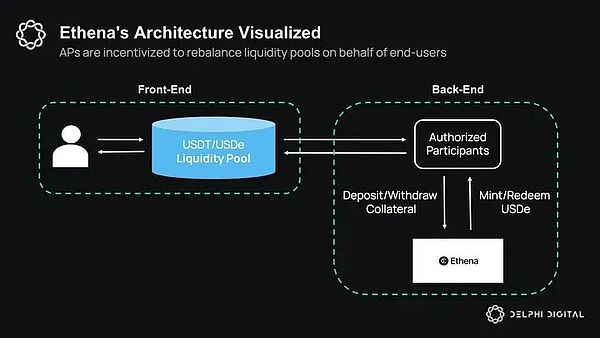
For example, if someone swaps 1000 USDT for 1000 USDe in the Curve pool, this will cause USDT to trade at a slight discount relative to USDe. APs will therefore be incentivized to mint USDe to buy the discounted USDT, thereby rebalancing the pool. In this process, 1000 new USDe will be created.
Behind the scenes, USDe is minted when APs deposit collateral such as ETH, LSTs, BTC, and other stablecoins into Ethena. The protocol then swaps these collaterals for pledged ETH or BTC through an internal swap function and matches an equal amount of short perpetual positions on centralized exchanges. Importantly, while derivative positions exist on exchanges, collateral assets are held over-the-counter to reduce counterparty risk (more on this in the “Risks” section).
Conversely, when USDT is trading at a tiny premium to USDDe, APs can take advantage of this market dislocation by purchasing discounted USDDe and redeeming it for $1 in collateral. In the background, APs will receive stETH from Ethena, and Ethena will unwind the short position of equal value.
The effect of this dynamic is that the liquidity pool should maintain an efficient 1:1 stable exchange ratio while users do not need to deal with the complexity of minting and redeeming USDe.
Finally, in order to receive the yield generated by the underlying collateral, users need to stake USDe into sUSDe through Ethena's front-end interface. Unlike other staking token models such as stETH, sUSDe is not a "rebasing" token, but a "reward" token. This means that instead of paying out yields in new tokens, the price of sUSDe increases over time to reflect the value accumulated within the staking smart contract. sUSDe also requires a 7-day unlocking period (more on this in the "Risks" section).
Learn from past failures
It’s worth noting that while the “delta neutral” model has been tried before, Ethena appears to have learned from past failures.
Despite being on the right track, projects like UXD and Lemma’s USDL ultimately failed to find meaningful product-market fit for three main reasons:
Scaling limited to perpetual DEXs — In the pursuit of “decentralization”, these projects ignore the necessity of centralized exchange (CEX) liquidity for scaling.
DEXs present security risks - The Mango attack that caused UXD to depeg in October 2022 showed that although DEXs may be “decentralized”, they still carry inherent risks.
Increased Negative Funding Risk — UXD and Lemma are not leveraging the native yield on the long end of their delta neutral positions. Lacking this additional buffer, these projects are more vulnerable to prolonged periods of negative funding rates.
Ethena avoids the above pitfalls by: (1) leveraging CEX perpetual liquidity; (2) aligning the incentives of CEXs with shareholders and stakeholders in the Ethena ecosystem; and (3) leveraging stETH as an additional source of yield to offset periods of negative funding.
While the model is an improvement over previous designs, it still has inherent risks. While there are many misconceptions that confuse USDe with Terra, the Ethena team has done a good job of highlighting the risks of USDe, including those that could easily be overlooked.
The following section will specifically explore these risks, their relative likelihood, and some of the risk management strategies adopted by the Ethena team.
Risks of Ethena
Ethena faces four main risks: (1) counterparty risk (2) negative funding risk (3) redemption and liquidity risk (4) automatic deleveraging (ADL) risk.
Counterparty Risk
Ethena's architecture relies on two main counterparties to operate: 1. Centralized exchanges (CEXs); 2. OTC settlement providers (OES providers).
CEXs are responsible for trading Ethena’s perpetual positions, while OES providers are responsible for custody and settlement of Ethena’s collateral. Although the incentives of these counterparties are highly aligned with Ethena, there are still inherent risks in relying on external entities. To mitigate these risks, Ethena integrates several risk management solutions:
Diversified Exchange Risk — Ethena is integrating with multiple CEXs including Binance, Bybit, Bitget, Deribit, and OKX. Therefore, if one exchange is impaired, Ethena’s risk is diversified. Importantly, these exchanges also have both tangible and intangible vested interests in Ethena’s success.
OTC Settlement - Ethena retains full control and ownership of collateral assets through OTC custody and settlement. Therefore, if certain unique events occur on any of the above exchanges, Ethena will retain full control of the collateral assets and can subsequently redeploy to another exchange.
Additional custody measures at the OES level - Ethena currently uses Copper, Ceffu and Cobo for over-the-counter custody and settlement. It is worth noting that under Copper's legal structure, user funds are part of a bankruptcy-remote trust. This means that in the event of Copper's bankruptcy, user funds are not part of Copper's property.
Frequent P&L Settlement - To further reduce CEX counterparty risk, Ethena is able to settle its P&L within a period of 8 to 24 hours, depending on the custodian. Therefore, Ethena is only exposed to the maximum loss that could occur within this window.
Solvency Verification — Ethena enables users to verify the existence of protocol collateral and Ethena derivatives positions. Currently, this is achieved by directly reading the custodial wallet API, exchange subaccount API, and on-chain wallets. This week, Ethena also released third-party certification of collateral by custodians, which will be conducted monthly in the future. Ethena is also in the process of bringing in additional external providers to eventually certify the accuracy of collateral and hedges.
The effect of the above measures is that Ethena’s exposure to counterparty risk is significantly reduced.
It’s also worth noting that counterparty risk is not unique to Ethena. Moreover, whether you hold USDT, USDC, or USDe, you implicitly trust a counterparty; the question is just who that counterparty is and how much they should be trusted.
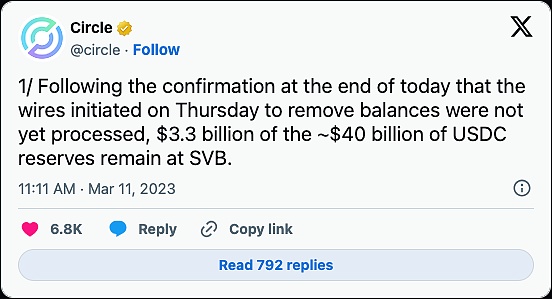
If you hold USDT or USDC, you implicitly trust Tether and Circle and the banks that hold their assets. While this has historically been seen as a “safe bet,” Circle’s exposure to Silicon Valley Bank (SVB) last March highlighted these inherent risks.
Additionally, Ethena appears to be shielded from some of the scrutiny risks associated with heavy reliance on the existing banking system. Additionally, with no ties to US clients, custodians, or CEX venues, Ethena appears to have some insulation from regulations.
While CEXs are not completely immune to regulatory risk, the U.S. financial regulatory system at least has no incentive to scrutinize Ethena because it does not undermine the fractional reserve banking system like Tether and Circle. Arthur Hayes highlighted these structural incentives in his article, Dust on Crust Part Deux .
Furthermore, while DAI and other CDP stablecoins may not have explicit counterparty risk in the traditional sense, as an end user, you are still accepting significant trust assumptions. Furthermore, by holding DAI, you implicitly trust the integrity of the code and the collective ability of the DAO to effectively manage the protocol.
Additionally, as CDPs continue to increase their RWA and USDC/USDT holdings, you are also making the same trust assumptions as with fiat-backed stablecoins. DAI’s RWAs are also managed by OTC entities, some of which are based in the US, and therefore have significant trust assumptions similar to any centralized issuer.
To be clear, this is not about moving the counterparty risk of Ethena. While Ethena has taken some smart precautions, USDe still faces significant counterparty risk. That said, all stablecoins face similar risks. It's more of a question of what return you get for holding that stablecoin and taking those risks. In the case of USDT and USDC, it's simply better liquidity.
Therefore, through a “risk-adjusted return” lens, USDe may be a more attractive option for some given Ethena’s yield.
Negative funding risk
A more relevant question circulating in CT (Crypto Twitter) is what happens when the funding rate goes negative?
As mentioned earlier, the natural state of perpetual funds has historically been biased towards the long term. As a result, fees have only been negative 20% of the time over the past three years. When taking into account the additional cushion provided by stETH earnings, this number is closer to 11%.
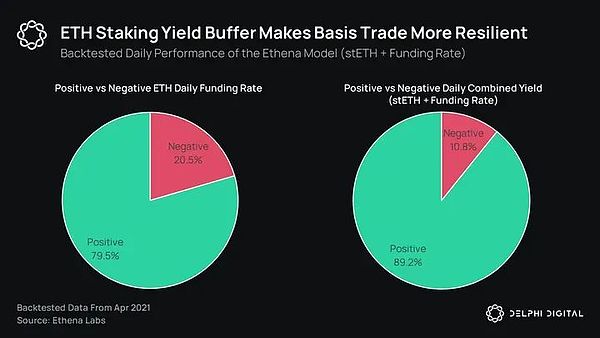
If yields do turn negative, the reserve fund will ultimately serve as a buffer, ensuring that USDe can maintain its 1:1 peg. Additionally, both Ethena and Chaos Labs have conducted extensive research on calculating the optimal size of this reserve fund.
Ethena’s research found that every $1 billion of USDe would require $20 million to survive almost all bear market scenarios, while Chaos Labs’ recommended fund size is closer to $33 million per $1 billion of USDe.
Currently, the reserve fund is worth just over $32 million relative to the $2.3 billion USDe supply. While this is significantly lower than Chaos Labs recommends, Ethena currently allocates 80% of its revenue to the reserve fund. Ethena added $5 million to the reserve fund last week alone. At this rate, Ethena should reach Chaos' target fund size within 9 weeks.
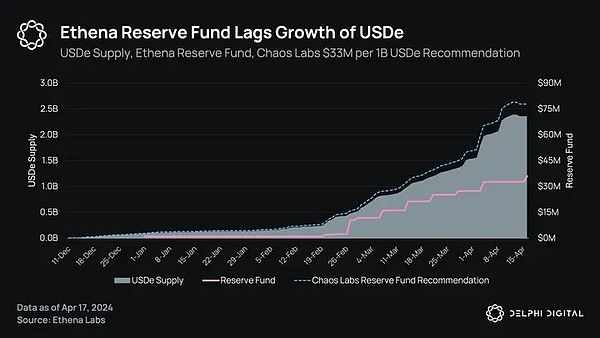
While the Ethena team does act prudently with regard to funding risk, a more valid criticism of the above analysis is that the historical data does not reflect Ethena’s actual future impact on funding rates. As a result, rates may actually turn negative and last longer than the team expects. As a result, a larger reserve fund may be needed.
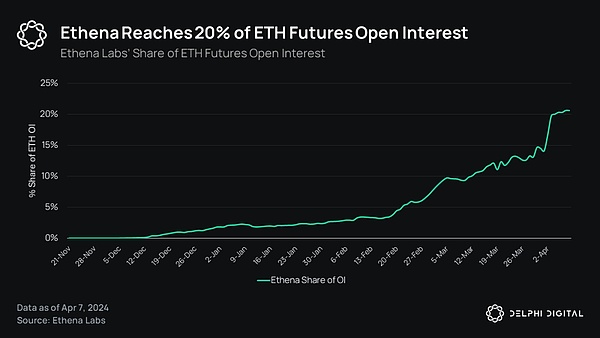
Intuitively, this makes sense. Funding rates are ultimately a function of supply and demand. Ethena inherently introduces more supply to the market, and if there aren't enough counterparties to absorb every dollar of new supply, funding rates should fall. Ethena already accounts for over 20% of ETH-PERP open interest (OI).
It is also worth noting that one of the unique things about the cryptocurrency market is that the majority of volume today actually comes from the retail market. Importantly, the retail market has inherently higher demand for long crypto assets than short, which may be supporting funding rates to some extent. In other words, there may be a "degen premium" in the structurally higher funding rates of CEXs.
As the launch of an ETH ETF increases participation from traditional finance (TradFi), we may see an erosion of this “degen premium” as more sophisticated market participants dilute the share of existing “long-biased” retail traders. We may see more institutions making Delta-neutral trades themselves to arbitrage the same market dislocations that Ethena identifies. This will cause funding rates and Ethena to become increasingly unattractive from a risk-adjusted perspective.
That said, it’s worth briefly mentioning a countervailing force that could push funding rates slightly higher. Some CEXs like Binance and Bybit have positive baseline funding rates. This effectively means that funding rates automatically move positive by default. Given that these exchanges together make up 50% of CEX open interest, this could push rates slightly higher.
While this does help Ethena to some extent, the net effect of the above resistance will still be an inherently lower natural state of future sUSDe returns. Therefore, maintaining a 1:1 USDe peg over the long term may require a larger reserve fund than Ethena currently anticipates based on historical data.
However, it is worth noting that Ethena does have a multi-billion dollar treasury that could be used to sell ENA tokens to build up additional stablecoin war chests. While this would be a last resort, the treasury could serve as an effective tool to help mitigate the above risks until Ethena can scale up its reserve fund accordingly. This is one of the lesser cited tools available to Ethena.
Redemption and liquidity risk
Another most important question circulating on CT is what happens if the funding rate remains negative for a long time causing the reserve fund to be depleted?
The most common response is that there is an “anti-reflexive” dynamic in Ethena’s design. In other words, when the rate starts to go negative and the reserve fund starts to decrease, redemptions will cause Ethena to unwind the equivalent short position, so that the funding rate returns to a positive value.
While theoretically correct, this logic does have some holes.
Furthermore, the assumption that redemptions will cause sUSDe returns to return to positive implies two assumptions: (1) strong demand from other parts of the market to short ETH-PERP will not cause the fee rate to remain negative, and (2) there is sufficient liquidity in the market to absorb USDe redemptions.
Let us first deal with Assumption 1.
Yes, redemptions of USDe will naturally push up the funding rate, but if demand for short ETH-PERP is equal or stronger in the rest of the market, the funding rate could remain negative long enough to deplete the reserve fund. Therefore, once the reserve fund is depleted, the principal balance of USDe will gradually drop below $1 as funding payments are made from the collateral balance.
It is worth noting that this will be a slow "bleeding" process rather than a reflexive collapse to zero. Assuming Binance's maximum negative funding rate is -100%, this means a loss of 0.273% per day. In addition, there may not be many USDe holders by then. Most users will exit immediately when they can get better risk-adjusted returns elsewhere.
However, this leads to Hypothesis 2.
The above dynamic is not a problem when the funding rate drops slowly and USDe holders have plenty of time to exit, but it may not be a problem in a left-tail event where the funding rate drops sharply. In the absence of sufficient liquidity to absorb large redemptions, the "reflexive" logic begins to break down.
In this case, there will be two types of users who want to exit: (1) users holding USDe and (2) users holding sUSDe, the latter of which requires a 7-day unlocking period.
USDe holders will exit first, causing Ethena's Delta neutral position to be quickly unwound. Once again, USDe holders will sell their USDe through the liquidity pool rather than redeem directly. Therefore, redemptions will be made by whitelisted APs, who will buy USDe from the liquidity pool at a slightly discounted price and redeem it for the underlying collateral. In the background, Ethena will unwind these positions by repurchasing equivalent short perpetual positions and handing over the collateral to the APs.
While buying back perpetual positions in a liquidity-constrained environment can actually experience some positive slippage, the wave of LST sales entering the market can experience significant negative slippage, especially for the less liquid LSTs.
Notably, Ethena mitigates this risk by selling its more liquid collateral first, such as ETH and BTC. An event that quickly dumps $1B of ETH into the market will certainly cause some short-term dislocation, but the ETH/ETH-PERP spread should not displace significantly enough to undermine USDe’s delta neutrality.
Currently, Ethena only holds 12% of LST collateral, given the high proportion of funding rates that make up sUSDe's returns. Therefore, Ethena will not face any significant risk of LST illiquidity until more than 90% of the collateral is redeemed. In general, the Ethena team plans to reduce its LST risk exposure by holding mainly ETH and BTC.
Nonetheless, as funding rates trend lower, Ethena may start increasing its LST allocation, as LST will constitute a larger share of sUSDe earnings. If Ethena holds 30-50% of LST, and all ETH and BTC collateral is sold, only illiquid LST is left for APs to redeem. This is where Ethena faces real risk in terms of redemptions.
In addition, if the market cannot absorb the large-scale selling of LST, this will cause LST to decouple from the price of ETH, thereby undermining the Delta neutrality of USDe. In addition, given that LST is often used as collateral in highly leveraged money markets, the decoupling of LST may also trigger a liquidation cascade, further undermining the Delta neutrality of USDe.
Therefore, APs redeeming USDe will end up being given LST collateral that may be trading at a discount on a mark-to-market basis. If APs can only receive $0.90 in collateral per dollar, this will then be passed on to end users in the market. As a result, USDe will depeg to $0.90 or lower.
As USDe depegs, those holding sUSDe must first unstake their sUSDe. As mentioned earlier, this requires a 7-day unlocking period. Therefore, most users may choose to sell sUSDe directly to the market to avoid this duration risk. If there are not enough counterparties willing to take the other side of this transaction and bear this duration risk, this will cause sUSDe to depeg as well.
As USDe and sUSDe decouple, a more relevant risk is liquidation. Given that a large number of USDe and sUSDe holders leverage their exposure through high liquidation loan-to-value (LLTV) lending pools through protocols such as Gearbox, a decoupling to $0.95 or even lower could lead to a major liquidation cascade. Likewise, if there is not enough liquidity to absorb this sell-off, the two assets will decouple further, exacerbating this reflexive dynamic.
However, it is important to note that this will not be a reflexive de-peg to zero like UST did. Furthermore, eventually liquidations will clear the remaining leverage in the system and selling pressure will ease. At this point, marginal buyers will enter the market and buy USDe at a significant discount, and eventually USDe will re-peg.
Therefore, the above scenario would not actually undermine Ethena’s solvency as a protocol. Ethena’s reputation would simply take a hit. It is also worth noting that the above scenario ultimately relies on a series of contingent and highly unlikely assumptions:
Funding rate turns negative dramatically
All USDe holders redeem at the same time
Ethena held a large amount of LST at the time
Redemptions consume all more liquid collateral
The market lacks liquidity to absorb LST redemptions
DeFi is leveraged to the limit; after shards liquid staking, a lot of leverage in the system may leave
Ethena team does not intervene
Therefore, while further risk measures are still theoretically possible and likely worthwhile (e.g., further replenishing the reserve fund or allocating only to the more liquid Lido stETH), the aforementioned scenario would constitute a “left tail” event.
Automatic deleveraging risk
The last major risk is the risk of automatic deleveraging (ADL) on centralized exchanges.
This happens in high volatility environments when exchanges incur “bad debts” due to wild price swings. ADL is the process of spreading the cost of these “bad debts” across other profitable traders, causing them to be forcefully liquidated at the bankruptcy price of the bankrupt user.
This means that while Ethena positions may be directly protected from such volatility due to being leveraged only 1x, they may still be affected indirectly through ADL.
For example, suppose a trader takes a 100x leveraged long position in ETH-PERP with a margin of 10,000 USDT. If ETH suddenly drops by 4%, there will only be enough margin to cover a 1% fluctuation. Therefore, if the trader's position is not liquidated in time, this difference will be considered a "bad debt". In a high volatility environment, this "bad debt" may accumulate quickly.
Normally, these losses will be covered by the exchange's reserve fund. However, if the reserve fund is completely depleted, ADL will occur. The remaining losses will be borne by traders who are more profitable and have higher leverage at the time. These traders will then be liquidated at the bankruptcy price of the bankrupt user.
Therefore, if Ethena is selected for ADL, this could force Ethena to take significant losses, thereby destroying the "Delta Neutrality" of Ethena's position. This could trigger panic and begin to catalyze the liquidation cascades described above. While Ethena's trading risks are distributed across multiple CEXs, these risks ultimately apply to all exchanges.
That said, it is worth noting that while ADL events should be taken seriously, their probability of occurrence has historically been low, especially for more liquid assets like ETH and BTC. For example, despite significant volatility, there have not been any major ADL events in the past five years. Additionally, most exchanges today have “reserve funds” that serve as an additional buffer against ADL events.
Furthermore, if an ADL occurs, Ethena will be able to immediately reopen the position on the same exchange or another exchange. Therefore, Ethena's reserve fund will cover any marginal losses and Ethena will quickly redeploy to keep USDe Delta neutral. In addition, the fact that Ethena settles profits and losses frequently should help reduce the chances of being selected for ADL.
Other risks
There are some other risks worth noting:
LST Depegging Risk — LSTs, especially the less liquid ones, may depeg independently outside of the redemption scenarios described above. This could occur due to a slashing event or an exogenous liquidity crunch. In addition to the above risk measures (e.g., holding a smaller percentage of LST collateral), it is also worth noting that Ethena will only begin gradual liquidations when the value of the collateral falls below the “maintenance margin.” Importantly, the maintenance margin increases as the size of the derivative position increases. Therefore, the stETH price must deviate by 65% relative to ETH before gradual liquidations begin.
Oracle Risk - Ethena uses an internal PMS system to determine the price assigned to collateral or received during minting/redemption of USDe. The internal system evaluates pricing from Ethena's trading venues, DeFi exchanges, OTC markets, and oracle providers such as Chainlink and Pyth. Ethena has implemented multiple layers of security to ensure that if incorrect data is ingested or the system produces unreasonable pricing, the protocol will not provide that price to users. Backup oracle data feeds also provide an additional layer of security.
Smart Contract Risks — Smart contract vulnerabilities account for the majority of DeFi and broader cryptocurrency hacks. To mitigate these risks, Ethena has worked with Zellic, Quantstamp, Spearbit, Cantina, Pashov, Code4rena for audits, and recently announced a public bug bounty program with Immunefi. Additionally, much of the complexity of Ethena’s operations occurs off-chain.
Unknown unknown risks – Finally, as with any deeply complex and interconnected system, there may be hidden tail risks. Although these risks may seem obvious in hindsight, they are often beyond the scope of human intelligence at the time.
Ethena’s Scalability
So, how big can Ethena be?
Since every dollar of USDe must be backed by an equal amount of short perpetual swap positions, Ethena’s scalability is ultimately limited by the size of the major cryptocurrency perpetual futures markets.
Currently, the total open interest of ETH contracts is about $8 billion, excluding CME. The Ethena team believes that holding positions exceeding 30% of the total open interest will introduce liquidity risk and affect the safe unwinding of these shorts. Therefore, using only ETH as collateral, USDe should be able to safely expand to approximately $2.4 billion.
This alone would make Ethena the fourth largest stablecoin by market cap, but there are a few things to note.
First, as the price of ETH increases, open interest will grow at a greater rate. A recent analysis by Chaos Labs found that for every 1% increase in ETH market cap, open interest increased by 1.2%-1.45%. This is likely because traders need more leverage to achieve their target returns. Therefore, at a 30% open interest rate at $5,000 ETH, USDe could theoretically support a market cap of $4.8 billion.
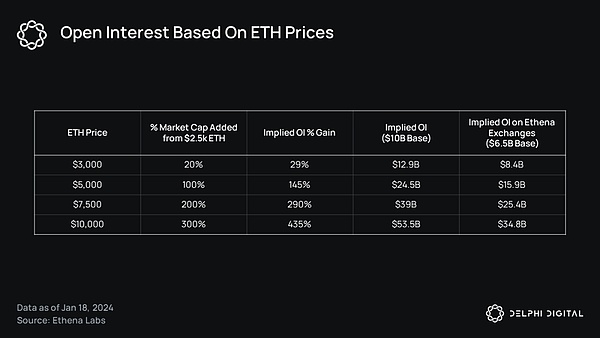
While this alone would bring USDe to a similar market cap as DAI, this implies that ETH is the only collateral asset backing USDe. As mentioned earlier, Ethena recently added BTC as additional collateral to further enhance Ethena's scalability. While BTC does not have a built-in yield like stETH and is therefore slightly less attractive as a collateral asset, it adds a new $16 billion in open interest for Ethena to exploit.
Therefore, assuming BTC open interest accounts for 30% of the market share, this would allow USDe to safely increase its market cap by another $4.8 billion. Overall, using current open interest data, this would expand USDe's total market cap to $7.2 billion. Assuming sUSDe's annual yield averages about 30% and 50% of USDe is staked, Ethena's annual revenue would be close to $1.1 billion.
Likewise, as the price of BTC increases, BTC open interest will also expand simultaneously. Using similar assumptions to ETH, BTC reaching $80,000 would give Ethena over $26 billion in BTC open interest to exploit. Therefore, with ETH reaching $5,000 and BTC reaching $80,000, USDe could theoretically scale to over $12 billion. Once again, assuming sUSDe has an annual yield of 30% and 50% of USDe is staked, Ethena's annual revenue would be $1.8 billion. Relatively speaking, this is 19 times Maker's revenue and 27 times Aave's revenue.
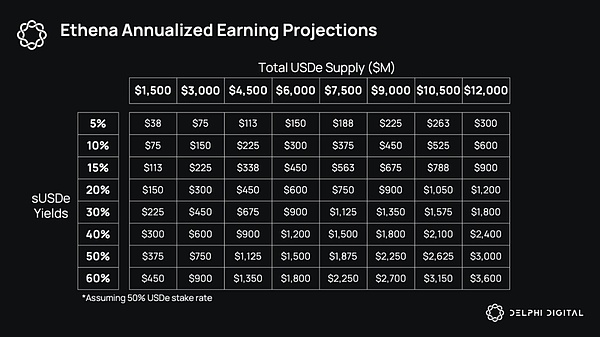
While the above scenario does rely on some optimistic assumptions, it is worth noting that even under the more pessimistic forecast, Ethena will still be one of the most profitable crypto protocols to date. If Ethena can simply maintain the current USDe supply of about $2 billion, and the sUSDe yield remains at about 40%, at a 50% staking rate, Ethena's annual revenue is expected to reach about $400 million.
This alone makes Ethena one of the most profitable crypto protocols ever.
Macro Impact on DeFi
Now that we have a deeper understanding of Ethena, let’s look at the broader CeFi, DeFi, and TradFi markets to explore its broader impact.
Historically, there are large differences in the returns of these markets. In an efficient market, all interest rates should theoretically be reduced to the risk-free rate plus a risk premium, but this is not the case in reality.
We can understand this difference by using (1) 3-month Treasuries (2) Delta Neutral Basis Trades (3) the DAI Savings Rate (DSR) as proxies for the “risk-free” rate in TradFi, CeFi, and DeFi, respectively.
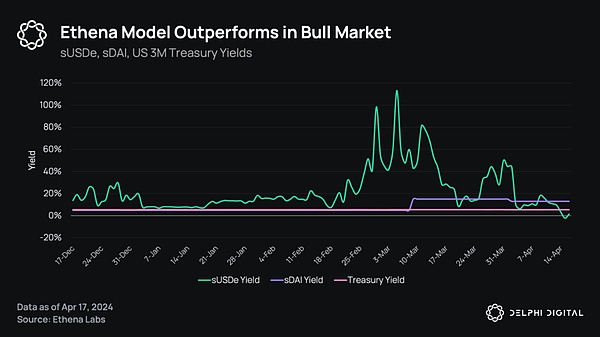
While interest rates in TradFi and DeFi are beginning to converge as MakerDAO and other DeFi protocols continue to introduce real-world assets (RWAs), interest rates in CeFi remain significantly different. Since delta-neutral basis trades are riskier than simply buying a treasury bond or depositing USDC in Aave, spreads should exist, but sometimes spreads as high as 10,000 basis points appear unreasonable. Rather than reflecting a true "risk premium", this spread reflects the complexity and inaccessibility of delta-neutral trades.
This is essentially the fundamental value proposition of Ethena - Ethena is essentially removing the "inaccessibility premium" embedded in CeFi interest rates by democratizing Delta-neutral trading and allowing it to be combined with the rest of DeFi. Therefore, USDe is actually a tokenized arbitrage tool that reconciles interest rates in DeFi, CeFi, and TradFi.
Importantly, this reconciliation has second-order effects. As USDe is essentially recalibrating DeFi’s base rate, the rest of DeFi has begun to catch up. This has led to two key integrations worth noting.
MakerDAO x Ethena x Morpho
Although MakerDAO has historically maintained a relatively conservative stance, it is at the forefront in adjusting to the second-order impacts of Ethena.
Maker’s first move was to increase the DAI Savings Rate (DSR) from 5% to 15%. For those who are not familiar with the DSR, the DSR is effectively the “risk-free rate” that DAI holders receive for staking their DAI. With sUSDe yields averaging 40% higher over the past three months, this move seems like a necessary step to maintain incentives for holding and staking DAI. Other protocols like Frax have taken similar steps. These are early signs of the aforementioned DeFi/CeFi rate convergence.
MakerDAO’s second move is more controversial. After deploying 100 million DAI to Morpho Blue’s Spark’s sUSDe/DAI and USDe/DAI markets through the Direct Deposit Module (D3M), Maker recently voted to increase this amount to a maximum of 1 billion DAI (22% of DAI backing). This will be deployed gradually based on the overall health of the protocol and D3M’s cash flow.
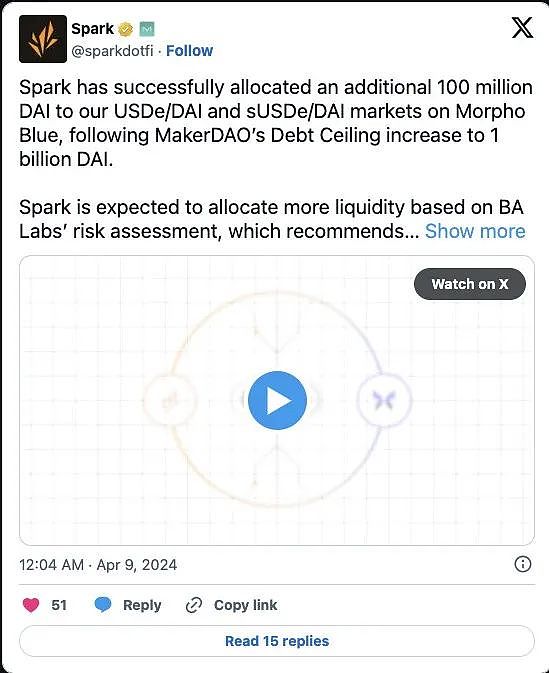
For those who are not familiar, Morpho Blue is a modular lending primitive that allows any third party to create and manage their own lending pools. Spark is a child DAO of Maker that manages sUSDe/DAI and USDe/DAI pools.
The net effect of this integration is that users are able to deposit sUSDe or USDe into these Morpho lending pools and borrow DAI against it. Not only does this inherently drive demand for DAI, but given that Maker is effectively the “lender” in this case, Maker is able to earn the annual percentage yield (APY) paid by the borrowers.
Currently, borrowers are paying a 20% annual yield on the 100 million DAI currently deployed. In theory, this should be slightly lower than the yield on sUSDe, as borrowers are effectively arbitrageurizing this spread. Importantly, this makes this integration very beneficial to Maker - as long as the yield on sUSDe remains high, Maker will be able to take full advantage of it.
To put things into context, if Maker injected an additional 900 million DAI today, and the APY remained constant, this would generate $200 million in annual revenue for Maker, assuming the cap is reached. While this is certainly optimistic, this amount is nearly three times Maker’s current annualized revenue.
As expected, this move by Maker has not been without its critics. While on the surface this may seem like a “risk-free” bet, the reality is that there is no such thing as a free lunch.
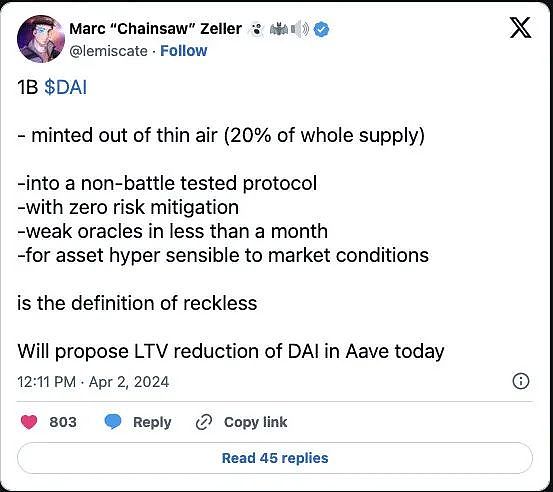
The biggest risk ultimately lies in the liquidation and oracle mechanisms. Given the relatively high liquidation loan-to-value ratios (LLTV) for these loans, a brief decoupling or oracle failure could trigger an unwanted liquidation, even though the underlying value of sUSDe or USDe has not actually changed. This could then set off a cascading effect where one liquidation triggers more liquidations.
To mitigate these risks, Spark made the difficult decision to “hard-code” the oracle. This means that the price of DAI and the price of USDe or sUSDe are fixed to the same price. In other words, as far as the oracle is concerned, the two assets cannot be decoupled.
This then begs the question of how liquidations are triggered. Importantly, like any liquidation, liquidations for fixed rate loans are based on the loan-to-value ratio (LTV).
LTV = (Loan Size) / (Collateral Value)
However, unlike variable oracle loans, which typically qualify for liquidation based on changes in the denominator (i.e., collateral value), fixed oracle loans are liquidated based on changes in the numerator (i.e., loan size).
More specifically, liquidation will only occur when the accumulated interest makes the position liquidable. To incentivize healthy liquidations, Morpho has a clever mechanism that doubles the borrowing rate approximately every 5 days when the market is at maximum utilization. This allows positions to be liquidated relatively quickly under a fixed pricing mechanism.
While this mode works smoothly in most situations, there are some unique scenarios worth noting that may cause problems.
First, in the case where USDe is decoupled and its fundamental value is lower than the LLTV of the loan, bad debts may accumulate because the oracle does not know the price of USDe. Borrowers will actually borrow more than the value of their collateral. This highlights the importance of setting a slightly lower LLTV for hard-coded lending pools. As a result, Maker is over-allocated to pools in the 77%-86% LLTV range.
The second risk lies in liquidation incentives.
According to Morpho’s design, liquidators receive a “liquidation bonus” to incentivize healthy liquidations. This bonus is a fixed percentage of the liquidated assets in return for repaying the liquidable loan. However, the important detail is that when using a fixed oracle, the value of the asset is not based on its market value, but rather on an equivalent price fixed by the oracle price.
Therefore, if USDe depegs to $0.85, and the liquidation bonus is only 5% on a 95% LLTV loan, this means that the liquidator will pay $0.95 to repay the loan, but only receive $0.90 ($0.85 + 8% liquidation bonus) in return. Therefore, liquidators have no incentive to liquidate loans when the USDe market value is below $0.90, because they will actually lose money.
Therefore, the only party with an incentive to liquidate this position is Maker itself, since they ultimately own the loan. Maker will then repay the loan by minting some DAI and quickly destroying it in a single atomic transaction. In the process of closing the loan, Maker will now hold sUSDe, which, importantly, is no longer worth $1.
Assuming sUSDe is marked to market on the MakerDAO balance sheet, these losses will then be borne by MKR holders as bad debts. So while MakerDAO may not appear to be directly exposed to Ethena, there is some indirect exposure. So the risks that apply to Ethena also apply to Maker, albeit to a lesser degree.
While the above analysis highlights the risks inherent in MakerDAO, it is important to ultimately view this integration through a “risk-adjusted” lens. If funding rates remain significantly elevated, Maker has the opportunity to potentially double its revenue. So while these risks may indeed come at the expense of MKR holders, the upside potential appears to be significantly asymmetric.
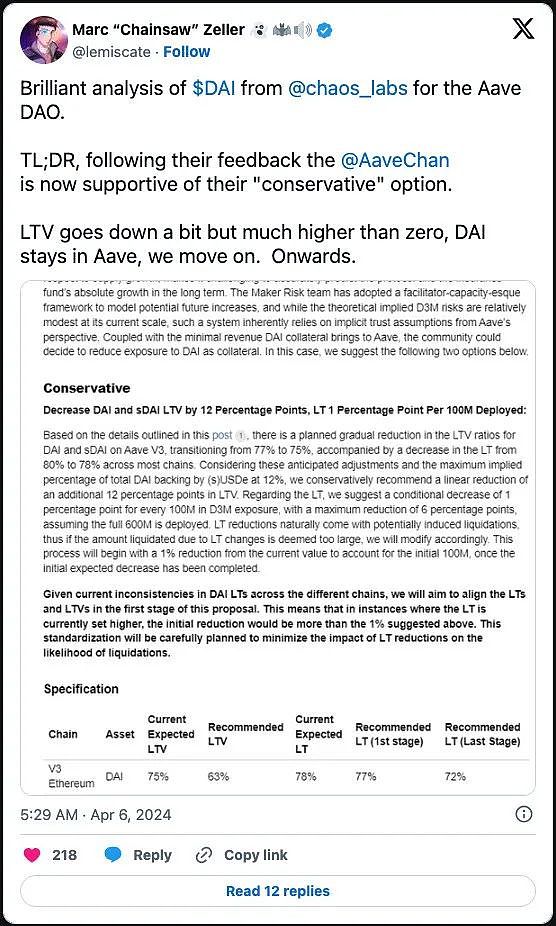
That said, this asymmetry is not necessarily passed on to other lending protocols that use DAI as collateral. Instead, protocols like Aave appear to be bearing the risk of this integration without participating in any of the benefits. As a result, Aave recently passed a proposal to reduce the DAI liquidation threshold by 1% for every additional 100 million DAI distributed through D3M. In theory, this means that as the risk of DAI increases, Aave reduces its exposure accordingly.
An important feature of USDe is that it has the potential to build DeFi’s first scalable yield curve.
For those who are not familiar with Pendle, a brief introduction is that Pendle is a DeFi protocol that allows users to divide income tokens into principal tokens (PT) and income tokens (YT). Users can buy PT to lock in fixed income, or buy YT to speculate on changes in income.
While Pendle has found initial product-market fit primarily through users purchasing YT to speculate on points liquid staking opportunities, there appears to be a greater opportunity at the intersection of Pendle and Ethena’s architectures.
Additionally, if Ethena is able to divide sUSDe into different maturities (e.g., 1 month sUSDe, 3 month sUSDe, 1 year sUSDe, 3 year sUSDe, etc.), Pendle can create a yield market based on this. The net effect will be a scalable yield curve on which users can speculate and lock in future sUSDe returns.
While this integration may seem trivial, the importance of fixed income products to TradFi and DeFi operating at scale is fundamental. The ability for large institutions to hedge forward rates could unlock idle capital that was previously constrained by DeFi market volatility.
Therefore, in the long run, this integration between Ethena and Pendle could become an inflection point for the institutional adoption of DeFi.
$ENA
The launch of Ethena has become one of the most successful protocol launches in crypto history to date. Much of this success is due to Ethena’s carefully planned airdrop campaign.
Currently, Ethena has divided the activity into two phases. The first phase uses Ethena's points, called "shards", which are mainly used to incentivize the liquidity provision of USDe in the Curve pool. At the end of the first phase, 5% of the total supply of ENA was airdropped to shard holders.
The second phase, which will last until September 2, or until the USDe supply reaches $5 billion, essentially does the same thing but renames “shards” to “sats.” Users can earn “sats” through similar incentive programs, such as USDe liquidity provision (LP) or using USDe to interact with other DeFi protocols such as Maker, Morpho, Gearbox, and Pendle.
While Ethena has not yet announced the exact amount of the airdrop, at the end of the second phase of the event, "sats" holders will receive a certain share of ENA tokens. As the article points out, ENA tokens will be used for governance voting on the following matters:
General Risk Management Framework
USDe Support Components
Exchange exposure
Custody risk exposure
DEX Integration
Cross-chain integration
New product priorities
Community Grants
Size and composition of the reserve fund
Allocation between sUSDe and the Reserve Fund
For the reasons stated above, ENA is currently used primarily as a governance token. That said, once the reserve fund is large enough, there may be proposals in the future to implement revenue distribution or a buyback and destruction mechanism to return part of the value created by Ethena to token holders.
Currently, Ethena’s annualized revenue is close to $200 million, making it one of the most profitable DeFi protocols today. Given that Ethena pays yield on sUSDe instead of USDe, Ethena’s profitability ultimately depends on the difference between sUSDe and USDe supply.
While Ethena’s revenue will certainly be impacted after shards are over as the incentive to hold USDe will be reduced, this should be much lower than the impact experienced by most projects. This is because stablecoins are one of the few crypto areas with built-in network effects. In other words, as more asset pairs are denominated in USDe and more protocols begin to accept sUSDe as collateral (such as MakerDAO), these standards will become more deeply embedded in the fabric of DeFi. As a result, USDe adoption is likely to be very durable.
Therefore, from a fundamental analysis perspective, Ethena will likely become one of the most profitable businesses in the entire crypto space. Not only will they have some of the highest profit margins in DeFi, but more importantly, those profit margins will remain stable because any emerging competitor will have difficulty achieving the same secondary market utility as USDe. In other words, while code may be a commodity in the crypto space, you can't replicate the "moneyness" of USDe at scale.
Looking ahead to Ethena
After launching one of the most successful protocols in history, USDe is now the fifth largest stablecoin with a market cap of $2.3 billion. As the market demand for yield continues to increase, reaching the $10 billion goal seems within sight.
In addition, Ethena's moat continues to expand . By aligning incentives with other protocols, Ethena's USDe standard has quickly gained popularity in DeFi. Therefore, despite competitive pressure, Ethena's market position remains solid.
However, Ethena’s impact on the crypto market is not without side effects. As USDe expands, risks such as negative funding, illiquidity in redemptions, and liquidation cascades are also increasing.
While the Ethena team has done an excellent job identifying and managing these risks, some risks may change dynamically over time. Therefore, it will become increasingly important to remain flexible and continually re-evaluate strategies.
Finally, as Ethena continues to coordinate yields across DeFi, CeFi, and TradFi, we appear to be entering a new interest rate paradigm. With protocols like Maker, Morpho, and Synthetix leading the way, expect other projects to find ways to integrate DeFi’s new benchmark yields.