The latest unemployment data released by the U.S. Department of Labor last night (18th) showed that the job market continues to cool. Specifically, in the week ending July 13, the number of people applying for unemployment benefits for the first time in the United States rose to 243,000, higher than the expected 229,000. The previous value was also revised up from 222,000 to 223,000.
At the same time, the number of people applying for unemployment benefits continuously in the week ended July 6 was 1.867 million, higher than the expected 1.856 million. The previous value was revised down from 1.852 million to 1.847 million.
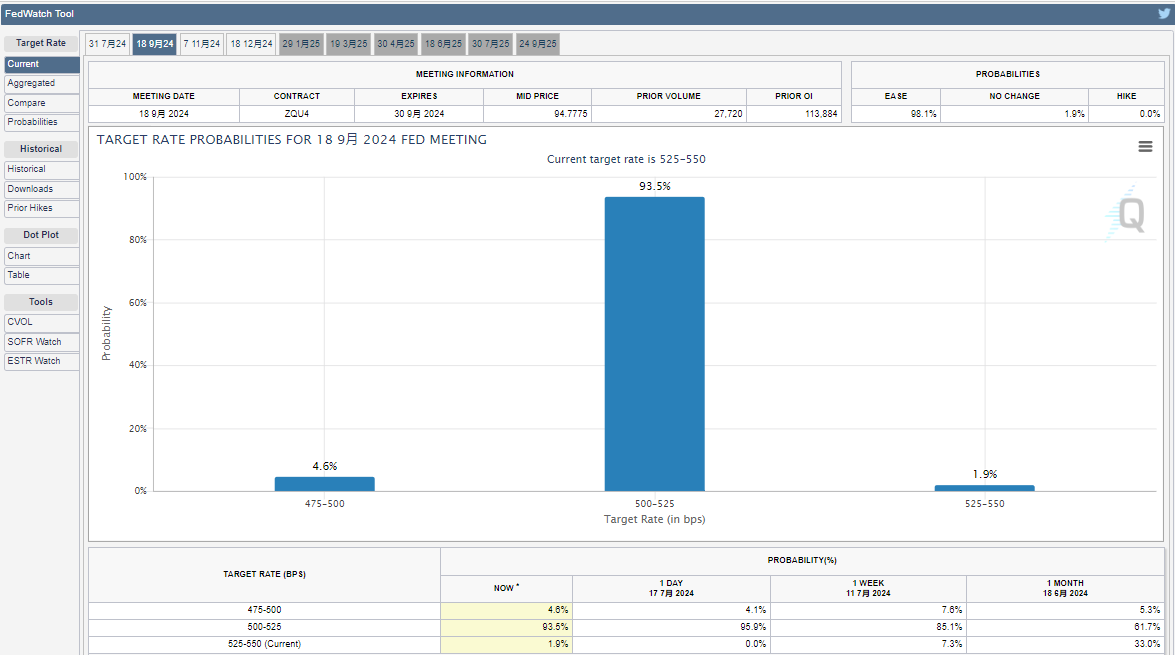
Chances of rate cut in September rise to 93.5%
In addition to the increase in the number of first-time jobless claims and continuous jobless claims, a number of recent economic data in the United States have shown that the U.S. economy is gradually cooling and inflation is slowing.
Against this background, Federal Reserve (Fed) Chairman Jerome Powell and other officials also gave dovish speeches, suggesting that the much-anticipated interest rate cut will come soon. For example, Federal Reserve Governor Christopher Waller bluntly stated on July 17 that the United States is approaching the point when it must lower its policy interest rate:
The service PMI (Purchasing Managers Index) released by the Institute for Supply Management (ISM) fell below 50, indicating a contraction in economic activity; the production index fell below 50, the first time since May 2020; the U.S. job vacancy rate reported 4.9 in May %, which is quite close to the pre-epidemic level.
The United States is approaching the point when policy rates must be lowered.
In addition, according to the CME Group's FedWatch tool, the market currently believes that the probability that the Fed will initiate an interest rate cut in September has climbed again to 93.5% from 85.1% on the 11th of this month, and the probability that it will not cut interest rates is only 1.9%.
However, for those who believe that the Fed will cut interest rates three times this year, public chain SEI Chief Investment Officer Jim Smigiel pointed out in a report that people’s expectations for the Fed to cut interest rates three times this year seem to be too high:
We do not expect three interest rate cuts.
A 25 basis point rate cut in September is possible, but further cuts in December remain to be seen.
Sam's Rule approaches triggering alert level
Although current economic data shows that U.S. inflation is gradually under control, as the economy cools, another concern in the market is that the U.S. economy may be in recession and a soft landing may be difficult to achieve.
Wall Street reporter Nick Timiraos, known as the "Fed's mouthpiece," hinted at the beginning of this month that the U.S. economy is facing the risk of recession based on the Sahm rule:
The U.S. unemployment rate rose to 4.05% in June from 3.96% in May. The data has increased by 0.22% since March.
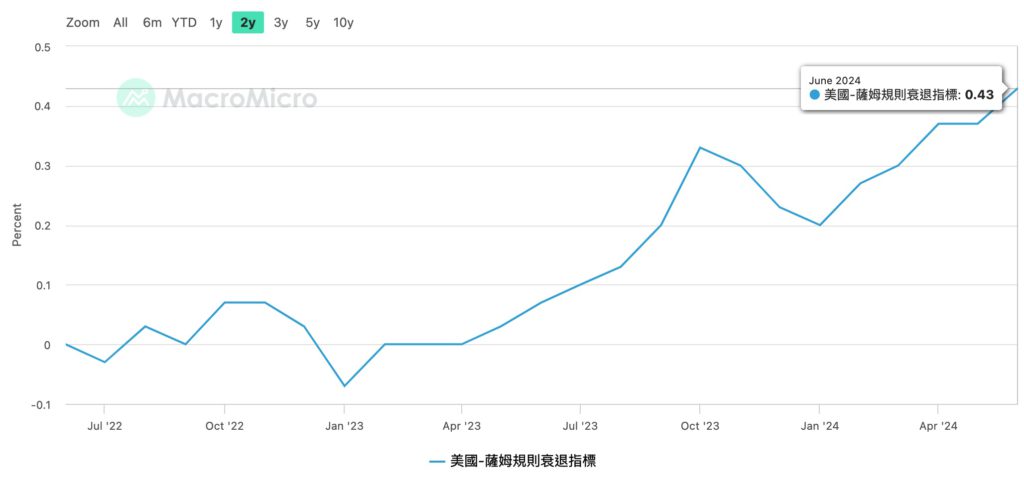
Using Sahm's rule, the three-month average is 0.42 percentage points higher than the minimum value in the previous 12 months, and is getting closer to the 0.5 percentage point threshold.
According to statistics from Macromicro, when the value of the Sam's rule recession indicator exceeds 0.5%, it means that the economy is experiencing a recession. It has reached 0.43 in June, and the trend is continuing to rise.
Sam himself, who invented the Sam Rule, also said in an interview with CNBC on June 18 that the Fed may cause an economic recession by delaying interest rate cuts:
The Fed may be pushing the U.S. economy into recession by continually delaying interest rate cuts.
This is a real risk, and I don't understand why the Fed wants to take it too seriously. I'm not sure what they were waiting for. Fed Chairman Jerome Powell’s tendency to wait until job growth deteriorates before cutting interest rates is a mistake.