Web3 is generally regarded as the third generation of the Internet, which is a new generation of the Internet that can help users achieve goals such as data ownership and self-governance.
At first, all entrepreneurs involved in Web3 held the ideal of building a more fair, transparent and trustworthy digital ecosystem. In this ideal, every Web3 user is part of the network, has control over their own data, and can exchange value in a borderless and trustless environment.
However, as time goes by, some platforms have gained a certain market share and voice by virtue of their first-mover advantage, and the original intention of Web3 seems to be gradually blurred in reality. They care less about the interests of platform users and more about their own short-term interests.
Faced with the dragon-slayer becoming the dragon, users choose not to pay. The crypto market where no one takes over is a vote by retail investors with their funds. Instead of choosing a project that goes against its original intention and only cuts leeks, it is better to participate in Meme.
At this moment, perhaps new dragon slayers are needed to change the status quo.
HelloDex is a decentralized trading platform that announced that it would distribute 80% of its profits to all users. In the white paper, they borrowed the famous saying of Che Guevara and described themselves as follows: "One day they took out money to distribute to users, not because they realized that the money was stolen from users, but because we came."
Users and platforms, leeks and sickles
Binance, the world's largest trading platform, has always claimed that the key to its success lies in "user-centricity". But in fact, this principle is shaped by the constant challenges of the external market.
Currently, Binance has the best resources, industry layout and influence in the entire crypto industry, but its main source of income is still the transaction fees of users. In the early days of Binance's development, it was already one of the largest platforms in the world, but the income obtained by its platform users was much lower than it is now. The main reason is that Binance clearly understands that users are the driving factor of its platform economy.
Previously, FCoin launched the "trading is mining" model, which returns transaction fees to users in the form of platform tokens. For each transaction made by the user, the fee paid will be 100% returned as platform tokens. This model quickly attracted a large number of users and trading volume in the early stage of its launch, making FCoin surpass Binance and become the world's largest trading platform. For this reason, Binance even announced the launch of the Digital Asset Trading Platform Alliance Plan, which will open 1,000 places for trading platforms that support trading mining and coin holding dividends.
Later, FCoin withdrew from the market due to its own management and funding problems, but the aftermath of its impact on the market has not dissipated to this day. Binance introduced more reward mechanisms, reduced transaction fees, and launched Launchpad, Launchpool and other initiatives to give back to platform users.
There is a similar situation in the DEX track. Ave, one of the largest on-chain aggregation platforms, has an annual revenue of no less than 14.8 million US dollars, according to incomplete statistics, but users on its platform have not benefited from it.
Ave’s current revenue sources are mainly from four aspects: fees for collecting token information and logos, fees for listing on popular token lists, fees for pop-up windows and carousel images, and others.
The inclusion fee for each token information and logo is approximately 350-650 USDT, and an average of 5 tokens are included every day. The minimum annual income of this business platform is approximately 638,000 US dollars.
The listing fee for the popular token list is approximately 3988-6888 USDT. Assuming that the top eight tokens on the list are listed every day, the minimum annual income is approximately 11.644 million US dollars.
Pop-up windows and carousel images are the highest-priced services, about 6,888 USDT, contributing 2.51 million USD in annual revenue.
According to SimilarWeb data, Ave has an average of 19,400 daily visitors, which means that each active user contributes $763 to Ave every day, or $278,000 per year.
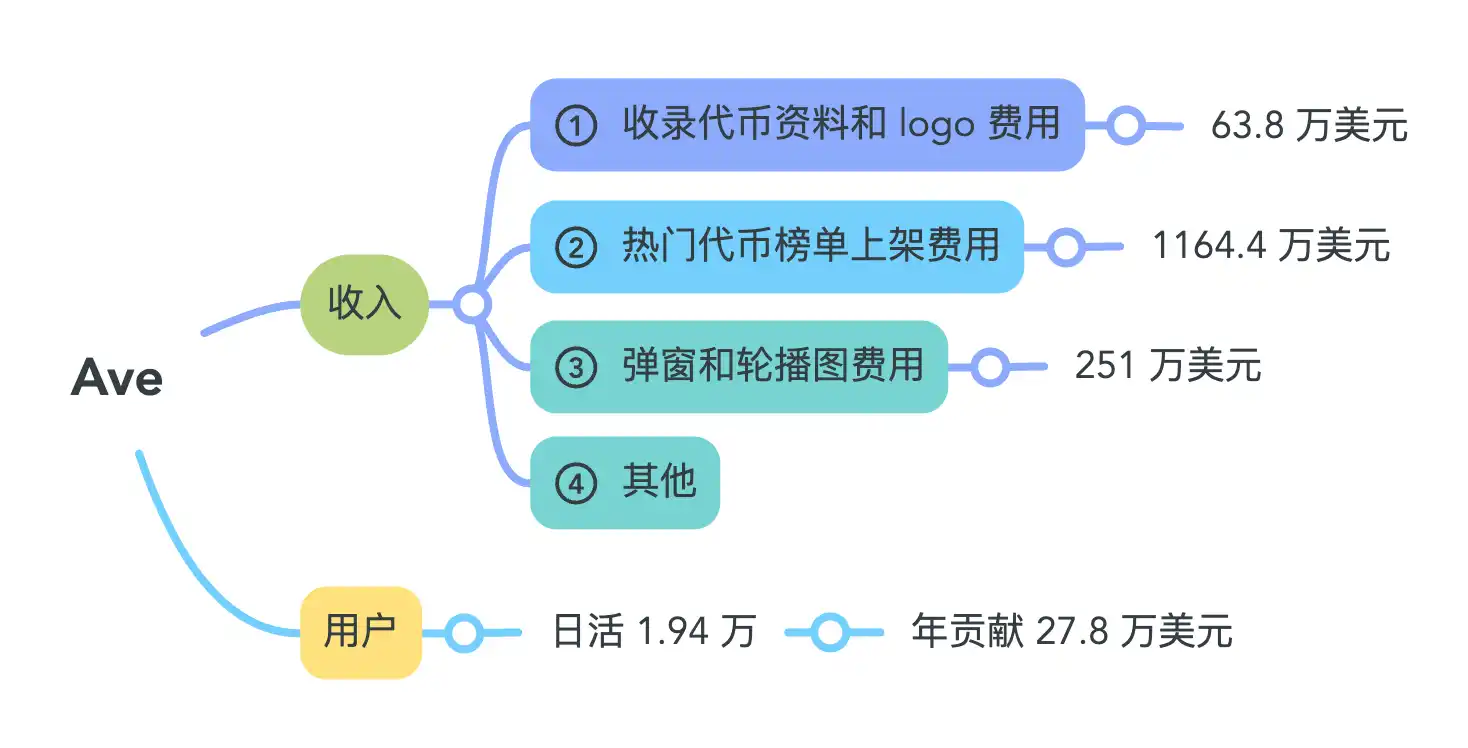
Ave's huge revenue is entirely dependent on the activity of users. However, these revenues are not distributed to users. Instead, users become the numbers behind Ave's high-profit tool.
HelloDex pioneers a revolution in the distribution of benefits
Traditional exchanges and projects often make a lot of profit through the traffic and popularity brought by users. Traditional exchanges and projects rely on user participation and traffic to make profits, but users are often ignored or even "robbed". Users have long been instilled with a mindset that the platform's profits have nothing to do with users, and the phenomenon of platforms bullying customers is common.
In fact, users are the real pillars of platforms and projects. Without the participation and support of users, no platform or project can survive and develop.
HelloDex, as a new decentralized exchange, is changing this situation and redefining the relationship between the platform, project parties and users through an innovative profit distribution model.
HelloDex distributes 80% of its profits to users. This model not only makes users the main beneficiaries, but also allows them to play a more important role in the development of the platform. HelloDex's innovation lies not only in the diversity of its functions and the efficiency of transactions, but also in the transformation of the concept behind it. The platform is no longer a simple profit-making tool, but a community of user interests.
HelloDex provides users with the confidence and support to refuse to be exploited. When using HelloDex, users can not only enjoy the convenience and efficient transactions brought by the platform, but also get tangible returns from the platform's profits. HelloDex is not just an exchange, but also a product that unites and empowers users.
This is a concept that is completely in line with the spirit of Web3, and every ordinary user can take back the rights that belong to them.
Truly decentralized platform
HelloDex is an innovative decentralized trading platform that aims to change the current crypto trading ecosystem and return the profits that originally belonged to users to users. The development of HelloDex is divided into three stages, each with clear goals and functional expansion.
In the first phase, HelloDex focused on building basic functions, achieving the same functions as Ave, and began to initially establish a profit model to generate revenue through transaction fees and advertising.
Users can use HelloDex to monitor the real-time Mint inscription list of major blockchains, support custom network IDs and RPC, and realize batch minting of inscriptions for multiple wallet accounts. Transaction speed and simplicity are the core advantages of HelloDex. In addition, HelloDex also provides slippage protection to prevent users from being attacked by MEV robots and reduce capital losses.
At the same time, HelloDex supports parsing all on-chain data of ETH, Solana, BNB, Base, ARB, OP and other chains, realizing complete transaction records, pool increase and decrease analysis to form charts, token holder rankings, capital inflow analysis including whale top buying and selling, and money-making and money-losing rankings. iOS and Android App will further simplify the transaction process, shorten each transaction time to 1-2 seconds, and greatly improve the user experience.
In the second phase, HelloDex will add instant messaging functions, integrate debox, btok, and Telegram functions, and support group chats, group sniper rifles, group voice, group conferences, etc.
Based on the completion of all on-chain data analysis and its own data provider and DeFi protocol analysis capabilities, it will also launch an asset management and analysis platform with the same functions as DeBank and a Dune data analysis platform. While parsing all blockchains, HelloDex will also provide node RPC to the outside world, breaking the monopoly of head node RPC interests, and still distribute 80% of the profits to everyone.
HelloDex will also launch HelloDexSwap, which will support Meme tokens and HelloDex governance tokens to form a trading pool in swap, thereby expanding the uses of governance tokens and creating a preliminary ecosystem.
In the third phase, HelloDex will launch its own public chain to complete the construction of a fully decentralized ecosystem, and the governance token will also be upgraded to the mainnet currency. In this phase, HelloDex will provide users with more comprehensive and efficient financial tools, natively integrating decentralized on-chain contracts, lending and other DeFi products. For example, on-chain contracts similar to dYdX will make all token allocation flows transparent, rather than centralized exchanges randomly dumping data.
80% of all profits of the HelloDex public chain are also distributed to users, making it a truly decentralized platform for profit sharing.
Dragon Slayer, users enjoy 80% of the profit distribution
HelloDex's profit distribution mechanism is designed to ensure that the platform's revenue can benefit all platform participants to the greatest extent. HelloDEX's revenue sources mainly include the collection of token information and logos, the listing of popular tokens, various pop-ups and carousels, and other fee-based items. In addition, priority is given to supporting the use of governance tokens for payment.
Of course, in the early stages of development, HelloDex will offer free activities for a period of time, and will only start charging after accumulating a certain amount of daily activity and user volume. After obtaining income, HelloDex will distribute it in proportion:
50%: distributed to the holders of governance tokens. This part of the proceeds is decided through the governance token voting whether to destroy the governance tokens, or distributed according to the number and duration of staked governance tokens;
20%: Team;
10%: security audit fees and team operation, development, and server costs;
10%: distributed to all users of HelloDex products, even if they do not hold governance tokens;
10%: distributed to group owners according to the transaction volume of the community, KOL, and individuals invited, as well as other weights. The rules will be announced before the token is issued.
The total supply of HelloDex governance tokens is 100 million, supporting cross-chain bridge conversion between the ETH chain and the SOL chain. In order to ensure the reasonable distribution and use of tokens, HelloDex has designed a detailed distribution plan:
30%: The treasury is used for other activities or development (locked);
10%: IDO pre-sale;
10%: Invitation and transaction points exchanged for governance tokens (the exchange ratio will be announced at TGE);
10%: airdrop and promotion;
10%: Team (the locked funds will not be unlocked until the project FDV reaches 100 million USD);
10%: listed on the trading platform (locked, the remaining part belongs to the treasury or destroyed);
10%: User security deposit, used to compensate for stolen funds;
10%: Treasury, HelloDex Chain development (not unlocked until the project FDV reaches $300 million);
In the initial stage of HelloDex, the total circulation is about 30%, including 10% IDO pre-sale, 10% invitation and transaction points, and 10% airdrop and publicity. Among them, the IDO pre-sale will be divided into two rounds, with a total volume and unit price of 3 million and 7 million pieces and 0.18 USDT and 0.19 USDT respectively, and it is expected to raise 1.87 million USDT. If calculated at the highest price, the initial circulation market value of HelloDex is about 5.7 million US dollars.
The latest data shows that the first round of pre-sales currently has only 390,000 USDT left.
Interestingly, since the circulation of HelloDex is linked to FDV, it means that before the unit price of HelloDex reaches $1, its circulation will most likely remain at around 30%. If HelloDex reaches the Ave income level, then each HelloDex holder can earn at least $0.247 per year, far exceeding the IDO fundraising price. All HelloDex users who do not hold tokens will also receive at least $1.48 million in income distribution per year. The distribution to the community, KOLs, and individual volunteers will also receive at least $1.48 million in income distribution per year.
Of course, HelloDex is not limited to just one product, Ave. The sniper rifles and other products that will be launched later will contribute huge profits, and the income distributed to all owners will also increase significantly.
This is a change that fits the spirit of Web3. It is time to return Web3 to all users rather than letting platforms monopolize it.
HelloDex may change the current Web3 environment with its innovative economic model and transparent profit distribution mechanism. As they wrote in their white paper, "The money generated by the activity of each user should be mostly given to every user who holds the governance token and every user who uses the product." Currently, HelloDex is opening a Space on Twitter to answer community questions all day long. You can click the link to participate .
Welcome to BlockBeats the BlockBeats official community:
Telegram subscription group: https://t.me/theblockbeats
Telegram group: https://t.me/BlockBeats_App
Official Twitter account: https://twitter.com/BlockBeatsAsia