One of the most commonly used recession signals by economists is the "inversion of U.S. bond yields." In the past half century, every time the inversion of yield rates is lifted, an economic recession will inevitably occur.
What is an inverted yield rate?
Under normal circumstances, bonds with longer maturities take longer to get back the principal, and they bear more risks in the process (ex: inflation, war), so the yield rate is usually higher.
However, if due to economic expectations, central bank policies (in order to curb inflation after the Fed epidemic, short -term interest rates were quickly raised in a short period of time), liquidity needs, etc., short-term bond yields > long-term bond yields When a situation occurs, it is called a yield inversion.
After the epidemic, yield rates have been inverted for two years
Currently, according to WGB data , the U.S. 2-year Treasury bond interest rate is 4.389% (interest rates for other shorter maturities are higher), and the 10-year interest rate is 4.206%. This round of inversion caused by the new crown epidemic has exceeded two years (starting in July 2022) and has continued to set the longest record since the 1980s.
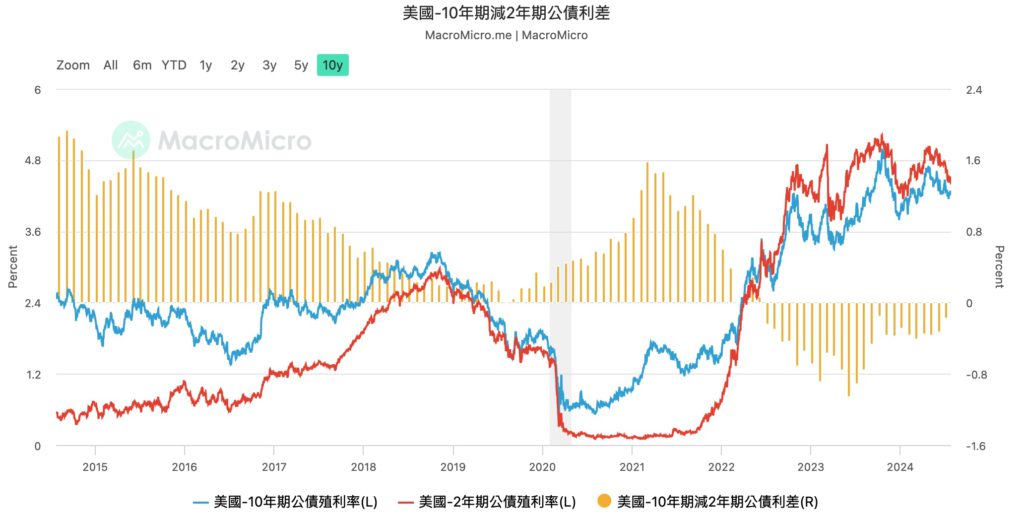
After nearly half a century of yield inversion, economic recessions have occurred.
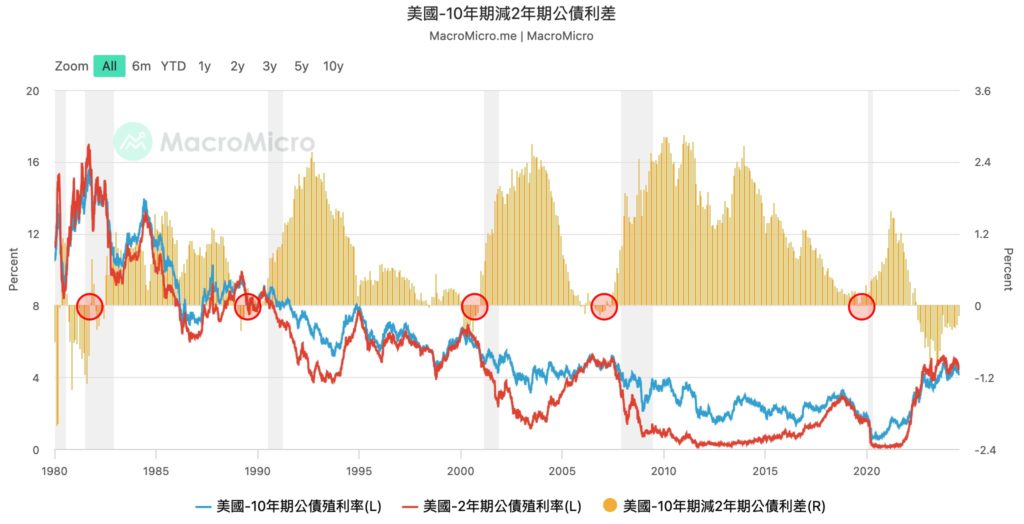
As you can see from the historical data chart of "Financial M Squared" below, the United States has experienced a total of five economic recessions from the 1980s to the present, and all of them have experienced yield inversions before. Here is a brief summary for you.
- 1981~1982: The outbreak of the second oil crisis caused inflation to rise again, and the U.S. central bank's strong monetary tightening caused the economy to enter recession again.
- 1990~1991: Tightening of monetary policy, coupled with supply shocks caused by the Persian Gulf War, once again pushed up inflation.
- 2001: The dot-com technology bubble, coupled with the impact of the 9/11 attacks.
- 2008 ~ 2009: U.S. real estate credit rupture and financial crisis broke out
- 2020 : The spread of the new crown epidemic and the global blockade (short hang time)
Can the U.S. economy successfully land softly this time?
But this time, the United States has surprised most economists. Not only has it successfully suppressed inflation, but its economy has also developed quite well. Treasury Secretary Yellen has repeatedly announced that the United States has achieved a soft landing.
Why did this inversion fail to predict a recession? Economist Jim Paulsen previously analyzed this, saying that firstly, this is because a major recession had already occurred before this inversion (during the epidemic lockdown), and secondly, because this time companies were able to quickly raise interest rates before the central bank (usually making it difficult for companies to raise funds) and giving them enough time to react, it was possible that the economy did not collapse this time.
But does this mean the U.S. economy is really safe? It may not be a 100% answer. After all, the Federal Reserve is expected to start cutting interest rates next. There is still a lot of uncertainty as to whether there will be a phenomenon where good things come true and then bad things happen, and whether the bubble driven by the AI craze will burst. investors should still be cautious.
How to calculate U.S. Treasury bond yields
As the world's largest economy, the U.S. government bonds issued by it are generally considered to have very low default risk and are therefore widely welcomed by investors. The so-called "U.S. Treasury bond yield" simply refers to the rate of return on the investment.
Usually when the United States issues public bonds, there will be "par price" and "coupon interest". The bond yield = "coupon interest / par price * 100%". Since the coupon interest will not change, but the coupon price will change with market demand, the yield rate will change.
For example, if you invest in a U.S. bond with a nominal price of US$1,000, and the coupon interest income after one year is US$30, the annualized return on investment is 3%, which is the yield rate.
But when the demand for bonds decreases, investors can buy them at a lower price, such as 800 yuan, but if the interest remains unchanged, the yield rate becomes 30/800 * 100% = 3.75%.