



Written by: TechFlow
The DePIN project in the Solana ecosystem has added a new force.
On August 7, a project dedicated to providing distributed bandwidth called DAWN announced that it had received US$18 million in financing led by Dragonfly, with participation from CMT Digital, Castle Island Ventures, Wintermute Ventures, 6th Man Ventures and ParaFi.
On the one hand, investors are gradually becoming disenchanted with VC coins and popular narratives, while on the other hand, there are still a lot of DePIN projects that are receiving huge amounts of funding.
Previously, there have been financings for popular projects in the same field as DePIN, such as IO.NET and Peaq, and there are also decentralized bandwidth projects such as Grass that basically collide with them in business. Is this DAWN worth participating in?
Decentralized broadband services, deploying hardware to achieve the "last mile" of wireless networks
First, let’s take a look at DAWN’s main business.
DAWN means dawn in English, but it is actually the abbreviation of "Decentralized Autonomous Wireless Network". From the name, it is easy to understand what it does:
Provide decentralized broadband services and break the monopoly of traditional centralized Internet service providers (ISPs).
DAWN's Official Twitter also mentioned that 52% of Americans only have one high-speed Internet provider to choose from. In some cases, for the same Internet service, some users may pay 100 times more than other users, depending on factors such as geographic location, infrastructure costs, and population density.
So, what exactly does DAWN do? We can get some clues from its project white paper.
First of all, it should be noted that DAWN is not a pure software project. Intuitively, contributing bandwidth requires installing a plug-in or downloading software to "hang up", but DAWN also requires the cooperation of hardware.
The main hardware used in the DAWN network is called the Robotic Antenna System (RAS), which is a smart wireless device installed on the roof of a building.
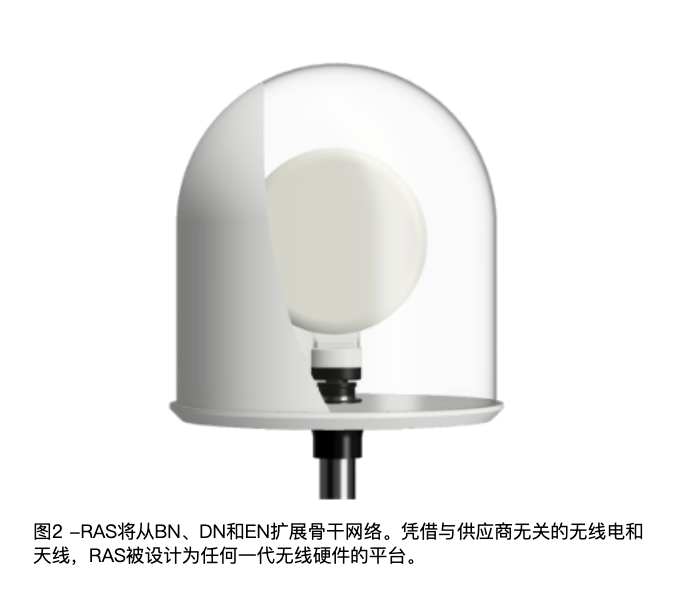
Main functions of RAS :
a) Automatic Alignment: RAS is able to automatically adjust its direction to obtain the best signal strength and quality.
b) Multi-band support: Supports multiple wireless frequency bands, including high-frequency technologies such as 5G millimeter wave.
c) Network Node: As a node in the DAWN network, it can receive and transmit data.
We are not proficient in wireless network transmission technology and hardware, but you can understand it as a signal receiver and transmitter, through which network signals are transferred and transmitted.
So the question becomes, which nodes need to install this device so that the wireless network can spread to those who need it?
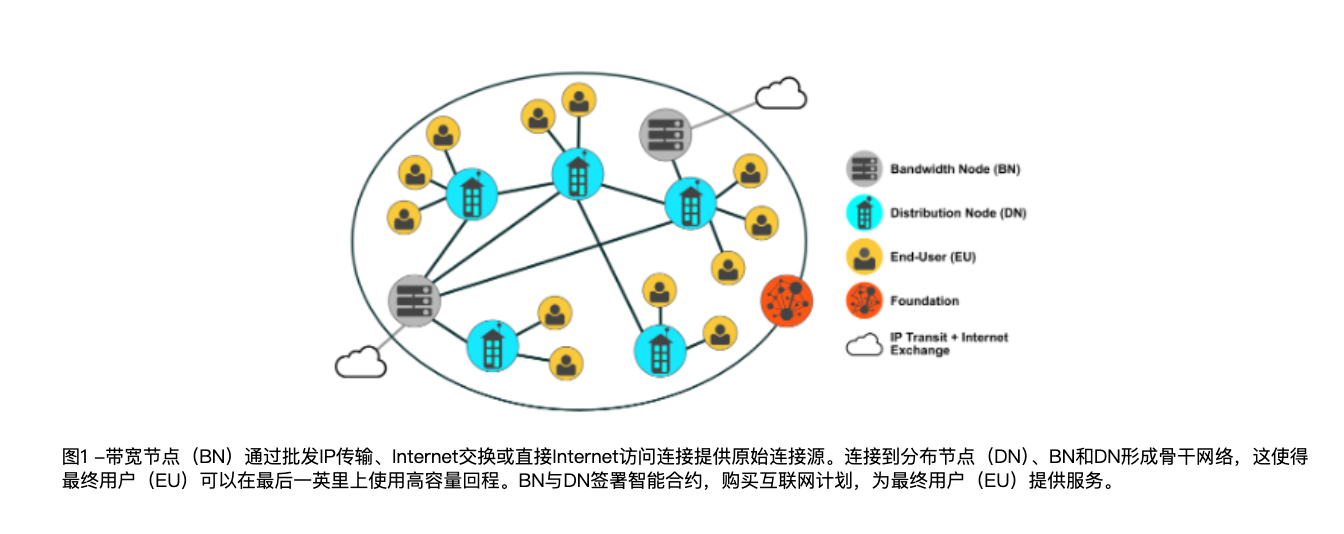
In the design of DAWN, network nodes are divided into three categories:
Bandwidth Node (BN): A large RAS device, usually installed in a data center or high-rise building, that provides the primary Internet connection.
Distribution Node (DN): A medium-sized RAS device installed on a commercial or residential building that receives signals from a BN and transmits them to other DNs or end users.
End User (EU): A small RAS device installed on an individual user's building that receives Internet service from a DN.
Thus, bandwidth nodes (BNs) provide wholesale Internet capacity for resale; distribution nodes (DNs) connect to BNs and further share bandwidth. End users (ENs) consume bandwidth from DNs, and a "last mile" wireless network circle is formed.
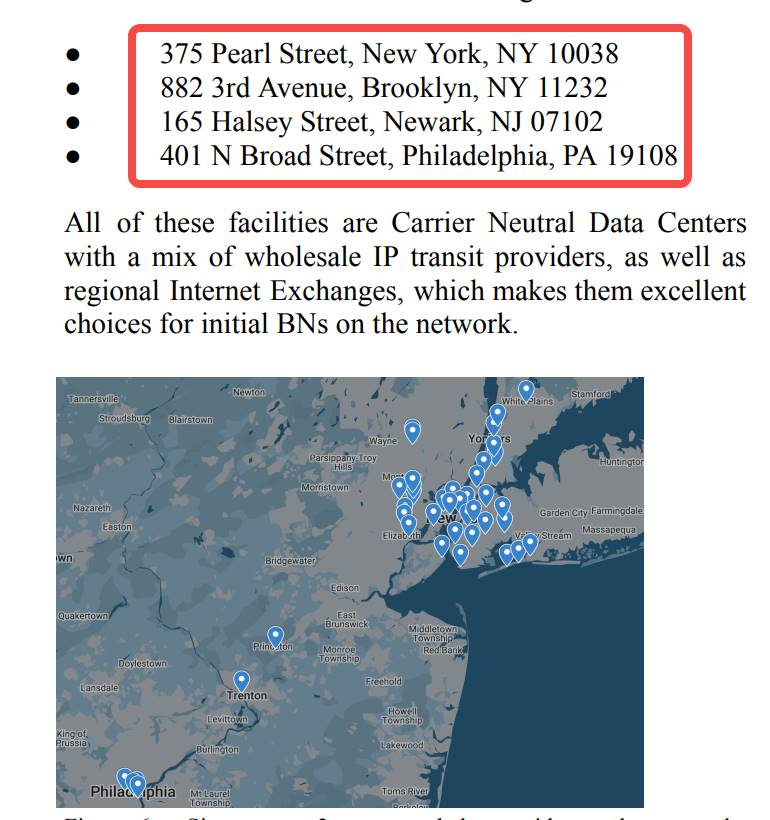
It can also be seen from the white paper that this business has started in New York and other regions in the United States, and is expected to cover more than 3 million households in the United States, and plans to expand globally to Asia, Europe and Latin America.
Use browser plug-ins as verification nodes
From a business perspective, the services provided by DAWN are far away from us. What other ways are there to participate in the project at this stage?
DAWN provides space for general users to participate by acting as validators.
Since different nodes in actual business are equipped with hardware devices to transmit wireless network signals, there are bound to be some issues that need to be verified:
For example, does the network signal you provide cover a certain range? What is the quality of the network signal?
Therefore, validators in the DAWN network actually allow others to verify key parameters such as bandwidth, quality of service, node location, etc. in a decentralized manner to ensure the credibility and performance of the network.
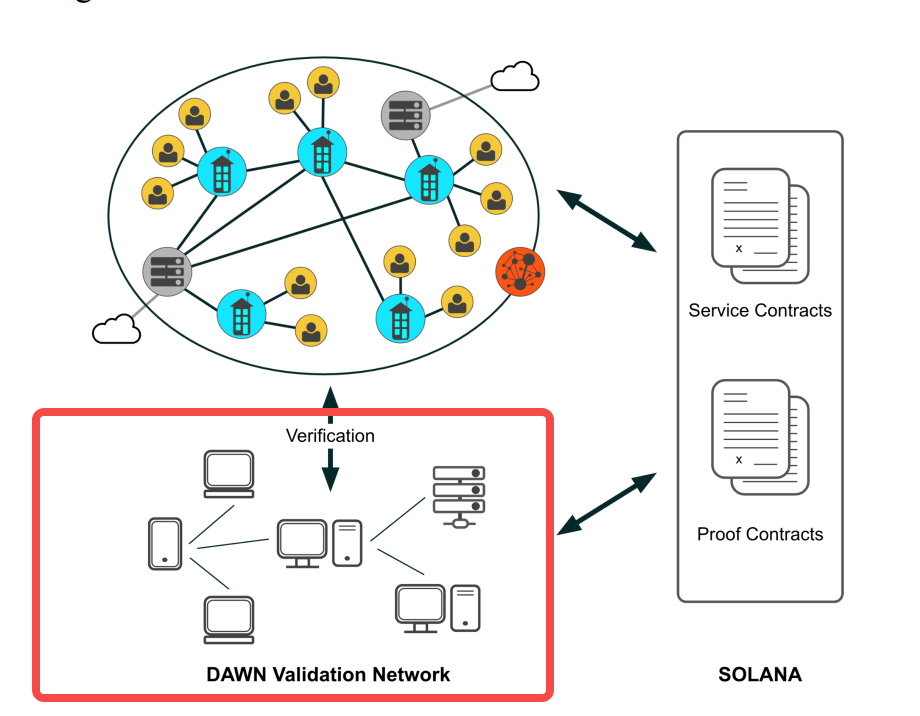
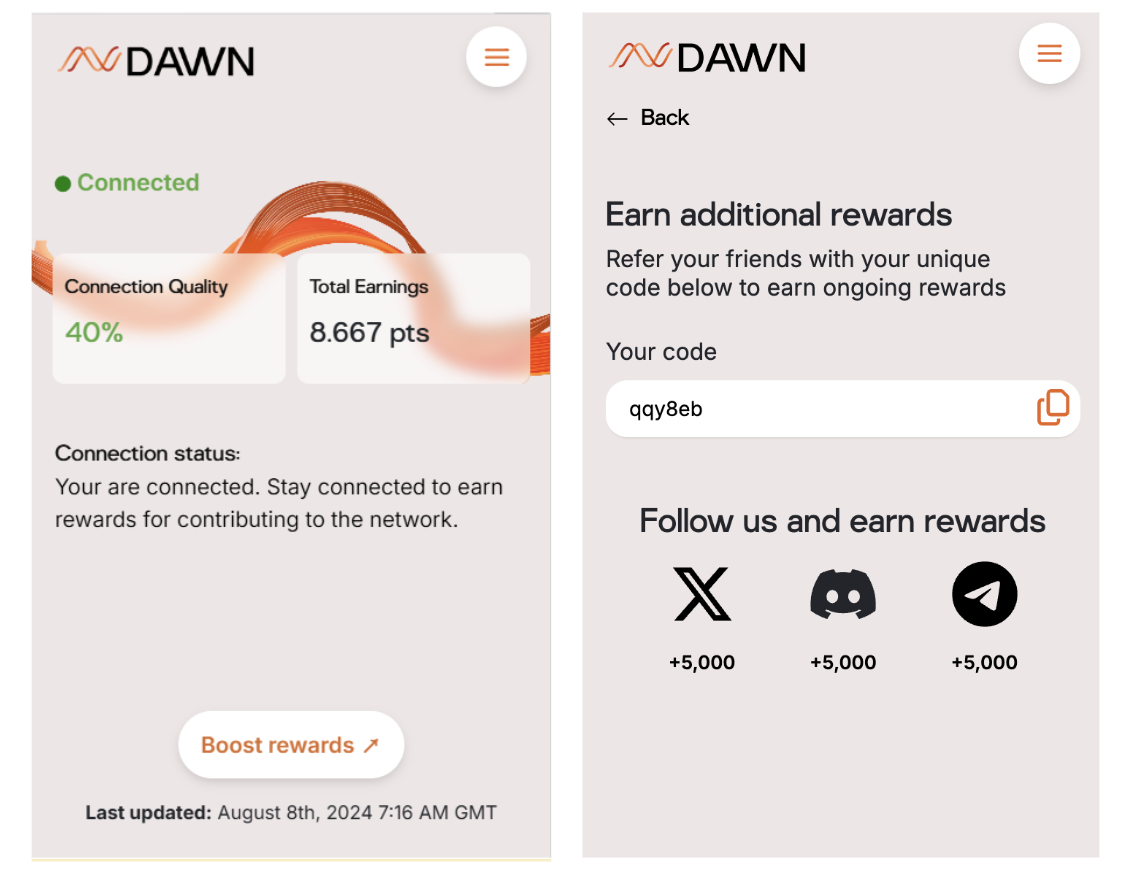
Accordingly, DAWN has designed a system called Witness Chain to do verification. The way to become a verifier is to download a web browser plug-in , register an account and stay connected. Users can get rewards by staying connected, recommending others to participate, and participating as a verifier (verifiers are randomly selected).
In addition, social media accounts that follow the project can receive an additional 5,000 points. If interested players need an invitation code when registering, they can fill in qqy8eb and complete the registration process to see their rewards.
Economic Model
DAWN is currently live on the testnet and will soon be available on Solana. However, the project co-founder has not yet revealed the timing of the move to the mainnet or set a date for the token to go live.
However, public information shows that project co-founder Neil Chatterjee ( @neilc_dawn ) said that this round of financing successfully exceeded the initial expectations of the 5 million SOL target, which will help promote plans to deploy "TGE activities" in the near future.
This also raises expectations for the token and potential enthusiasm for participation.
From the current design, DAWN adopts a flexible token supply model, which means that the total supply of tokens is not fixed, but can be adjusted according to the development needs of the network.
The explanation given in the white paper is that this is to support continued technological innovation and adapt to the volatility of the telecommunications investment cycle; but outside of the narrative, it remains to be seen how this change model will affect the price of the currency.
At the same time, DAWN tokens play multiple roles in the network, such as:
Incentivize early adopters to deploy network infrastructure
As a transaction medium within the network, used to buy and sell bandwidth
Used to obtain network resources, such as frequency, IP address space, etc.
In addition, DAWN has introduced a unique "medal" system where users can obtain a medal by staking 100,000 DAWN tokens. Medal holders can specify specific geographic areas and technologies to increase the reward multiplier for that area.
Badge holders receive 12% of the revenue from bandwidth transactions in a designated area, so the system is designed to encourage network expansion to high-potential areas.
From the perspective of token distribution, nodes in various networks (the BN, DN and AN mentioned above) will receive a reward of 25% of the total tokens, third-party validators (i.e. the aforementioned browser hang-ups) and ecological partners will receive a total of 10% of token rewards, the project treasury, team and investors will each receive 20%, and the token unlocking terms are currently unknown.
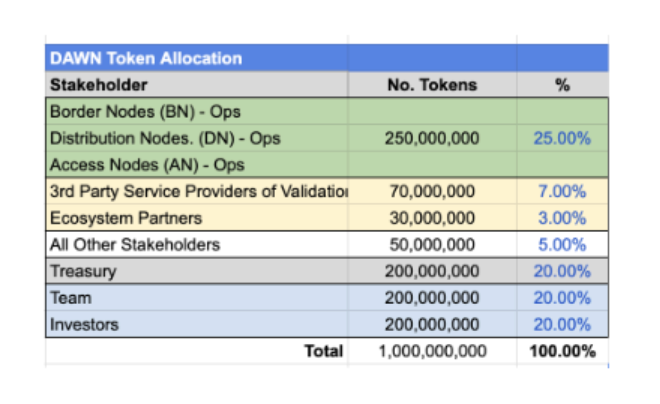
For more details about the token and economic model, please refer to the project white paper .
Founder and team
Project co-founder Neil Chatterjee was attracted to computer science at an early age. His father worked at Bell Labs, which opened the door to the world of technology for Neil. Neil later attended Princeton University, specializing in robotics.
In 2014, he made a bold decision to drop out of school and join a startup as vice president of engineering. This decision became a turning point in his career.
During his brief stint at Facebook, Neil developed a phone case for close-range mobile data sharing. This project gave him a deep understanding of how people can solve many connectivity challenges when they come together. Inspired by this, he returned to Princeton and built a wireless network covering the entire campus and surrounding towns.
The developer behind the DAWN project is called Andrena, which is the company founded by Neil.
It is also worth mentioning that another author of the DAWN project white paper is Professor Pramod Viswanath of Princeton University, who is a core member of another popular encryption AI project Sentient , which raised 85 million SOL in the Seed round of financing in July 2024.
DePINs are crowded together, is the future unpredictable?
In general, what DAWN wants to do is, on a larger scale, bandwidth sharing; on a smaller scale, it is to solve the problem of the last mile transmission of wireless networks through DePIN hardware.
In the same track and with the same business segment, IO.NET, Grass and Menson are all similar. Although the business is not exactly the same, in the eyes of investors, it is actually difficult to delve into the differences between them.
A more intuitive understanding is that there are a lot of DePIN projects, and the projects with high financing in the previous cycle have all experienced different degrees of decline after the token TGE. Whether the secondary market will be immune to such projects, or will start a new greater fool carnival after a round of ruins, still needs to be analyzed in combination with the overall market sentiment and market conditions at the time of TGE.





