Web3 is gradually moving from concept to practical application, driving new developments in the digital economy. The construction of industry-level and standardized infrastructure is progressing steadily, the industry is being built more comprehensively, and the collaboration is closer. Innovative projects that actively build industry standards, such as CESS, are promoting a more complete standard system, laying a solid foundation for the development of Web3. This positive evolution is driven by a vision of a more secure, efficient, and democratized Internet, in which data sovereignty and privacy are paramount. As the industry develops, innovators continue to solve challenges such as data integrity, accessibility, and scalability, shaping the future of digital interactions and transactions.
In the context of this transformation, CESS, as a pioneer in the infrastructure field, has made important contributions to the standardization and advancement of decentralized storage solutions. We are committed to overcoming industry pain points, establishing new performance benchmarks, and building a strong and secure Web3 ecosystem, and a data value network where data ownership returns to users and value returns to owners.
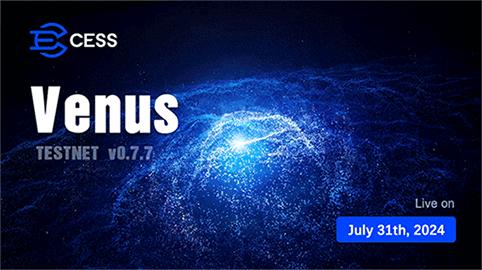
We named our latest testnet “Venus” to symbolize the vision of the project and our unwavering confidence in continued construction. Venus, also known as the morning star, appears in the eastern sky at dawn, heralding the end of darkness and the beginning of a new day. This powerful imagery aligns perfectly with our mission: to lead the Web3 industry from uncertainty to clarity and provide data management solutions for future development.
Testnet Venus embodies our journey to continuously build, explore, and lead the future of decentralized storage, CD²N, and AI integration . With each iteration, we are enhancing infrastructure, improving data security and storage efficiency, and supporting the development of decentralized networks that meet the high demands of the Web3 era. The Venus testnet highlights our five years of hard work, continuous contribution, and innovation in the industry, and builds a brighter, more secure, and data-sovereign future with other participants.
Review of CESS Testnet v0.7.6, a milestone
In the CESS incentive testnet v0.7.6, which is about to end, the number of storage nodes has exceeded 10,000 , which marks a remarkable milestone for CESS in promoting the field of decentralized storage. During the operation of v0.7.6, CESS actively innovated and contributed to the standardization of the decentralized storage industry. In February, the IEEE (Institute of Electrical and Electronics Engineers) standards organization approved the industry standard proposal for the standard number P3233 requested by CESS, entitled "Standard for Blockchain-Based Decentralized Storage Protocol Specification" . The approval of this standard not only marks the authority and foresight of CESS in the field of technology, but also means that the development and application of decentralized storage technology worldwide will move towards standardization and normalization; in early April, CESS, as a vice-council member of the Hong Kong Web3.0 Standardization Association , attended the first council meeting of 2024 in Hong Kong. Together with well-known companies and experts from different fields, we will discuss and promote the standardization process in the Web3 field.
Through the past several rounds of continuous updates and optimizations, we have established our position as an infrastructure in the industry, solved a series of pain points in the decentralized storage and CD²N industries, and are committed to establishing industry standards, thereby promoting the development and maturity of the entire blockchain storage technology. Today, I am honored to announce that the Venus test network will take over v0.7.6, bringing a series of optimizations and updates to promote the development and application of decentralized storage technology, and promote the entire industry to move towards higher standards and broader application prospects.
What problems does the testnet Venus solve and what impact will it have on the industry?
The upcoming CESS testnet Venus not only reflects CESS's significant technological progress, but also has a profound impact on the development of the entire industry, CESS data value network, miner participation, user experience and other aspects.
From the perspective of the decentralized storage industry, the focus of the CESS testnet Venus update is to enhance data security and storage efficiency. By optimizing the idle space proof algorithm, it not only shortens the data processing time, but also enhances the network's security protection capabilities. In addition, the testnet Venus also effectively improves the operating efficiency of storage nodes by reducing memory usage and increasing data recovery speed. These technological advances are of innovative significance in promoting the standardization and normalization of decentralized storage technology.
From the perspective of CESS's development direction, this testnet update enables CESS to better handle and manage large-scale data needs, laying a foundation for an efficient, secure, and massively stored decentralized storage network for the data value network that CESS is committed to building . By expanding the deployment and management of storage nodes, CESS maximizes the use of hardware resources, and by increasing the data redundancy multiple, it further ensures the integrity and reliability of stored data, which is also an innovative means of storage in the DePIN field. The testnet Venus improves the network's storage capacity and processing capabilities, and also provides a more stable and secure storage solution for high-frequency dynamic data in the Web3 field.
We would like to express our special thanks to the miners who have actively participated in the testing and accompanied CESS's continuous growth. The launch of the test network Venus simplifies the node management and deployment process through multi-storage node deployment scripts, allowing miners to efficiently manage multiple storage nodes on a single device. The optimized reward distribution mechanism ensures that miners' income is more stable, thereby encouraging more miners to participate in the construction and maintenance of the network. We look forward to working with more miner partners to build the standard of the decentralized storage industry!
At the same time, the test network Venus has significantly improved the user experience . Through the newly added DeOSS functions such as large file breakpoint resume and pluggable file storage scheduling module, the convenience and efficiency of users using CESS storage and CD²N services have been greatly improved. The newly introduced DeOSS proxy authorization function has lowered the user's usage threshold. Even without Gas, users can easily authorize the use of CESS space through local signatures.
In general, the update of CESS testnet Venus not only enhances CESS's technical strength as a decentralized cloud storage and CD²N service provider, but also plays an important role in driving the entire blockchain storage industry forward. These developments not only bring technical advantages to CESS, but also set new high standards for data security, storage efficiency and user experience in the Web3 ecosystem.
Testnet Venus optimization updates and reward details
The CESS test network Venus will be officially launched at 8:00 (UTC 0) on July 31, 2024. The series of new features and upgrades that this version will bring are detailed as follows:
Storage Node
1. Optimize the idle space proof algorithm to significantly shorten the time it takes to generate random challenge proofs for idle data.
2. Optimize the idle data generation algorithm to reduce the memory usage of each bucket of the storage node when generating idle data to 50% of the original.
3. Optimize the idle data recovery algorithm. On the one hand, fix the bug that idle data cannot be recovered normally in some cases when it is lost; on the other hand, improve the recovery speed of lost idle data.
4. Added a new multi-storage node deployment script to facilitate users to deploy and manage multiple storage nodes on one device to achieve maximum utilization of hardware resources.
5. Update the redundancy multiple of user data in the CESS network from 1.5 times redundancy to 3 times redundancy to further ensure the integrity and reliability of user data storage.
CESS-DeOSS
1. DeOSS adds the function of resuming large file transfers from breakpoints, and implements the corresponding go SDK calling method.
2. DeOSS adds a pluggable download cache module to improve cache space utilization.
3. DeOSS adds a pluggable file storage scheduling module to improve user file storage efficiency.
4. The SDK adds the DeOSS proxy authorization function, which makes it easier for developers and Web3 applications to perform batch initialization and storage space gifting to their users. On the other hand, it lowers the threshold for users to use it, that is, users can authorize DeOSS space through local signatures without gas (DeOSS payment).
The reward rules for CESS testnet Venus are as follows:
Storage Node
The total points rewarded to all storage nodes in the CESS Venus test network is 60,000 , which corresponds to 6 million in the mainnet $CESS. The final points of each node are calculated according to the percentage of mining reward (TCESS) that node accounts for. For example, at the end of this round, the total mining rewards of the CESS network is 10 million TCESS, and storage node A is 10,000 TCESS at the end, then node A can get 60 points in this round. Please go to the CESS official website faucet to collect the test currency TCESS required for staking.
CESS faucet: https://www.cess.network/faucet.html
Tips: At the end of this round of testing, the mining rewards must be greater than 30 TCESS to be considered a valid node.
Total network storage power and storage node mining rewards View link: https://scan.cess.network/
Consensus Node
There is no points reward for consensus nodes in this round.
The final storage node points will be announced on CESS official Twitter and Telegram, and the points will be distributed as mainnet rewards at a ratio of 1:100 (i.e. 1 point can be exchanged for 100 $CESS).
CESS Twitter: https://twitter.com/CESS_Storage
CESS Telegram: https://t.me/CESS_Storage_official
Testing Guide
- CESS Account Creation Guide: https://doc.cess.network/user/cess-account
- Storage Node Deployment Guide: https://doc.cess.network/cess-miners/storage-miner/running
- Consensus Node Deployment Guide: https://doc.cess.network/cess-miners/consensus-miner/running
- Developer DeOSS Deployment Guide: https://doc.cess.network/products/deoss/introduction
- DAPPs deployment guide (ink and EVM): https://doc.cess.network/developer
If you encounter any problems while joining the testnet, please join CESS Telegram to contact the official staff and we will be happy to help you.
CESS invites you to build a data value future together
In the data-driven future, CESS, as a blockchain-based decentralized cloud storage and content distribution network (CD²N), supports large-scale commercial storage and provides a full-stack solution for high-frequency dynamic data storage and retrieval of Web3. CESS pioneered the decentralized object storage service (DeOSS), and with its significant technical strength and innovative services, it has realized the decentralized data service of Web3 with the powerful performance of Web2. We sincerely invite you to join the CESS test network Venus and build a prosperous, diverse, and data asset sovereign data value network.