Last month, a nano-bitcoin miner successfully mined a bitcoin block on the Solo CKPool mining pool using a palm-sized lotto mining machine that sells for less than $265 and obtained bitcoins worth about $210,000. Since the device has only a 1.1 billion chance of successfully mining coins alone approximately every 10 minutes, this miner is as lucky as winning the lottery.
Another miner wins 200,000 magnesium reward
It is worth noting that a similar incident has occurred now. On-chain data shows that an independent miner dug out Bitcoin block 858978 through the Solo CKPool mining pool at 00:21 on August 30, Taiwan time, and obtained 3.275 BTC ( Block reward + handling fee), worth approximately US$200,000.
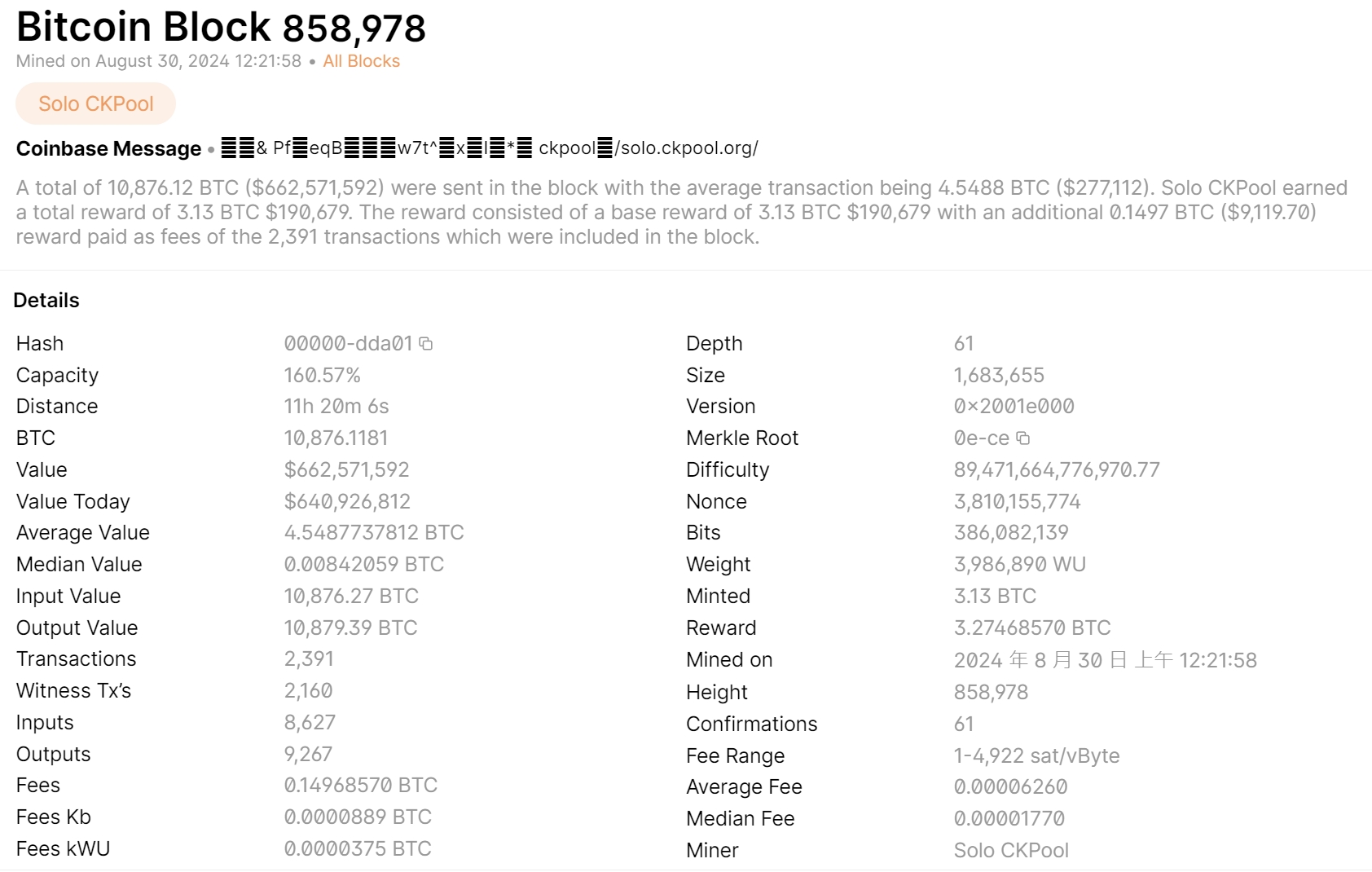
Most Bitcoin miners will pool their computing power with other miners to form a mining pool, and distribute rewards evenly according to the computing power contributed by each miner. However, according to the official website , the node infrastructure service Solo CKPool claims to allow miners to mine alone. Therefore, the person who mines can enjoy all the rewards exclusively and does not have to share them with others in the mining pool. Therefore, the reward for this miner is considerable.
How low are the odds?
Some mining experts pointed out that the current computing power of the entire Bitcoin network is 565.21 EH/s, but the computing power of CKPool is only 213 PH/s, accounting for only 0.000377% of the computing power of the entire Bitcoin network. It is speculated that this mining pool There may be thousands to tens of thousands of lottery mining machines and some scattered miners gathered together, but the mining reward is indeed obtained by one machine alone. This miner is quite lucky.
How difficult is it for independent miners to mine blocks? Blockchain developer Justin W tweeted an analysis . Assuming that the mining machine run by the miner is Antminer S19 With 0.000021875% of the entire network’s computing power, the chance of mining a block is only one in 4,571,428:
Assuming a block is produced every 10 minutes, the miner could take 87 years to mine a block. Assuming average electricity costs, the cost of running one of these is about $130/month, which is a real lottery win.
Which mining machine won the prize this time?
When the Solo CKPool mining pool successfully mined a Bitcoin block last month, Bitcoin mining equipment retailer Altair Technology came forward and claimed that it was its own lottery mining machine Bitaxe with a computing power of only 500 Gh/s. However, Different from last time, this time no lottery mining machine manufacturer came forward to announce that it was mined by its own mining machine.
If the miner who wins the jackpot this time still mines the block through a Bitaxe lottery mining machine, the chance of winning the lottery is only 1 in 1.1 billion. Compared with the lottery winning rate of about 1 in 13.98 million, the miner successfully packaged the block. The probability is much lower than the Zhongda Lotto probability.
So can we tell which of our own mining machines won the prize this time? In fact, there is no on-chain data to prove the model of the independent mining machine that mined the Bitcoin blocks. It can only be inferred based on the computing power of the mining pool. Therefore, manufacturers must be able to infer that it is their own mining machine. In fact, it is There is a certain degree of difficulty.