Editor's note: This article deeply explains Solana's potential problems. Although its user base and transaction volume seem to be better than Ethereum, in-depth analysis shows that most of the transaction volume may come from fake and runaway projects, leading to false prosperity. Through detailed data analysis of user activity, DEX transaction volume, MEV phenomenon, etc., the author points out that SOL's indicators are exaggerated and the on-chain ecology faces serious fundamental problems.
Lately, my social media timelines have been flooded with bullish talk about $SOL, as well as hype for Altcoin. I’ve come to believe that the Altcoin supercycle is real, and that Solana will surpass Ethereum as the dominant layer 1 (L1) blockchain. However, when I dug deeper into the data, the results were disturbing… In this post, I’ll share my findings and why Solana might be a house of cards.
First, let’s look at the bull case clearly laid out by @alphawifhat:
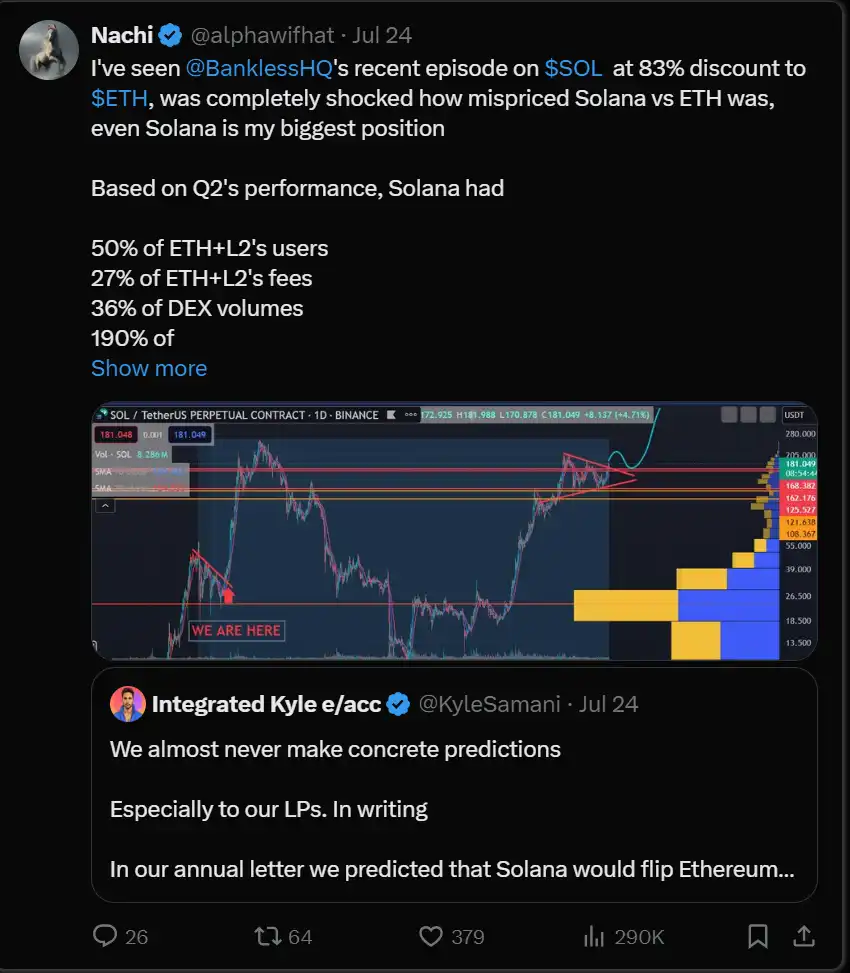
User base comparison
Four key data comparisons with ETH and L2:
High user ratio
Relatively higher fees
Higher decentralized exchange (DEX) trading volume
Significantly higher proportion of stablecoin transactions
The following is a comparison of the user base of ETH mainnet and SOL (only the mainnet data is compared, because after the Dencun upgrade, most of the ETH transaction fees come from the mainnet, data source: @tokenterminal):


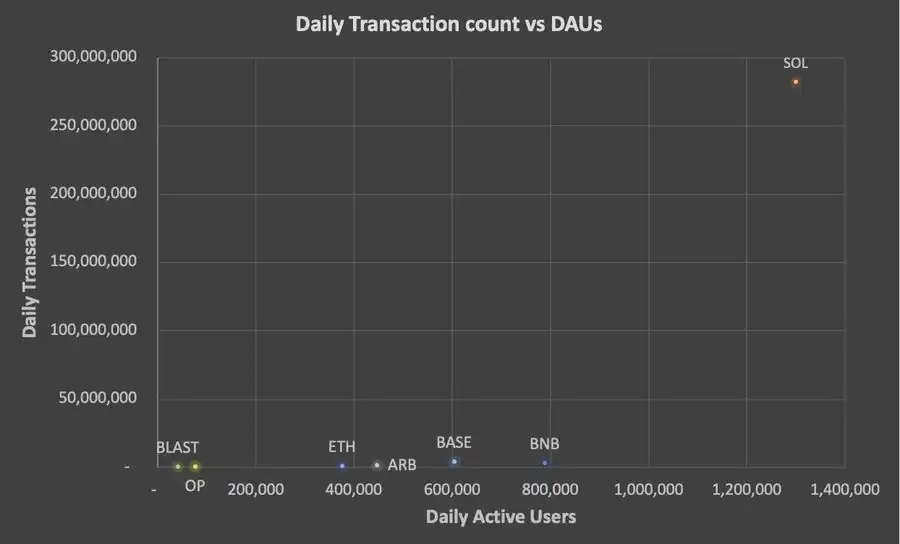
On the surface, SOL’s numbers look impressive, with over 1.3 million daily active users (DAUs) compared to ETH’s 376,300. However, when I factored in the number of transactions, something strange occurred.
For example, on Friday, July 26, ETH had 1.1 million transactions, corresponding to 376,300 DAUs, which means each user performs approximately 2.92 daily transactions. However, SOL’s data is 282.2 million transactions, corresponding to 1.3 million DAUs, which means each user performs an average of 217 transactions per day.
I thought it might be due to SOL's low fees, which allowed users to make more trades, adjust positions more frequently, increase arbitrage robot activities, etc. But when I compared it with another popular chain, Arbitrum, I found that Arbitrum's per-user transaction volume was only 4.46 on the same day. Looking at the data of other chains also yielded similar results:
Given that SOL has a higher number of users than ETH, I checked Google Trends, which should be relatively neutral on the value per user.
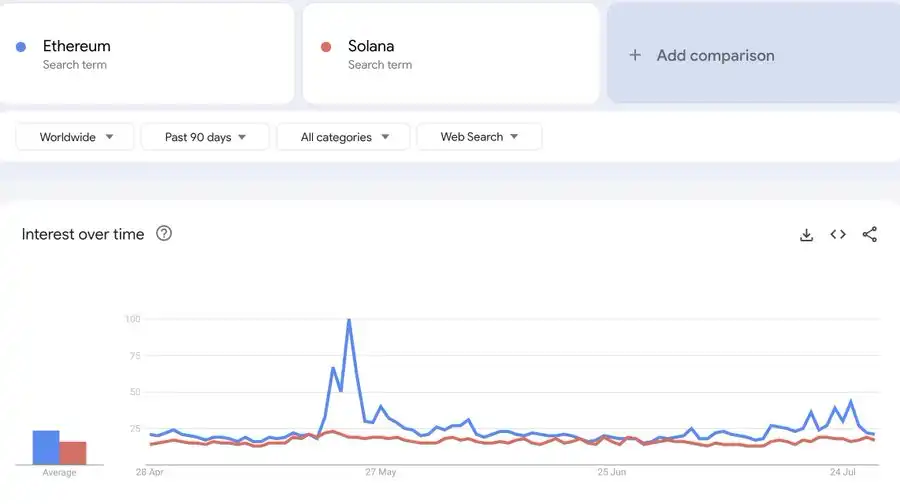
It turns out that ETH is either trending in lockstep with SOL or ahead. This is not what I expected given the huge difference in DAUs between SOL and the recent hype surrounding the SOL Altcoin craze, so what exactly is going on?

Analysis of decentralized exchange trading volume
To understand the discrepancy in transaction numbers, it is instructive to analyze Raydium’s liquidity pools (LPs). Even at first glance, it’s clear that something is amiss:

At first, I thought this was just wash trading via low-liquidity “honeypot” liquidity pools (LPs) to attract the occasional Altcoin speculator, but a closer look at the charts showed that the situation was far worse than I thought.
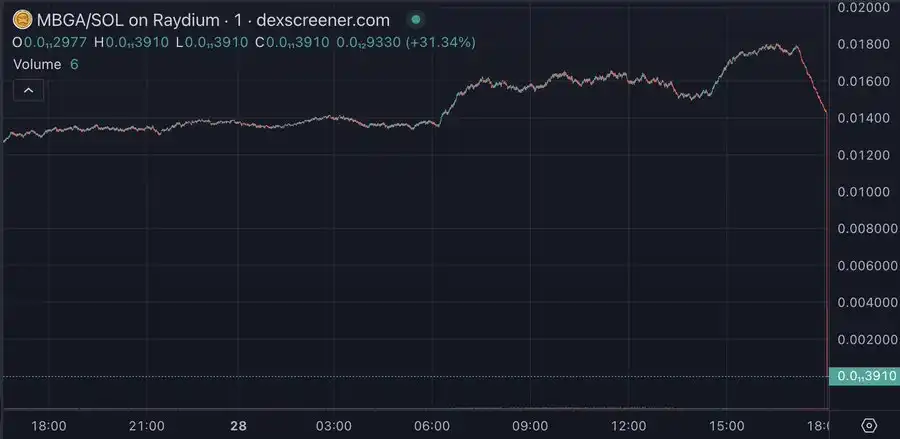
Every low-liquidity pool project has run away in the past 24 hours . Take MBGA as an example. In the past 24 hours, there were 46,000 transactions with a transaction volume of $10.8 million, 2,845 independent wallets involved in buying and selling, and more than $28,000 in fees were generated on Raydium. (In comparison, a legal liquidity pool of similar size, $MEW, only generated 11,200 transactions)
After checking the participating wallets, it was found that the vast majority seemed to be robots belonging to the same network, making tens of thousands of transactions. They independently generated fake transaction volumes through random SOL amounts and random transaction times until the project ran away and then moved on to the next target.
In Raydium’s standard liquidity pool, more than 50 projects have gone dark in the past 24 hours alone, with a trading volume of more than $2.5 million, generating a total trading volume of more than $200 million and generating more than $500,000 in fees. Orca and Meteora have significantly fewer projects that have gone dark, while there are almost no projects with substantial trading volume on Uniswap (ETH).
Obviously, the phenomenon of running away on Solana is very serious, which has brought many impacts:
1. Considering the abnormally high ratio of trading users, and the number of wash trading and runaway projects on the chain, the vast majority of transactions are not organic. On the main ETH L2, the one with the highest daily trading user ratio is Blast (which also has lower fees and users are also farming Blast S2), with a trading user ratio of 15.0x. As a rough comparison, if we assume that the real SOL trading user ratio is similar to Blast, this means that more than 93% of the transactions (and corresponding fees) on Solana are inorganic.
2. The only reason these scams exist is because they can make money. Therefore, users lose at least an amount equal to fees and transaction costs every day, which adds up to millions of dollars.
3. Once these scams are no longer profitable (i.e. when actual users get tired of losing money), most trading volume and fee income are expected to drop significantly.
4. It appears that users, real fee income, and DEX trading volume are greatly exaggerated.
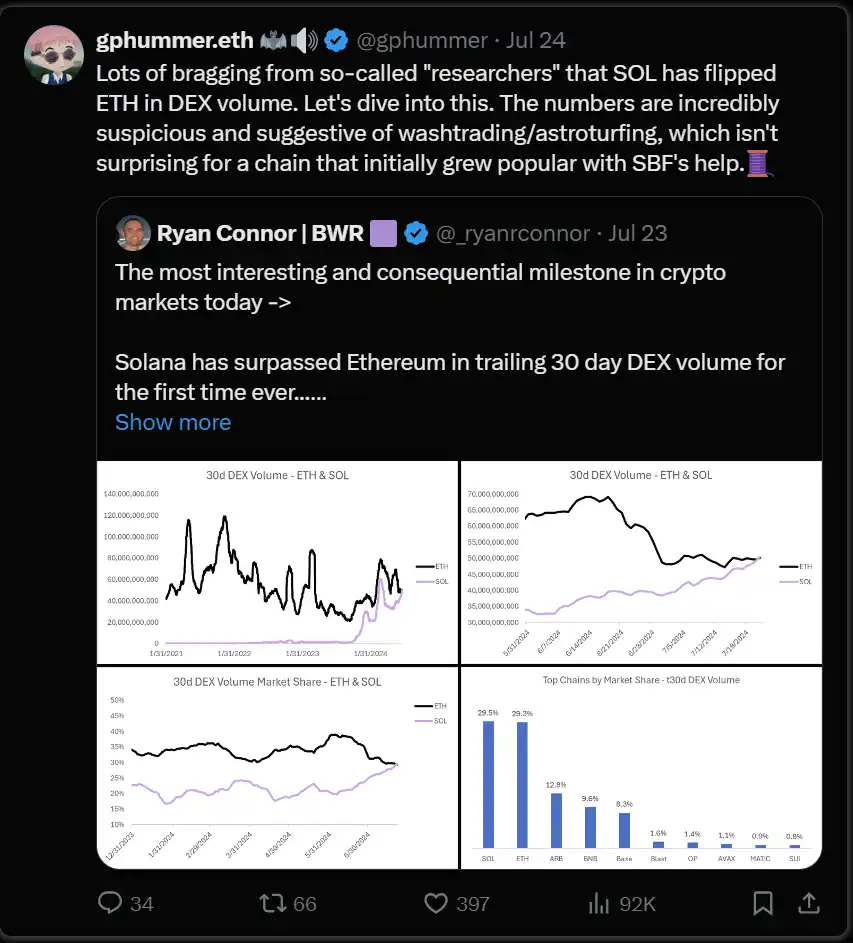
I'm not the only one to come to this conclusion, @gphummer recently made a similar observation:
MEV on Solana
Solana’s MEV is in a unique position, unlike Ethereum, Solana does not have a built-in transaction pool (mempool); instead, projects like @jito_sol once (now abandoned) created extra-protocol infrastructure to simulate transaction pool functionality, thus providing opportunities for MEV, such as front-running, sandwich attacks, etc. Helius Labs wrote an insightful article with details on Solana’s MEV .
The problem Solana faces is that most of the tokens traded are ultra-high volatility, low liquidity Altcoin, and traders often set slippage of more than 10% to ensure smooth execution of trades. This provides MEV with an attractive attack surface from which to extract value:
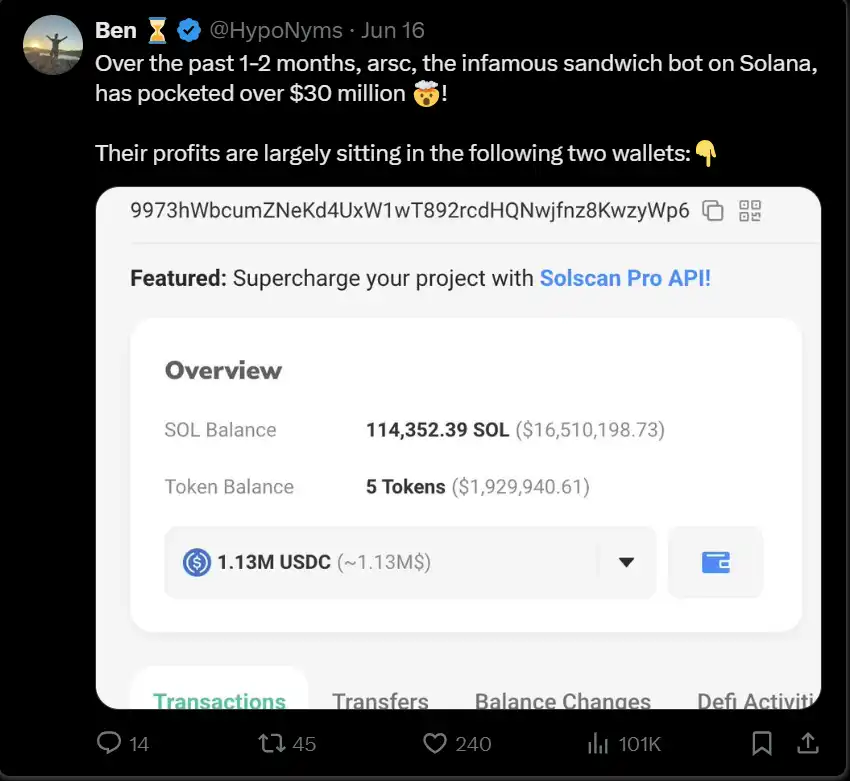
If we look at blockspace profitability, it’s clear that the majority of value currently comes from MEV tips:
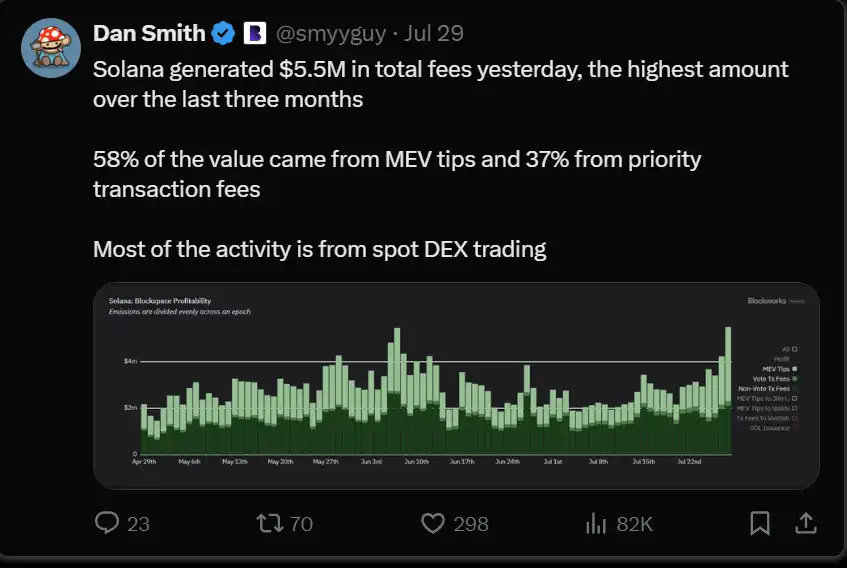
While this is technically considered “real” value, MEV is only exercised as long as it is profitable, which is as long as retail investors continue to participate in (and net lose money on) Altcoin. Once the Altcoin craze begins to cool, MEV fee revenue will collapse as well.
I see a lot of arguments about SOL mentioning that there will eventually be a shift to infrastructure projects like $JUP, $JTO, etc. While this shift may indeed happen, it is worth noting that these tokens, with their lower volatility and higher liquidity, obviously will not offer the same MEV opportunities.
Sophisticated players are incentivized to build the best infrastructure to take advantage of this situation. In my in-depth research, several sources mentioned rumors of these players investing in control of trading pool space and subsequently selling access to third parties. However, I was unable to verify this information. However, there are some clear distorted incentives - by directing as much Altcoin activity as possible to SOL, this allows certain sophisticated individuals to continue to profit from MEV, as well as conduct insider trading on these Altcoin and benefit from the price increase of SOL.
Stablecoins
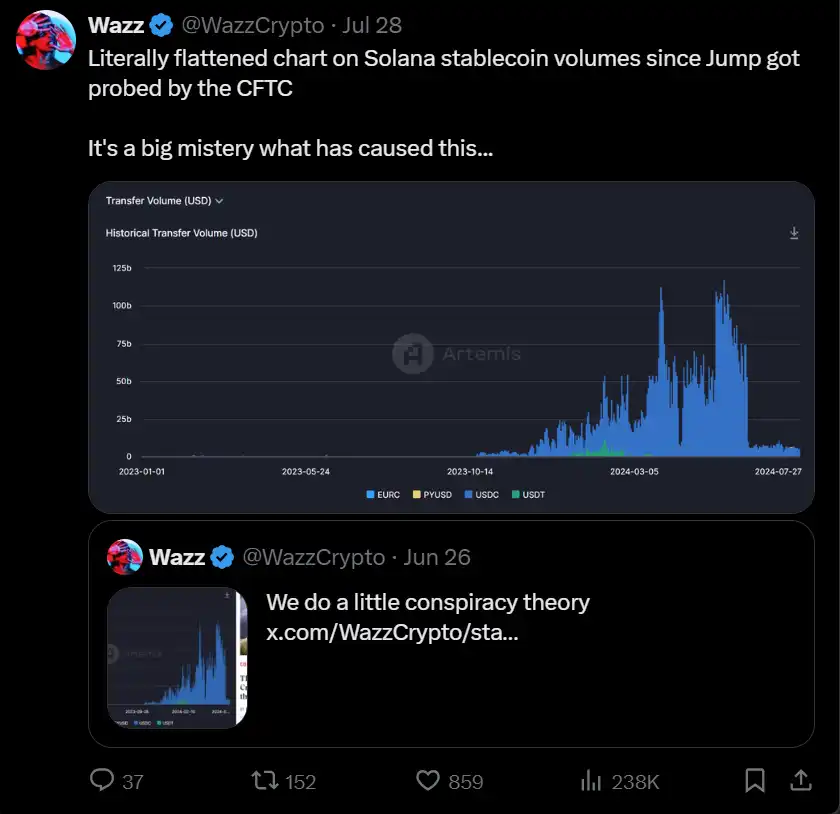
Another oddity comes up when it comes to stablecoin volume and total value locked (TVL). Stablecoin volume is significantly higher than ETH, but when we look at @DefiLlama’s stablecoin data, ETH’s stablecoin TVL is $80 billion, while SOL is only $3.2 billion. I think stablecoin (and more broadly) TVL is a less manipulable metric than volume and fees on low-fee platforms, and shows the exposure of participants in it.
This is further emphasized by the dynamics of stablecoin trading volumes — @WazzCrypto noted that when the CFTC announced it was investigating Jump, trading volumes suddenly dropped.
Retail value extraction
Apart from running away and MEV, the outlook for the retail market remains bleak. Celebrities chose Solana as their preferred chain, but the results were not ideal:
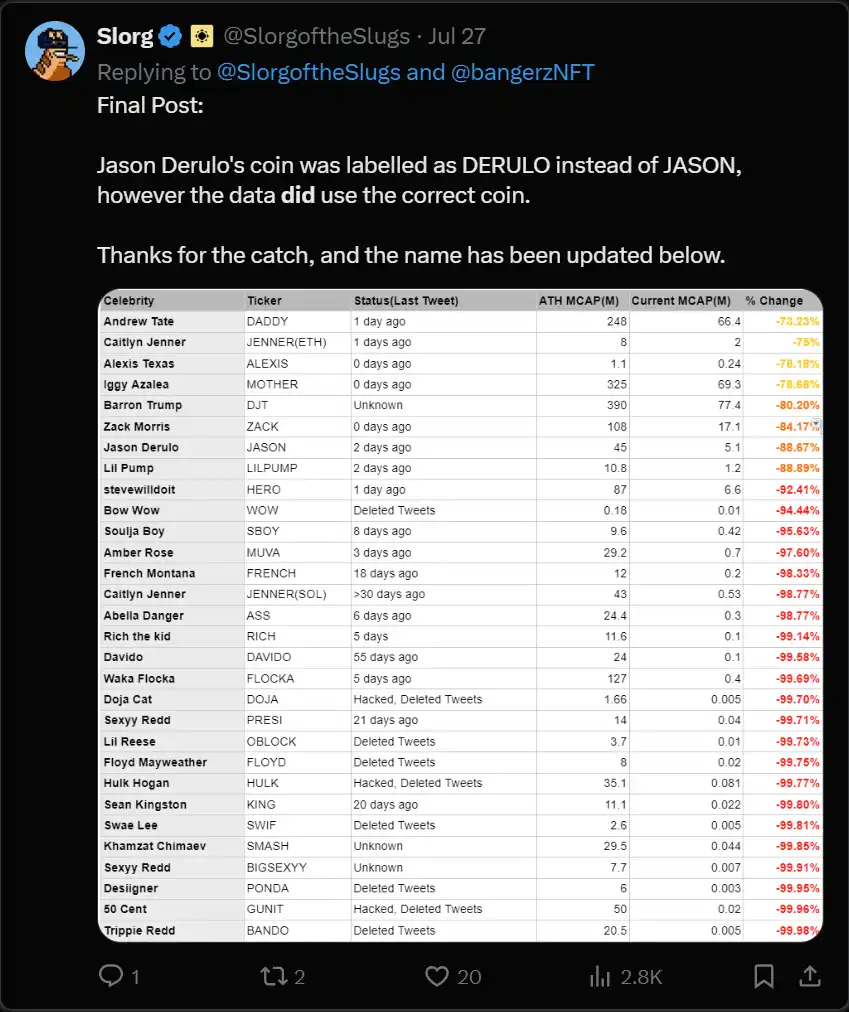
Andrew Tate’s DADDY was the best performing celebrity token, but still had a -73% return, and at the other end of the boxing skill level, things were just as bad:
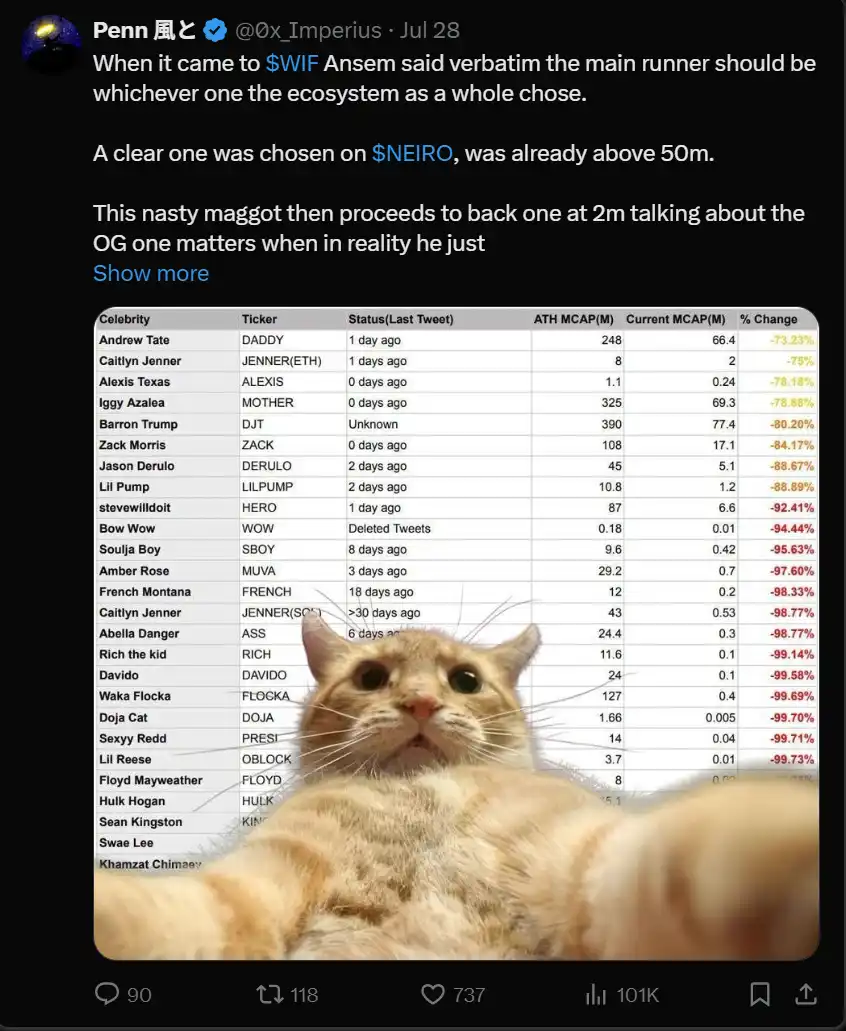
A quick search on X also shows evidence of rampant insider trading and developers dumping tokens on buyers:
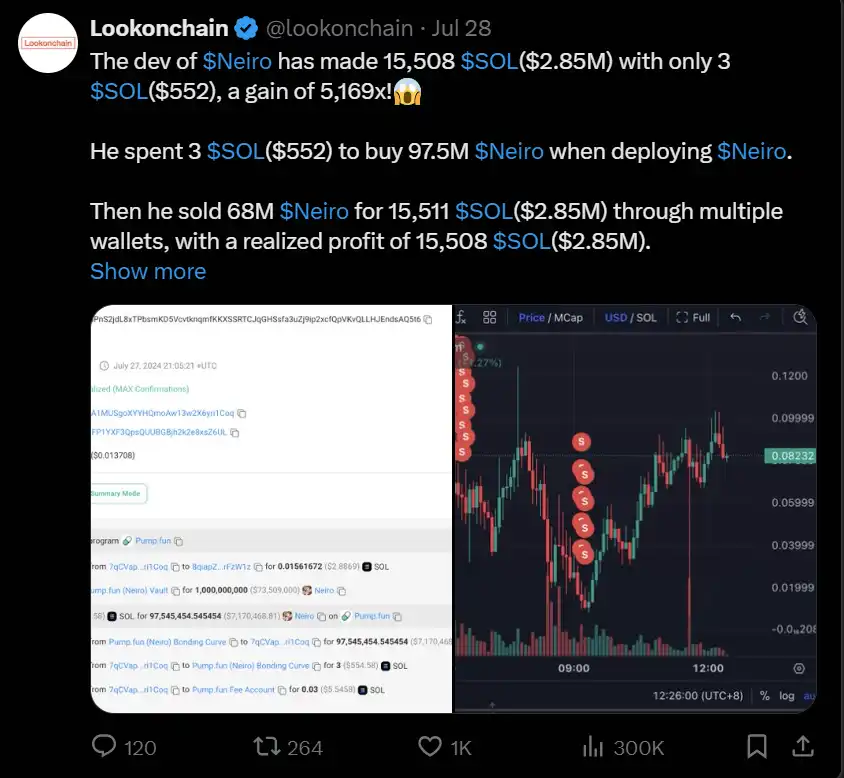
I don’t think a KOL’s posts on X are representative of the wider user base, it’s easy for them to get into a position in the current frenzy, promote their token, profit from followers, and repeat. There’s definitely survivorship bias here — the voices of the winners are much louder than the losers, creating a distorted perception of reality.
Objectively speaking, retail investors are losing millions every day, victims include scammers, developers, insiders, MEV, KOLs, etc., not to mention that most of the tokens they trade on Solana are just Altcoin with no real support. It is hard to deny that most Altcoin will eventually go the way of $boden.
Other considerations
Markets are fickle, and when sentiment shifts, factors that were once invisible to buyers become apparent:
Poor chain stability and frequent failures.
· High transaction failure rate.
Block explorers are difficult to read.
High barrier to entry for development. Rust is much less user-friendly than Solidity.
Poor interoperability with the EVM. I think it would be healthier to have multiple interoperable chains competing with each other, rather than being restricted to a single (relatively centralized) chain.
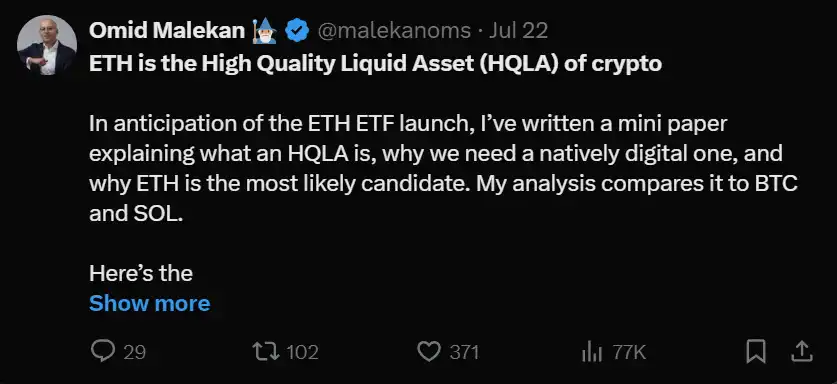
ETFs are unlikely, both from a regulatory and demand perspective. @malekanoms also points out something that I think is relevant from a traditional finance perspective (plus a rebuttal from @0xmert):
· High emissions of up to 67,000 SOL per day (approximately $12.4 million).
· There are still 41 million SOL (~$7.6 billion) locked in the FTX Legacy Sale. 7.5 million (~$1.4 billion) will be unlocked by March 2025, with another 609,000 (~$113 million) unlocked per month until 2028. Most tokens can be purchased for around $64 each.
in conclusion
As usual, shovel and hammer sellers are profiting on the Solana Altcoin craze, while speculators are often unwittingly losing money, and the commonly cited SOL metric is significantly inflated. In addition, the vast majority of organic users are rapidly losing money on-chain due to the influence of bad actors. We are currently in the mania phase, and retail inflows are still exceeding outflows from these mature players, creating a positive halo. Once users become exhausted from continued losses, these indicators will quickly collapse.
As mentioned above, SOL also faces multiple fundamental headwinds that will come into focus if sentiment turns and any price increase will exacerbate inflationary pressures and unlock. Ultimately, SOL is overvalued from a fundamental perspective, and while existing sentiment and momentum may drive prices higher in the short term, the long-term outlook is much more uncertain.
Disclaimer: While I have held SOL at various times in the past, I do not currently hold any significant SOL position. Many of the opinions I have stated above are my own speculations and not facts. I may be wrong in my assumptions and conclusions. Always do your own research - this is not financial advice.
「 Original link 」
Welcome to BlockBeats the BlockBeats official community:
Telegram subscription group: https://t.me/theblockbeats
Telegram group: https://t.me/BlockBeats_App
Official Twitter account: https://twitter.com/BlockBeatsAsia