


Author: Weizhi; Source: BlockBeats
Recently, I noticed that "Pokemon Go" has started to enter the Non-Fungible Token (NFT) market, and I didn't expect this super IP to also be trying to integrate with Blockchain technology.
Combining online and offline gameplay is certainly interesting, but this game has always had an inescapable problem, which is that users can cheat by using plug-in tools to capture rare Pokemon around the world using location data. Although we don't know exactly what NFT gameplay Pokemon will launch this time, if they still use the previous mechanism, it may be another "scientist" involution game.

But this problem is not unsolvable. What if there was a mechanism that could locate and verify? Readers familiar with the DePIN track should know that Roam's solution can solve this GPS cheating problem.
As the only Web3 IDP project of the Wireless Broadband Alliance (WBA), Roam is committed to building a unified global decentralized WiFi roaming network. After in-depth research, the author found that Roam is different from other more vertically-oriented DePIN projects, as it is more like an ecosystem. The foundation of this system is a network that connects real users' physical devices, and the project team can build various decentralized applications based on this basic platform, while Roam can also cooperate with other projects to provide data storage, CDN and other services. Expanding the imagination, solving the GPS cheating problem is just the tip of the iceberg for Roam's landing scenarios.
Roam: The "Docking Station" for Entering the Global WiFi Network
Before discussing Roam's overall ecosystem, let's briefly introduce the Roam protocol.
Roam's original vision was to build a unified decentralized WiFi Open Roaming network. Currently, the Roam network has already covered more than 190 countries and regions, with more than 700,000 self-built WiFi nodes. Roam app users can achieve seamless WiFi roaming among the 3.5 million OpenRoaming nodes and these 700,000 self-built nodes globally, without the need to repeatedly register and log in, and can access the Internet smoothly and uninterruptedly. This huge potential market has also helped Roam secure investments from Volt Capital, Anagram and SamsungNext.
From the user's perspective, the ability for the phone to automatically connect to WiFi is the most direct convenient experience, and behind this seamless roaming is the role played by the OpenRoaming security certificate and DID+VC technology in user privacy and data verification.
The operating mechanism of the Roam protocol can be roughly understood as follows: when the user first downloads and opens the Roam app, the system will automatically generate a DID (digital identity) for the user and configure the Open Roaming security protocol. On this basis, the user's VC (verifiable credential data) is stored on the Blockchain by Raom. When the user approaches Roam's router again, the user's device will automatically send the corresponding VP, and the system will recognize and allow the user to connect to the network.
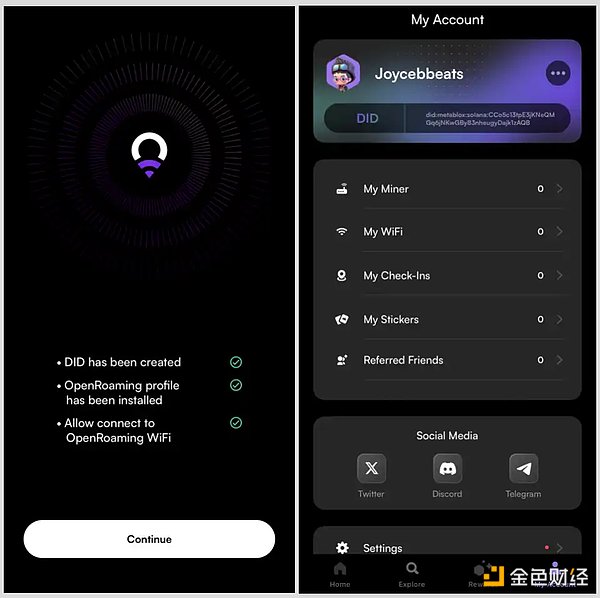
Through DID+VC technology, when the user connects to Roam's open roaming network, the identity authentication process will be performed on the decentralized Chain, ensuring the privacy and security of the user's data. Combined with the scale advantage of more than 4 million WiFi nodes globally, Roam stands out in the decentralized WiFi field. Now, in the DePIN track, Roam has already made more advanced and multi-dimensional deployments.
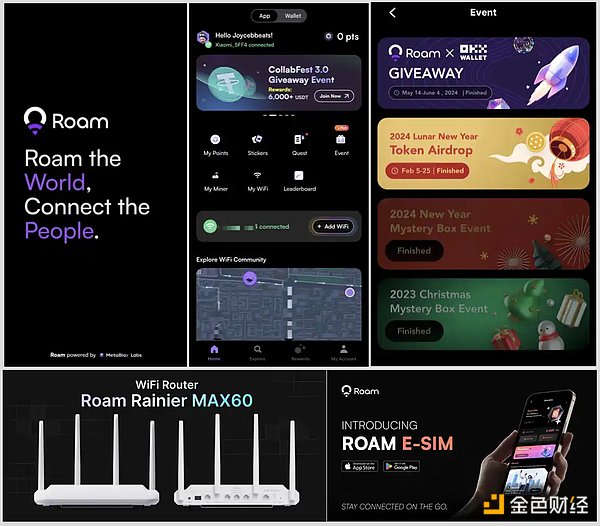
Roam APP, Roam Rainier MAX60, Roam eSIM
The Roam app was launched in June 2023, and users only need to download the app, and the system will automatically help the user create a DID and configure and install the OpenRoaming credentials, after which the user can start seamless roaming to any OpenRoaming network and Roam's self-built WiFi network globally. Users can participate in the construction of the Roam network in different ways and receive corresponding rewards (Roam Points), and these point tokens can be burned for $ROAM tokens after the TGE. Currently, the Roam app has registered over 750,000 users.
In addition to software products, Roam has also launched its second-generation hardware product Roam Rainier MAX60, which is a hardware device that combines high-speed WiFi performance and Blockchain mining capabilities. While providing up to 6000Mbps of network speed and supporting connections for more than 200 devices, it also has mining capabilities. Users can earn Roam points by keeping the device running daily, and accumulate more points by sharing WiFi connections, and these points can be exchanged for $ROAM tokens in the dedicated burning pool in the future.
And to further meet the travel needs of users, Roam has also launched Roam eSIM, allowing users to achieve seamless, secure and flexible international data roaming without the need for a physical SIM card.
After understanding this, one may think that Roam is only focused on the scenario of users using WiFi, but in fact, Roam sees the construction of a decentralized data roaming network as the foundation for future development, and what Roam really wants to do is to become the "decentralized telecom data layer".
Becoming the "Decentralized Telecom Data Layer" for DePIN Projects
If we see the previous DePIN projects, users and the public Chain L1 they are in as the relationship between vehicles, passengers and roads, then what Roam wants to do as the "decentralized telecom data layer" is to serve this transportation ecosystem with telecom data networks and power grid facilities. You can use the "physical layer L1" to more concretely understand what Roam wants to do - that is, to lay out a multi-functional network data layer through hardware.
Roam's ability to propose a "data layer" positioning first comes from its scale advantage in the DePIN market. On DePINscan, Roam's node count has already exceeded 600,000, ranking third among DePIN projects, surpassing former star projects like Helium, Hivemapper and DIMO.
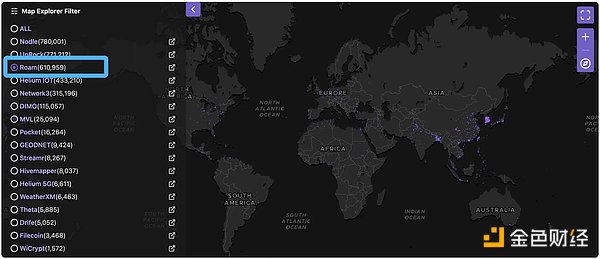
DePIN project node ranking, and Roam's node coverage, source DePINscan
The large user base and node resources are just the first step for Roam to approach the data layer. Through seamless connectivity, decentralized security mechanisms, economic incentives and global coverage advantages, Roam has redefined the relationship between hardware, users and data. To understand Roam's new positioning, we need to combine Roam's potential to provide telecom data resources and physical devices for the operation of other DePIN projects. Just as Layer1 is the foundation layer for Blockchain applications, Roam's function is similar to a hardware "physical layer L1".
Basic Functions: Seamless and Secure Network Connectivity
In Layer1, the flow of assets depends on the basic infrastructure of the network. L1 provides the core transaction processing capabilities, ensuring the stable circulation and secure processing of assets in the network, just like the foundation of Blockchain to ensure the stability and reliability of all transactions and smart contracts.
Roam plays a similar role in the field of telecom data. In terms of functionality, through a decentralized network architecture, just as L1 provides a basic guarantee for the flow of assets on the Blockchain, Roam also provides users with stable WiFi connections around the world, ensuring that users' WiFi connections between different locations can be as stable and reliable as the flow of assets on the Chain.
In terms of implementation, L1 reduces transaction confirmation time through efficient consensus mechanisms and infrastructure to enable assets to flow conveniently globally. When users connect to Roam's WiFi network, they only need to set it up once, and then all WiFi nodes supported by the Roam network can be connected automatically in the background, without the need to enter a password or make additional settings.
Decentralization: Using Nodes to Build a "Global IoT"
Among the massive telecom data access nodes owned by Roam, each node provides network services for users, while also generating identity, location and time data. The ledger of these data will be synchronized to the Solana Blockchain in real-time, and in the future Roam will also cooperate with service providers on other public chains such as Arbitrum and IoTeX to provide data cross-chain bridge services for their ecosystem projects.
This mechanism is an innovation over traditional IoT. Typical WiFi networks rely on centralized servers and databases to process user identity information and connection requests, and users usually need to enter personal information or log in to an account when connecting to WiFi, and these data are stored in the centralized systems of the service providers, which may be vulnerable to attacks and lead to data leakage or abuse.
In contrast, Roam has greatly improved user privacy protection by introducing decentralized identity (DID) and verifiable credential (VC) technologies. When users connect to Roam's WiFi hotspots, the identity verification process relies on encryption technology on the Blockchain, ensuring that user identity information will only be verified with the user's authorization.
In addition to the privacy protection advantage, the decentralized telecom data layer built by Roam has broken through the limitations of the centralized model in the transmission, storage and maintenance of data in traditional IoT, and the data flow has transcended the restrictions of different hardware devices, truly realizing "global interconnection".
Mining Mechanism: User Participation, Community Empowerment
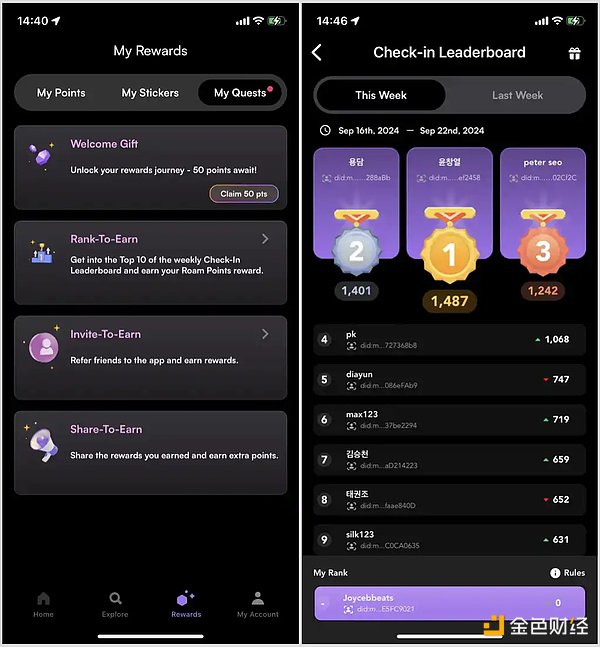
The community is the key to user growth for all decentralized projects. Usually, Layer 1 project teams rely on community miner nodes to ensure the security and efficient operation of the network, while Roam introduces the behavior of users checking in to WiFi to verify the normal operation of the network services. At the same time, miner users can also deploy their WiFi OpenRoaming nodes to jointly build a decentralized WiFi roaming network. As a reward, users in different roles not only receive free services but also earn reward tokens. This incentive mechanism design is similar to the "validators" or "proof-of-stake" (PoS) systems in L1, focusing on user identity verification and network node operation to ensure the decentralization and security of the Roam network.
In this way, the significance of Roam is not only as a global shared telecommunications data resource library, but also as an ecosystem with community stickiness, centered around telecommunications data connectivity, for developers and users.
Will Roam Become a "Public Good" in the DePIN Field?
So just as computers came before the internet, what blockchain wants to change is at the internet level, while what Roam wants to change is at the computer hardware level.
The Roam ecosystem will consist of four strategic modules: Roam Network, Roam Growth, Roam Discovery, and Roam Community. Roam Network will focus on developing and maintaining core infrastructure, such as the Roam applications and network nodes that can be seen now. Roam Growth and Roam Discovery modules aim to attract enterprise and individual developers to join the platform and encourage them to create applications that benefit both the company and Roam builders, while Roam Community will serve as a platform for users to exchange, share information and provide feedback.
Based on this strategic system, Roam guides users to shift their participatory role from traditional airdrop chasers to community builders. This is also a direction that current DePIN projects have not paid attention to, as existing DePIN protocols are mainly focused on a specific vertical field, while Roam's goal is to break down data barriers, connect end-user devices, and provide a decentralized telecommunications data layer for individual developers and entrepreneurs.
To put it more bluntly, Roam can provide "new mines" for users.
Filecoin, a well-known decentralized storage project, sells an IPFS miner at a price far exceeding its own value, but why can only Filecoin do decentralized storage? Roam can do the same. If a third party wants to use Roam's own data to build a decentralized storage network, it would be very convenient, as the scale of Roam devices and services has already fully met the requirements.
Orchid Protocol (OXT), the leader in decentralized networks, is also a business that Roam can serve. Utilizing Roam's device locations and data to build a decentralized network service is not difficult to imagine.
Roam has chosen a free and open approach, allowing more users to get started easily and gradually build a more sticky user ecosystem. Compared to directly passing on operating costs to WiFi users, Roam charges commercial fees for providing services to third-party service providers. Many DePIN projects' revenue depends on the miner community, while Roam's business model is expected to create a sustainable source of income for the platform, exploring a more sustainable development path.
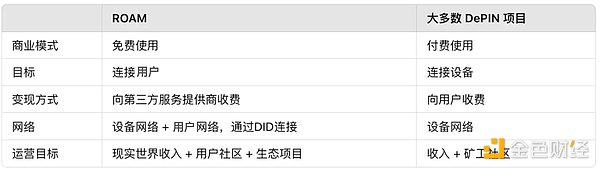
The growing user community can bring strong network effects to Roam, and these network effects in turn will drive more ecosystem projects to join, further enhancing the platform's value and appeal. When Roam's user community reaches a certain scale, Roam will have the potential to provide a platform for other vertical DePIN projects.
Against this backdrop, Roam is likely to develop into a "public good" in the DePIN field. Although its profit model relies on charging fees for third-party commercial services, its open, shared, and user-first characteristics give it the qualities of a public good. Just like the infrastructure of the internet, Roam connects users and devices through decentralized technology, and in the future, it may play a role similar to a public good in the DePIN ecosystem, serving a wider user base and becoming a key force in driving the development of the entire decentralized network.






