Author: Snow
Translator: Paine
Reviewers: KOWEI, Wayne, Elisa, Ashley, Joyce
Key Points of the Report
reStaking is a mechanism that increases yield by releasing liquidity and increasing leverage, primarily based on the security framework of Ethereum. Although it can provide additional returns for stakers and improve capital efficiency, it also brings a series of risks, including slashing, liquidity, centralization, contract and smart contract risks. EigenLayer is a pioneer in this field, but with the entry of more and more competitors such as Symbiotic, Karak Network, Babylon, BounceBit and Solayer, the market capital is being dispersed, and it may face more challenges in the future. Users need to carefully consider the risks and benefits of participating in reStaking protocols and configure corresponding contract monitoring to ensure asset security.
Background
Staking and Liquid Staking
Staking on Ethereum refers to users locking their ETH in the Ethereum network to support the operation and security of the network. In Ethereum 2.0, this staking mechanism is part of the Proof of Stake (PoS) consensus algorithm, replacing the previous Proof of Work (PoW) mechanism. Stakers become validators by staking ETH, participating in block creation and confirmation, and in return, they can receive staking rewards.
The emergence of Liquid Staking Derivatives (LSD) aims to solve the liquidity problem in traditional staking. It allows users to obtain liquid tokens (such as Lido's stETH or Rocket Pool's rETH) representing their staked shares while staking tokens. These liquid tokens can be traded, borrowed or used for other financial activities on other platforms, allowing them to participate in staking to earn rewards while maintaining the flexibility of their funds.
Breakdown of Trust Networks
The Bitcoin network introduced the concept of decentralized trust from its inception, designed as a peer-to-peer digital currency system based on UTXO and script language. However, its ability to build various applications on the network is limited. Later, Ethereum, through its highly programmable virtual machine (EVM) and modular blockchain concept, allowed developers to build permissionless decentralized applications (DApps) on its consensus layer, providing trust and security for all DApps built on it. However, many protocols or middleware have still not been able to fully utilize Ethereum's trust network.
For example, Rollups separate transaction execution from the EVM, only returning to Ethereum for transaction settlement, effectively improving Ethereum's performance. But these transactions are not deployed and verified on the EVM, so they cannot fully rely on Ethereum's trust network. In addition to Rollups, other systems based on new consensus protocols, such as sidechains, data availability layers, new virtual machines, oracles, and cross-chain bridges, also face similar challenges and need to establish their own trust layer to ensure security and prevent malicious behavior, known as Active Verification Services (AVS).
Fragmentation of Liquidity
As the largest Proof of Stake (PoS) blockchain, Ethereum has many projects that rely on staking to ensure their security, such as cross-chain bridges, oracles, data availability layers, and zero-knowledge proofs. Therefore, whenever a new project is launched, users must lock up a certain amount of funds, leading to different projects competing for a limited pool of funds. As the staking yield offered by different projects continues to rise, the risks borne by the projects also increase, forming a vicious cycle. On the other hand, users can only stake their limited funds in a limited number of projects, resulting in a low utilization rate of their funds. With the increasing number of public chains, applications, and various projects, liquidity is becoming increasingly fragmented.
Market Demand for Staking Services
With the approval of the Bitcoin spot ETF and the successful Ethereum Cancun upgrade, Ethereum has regained new vitality. As of July 15, 2024, over $110 billion worth of Ether (ETH) has been staked, accounting for 28% of the total supply. The amount of staked ETH is referred to as Ethereum's "security budget" because these assets are subject to network penalties in the event of double-spend attacks and other protocol violations. Users who stake ETH contribute to enhancing Ethereum's security and receive rewards through protocol issuance, priority tips, and MEV. Users can easily stake ETH through liquid staking pools without sacrificing the liquidity of their assets, leading to an increasing demand for staking.
Against this backdrop, the market has a growing need for shared security, requiring a platform that can use the staked assets of users to secure multiple projects, which is the context in which reStaking emerged.
What is reStaking
Today, the modular expansion of blockchains has led to the emergence of many new protocols and supporting middleware. However, each network needs to establish its own security mechanism, often using variants of Proof of Stake (PoS) consensus, but this approach results in each security pool becoming an isolated entity.
reStaking is the process of using the economic and computational resources of one blockchain to protect multiple blockchains. In PoS blockchains, reStaking allows the staking weight and validator set of one chain to be used on any number of other chains. This involves re-staking the liquid staking tokens that have already been staked on Ethereum to become validators on other blockchains, in order to earn more rewards and improve the security and decentralization of the new networks. The result is a more unified and efficient security system that can be shared across multiple blockchain ecosystems. This concept extends Ethereum's existing economic trust to protect other distributed systems, such as oracles, bridges, or sidechains.
The concept of reStaking has existed in the industry for several years, with the Polkadot ecosystem experimenting with this concept in 2020. Cosmos launched a reStaking model called "Shared Security" in May 2023, and Ethereum introduced a similar model through EigenLayer in June 2023. The main value of reStaking protocols comes from the staked funds locked on Ethereum, making Ethereum as a PoS blockchain the most economically secure.
A key difference between the reStaking mechanism and liquid staking is that while both mechanisms can help the ETH staked on Ethereum earn more rewards, the reStaking mechanism fully inherits the trust consensus of the staking mechanism and extends it, allowing validators to make trustworthy commitments to more applications, infrastructure, or distributed networks, thereby improving the overall economic security of the Ethereum ecosystem.
How reStaking Works
The core of reStaking is to use the liquid staking token assets to stake on validators of other blockchains, earning more rewards while establishing a shared security pool to improve the security and decentralization of the new networks. Specifically, Liquid Staking Tokens (LST) represent the tokenized form of staked ETH and accumulated rewards, while Liquid Restaked Tokens (LRT) represent the tokenized form of re-staked ETH and accumulated rewards. reStaking is built on Ethereum's security framework, aiming to optimize the utilization efficiency of capital in the cryptocurrency ecosystem. Stakers not only can support the security of one network, but also provide validation services to multiple networks, thereby earning additional rewards.
The main issue faced by reStaking is still liquidity. Similar to PoS staking, the assets locked in the nodes after reStaking have limited liquidity. To solve this problem, Liquid Restaked Tokens (LRT) were introduced. LRT is a synthetic token issued for re-staked ETH or other LSTs, used by multiple Active Verification Services (AVS) to ensure the security of applications and networks, and distribute various types of additional rewards. This allows the staked assets to provide security support in multiple services, while bringing additional rewards and returns to the stakers. Therefore, although there are some detailed risks in the reStaking process, it brings important liquidity and returns to stakers and DeFi.
Track Analysis
Competitive Projects
EigenLayer
EigenLayer is a leading player in the reStaking domain and currently has no direct competitors of significant scale. As an innovative concept, there are relatively few direct competitors in the market. However, EigenLayer may face the following potential competition and challenges:
Other LSD protocols may develop their own reStaking functionalities, such as Lido Finance and Rocket Pool.
Other data availability and governance service protocols may develop their own LSD functionalities, such as The Graph and Aragon.
Other Layer 2 or cross-chain protocols may develop their own security and trust networks, such as Polygon and Cosmos.
As EigenLayer primarily uses LSD as collateral, LSDFi projects in the market may also compete for the LSD market share.
Karak Network
Karak Network operates similarly to the EigenLayer protocol, but its AVS service is called Distributed Security Service (DSS) and it has launched its own Layer 2 network K2. Unlike EigenLayer, Karak aims to support reStaking of any asset, and the platform currently supports reStaking of assets such as ETH, various LST and LRT assets, as well as stablecoins like USDT, USDC, Dai, and USDe. Additionally, Karak has deployed on Ethereum, Arbitrum, BSC, Blast, and Mantle, allowing users to choose the network for reStaking based on their asset distribution.
Babylon
Babylon is a Bitcoin-based reStaking protocol that introduces staking functionality for Bitcoin, allowing BTC holders to trustlessly stake their assets to other protocols or services that require security and trust, and earn PoS staking rewards and governance rights. Babylon covers two aspects: one is that BTC holders can stake BTC to provide security and credibility to other protocols, and earn rewards; the other is that new protocols in the PoS chain or Bitcoin ecosystem can utilize BTC stakers as validators to enhance security and efficiency.
Solayer
Solayer is a reStaking protocol in the Solana ecosystem, supporting SOL holders to stake their assets to protocols or DApps within the Solana ecosystem that require security and trust, in order to earn more PoS staking rewards. Solayer has completed a builder's round of financing, with investors including Solana Labs co-founder Anatoly Yakovenko, Solend founder Rooter, Tensor co-founder Richard Wu, and Polygon co-founder Sandeep Nailwal. Solayer supports users depositing native SOL, mSOL, JitoSOL, and other assets. As of July 15, 2024, the Total Value Locked (TVL) on the Solayer platform exceeded $105 million, with SOL accounting for about 60%.
Picasso
Picasso is a universal reStaking blockchain built on the Cosmos SDK. It connects to base chains through the IBC protocol and handles the detailed information of deposited assets, then allocates the funds to AVS. Picasso's reStaking solution is similar to EigenLayer, which allows a subset of the network to join to protect the AVS weight. This architecture has been replicated across multiple base chains and unified on Picasso. Picasso's node operators are selected by a governance mechanism. Currently, Picasso's reStaking layer only accepts assets deposited through SOL LST from Solana and native SOL as reStaking collateral. Picasso's roadmap plans to launch AVS on Solana first, and then expand to Cosmos chains and other assets. Currently, the reStaking products supported on Picasso include SOL, JitoSOL, mSOL, and bSOL LST assets.
Universal reStaking Protocols
Universal reStaking is a system that can centralize the reStaking of native assets from multiple chains. This approach is independent of specific assets and base chains, allowing the concentration of many staking assets across multiple chains. Universal reStaking relies on an additional layer or a series of contracts across multiple blockchains between the economic security source chain and the AVS.
Summary
The reStaking domain is currently experiencing rapid development. While EigenLayer is a pioneer in this field, more and more competitors and innovators are joining, continuously expanding the application scenarios and technical boundaries of reStaking. reStaking not only brings new revenue models, but also drives the progress of the security and liquidity of the blockchain ecosystem.
Market Size
According to data from defillama, as of July 21, 2024, the total value locked in the global ETH liquid staking market was $47.599 billion. Lido is the largest participant, accounting for 72.31% of the locked value. Lido provides a liquid staking solution that allows users to stake ETH to the Ethereum 2.0 network and receive an equivalent stETH token, which can be used or restaked in the DeFi market. The main reStaking protocols include EigenLayer and Tenet.
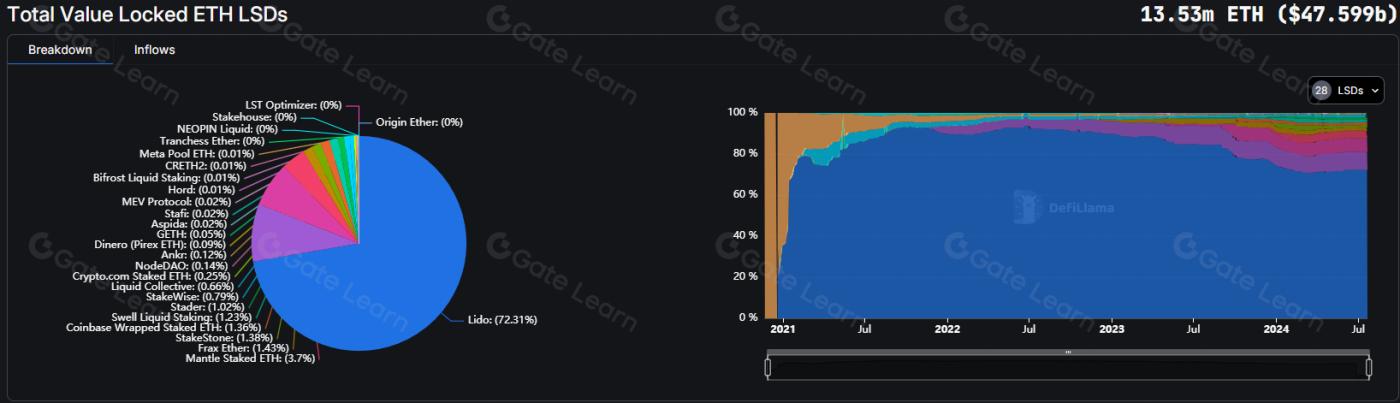
Source: https://defillama.com/lsd
As of June 25, 2024, the total value locked in the global reStaking market reached $20.14 billion. Currently, most reStaking protocols are deployed on the Ethereum chain, with a total locked amount of $19.4 billion in ETH and derivative assets; in addition, through reStaking protocols on the Solana chain, such as Picasso and Solayer, $585 million worth of assets have been staked; through Pell Network and Karak, $2.233 billion worth of BTC has been restaked on various chains (including Bitlayer, Merlin, and BSC).
The chart below shows the total value locked of the leading reStaking solutions (EigenLayer, Karak, Symbiotic, Solayer, Picasso, and Pell Network) in terms of reStaked assets. Overall, the total amount of reStaked assets exceeds $20 billion. The majority comes from native reStaking of ETH and ETH LST, and the top three reStaking assets by TVL are all ETH-centric.
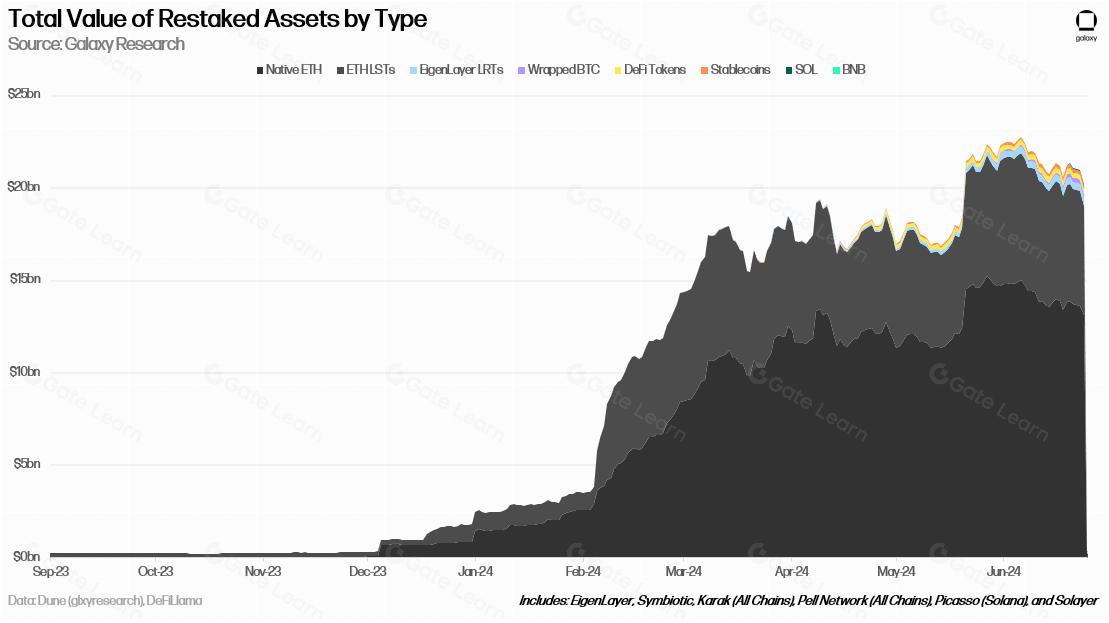
Source: https://x.com/ZackPokorny_
Core Competitive Factors
Asset Scale
Asset scale refers to the total amount of assets staked on the platform. A high-quality staking platform should have a large-scale of assets to demonstrate its stability and credibility. For example, EigenLayer currently has 5,842,593 Ethereum staked, with a total TVL exceeding $18 billion, making it the largest protocol in the reStaking domain.
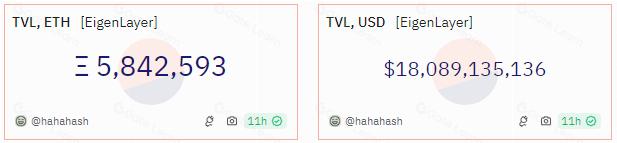
Source: https://dune.com/hahahash/eigenlayer
Yield Rate
- reStaking projects should provide higher yields than single staking to attract user participation. To achieve this, they need to optimize staking strategies, reasonably allocate income and rewards, and leverage compounding effects to improve users' capital efficiency and returns. For example, EigenLayer's reStaking proposal allows the liquid Token, in addition to staking Ethereum to earn rewards, to also earn rewards from cross-chain bridges, oracles, LP staking, and other DeFi activities.
- Staking Ethereum rewards, such as those obtained through liquid staking protocols like Lido;
- Token rewards for building and validating nodes for partner projects;
- LP rewards from staking the liquid Token in DeFi.
Liquidity
reStaking projects need to solve the liquidity problem of staked assets, allowing users to conveniently join or exit staking, or transfer assets to other protocols or platforms. Therefore, they need to provide services such as liquid staking tokens, liquidity mining, and lending markets to enhance user liquidity and flexibility.
Security
Protecting user asset security is the primary goal of staking projects. reStaking projects must ensure that user assets will not be damaged due to smart contract vulnerabilities, validator misconduct, or hacker attacks. Therefore, high-level security measures and risk management mechanisms are indispensable, such as multi-signature, firewalls, insurance, and penalty mechanisms. For example, EigenLayer becomes a validator node by staking Ethereum-related assets, and borrows the security of the mainnet through a slashing mechanism.
Ecosystem
The reStaking project needs to build a strong ecosystem, supporting verification services for various PoS networks and protocols, thereby enhancing the security and decentralization of the network, and providing users with more choices and opportunities. To achieve this goal, it is necessary to cooperate and integrate with other blockchain platforms, DeFi applications, and Layer 2 protocols.
What risks will reStaking bring?
Slashing risk
In the staking mechanism of Ethereum, as well as in the reStaking protocols, there is a 50% slashing risk. This means that users' funds may face the risk of being slashed, although this risk will be diversified across multiple nodes.
Liquidity risk
Many reStaking protocols will lock a large amount of liquidity in reStaked tokens (LST). If most of the LST is locked in the reStaking pool, it may lead to increased volatility of the LST price relative to ETH. This situation will increase the user's risk exposure, as the security of the AVS is directly related to the liquidity of the LST. When a certain type of LST is too concentrated in the AVS, the liquidity risk will be further increased.
Centralization risk
Centralization risk may lead to DAO hacking attacks. For example, if one-third of the ETH is concentrated in a single AVS, exceeding the traditional Byzantine fault tolerance security threshold, this part of the ETH may be slashed due to failure to submit fraud proofs, rather than due to technical issues such as double signing. Centralization risk means that the coupling in the system increases, increasing the overall fragility of the system.
Contract risk
Participating in reStaking requires interacting with the project's contracts, so users need to bear the risk of the contract being attacked. The project's funds are ultimately stored in the contracts of protocols like EigenLayer, and if these contracts are attacked, the user's funds will also suffer losses.
LST risk
LST tokens may be subject to de-anchoring or value deviation due to LST contract upgrades or attacks.
Withdrawal risk
Currently, except for EigenLayer, the mainstream reStaking protocols in the market mostly do not support withdrawals. If the project party fails to implement the corresponding withdrawal logic through contract upgrades, users will not be able to withdraw their assets and can only exit through the secondary market.
How to mitigate these risks?
reStaking is an emerging concept, and there has not been sufficient time to test the contracts and protocols. In addition to the risks summarized above, there may be other unknown risks. Reducing these risks is therefore particularly important.
Fund allocation
For users who use large amounts of funds to participate in reStaking, directly participating in the Native ETH reStaking of EigenLayer is an ideal choice. This is because in the Native ETH reStaking, the ETH assets deposited by the user are not stored in the EigenLayer contract, but in the Beacon Chain contract. Even in the worst case of a contract attack, the attacker cannot immediately obtain the user's assets.
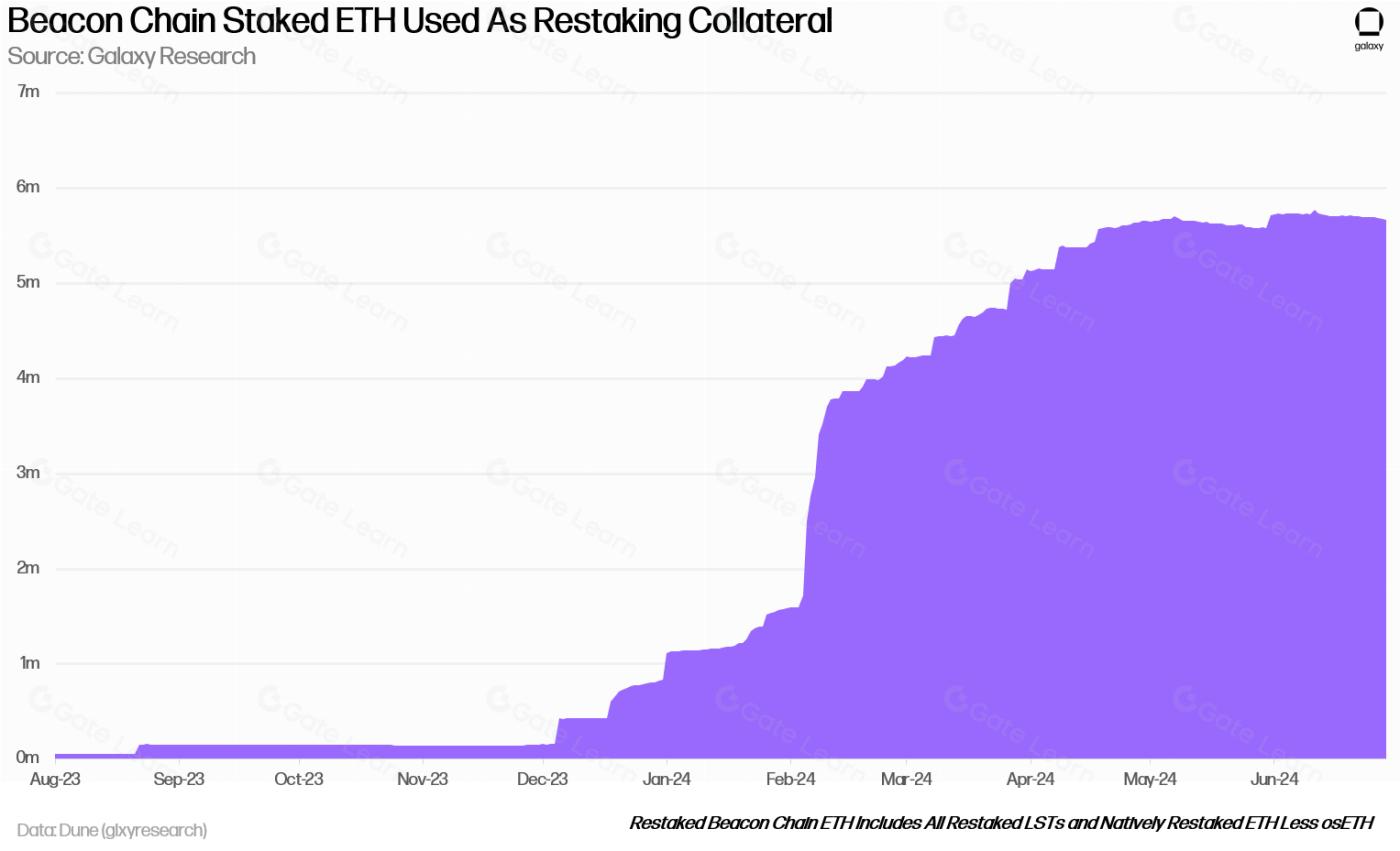
Source: https://x.com/ZackPokorny
(Currently, there are 33.4 million ETH staked on the Beacon Chain (including ETH in the entry/exit queue).)
For users who want to use large amounts of funds to participate but do not want to wait for a long redemption time, they can choose the relatively stable stETH as the participating asset and directly invest in EigenLayer.
For users who want to earn additional returns, they can appropriately allocate a portion of their funds to projects built on EigenLayer, such as Puffer, KelpDAO, Eigenpie, and Renzo, based on their risk tolerance. However, it should be noted that these projects have not yet implemented the corresponding withdrawal logic, and participants need to consider the withdrawal risk and pay attention to the liquidity of the relevant LRT in the secondary market during the investment process.
Monitoring configuration
The projects mentioned above have the ability to upgrade contracts and pause operations, and the project party's multi-signature wallet can execute high-risk operations. For advanced users, it is recommended to configure the corresponding contract monitoring system to monitor the upgrade of relevant contracts and the execution of sensitive operations by the project party.
Parameter optimization
Optimize the reStaking parameters (TVL cap, reduction amount, fee distribution, minimum TVL, etc.) and ensure the diversification of funds between AVSs. reStaking protocols allow users to choose different risk profiles when depositing for reStaking. Ideally, each user should be able to evaluate and choose which AVS to reStake to, without having to delegate this process to the DAO.
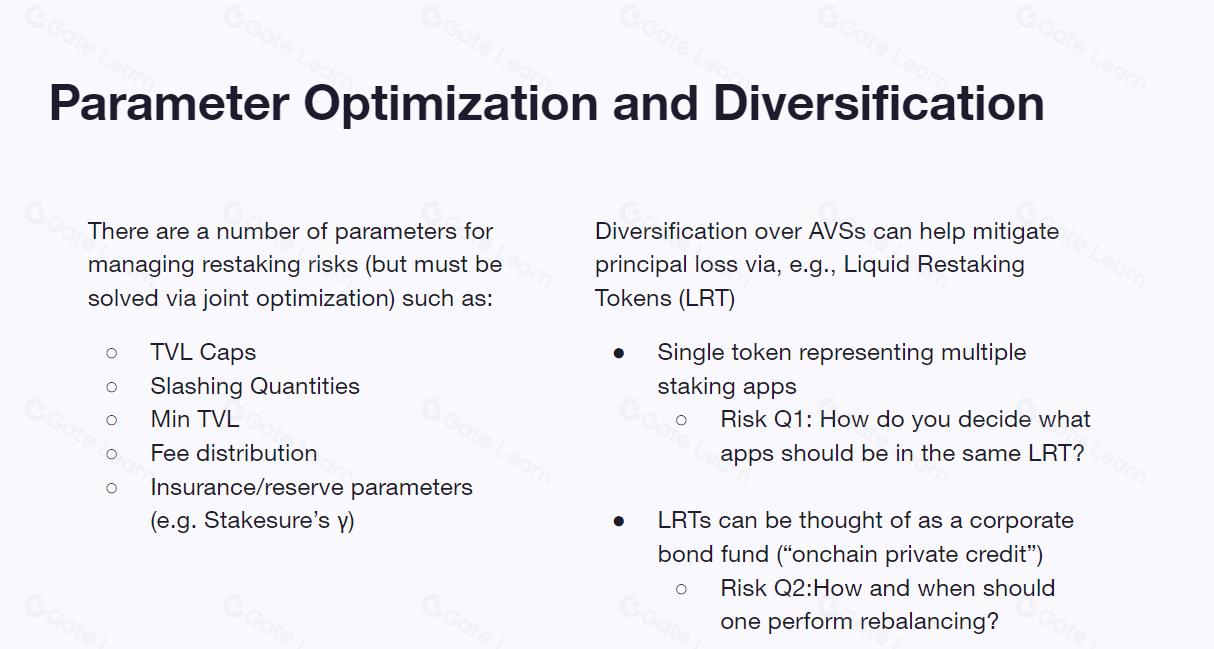
Source: https://docs.google.com/presentation/d/1iIVu6ywaCqlTwJJbbj5dX07ReSELRJlA/edit?pli=1#slide=id.p23
Challenges faced
From the perspective of application chains, reStaking applications represented by EigenLayer can meet the needs of small and medium-sized application chains to reduce node deployment costs. However, these application chains cannot fully meet their security requirements, and the sustainability of their demand is also relatively weak.
From a competitive perspective, although the reStaking track has a huge capital volume, as more and more reStaking applications are launched, market capital will be dispersed. If the profitability of reStaking applications like EigenLayer declines, for example, when the bear market is sluggish, the demand from the application chain side drops sharply, will this lead to a capital squeeze effect?
From the perspective of cooperation partners, EigenLayer initially developed 14 AVS cooperation partners. Although the AVS may be attracted by the potential returns in the early stage, the security risks of the reStaking mechanism may affect the willingness of subsequent AVS operators to join.
From the user's perspective, in the short term, users may not be able to obtain generous Staking returns. The uncertainty of the Staking return rate may have a negative impact on the future growth of the user base.
Copyright belongs to Gate.io.