The Fantom development team Sonic Labs (formerly Fantom) has shifted its focus to the newly launched Layer1 blockchain Sonic after changing the team name. Today, the team released the Sonic Litepaper.
The Litepaper covers Sonic's incentives, technology, and token economics, introducing mechanisms such as game theory. This article will focus on Sonic's token economics distribution and airdrop eligibility.
For detailed information, please refer to the Litepaper.
Sonic Token Economics
The Sonic Litepaper outlines the token economics of the native token $S:
- Total Supply of 3.175 billion S tokens; Circulating Supply: 2.88 billion S tokens.
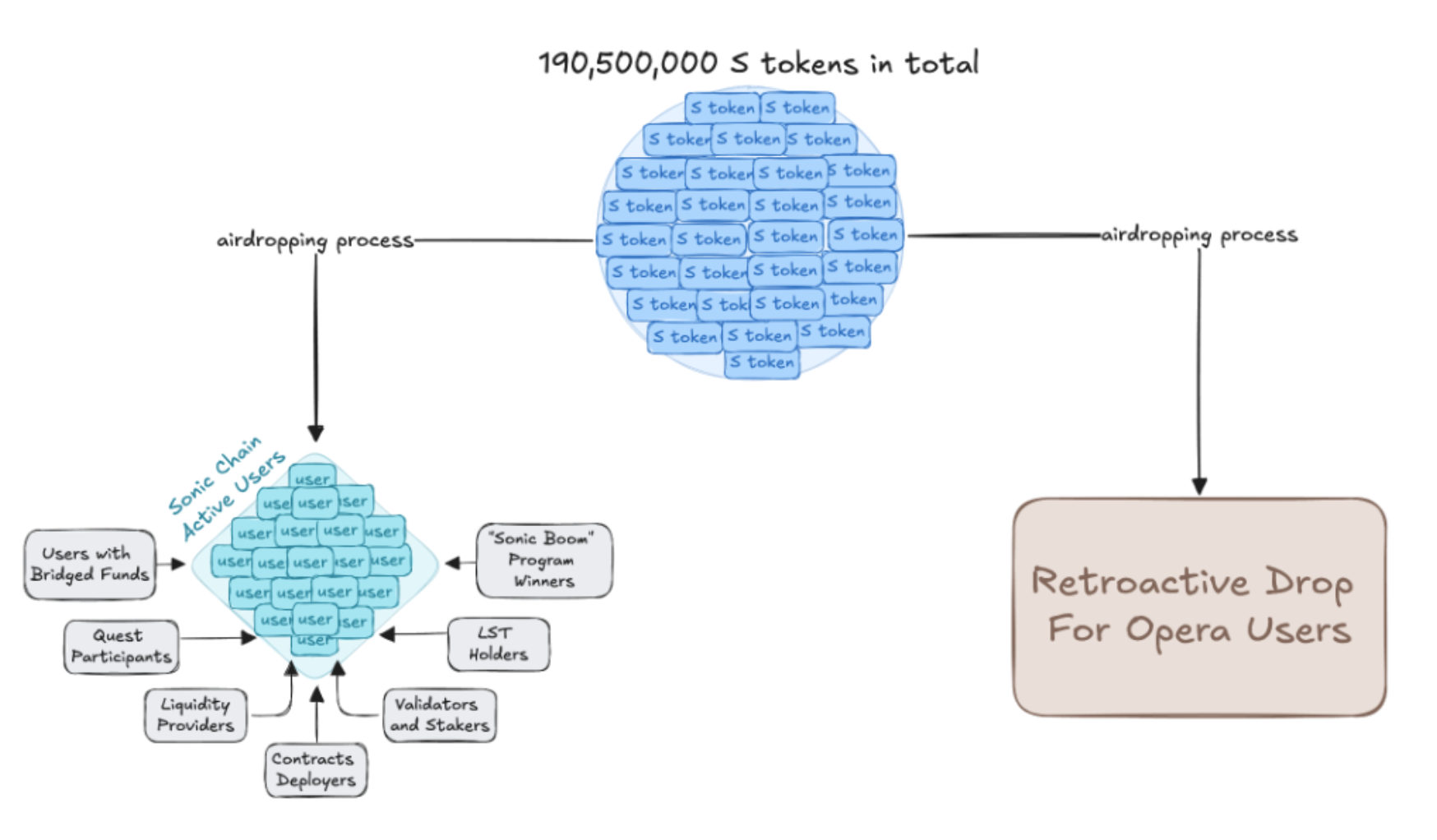
- Airdrop Allocation (6%): A total of 190.5 million S tokens will be distributed, starting 6 months after S token launch and unlocked gradually over the next 9 months.
- Growth Fund: 1.5% of the initial supply (47.625 million S) will be issued annually for 6 years after the token launch, to fund development, marketing, and ecosystem expansion.
- Validator Rewards: 4 years after token launch, S tokens will have a 1.75% annual inflation rate to reward validators.
The Litepaper provides detailed information on the token distribution beyond the key points mentioned above.
6% Airdrop for Sonic and Fantom Opera Users
According to the Litepaper, the Sonic airdrop will be distributed to Sonic and Fantom Opera users. The following Sonic chain users will be eligible for the airdrop rewards:
- Bridge fund users
- Mission participants
- Liquidity providers
- Contract deployers
- Validators and stakers
- LST holders
- Sonic Boom program winners
Additionally, the Sonic team has designed a deflationary airdrop system with a unique linear decay mechanism to minimize sudden changes in the circulating supply in the short term.