Author: David C., Bankless; Compiled by: Tong Deng, Jinse Finance
Over the past four months, we have rated a series of Solana ecosystem Altcoins on the Token Hub product, many of which have received bullish ratings.
These include Kamino (KMNO), Drift (DRIFT), Sanctum (CLOUD), and Jito (JTO). While most have seen significant gains (Kamino has risen as much as 111%), we still believe they have room to grow.
As the market becomes increasingly bullish, it's time to revisit these tokens, delve deeper into their bullish cases, and explore the forces that can propel them forward.
Kamino
Kamino Finance on Solana is the top platform for stablecoin and major asset yield farming; its recent growth has brought its TVL to $1.6B.
Tools like leveraged LST staking, liquidity provision, and lending markets have helped Kamino outperform other protocols, consolidating its leading position as ecosystem activity and competition intensify. The rise of stablecoins on Solana, particularly the launch of PYUSD, has made Kamino a prime destination for yields, with PYUSD yields reaching 30% in July before gradually declining. This solid foundation has set the stage for Kamino's Lend V2, which will introduce new primitives, products, and upgrades, evolving Kamino into a comprehensive DeFi layer.
The first primitive in V2 will be the Market Layer, which can permissionlessly create different lending markets. These can be customized to include new assets not currently supported by Kamino's four live market targets, to cater to a wider range of user risk profiles.
The second primitive is the Vault Layer, which will optimize yields across multiple markets. For example, a stablecoin vault can toggle between JLP and Ethena Markets to achieve the best yields. It can also be customized based on risk tolerance, such as only deploying to highly liquid and low-volatility markets. With the advent of the Vault Layer, partner and curator vaults also come into play, opening the door for further institutional adoption. Through tailored yield strategies, institutions can set their own risk and liquidity preferences, while retail users can access expertly managed vaults that share the interest generated.
This upgrade also lays the groundwork for future use cases, including real-world assets (RWA) and peer-to-peer lending, further unlocking the practical applications of DeFi.
Additionally, Lend V2 introduces new products to Kamino, such as spot margin, lending order books, and limit orders. These product innovations are supported by other key V2 upgrades, such as Scam Wick Protection and Liquidation Auctions, which help protect users and reduce liquidation penalties during market volatility. Furthermore, isolated and cross-mode improvements enhance risk management, ensuring safer lending across different asset types.
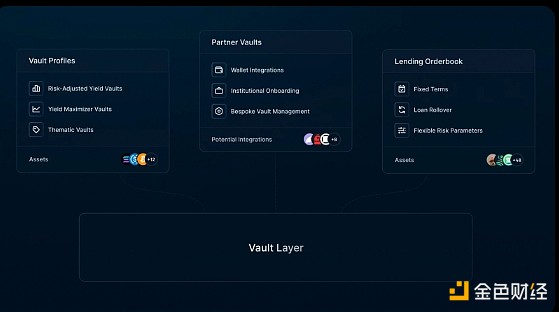
Overall, these innovations and upgrades are likely to help Kamino strengthen its foundational role in the Solana DeFi ecosystem, providing enhanced yield opportunities and expanding its ability to become a core financial primitive on the chain.
Sanctum
On top of this, Sanctum provides whitelisted validators the ability to launch their own liquid staking tokens, increasing the appeal of its protocol, as on Solana, the more valuable a protocol is, the higher the priority of its transactions.
This has already attracted many participants, such as Jupiter's JupSOL, which already controls 10% of all staked SOL, while Sanctum-backed LST accounts for at least 23% of all LST on the network. This rapid adoption highlights Sanctum's ability to unlock value in Solana's staking economy. Given that Solana has around $62B in staked capital, accounting for 68.7% of its total supply, surpassing Ethereum in total staked amount but lagging far behind in liquid staking - with 65% of staked ETH in a liquid form, compared to only 6.5% of staked SOL in LST - Solana has immense growth opportunities, which have already attracted major players like Binance, Bybit, and BitGo, who have already or will soon launch Solana LST with Sanctum, adding hundreds of millions in TVL to the project.
This will impact CLOUD in several ways. First, if we expect Sanctum's whitelist of validators to continue growing, it will have a direct deflationary effect on CLOUD, as validators must stake CLOUD to launch LST with Sanctum and must stake to vote on which validators become Sanctum partners. Additionally, while less specific, CLOUD has more room to play a positive role in Sanctum's expanding product network, ranging from free LST to creator coins and debit cards with ecosystem-tied rewards.
In summary, LST on Solana has immense capital opportunities, and Sanctum as a protocol is uniquely positioned to help validators, companies, and all relevant parties leverage this liquid staking expansion, capturing value and enhancing their role in the ecosystem in the process.
Drift
The Drift Protocol has become the first platform to bring prediction markets to the network, solidifying its leadership position in the Solana ecosystem.
The newly launched BET feature allows users to speculate on future outcomes using a capital-efficient model similar to perpetual futures trading. Users can not only bet using USDC, but also SOL and long-tail ecosystem assets, expanding the appeal and use cases of the native Solana market.
Prediction markets have already seen success on other chains, such as Polygon's Polymarket, but Drift's first-mover advantage on Solana puts it in prime position to capture the attention and liquidity of the chain's active user base. Leveraging Solana's fast, low-cost transactions, Drift's BET product could be a major driver of user engagement, especially in the lead-up to the US elections in November.
Drift's introduction of account margin to prediction markets has enhanced the platform's usability, but also increased inherent risks. Nevertheless, Drift's bullish prospects are driven by its ability to harness Solana's degen-level capabilities, making the protocol a prime contender to attract capital and user attention during this election season.
Jito
The leading Solana Liquid Staking protocol Jito is reportedly developing synergies between its existing staking infrastructure and re-staking, with Jito Restake announced on July 25th, a vault-managed re-staking concept that allows users to contribute to the crypto-economic security of any Solana-based token application.
The Jito Restake code has already been open-sourced for public review, and the contracts have entered the formal audit and verification process, though the timeline for mainnet deployment remains unclear. While the collateral quality of long-tail native Solana assets may be lower than Ethereum, the blockchain's faster network speeds can create a unique value proposition for high-performance re-staking applications.
As a leading Solana staking infrastructure provider, controlling a third of all liquid staked SOL, Jito's simple business model is particularly well-suited to benefit from increases in the SOL price, as its revenues are token-denominated.
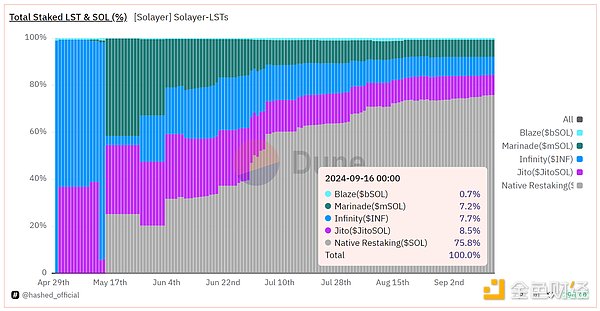
With Jito also providing MEV relay infrastructure and plans to offer re-staking, it is often described as the "Lido x Flashbots x EigenLayer" of Solana. Considering that Solana's native staking yields are higher than those offered by Ethereum, and Jito's functionality goes beyond a typical liquid staking protocol, many industry observers believe Jito's trading valuation should be higher compared to adjacent competitors.
Future Outlook
Over the past four months, we have observed a series of Solana-based Altcoins exhibiting positive trajectories, many of which show continued growth potential.
Kamino has become a leader in the revenue generation space and a DeFi hub, a role that may only expand with the upcoming launch of Lend V2. Sanctum, with its unique whitelisted validator structure, is committed to driving the expansion of LST on Solana, unlocking massive capital opportunities for its staking economy. Drift is the pioneer in bringing prediction markets to Solana, providing Solana with the potential to drive massive user engagement during the upcoming election season hype. Meanwhile, although Jito has underperformed so far, it continues to evolve as a key participant in the ecosystem, and with the dominance of JitoSOL, it becomes a core that will be restaked as the blockchain develops.
These protocols collectively serve as indispensable growth catalysts for the Solana ecosystem and will outperform other tokens within the ecosystem.