Original | Odaily Planet Daily
Author | jk
With the rapid development of the DeFi field, Bouncebit has attracted widespread attention since its listing on Binance. From the initial creative conception to becoming an important participant in asset management today, Bouncebit's journey has been full of challenges and opportunities.
Odaily Planet Daily was fortunate to interview the founding team of Bouncebit, delving deeply into how they have integrated resources and optimized the user experience through an innovative CeDeFi model to drive the transformation of asset management. At the same time, the team also shared the main features of the recently released V2 version of Bouncebit, as well as how to cope with market changes and user needs.
In the interview, the founders of Bouncebit also discussed the milestone events that users should expect in the coming months. Their vision is not only to promote their own growth, but also to lead the industry's innovation and transformation in the wave of decentralized finance. Let's learn how Bouncebit stands out in this highly competitive market.
The following is the full text of the interview:
Odaily:
Today we can be a little more casual, and we can talk from both the project and industry perspectives. We can start with the initial intention of the project, talk about the starting point of entrepreneurship, the source of inspiration, and whether there are any interesting stories to share in the middle.
Bouncebit:
Our initial conception was to build a CeDeFi. The Ethena project was the first to propose a similar concept, but all their transactions were completed by the team. This self-trading model has certain risks, and it is difficult to find effective solutions once problems arise. So we decided to avoid this direct trading method and have the transactions handled by professional asset management teams. We were fortunate to meet many teams skilled in arbitrage, so we chose to integrate various resources, with each person focusing on their own strengths, so that we could quickly achieve cooperation.
For example, Binance's custody service is very powerful, but it is mainly aimed at high-net-worth individuals, and ordinary users can hardly access it. You have to have a large amount of BTC on platforms like Bitmain to enjoy these high-end strategies, which is very difficult for most people. However, although these teams have performed well, their financing is difficult. I think DeFi is a good financing tool, so we chose to focus on providing financing tools, and let other teams continue to focus on their strengths in trading and arbitrage. Through this resource integration, retail investors can also enjoy strategies similar to high-net-worth individuals.
We chose BTC as the core asset, partly because BTC Layer 2 was very popular at the time. Although everyone is talking about the decentralization of BTC, I have always believed that BTC cannot be separated from a certain degree of centralized support. Therefore, we frankly accept the hybrid model of CeFi + DeFi, because this is more feasible in actual operation. Many projects in the BTC ecosystem, such as Babylon, still rely on centralized custody services in the end. So ignoring the existence of centralization is unrealistic, and we believe that accepting and integrating the two is the direction of the future.
I have always focused on DeFi, and have experienced the ups and downs of the market, so I hope to find a more long-term and sustainable solution, rather than just focusing on short-term profits. This is also the original intention of us starting transactions from the perspective of capital arbitrage.
Odaily:
We all know that Bouncebit first entered the public eye because Binance's Megadrop first launched Bouncebit, and users skyrocketed in just two days. Now a few months have passed, how do you view the role of this event? What role did it play in the overall project development process?
Bouncebit:
As an asset management project, Bouncebit is different from those DeFi projects that simply roll up TVL. Other projects usually just let users deposit funds in their wallets, while we need users to deposit funds into a custodial account and participate in arbitrage, which is much more complex than general DeFi products, especially for those who have previously suffered losses, they will be more hesitant. Therefore, although our user growth is relatively stable, the growth rate is relatively slow, and the TVL only just exceeded $1 billion before the Binance announcement. However, even so, we earned about $10 million for users in March and April, which was achieved through pure BTC arbitrage management, not through lending.
As the first project launched in Binance's Megadrop, this event did bring us a lot of traffic and allowed many users to first encounter and use BTCB. We also found an effective entry point through the design of this event, that is, users do not need complex conversion operations, they only need to directly deposit BTC to the BSC chain, and the experience is very seamless. This made us the first project to fully utilize BTCB, successfully attracting a large number of users' attention and participation.
Odaily:
Let's talk about the new products. Bouncebit is about to release V2, what are the main new products and new features?
Bouncebit:
The V2 release this time mainly includes two parts: one is the V2 of the CeDeFi Portal, and the other is the V2 of BounceClub.
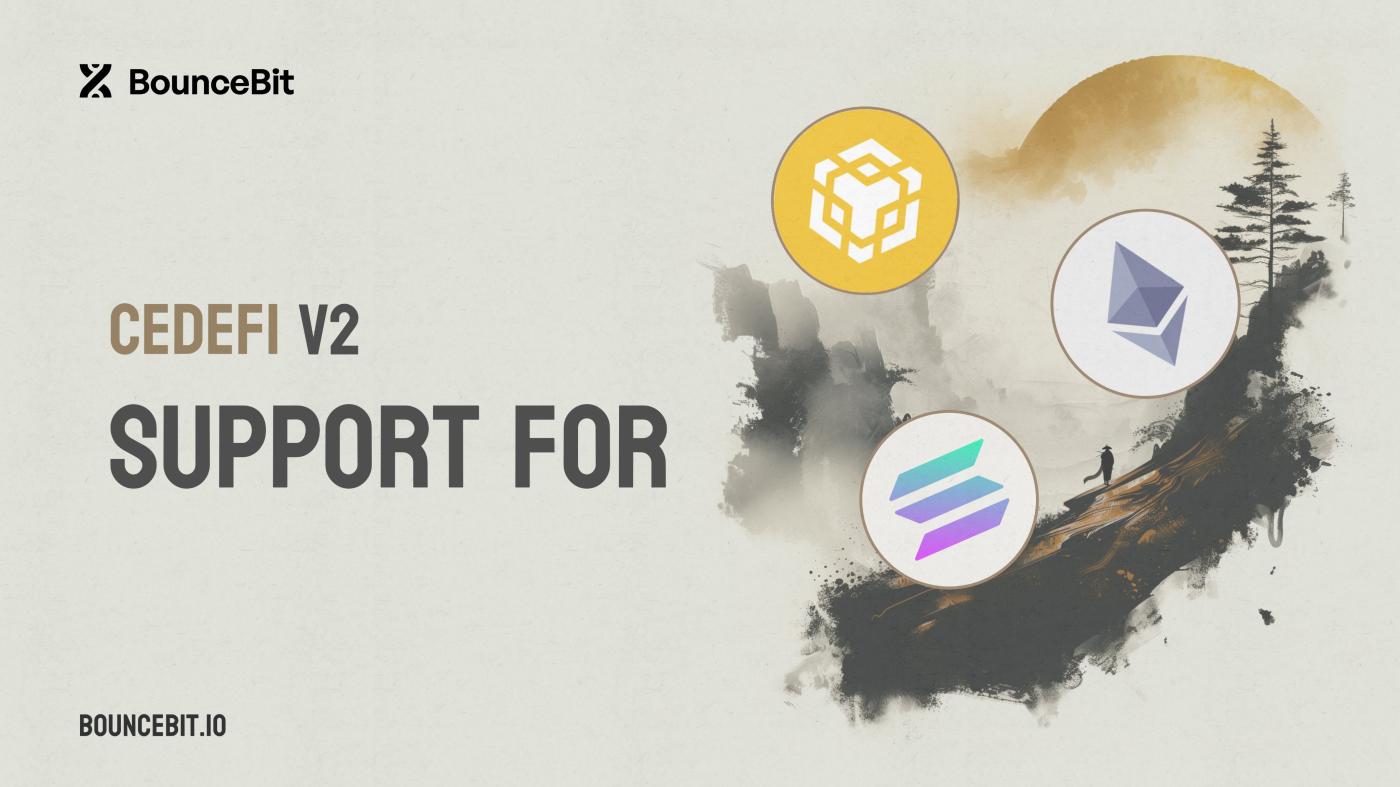
The V2 of CeDeFi now supports cross-chain and multi-asset. Source: BounceBit official X
All along, CeDeFi Portal has been our core asset management platform, while BounceClub is the multi-functional interactive platform on the BounceBit chain. In the V2 version, the CeDeFi Portal has been comprehensively expanded on the basis of V1 BTC asset management, creating a cross-chain, multi-asset, and multi-strategy CeDeFi asset management platform, and integrating with BounceClub, equipped with on-chain rewards and rebate systems. Users not only can manage assets on multiple chains, but also can trade and entertain while participating in asset management, and even participate in the new project's IDO, realizing the true "play and earn" integration.
The upgrade of CeDeFi Portal V2 is quite intuitive. We have added more strategy products and optimized the contracts, greatly improving the user's operation experience. Specifically: users no longer need to consider cross-chain issues, they can place orders directly on their respective chains; the optimized subscription and redemption experience has improved the fluency of user transactions and operations; the supported assets have been expanded from the original BTC to BNB, ETH, SOL and other multiple assets; in addition to fixed income and self-selection of asset management institutions, we have also added automatic and structured products. The automatic strategy will help users optimize asset allocation and provide them with more investment choices.
As for BounceClub, we initially built an App Store-like operating system, and this model attracted a lot of investors in the early stage. But after we finished developing and operating it, we found that the actual effect was not as good as expected. Therefore, in V2, we adjusted the direction and simplified the operation process, integrating the content that users are most interested in. Now, users can easily experience the popular DApps in the market through our platform, whether it's playing games or participating in DeFi, it has become more convenient.
BounceClub will also play a greater role in BounceBit V2, serving as the incentive center for CeDeFi users. We will design more gamified gameplay for asset management users, allowing them to earn while playing while managing their assets. In the future, BounceClub will launch invitation rebates, game rewards, and IDO activities to further incentivize user participation and enhance the user stickiness of the platform.
We are well aware that asset management is a long-term and far-reaching matter, and we hope to achieve excellence in CeDeFi asset management, while fully utilizing the advantages of Web3. Web3 is actually a mechanism for rapid distribution of rewards, so activities and rebates are very effective incentive means in this system. Therefore, our positioning is very clear, CeDeFi Portal is the core asset management platform, and BounceClub is the interactive and incentive center, complementing each other. BounceClub not only provides more returns and entertainment for CeDeFi users, but also brings more attractive added value to their investments in CeDeFi.
Looking back on the development of BounceBit, the mainnet has been online for 6 months. "Simplifying the complex" is the design concept we had in developing V2. We found that many product designs in the Web3 field often fall into the trap of "making the complex even more complex" - in order to tell stories and increase valuations, the complexity of products continues to increase, ultimately diluting their core value.
BounceBit's first-generation product was relatively complex, which was an early attempt for us to explore CeDeFi. In the past few months, through reflection and market feedback, we realized that users need more intuitive and user-friendly products. Therefore, in the V2 version, we have focused on simplification, removing unnecessary complex functions, and focusing on solving users' core needs in asset management.
Of course, the process of simplifying the complex is inevitable to make some trade-offs. For example, we cannot stack the returns of multiple projects, although this may reduce the attractiveness in the short term, but in the long run, products that focus on actual needs and simplify functions can truly win the recognition of users and stand firm in the highly competitive market, haha.
Odaily:
I see you have been talking about the DeFi Summer, can you share your reflections on this historical market trend, as well as your perceptions of the current market and the future direction? What is BounceBit's strategy in this market?
BounceBit:
Looking at the previous cycle, why do I think this round has not seen a similar DeFi Summer? The main reason is that this market has not experienced a dramatic collapse like COVID. Usually, the market needs a "savior" to drive the recovery after a major crash, which will then lead to a big market trend. The rise of DeFi Summer was precisely because the market crashed at that time, and everyone rushed in to participate and drive the market. But this cycle was led by the positive news of ETFs, and although the market has experienced a period of heat, it has now entered a cooling period. Therefore, the recent trend has been relatively weak. I believe the big cycle will not fundamentally change, and the state of 2024 will be similar to 2020, while 2025 is likely to be a new round of big year.
The previous round of Bitcoin's new high was in November 2020, rising directly from $20,000 to $68,000 in four to five months. Therefore, theoretically, Bitcoin may return to $70,000 or $80,000 by the end of this year, and may rise to an even higher level next year, if there are real expectations of reaching $100,000. I am optimistic about Q4 and the whole of 2025.
Against this market background, BounceBit's strategy has always been to maintain flexibility. When managing assets, we cannot blindly follow market hot spots, but need to adjust our strategies in a timely manner according to market changes. Our CeDeFi platform has designed a cyclic mechanism to encourage user behavior and adjust the revenue structure based on market dynamics, which can effectively cope with market fluctuations.
For arbitrage returns, my understanding is that when market returns are high, capital may flow from other platforms to us; when returns decline, capital may flow back to other platforms. We are currently doing a CeDeFi platform, and I believe the core advantage of CeDeFi is that the funds are not on-chain, but on centralized platforms like Binance that have proof of reserve, with over $100 billion in asset reserves. In the previous cycle, Binance's asset size was only $20 billion. This base has increased fivefold, and these funds cannot easily flow out of CEX to become on-chain liquidity, the only way is through CeDeFi.
By the way, the popularity of Pendle actually reflects some market anxiety. During the DeFi Summer, everyone was a warrior. For example, setting up liquidity mining pools, incentivizing users to stake, and even issuing tokens in seconds. The rise of Pendle shows that the market lacks confidence in short-term liquidity, and people are starting to rely on points and delayed liquidity release strategies. This is a manifestation of lack of market confidence, and the current staged airdrops are no longer comparable to the pure DeFi craze of that year. Therefore, we choose to focus on asset management rather than participating in these short-term "point farming" behaviors.
Odaily:
There are two more general questions: From the perspective of a "bull market in a bear market", how do you think the differences between Asia and Europe/America will be reflected in the crypto world?
BounceBit:
Let's start the discussion from the perspective of regulation. Personally, I think the original ideal of decentralization is difficult to fully realize. Now most projects actually have varying degrees of centralization, rather than true DeFi, indicating that the decentralization ideology is not as strong as originally envisioned. Over time, regulation will become increasingly stringent, especially on token listings. In the future, there may be a clear framework requiring all new token listings to go through a registration review process. For example, the US may introduce a new regulatory framework requiring all projects to go through a strict review process.
In terms of evaluation criteria, traditional industries focus more on financial indicators such as revenue, while the crypto industry's evaluation criteria tend to be more inclined to factors such as hype and TVL. This cognitive difference may become more and more evident in future review mechanisms. Perhaps in the future, the review will be undertaken by different entities, with some by traditional regulatory agencies like the SEC, and others by experts within the crypto industry.
In such an environment, I think the crypto industry has gone through multiple cycles and is unlikely to see a large influx of new users again. Nowadays, new users entering the crypto market are often due to the poor global economic environment, trying to obtain returns through cryptocurrencies, rather than being truly interested in the technology itself. As the market and regulation mature, the source and motivation of new users in the future may become more and more concentrated in these areas.
Odaily:
Do you have any underlying insights to share? Or anything you want to say to new crypto users, entrepreneurs or developers?
BounceBit:
A metaphor I often use is, do you think Las Vegas can become New York? The underlying logic, functional division, and pillar industries of these two cities are completely different.
Similar situations also often occur in the Web3 world, such as many people comparing Telegram and WeChat. Although they both provide mini-program functions, WeChat is a necessity of life, while Telegram's user base is completely different. Telegram users may be more inclined to marginalized activities rather than using daily tools. Therefore, although the two have similar functions on the surface, their underlying logic and user groups determine that they are completely different ecosystems. Will degen care if you build an e-commerce type mini-app in it? Obviously not very likely, they are more concerned with fast-paced profit opportunities.
Just as New York cannot become Las Vegas, and Las Vegas cannot become New York. But no matter which city, you can always build a new road or a new bridge, which is something that every city will need, and this is the opportunity we need to find in the industry.
Also, many people in the crypto world are unwilling to admit that they have made money by luck. There are many people who have made money in the crypto world, but have actually lost a lot when they entered the traditional industry. I think acknowledging the luck factor is an important cognition, and at the same time, we also need to acknowledge that the luck factor accounts for a large proportion in this industry. Success or failure often depends on luck.