"Games are a form of communication, and also a bridge that connects people. Like a rope, they tightly bind people together." - Hideo Kojima, creator of Metal Gear
Introduction
The blockchain gaming market is experiencing rapid growth, and is expected to achieve a compound annual growth rate (CAGR) of approximately 68% between 2024 and 2030, with the market size potentially reaching $301.5 billion by 2030. This growth is primarily driven by the decentralized nature of blockchain, which allows players to truly own in-game assets such as Non-Fungible Tokens (NFTs) and Tokens. This ownership creates a distinct difference between GameFi and traditional gaming ecosystems, providing a unique experience that combines entertainment and economic incentives, which traditional gaming platforms struggle to match.
While various types of GameFi are expected to thrive in the next decade, role-playing games (RPGs) are particularly well-suited to leverage the decentralized model of GameFi. RPGs emphasize character progression, immersive worlds, and the construction of in-game economies. In traditional RPGs, players often invest significant time in cultivating characters, acquiring rare items, and exploring complex storylines, but these achievements cannot generate tangible returns outside the game ecosystem. GameFi, however, enables players to truly own and trade these assets, such as rare items and characters, in the form of NFTs. This imbues in-game accomplishments with real-world value and enhances player engagement through additional growth incentives. The 2023 report by Game7 further corroborates the strong synergy between RPGs and GameFi, indicating that RPGs are the most popular Web3 game genre, accounting for 22% of all Web3 games, followed by action games at 17%.
Web3 Game Distribution by Type
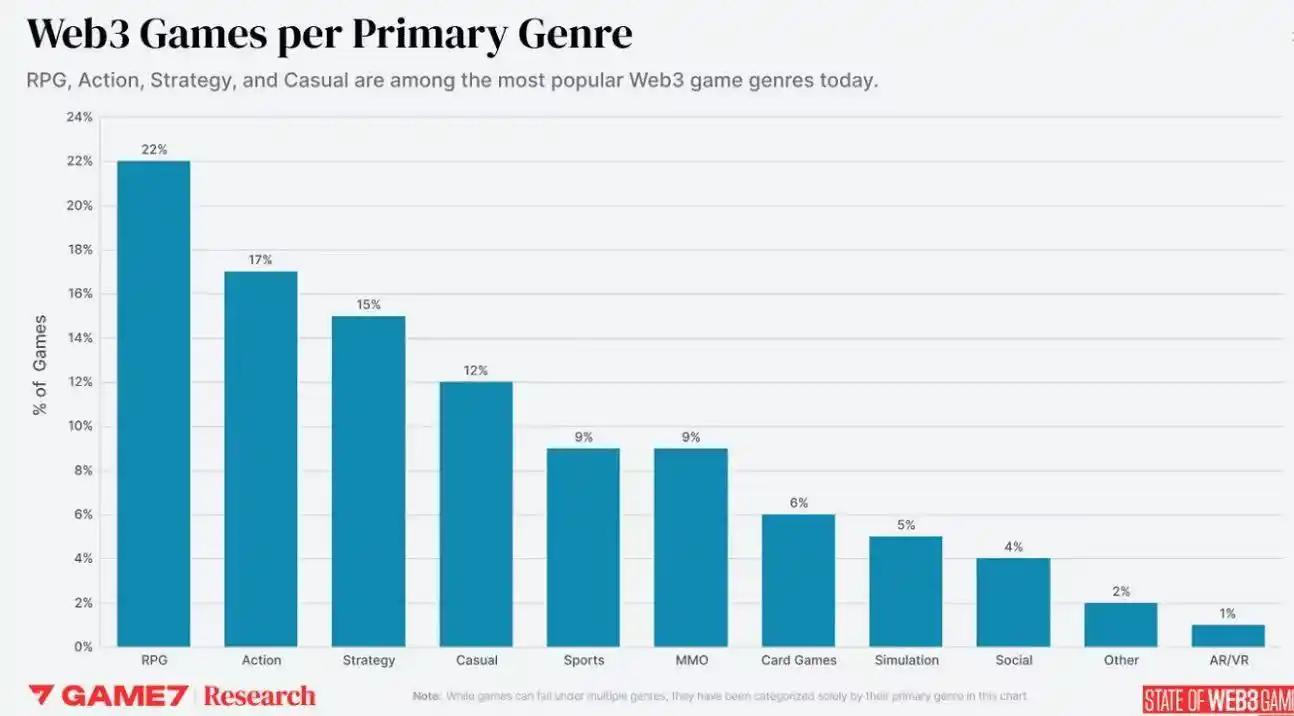
Source: Web3 Game Distribution by Type
Another indicator of growth in the Web3 GameFi domain is the rise of AAA and AA games. AAA games require a minimum funding of $25 million, are backed by publishers, and have experienced teams, providing unprecedented quality and immersion. Currently, AAA games account for only 1% of Web3 games, while AAA and AA games combined make up 6%, which is higher than the 4% on the traditional Web2 platform Steam. This growth may be driven by various factors, including the complexity of Web3 construction (requiring additional understanding of blockchain and smart contracts) and the fact that 71% of Steam users interact with AA or AAA games daily. This indicates a user preference for high-production-value games, suggesting that AAA games in GameFi can meet market demand.
Furthermore, the report also explores the growth of RPGs and action games, as well as comparative metrics across major games and chains.
Core Differences in Web3 Games
Illuvium, Axie Infinity, and Seraph demonstrate the integration of high-quality gameplay with decentralized economic systems.
Illuvium focuses on creating a visually stunning 3D world, combining PvE and PvP mechanics; Axie Infinity popularized the "Play to Earn" model, allowing users to earn real-world income through gameplay, but faces challenges in user retention; Seraph stands out by introducing a system of items and loot boxes with varying degrees of rarity, introducing randomness to ensure that players of all investment levels can receive high-value rewards.
This common "degen" reward structure can generate excitement in players and encourage continuous participation. As a PC and mobile-based loot-based game, Seraph integrates Non-Fungible Tokens (NFTs) to verify rare virtual assets acquired or purchased through gameplay, enabling free trading and monetization, promoting a healthy participation loop and enhancing player engagement.
The following is an example of Seraph's dynamic reward system, where the Luck Value reflects the significant differences in reward rarity.
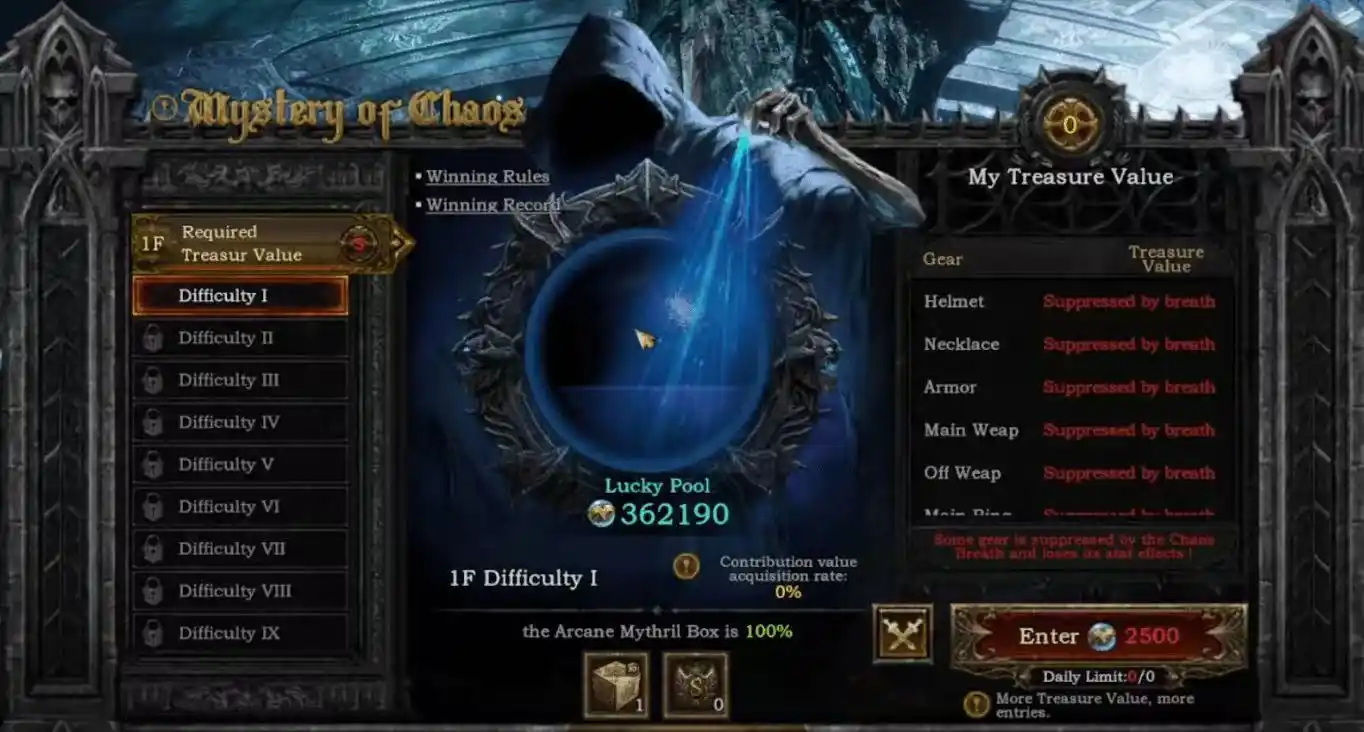
Source: Seraph, Mystery of Chaos
Comparison of Economic Mechanisms in Different Games
In successful Web3 games, the structure and mechanisms of the in-game economy are key factors driving player interaction and engagement, with one of the most renowned dual-token economic models being the Smooth Love Potion (SLP) and Axie Infinity Shards (AXS) in Axie Infinity.
SLP is a utility token earned through gameplay, used to breed new Axies, forming a circular economy where players are rewarded for participating. SLP can also be traded on the secondary market to realize real-world value, allowing players to monetize their in-game achievements. On the other hand, AXS is a governance token, enabling holders to vote on important decisions regarding the game's future and participate in staking to earn additional rewards.
Illuvium, on the other hand, operates on a robust Non-Fungible Token (NFT) market, where players can trade rare assets such as Illuvials. By combining the collection component with a "Play to Earn" model, Illuvium adds value and depth to its economy.
Seraph adopts a single-token model, with the utility token stored off-chain. This strategy promotes a stable economic cycle, allowing players to easily transfer funds and concentrating user capital and participation on a single currency.
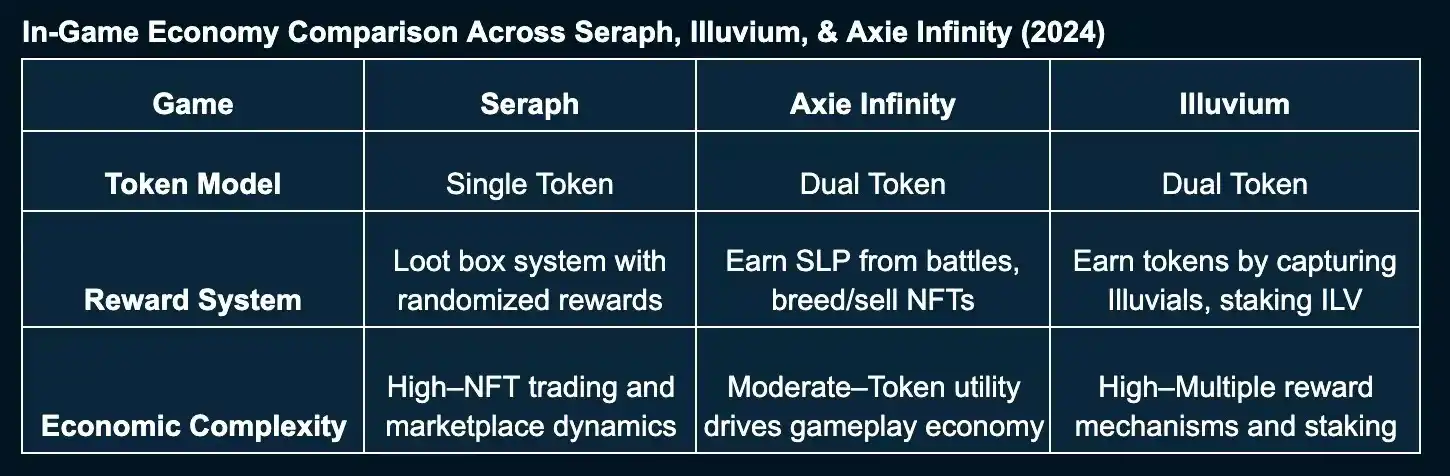 Source: Comparison of in-game economies of Seraph, Illuvium, and Axie Infinity (2024)
Social Factors
In Web3 games, community engagement on social platforms is crucial for building a strong player base and maintaining user interest. Twitter, Discord, and Telegram are key tools for developers to provide update information, interact with players, and foster a sense of belonging within the game ecosystem. The popularity of a game and the activity of its community are directly related to its long-term success, especially in the decentralized blockchain-based ecosystem.
Axie Infinity has 869,000 followers on Twitter and 591,000 members on Discord, boasting one of the most active communities in the field. This vibrant community has helped drive early adoption and previous relevance of Axie Infinity.
Seraph also maintains a strong community presence on social media, with 374,000 Twitter followers, 321,000 Discord members, and 92,000 Telegram members. This active community engagement has contributed to Seraph's rapid growth.
While Illuvium's scale is slightly smaller, it still has 399,500 Twitter followers, 116,000 Discord members, and 17,000 Telegram members, emphasizing the importance of maintaining active communication channels. Although all major competitors have impressive follower counts, Seraph has stood out in recent growth, adding 52,000 Twitter followers in the past month, compared to 1,900 and 2,100 for Axie Infinity and Illuvium, respectively.
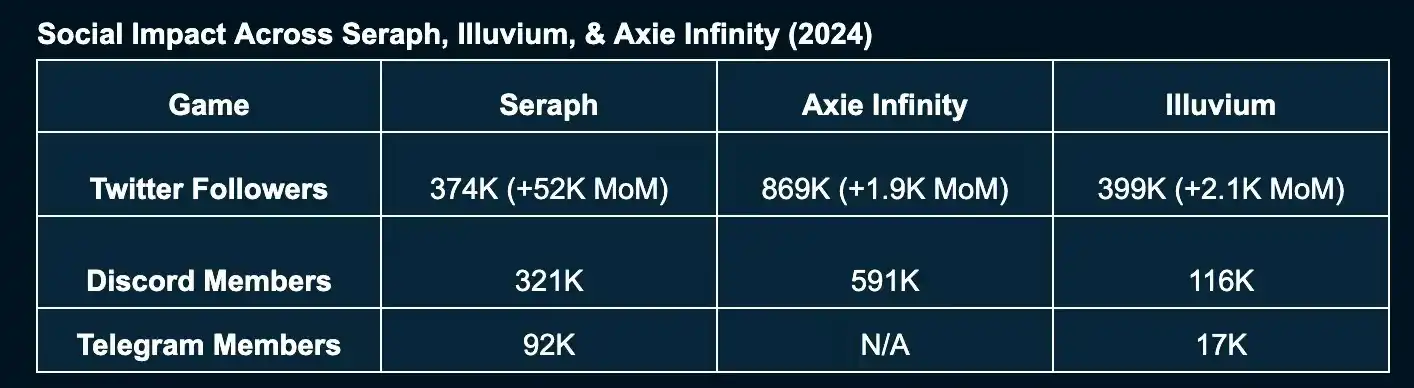 Source: Social Impact of Seraph, Illuvium, and Axie Infinity (2024)
Having a large active audience across multiple platforms allows games to maintain communication with players and keep them informed and engaged with upcoming features. The recent follower growth also indicates that the games have successfully attracted player attention in the short term.
Quantitative Metric Comparison
Despite the challenges facing the overall crypto market, the daily transaction volume of blockchain games increased by 8.94% in August 2024. In 2024, Seraph reached 537,000 Daily Active Wallets (DAW), significantly surpassing Illuvium's 200+ and Axie Infinity's 154,000.
However, Axie Infinity still dominates the Non-Fungible Token (NFT) market with a market capitalization of $34 million, followed by Seraph at $15 million and Illuvium at $2.8 million. In terms of NFT trading volume, Seraph far exceeds Axie Infinity and Illuvium, with $65.5 million compared to $22 million and $3.1 million, respectively.
Seraph's high Daily Active Wallets (DAW) may be attributed to its 66% 7-day retention rate during the pre-season, indicating that many new users have remained active.
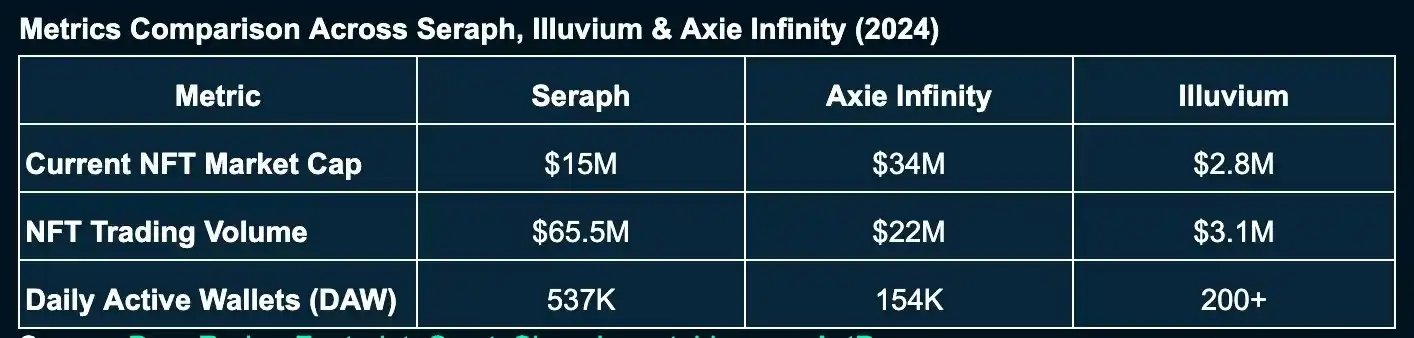 Source: Comparison of Seraph, Illuvium, and Axie Infinity metrics (2024)
Source: DappRadar, Footprint, CryptoSlam, Immutable.com, ActPass
Comparing Top GameFi Chains
Evaluating the performance of leading GameFi chains, such as opBNB, Ronin, Polygon, and Immutable X, requires focusing on key factors like gas fees, transactions per second (TPS), and scalability. These metrics are particularly important for Non-Fungible Token (NFT)-based game ecosystems, as fast and cost-effective transactions are crucial to meet the high transaction volume demands.
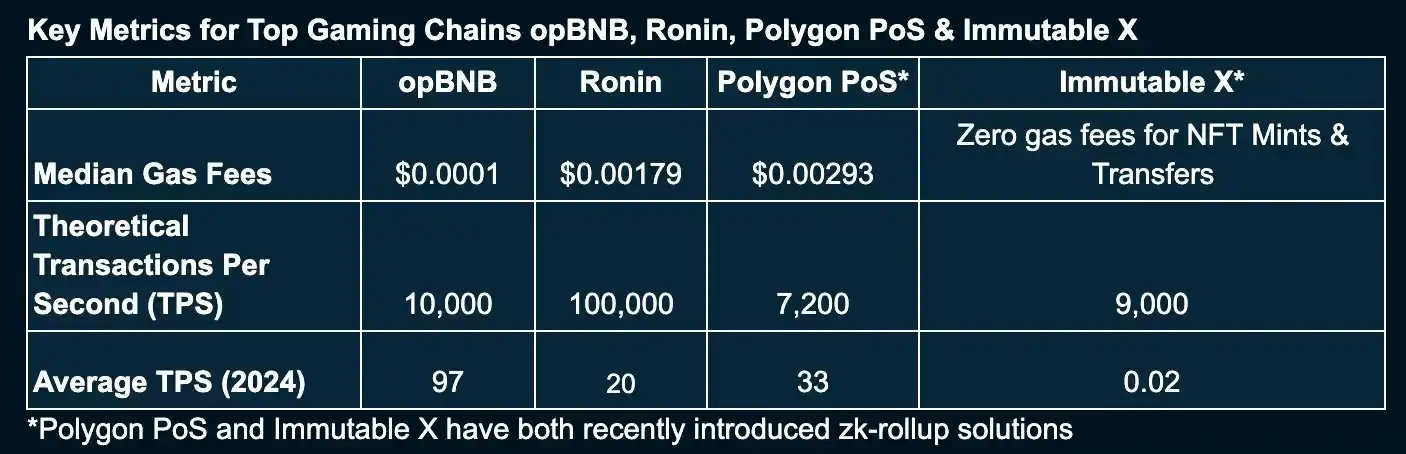 Source: Key metrics for top gaming chains: opBNB, Ronin, Polygon PoS, and Immutable X
Here's a breakdown of the key metrics:
· Gas fees: In GameFi, gas fees are crucial, as frequent micro-transactions and Non-Fungible Token (NFT) transactions are the core of the ecosystem. opBNB offers the lowest median gas fees among the top chains at just $0.0001, making it highly cost-effective. Ronin has a median gas fee of $0.00179, Polygon PoS at $0.00293, while Immutable X waives gas fees for NFT minting and transfers.
· TPS: High TPS is crucial for handling real-time multiplayer games and frequent asset transactions. As of October 2024, Ronin leads with 100,000 TPS, surpassing Immutable X's 9,000 TPS and Polygon PoS's 7,200 TPS. opBNB also performs well with 10,000 TPS, ensuring scalability for large-scale Non-Fungible Token (NFT) transactions.
· Average TPS: While the theoretical maximum TPS can reflect network capacity, actual usage often differs. Currently, opBNB's average TPS is 97, far below the theoretical limit of 10,000; Ronin's average TPS is 20, Polygon PoS is 33, and Immutable X is only 0.02. This indicates that the actual TPS is much lower than the theoretical maximum, suggesting that scalability is not an immediate concern. However, as the gaming industry evolves and Account Abstraction (AA) becomes more prevalent, especially in complex game ecosystems, high TPS becomes crucial to effectively manage the increased load and ensure a smooth user experience.
Fast transactions, low gas fees, and good scalability are key for GameFi chains to meet the growing demands of the Non-Fungible Token (NFT) gaming economy. opBNB leads in 2024 with an average TPS of 97 transactions per second, further demonstrating its ability to handle a large volume of transactions. As GameFi continues to expand, these chains will play a critical role in shaping the future of blockchain gaming.
Evaluating GameFi Chains
To evaluate the success of blockchain networks in the gaming industry, key performance indicators include Daily Active Wallets (DAW), Total Value Locked (TVL), and the number of games per chain. Comparing opBNB, Ronin, Polygon, and Immutable X will show how these metrics reflect the activity and user engagement of the ecosystems. Additionally, security is of paramount importance, as major blockchain hacks can undermine user trust in GameFi platforms.
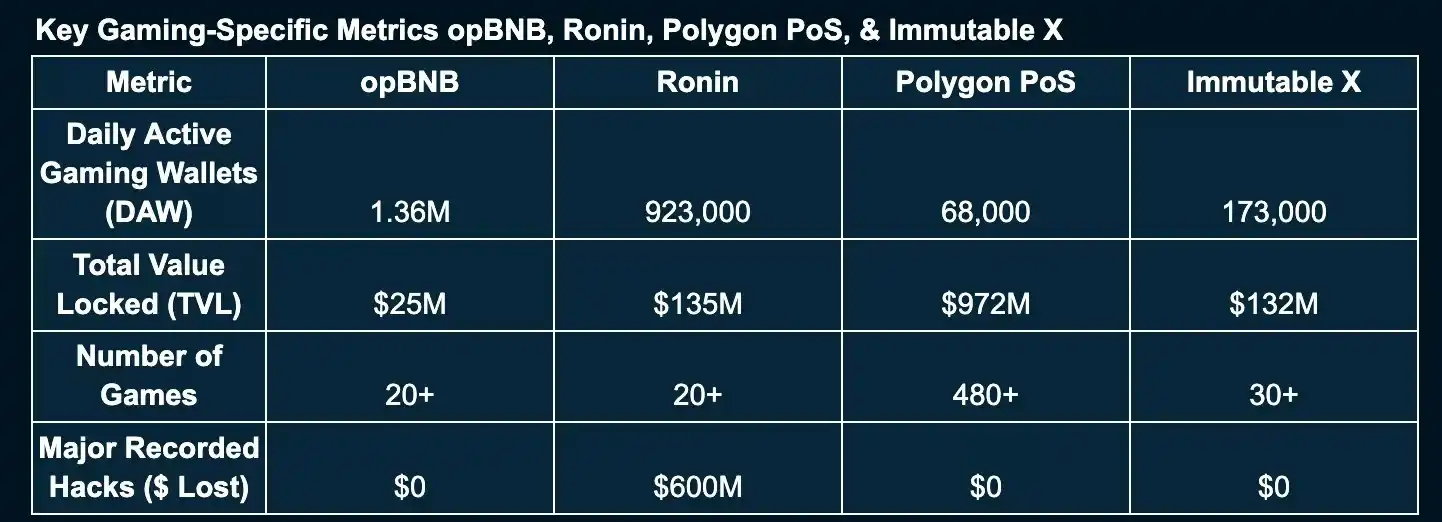 Source: Game-specific key metrics: opBNB, Ronin, Polygon PoS, and Immutable X
Source: DappRadar, Footprint, defillama, Crypto Briefing, CNN
We found:
· Daily Active Wallets: As of October 2024, opBNB achieved a 72% quarter-over-quarter growth in Daily Active Wallets, reaching 1.36 million daily active players, highlighting its scalability and performance in the gaming domain. In comparison, although Polygon is a widely-used platform, its DAW is only 68,000, indicating a decline in its gaming user base. Ronin and Immutable X have shown stable DAW, at 923,000 and 173,000, respectively, maintaining consistent engagement within their ecosystems.
· TVL: Polygon leads with a TVL of $972 million, solidifying its importance in the gaming space. Ronin and Immutable X closely follow with $135 million and $132 million, respectively. Meanwhile, as a newer Layer 2 solution, opBNB has quickly gained attention with a TVL of $25 million.
· Number of Games: Polygon leads with over 480 games, cementing its position as a developer hub. opBNB closely follows with over 20 games, showcasing its rapid expansion in the GameFi domain. Ronin and Immutable X have 20+ and 30+ games, respectively, focusing on specific game titles, such as Axie Infinity on Ronin and Non-Fungible Token (NFT)-driven titles on Immutable X.
· Major Recorded Hacks (Loss Amount): opBNB and Immutable X have not experienced any recorded hacking incidents, maintaining a strong security record. Polygon faced a potential vulnerability, but a white hat hacker discovered the bug and proactively reported the technical flaw to the team. Meanwhile, Ronin faced a significant security challenge, suffering a $600 million hack where attackers were able to compromise private keys to validate network transactions. After the hack, Ronin implemented security upgrades, such as increasing the number of validators and adding Hardware Security Modules (HSMs), to prevent future attacks.
Conclusion
In summary, the GameFi ecosystem is entering a critical expansion phase, with an expected market value of $301.5 billion by the end of the decade. This rapid growth is driven by the decentralized ownership of in-game assets, such as Non-Fungible Tokens (NFTs) and Tokens, which provide players with real-world value and unique economic incentives that traditional gaming ecosystems cannot offer. Despite broader market challenges, Daily Active Wallets grew by 8.94% in August 2024, further highlighting the resilience of the current GameFi landscape.
As blockchain infrastructure continues to improve, providing greater transaction capacity, lower gas fees, and better scalability, this enhancement creates a favorable environment for GameFi projects, particularly those with Non-Fungible Token (NFT)-driven economies and significant social impact. Leaders like opBNB, Ronin, and Immutable X stand out for their balanced approach to speed, cost, and scalability, attracting the attention of developers and players.
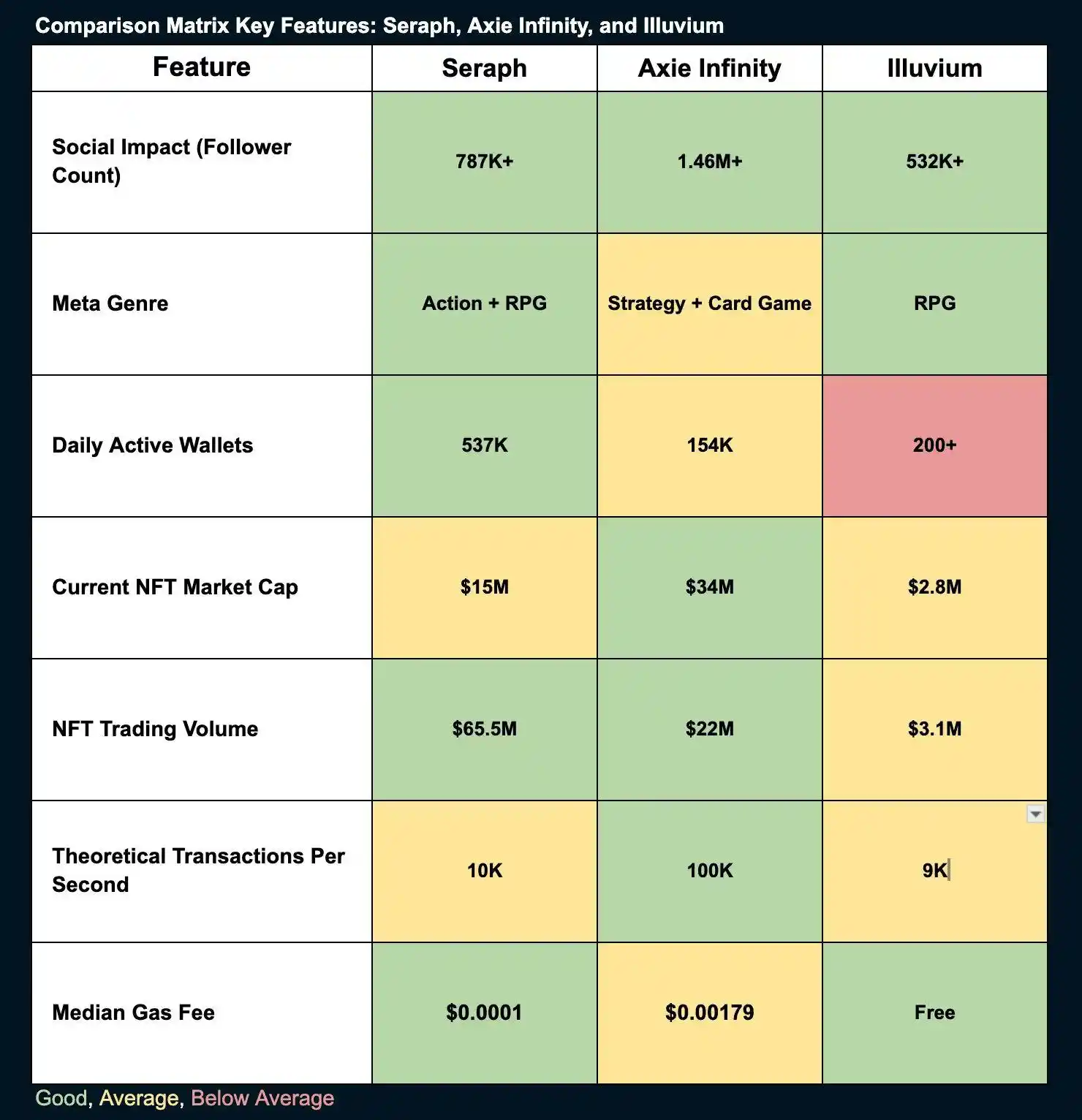 Source: Comparative Matrix of Key Features: Seraph, Axie Infinity, and Illuvium
Disclaimer
Nansen and Slice Analytics have generated the following report based on the existing service contract with Seraph (the client). Although Seraph has the right to review and provide feedback to Nansen, Nansen maintains full editorial control over the publication of this report. All views expressed are the independent opinions of the Nansen research analysts (the report authors). This report is for informational purposes only and does not constitute investment, financial, professional, or other advice. For more information, please refer to the disclaimer at the end of this report and our terms of service. "Original link"
Welcome to join the official BlockBeats community:
Telegram Subscription Group: https://t.me/theblockbeats
Telegram Discussion Group: https://t.me/BlockBeats_App
Twitter Official Account: https://twitter.com/BlockBeatsAsia