As the price of BTC exceeded $89,000, the market entered a long-lost bull market atmosphere, and Altcoin rose sharply, with many public chain tokens nearly doubling in price.
The recovery of the market has not brought about the emergence of mainstream sectors. The market currently lacks a mainstream narrative and may continue to show this trend for some time to come. In the absence of a main narrative, using the public chain ecosystem as an entry point to find Beta and Alpha may be a feasible trading strategy in the future.
Therefore, we explored an analytical framework and analyzed and compared Sui and Aptos, which have performed well recently, within this framework.
Analysis framework: How to evaluate the public chain ecology?
The most direct influencing factor of the outbreak of public chains will be the massive influx of funds. The influx of large amounts of liquidity will promote the development of the entire ecosystem. The wealth creation effect brought about by excess liquidity will attract more market attention and funds into the ecosystem. , and continuously promote ecological activity.
Therefore, when evaluating the public chain ecology, we will pay the most attention to factors that may cause large inflows of funds and the public chain's ability to handle liquidity, as well as data indicators that can reflect the inflow of funds and users.
Base trading activity
Whether it is ETH in the ICO and NFT period, SOL in the Memecoin period, or BTC in the Inscription period (while promoting the demand and consumption of BTC through mining and purchasing), they are all standard tokens for transactions. When NFT, Meme, etc. After generating a strong wealth creation effect, users need to purchase native tokens to enter the new Crypto Casino, creating a huge native purchase demand for public chain tokens, thereby promoting price increases and ecological prosperity.
These large-scale Casinos are not only part of the ecology, but also directly promote the growth of public chain tokens through the prosperity of the ecology. They also attract a large amount of funds into the chain. The excess liquidity will enrich other ecological projects, thereby revitalizing the entire ecology.
In this dimension, there is actually a conflict between public chains and exchanges. A large number of high-quality TGE projects directly enter the exchanges without benefiting the public chain itself. If you want to form local currency transactions of public chain tokens, you must rely on existing (or This is true for new assets that only exist on the chain in the initial stage, such as NFT, inscriptions, and Meme. We will pay close attention to new asset issuance methods with wealth creation effects on different public chains, but we have not yet seen significant innovation, so In the short term, attention will be paid to which public chain will take on more liquidity excess from Solana on the Meme track.
The degree of completeness of ecological infrastructure and whether there are windows and incentives to attract liquidity
The degree of perfection of the infrastructure determines whether the funds are willing to stay after entering. User-friendly experience and rich fund interest earning strategies will be more conducive to the retention of users and funds. Windows and incentives to attract liquidity will be more conducive to promoting the entry of funds.
There are three main channels for capital entry: other public chains, CEX and Web2. The friction of capital migration increases step by step. The more levels of capital can be attracted, the more conducive to the development of the public chain.
For example, Base is backed by Coinbase, opening up the path from the exchange directly to the chain. The issuance of cbBTC and liquidity guidance incentives have also attracted more TVL to the ecosystem. Solana is promoting the development of Payment and Payfi, hoping to attract Web2 funds to enter. on the chain.
Development strategy and positioning of public chain
Including the public chain’s planning for development paths, main markets, and core tracks. For example, the Solana team has a very clear development path in this round. The core team started by promoting the Meme track and attracted a large number of users through the Meme track. and liquidity, and then vigorously promoted Payfi, DePIN and other tracks to take advantage of high-efficiency public chains, attracting leading projects such as Render, Grass, and IO.net to settle in. However, Ethereum lacked a core development strategy in this round, and Rollup -centric’s roadmap has also been criticized.
Funds and user data changes
Public chain TVL is often used as a measure of ecological capital volume, but TVL itself is mainly composed of public chain tokens and ecological tokens. It is greatly affected by currency prices and cannot accurately reflect the inflow of funds.
In addition, platforms such as Defillama directly add the TVL of each DeFi protocol when calculating the TVL of the public chain. The tokens in circulation are not counted as TVL, and the tokens in circulation itself may indicate stronger transaction demand.
Therefore, this article will focus on the growth of the market value of stablecoins, the net inflow of ecological funds and DEX trading volume, etc., as indicators of changes in funds and liquidity, while also paying attention to user activity.
Chip structure and price trend of public chain tokens
The growth of the public chain ecosystem and the currency price generally complement each other. The increase in the price of the public chain currency will attract more market attention. After the public chain tokens rise sharply, the market will look for project investments within the ecosystem in the hope of obtaining higher returns. , this liquidity spillover will promote ecological prosperity and enhance the overall ecological wealth creation effect.
Token economics and chip structure will determine the rising resistance and time window of public chain tokens. Tokens with smaller rising resistance and greater space will be more likely to drive the prosperity of the entire ecosystem.
Sui ecological analysis
Basic information and recent progress of public chains
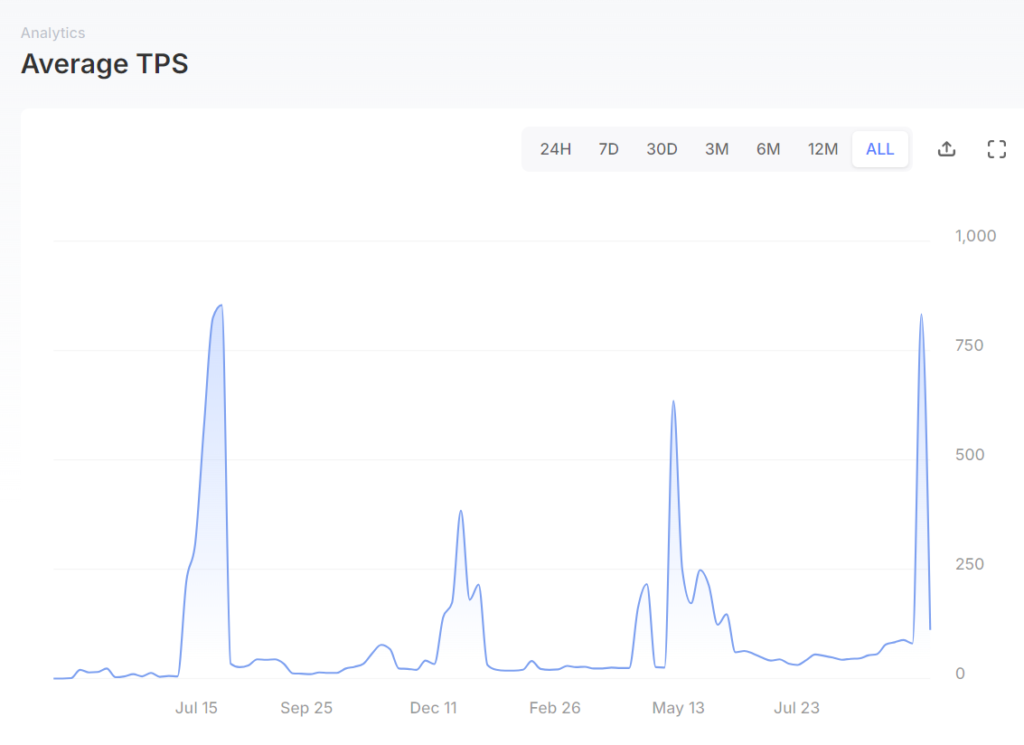
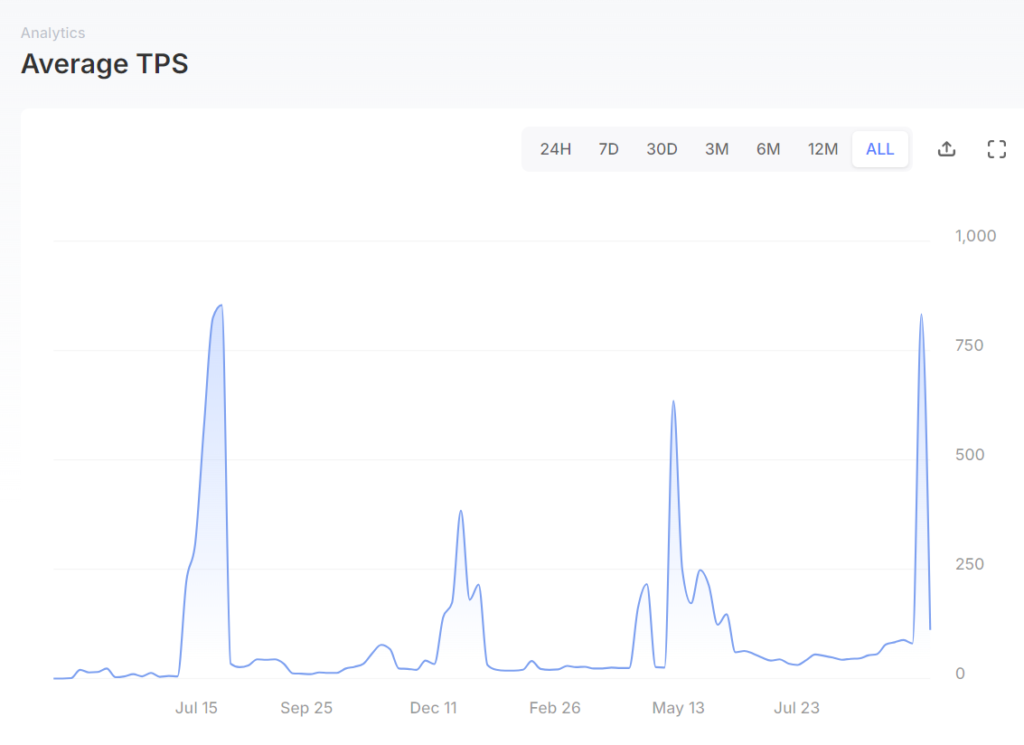
Sui is a high-performance Layer 1 public chain based on the Move language, developed by Mysten Labs. In terms of performance, according to data released by the Sui Foundation, Sui's highest TPS can reach 297,000. In actual implementation, Sui's current highest TPS reaches about 800.
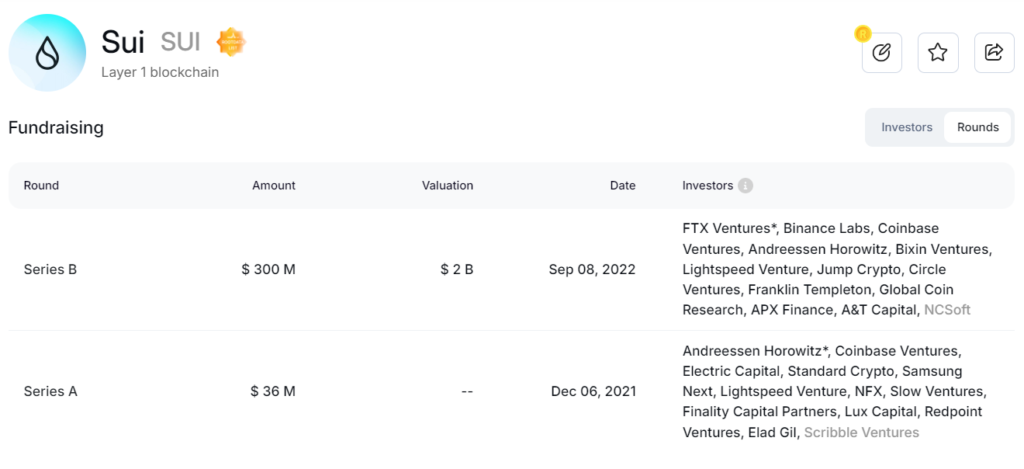
In terms of financing background, Sui announced Series A and Series B financing, completing a total of $336M in financing, and the Series B financing valuation was $2B. The investors have strong backgrounds, including A16z, Coinbase Ventures, Binance Labs and other top funds participating in the investment.
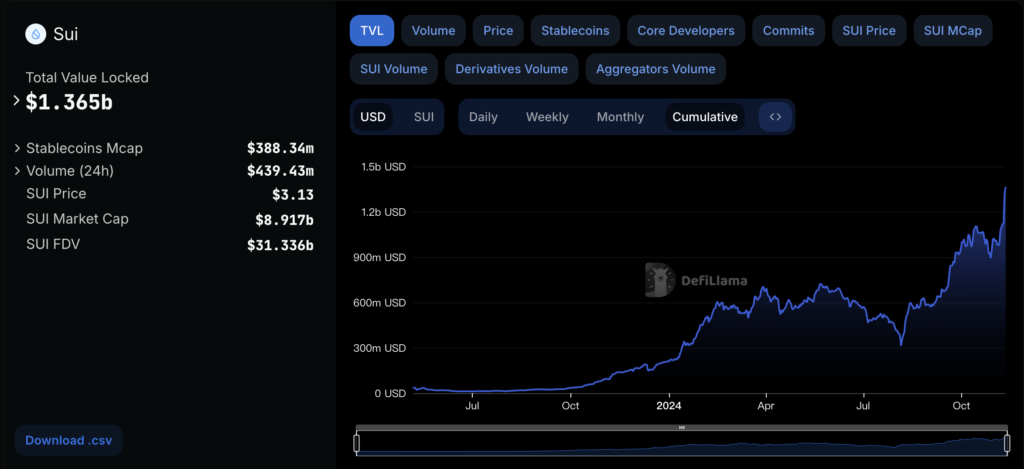
The Sui mainnet was launched on May 3, 2023. In the past year and a half, the TVL of the Sui ecosystem has risen rapidly, currently ranking 5th among all public chain ecosystems, and has formed a network including DEX, lending, stablecoins, DeFi infrastructure ecosystem such as liquidity staking.
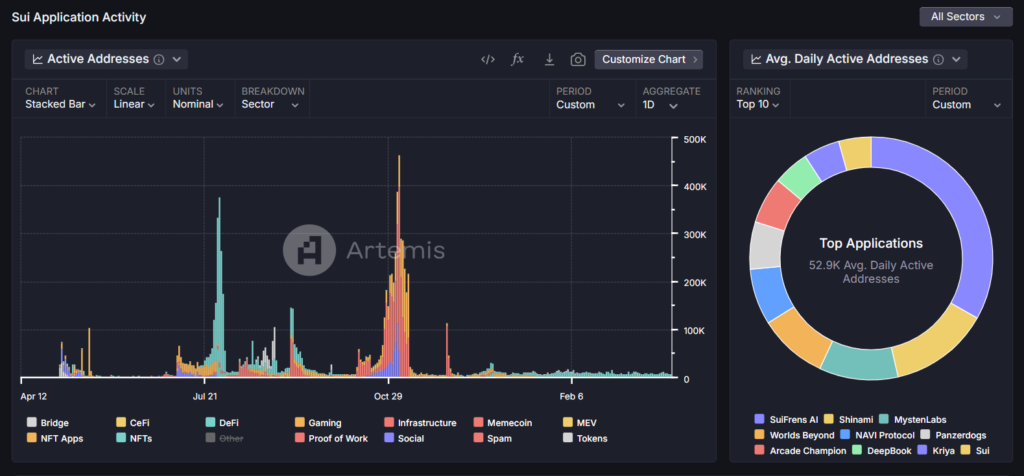
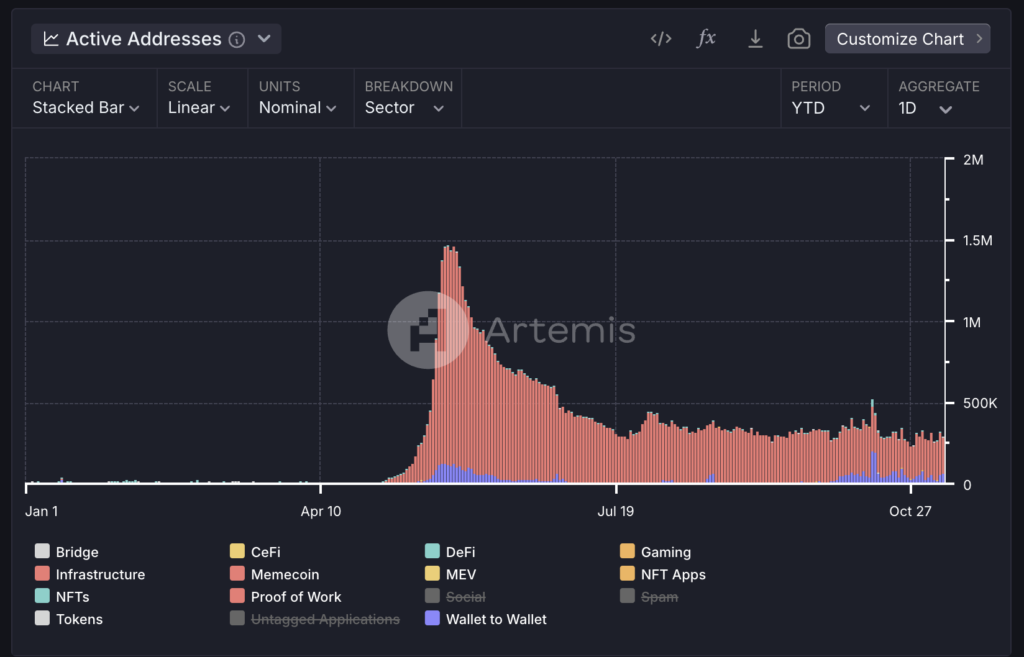
The Sui ecosystem did not gain many stable daily active users in the early stages of development. It was not until May 2024 that it began to attract a large number of users. The current number of daily active users is stable at around 1M.
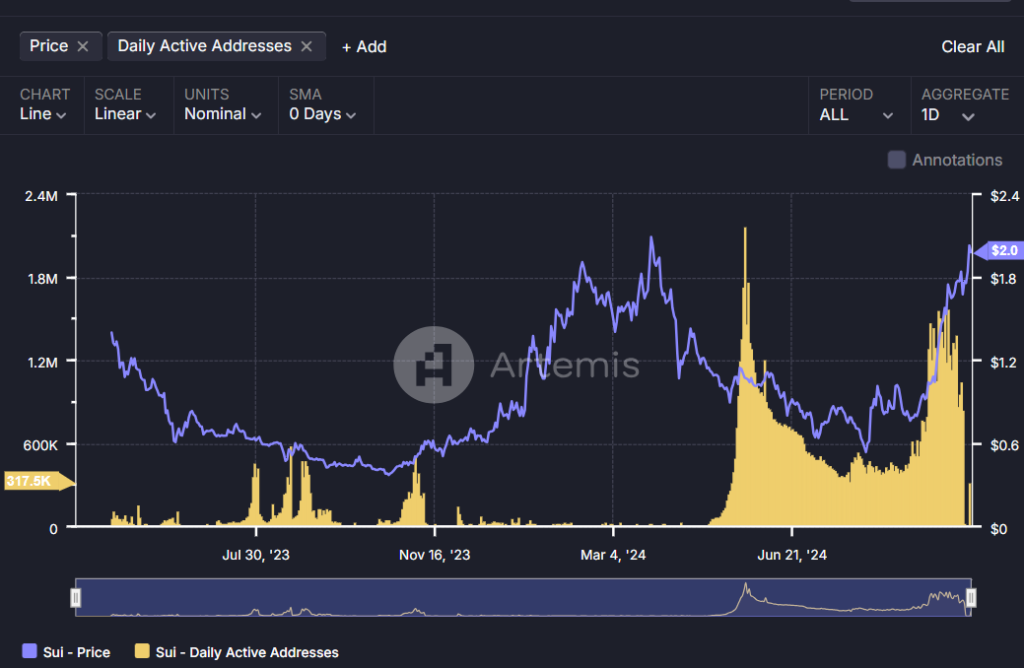
The currency price of SUI entered a stage of rapid rise in September and became one of the best-performing crypto assets in September, significantly outperforming BTC and SOL. The recent price high is close to the previous high. As currency prices rise, Sui has recently announced a number of ecological developments:
- On September 2, 2024, Sui announced the launch of the handheld game console SuiPlay0X1, which natively supports Sui ecological games and Steam and Epic game libraries. The game console is priced at $599 and will be delivered in 2025.
- On September 12, 2024, Grayscale announced the launch of Grayscale SUI Trust Fund, which was officially open to qualified investors. As of October 8, the fund's AUM has exceeded $2.7M.
- On September 17, 2024, Sui and Circle reached a cooperation, and USDC was expanded to the Sui network. On October 8, the native USDC was launched on the Sui mainnet.
- On October 1, 2024, Sui Bridge was launched on the mainnet and currently supports ETH and WETH bridging between Sui and Ethereum, protected by the Sui network validator.
Base trading activity
The Sui ecosystem has not produced many new asset plays, but Memecoin transactions were relatively active in early October, and tokens such as HIPPO, BLUB, FUD, AAA, and LOOPY performed well.
In particular, HIPPO has brought a very good wealth creation effect. It is currently the second-largest token in the Sui ecosystem after CETUS and DEEP. Compared with the low point, the token has increased by more than 50 times and has fallen by more than 70 times at the high point. %, there is currently a significant rebound.
Memecoin’s trading enthusiasm is also reflected in the rapid increase in the number of new tokens. Since mid-September, the number of newly created tokens on Sui has remained above 300 per day, and has reached more than 1,000 on many days since October. However, it has now back down to lower levels.
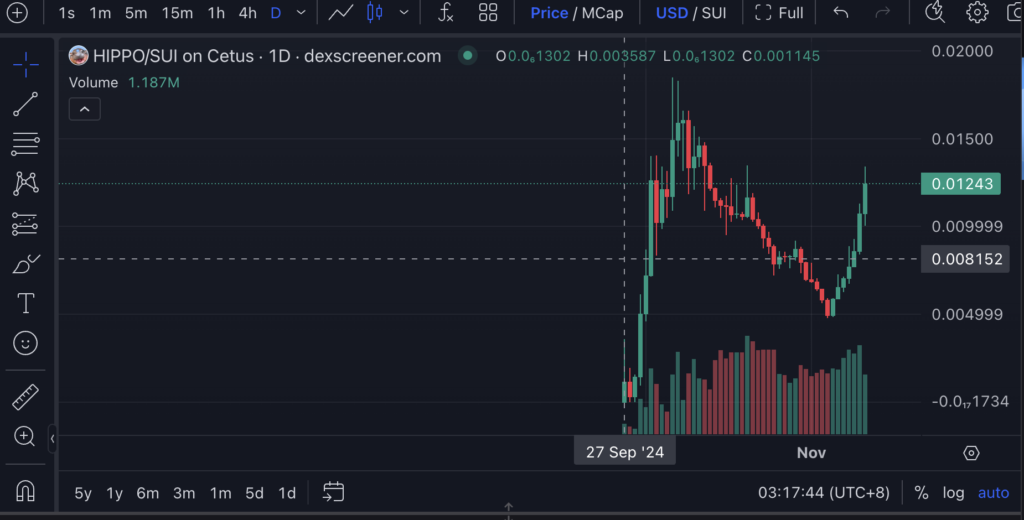
On the Meme trading infrastructure, Cetus serves as the main AMM. Trading Bots generally use PinkPunkBot. Movepump is a Memecoin launchpad similar to Pump.fun. After the liquidity reaches a threshold, the currency will be listed on BlueMove Dex, which makes its TVL and transaction volume data It rose sharply in early October.
Ecosystem overview
According to Sui Directory statistics, there are a total of 86 projects in the Sui ecosystem, of which, in addition to infrastructure, they are mainly games (23 projects) and DeFi (16 projects).
According to CoinGecko data, the market value of Sui ecological projects is relatively low. Except for SUI, the only projects in the top 500 in market value are the recently emerged HIPPO. In addition to stablecoins, the top 1,000 projects in market value include FUD, CETUS, BLUB and NAVX, that is, only Meme and DeFi leading projects have fewer investment targets.
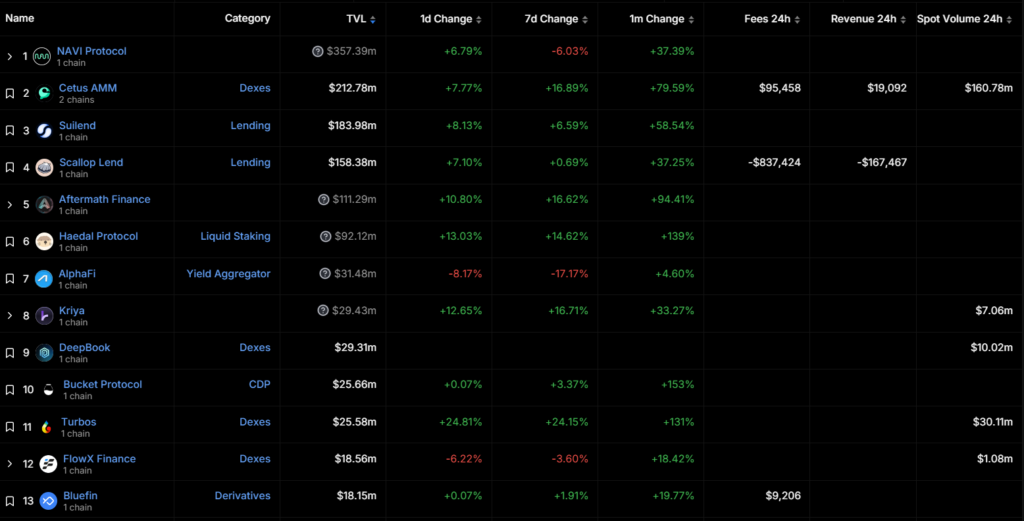
According to DeFillama statistics, there are 40 DeFi protocols in the Sui ecosystem, among which the top three protocols are: NAVI Protocol (lending), Cetus AMM (DEX), Suilend (lending), Scallop Lend (lending) and Aftermath Finance (transaction aggregation) TVL with liquidity staking) follows closely behind, as well as revenue aggregation protocol AlphaFi, stablecoin protocol Bucket and derivatives trading protocol Bluefin.
NAVI Protocol
The leading lending agreement in the Sui ecosystem has a TVL of $314.8M, a total loan amount of $464.63M, and a total loan amount of $149.83M. TVL is mainly composed of WUSDC, SUI and SUI derivatives. Among them, WUSDC on the Sui chain The total amount is $283.05M, and the TVL occupied by WUSDC in NAVI Protocol is approximately $900 million, accounting for more than 30%.
NAVI Protocol is building Volo, a liquid staking protocol for SUI. The price of the protocol token NAVX has performed well recently. Compared with the low point ($0.003) after the plunge on August 5, the current price ($0.19) has increased more than 6 times. On October 4, NAVX was listed on Bybit and launched Launchpool.
Cetus AMM
The DEX built on both Sui and Aptos is also the most mature DEX in the Sui ecosystem. It supports AMM Swap, limit orders and DCA trading forms in terms of trading strategies, and uses the centralized liquidity (CLMM) strategy in AMM.
In addition, Cetus integrates Wormhole SDK and builds a cross-chain bridge interface on its own front-end to enrich user experience. The price of CETUS has also performed well, rising by nearly $0.02 since the low point on August 5 ($0.038), an increase of more than 5 times. With the recent listing on Binance, the price of CETUS has once again increased by more than 1 times, and its current market value is approximately US$260 million.
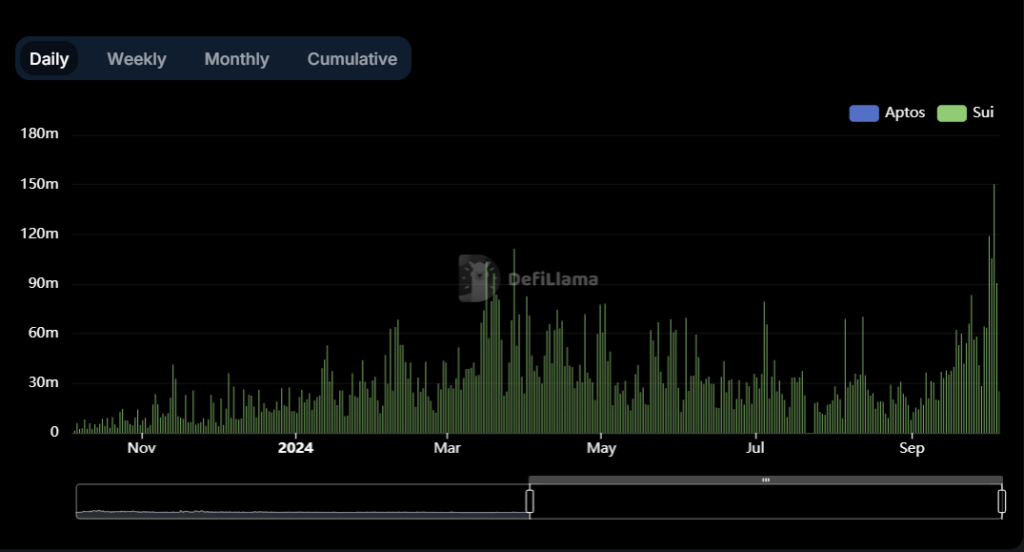
On September 23, Cetus launched the first Meme Season, which aims to provide grants for Meme tokens traded on Cetus. Since October, Cetus' trading volume has increased significantly, with daily trading volume exceeding US$100 million, exceeding the peak in March-April this year.
Suilend
Sui Ecological Lending Protocol Longer provides a total loan amount of $227.58M and a total loan amount of $57.69M. Its total loan amount and utilization rate are both lower than NAVI Protocol.
The composition of TVL is also mainly composed of SUI and WUSDC. The total TVL composed of SUI and WUSDC is equivalent to that of NAVI Protocol, but derivatives of SUI have not been introduced yet.
This project is built by the Solend project team, so SOL can be packaged into the Sui ecosystem for profit. It is worth mentioning that both Suilend and NAVI Protocol use SUI or SUI derivatives to provide incentives for lending behavior. Suilend uses SUI and NAVI Protocol uses vSUI. In May 2024, Suilend launched a points campaign to reward users who deposit assets to the platform.
ecological development strategy
Web3 Gaming has always been a very important part of Sui's ecological strategy. The Move language used by Sui adopts an object-oriented architecture and uses objects as the basic unit of data storage instead of using an account model like other blockchains. This makes More abundant and composable on-chain game assets can be defined on Sui. At the same time, Sui's extensibility, zkLogin, etc. also provide game users with a game experience closer to Web2.
In the early days of Sui's ecological development, the ecological flagship game Abyss World attracted a lot of market attention. The game was supported by AMD and Epic Games. On June 24, 2023, the Japanese social game giant announced that it would become a validator node of Sui and set up a new platform in Sui. Game development is carried out on Sui. On September 22, 2023, South Korean game developer NHN was reported to be developing chain games based on Sui. On September 28, 2023, Sui launched the Web3 game portal Play Beyond to facilitate users to explore Sui in one stop. game.
However, due to the poor performance of the chain game track in this cycle, Sui has not run any games with an out-of-the-circle effect. Judging from the data, although games and social projects will be the main sources of Sui users in 2023, after entering 2024, the Sui ecosystem fell into silence.
Recently, the Sui ecosystem has begun to work together in many aspects, and the strategy seems to be very similar to that of Solana in the early days: the price of SUI tokens has risen rapidly, Meme with wealth-creating effects has appeared, and ecological tokens have taken off in an all-round way, supplemented by grayscale establishment A series of good news such as Sui Trust Fund, native USDC landing in Sui Ecosystem, ecological project tokens going online on core CEX, Sui Foundation announcing investment in ecological projects, quickly attracted the market's attention to Sui, and the voice of "Solana Killer" continued to appear. .
At the same time, it can be seen that the Sui ecosystem still regards games as one of the main lines of the ecosystem, including the launch of SuiPlay0X1 and Grayscale’s promotional video for Sui games.
In addition, in terms of market selection, the Korean market has shown a high degree of interest in Sui. SUI tokens continue to occupy the top positions in the trading volume of the Upbit exchange. In the spot trading volume of SUI tokens, Upbit is second only to Binance. It can be seen that The importance of the Korean market in Sui's ecology.
Funds and user data changes
In terms of funding information , Sui Ecosystem’s TVL has grown rapidly since August 5, rising from a low of around US$300 million to more than US$1 billion. However, since TVL is mainly composed of SUI and ecological tokens, this information cannot be Reflects the real capital inflow of the Sui ecosystem.
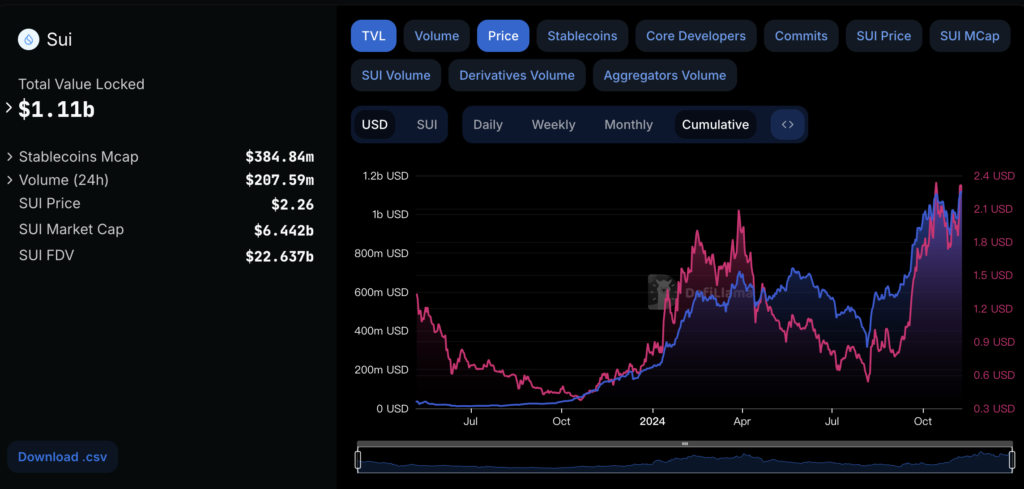
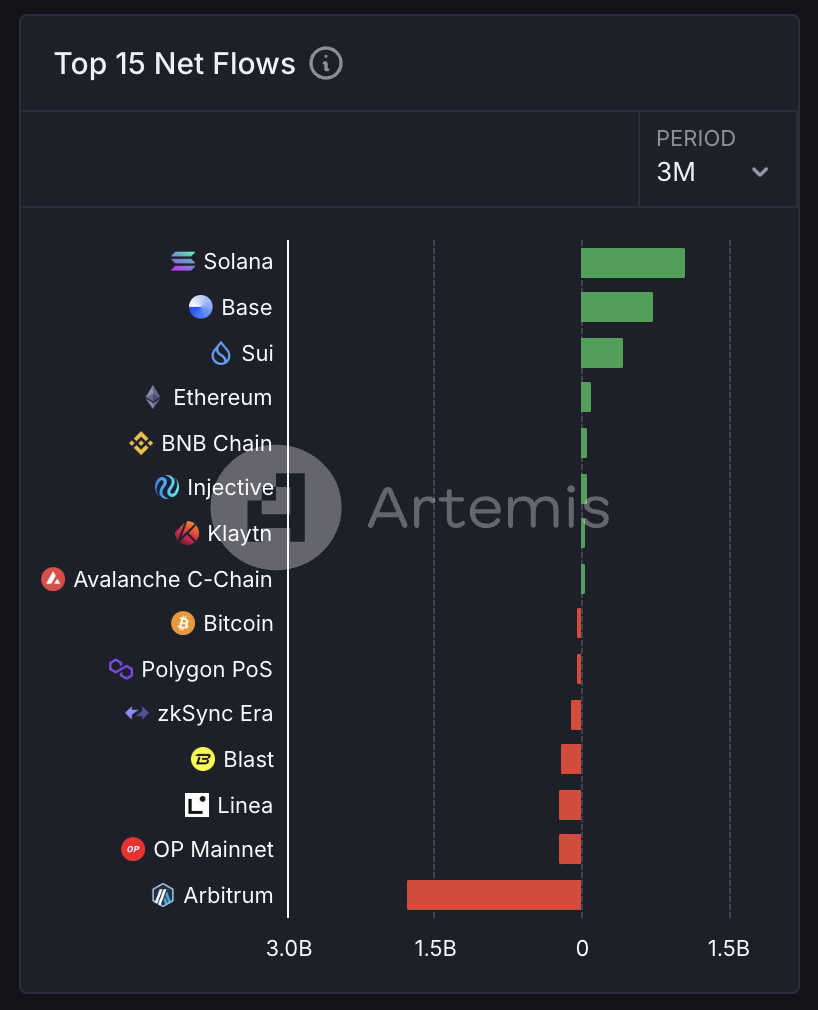
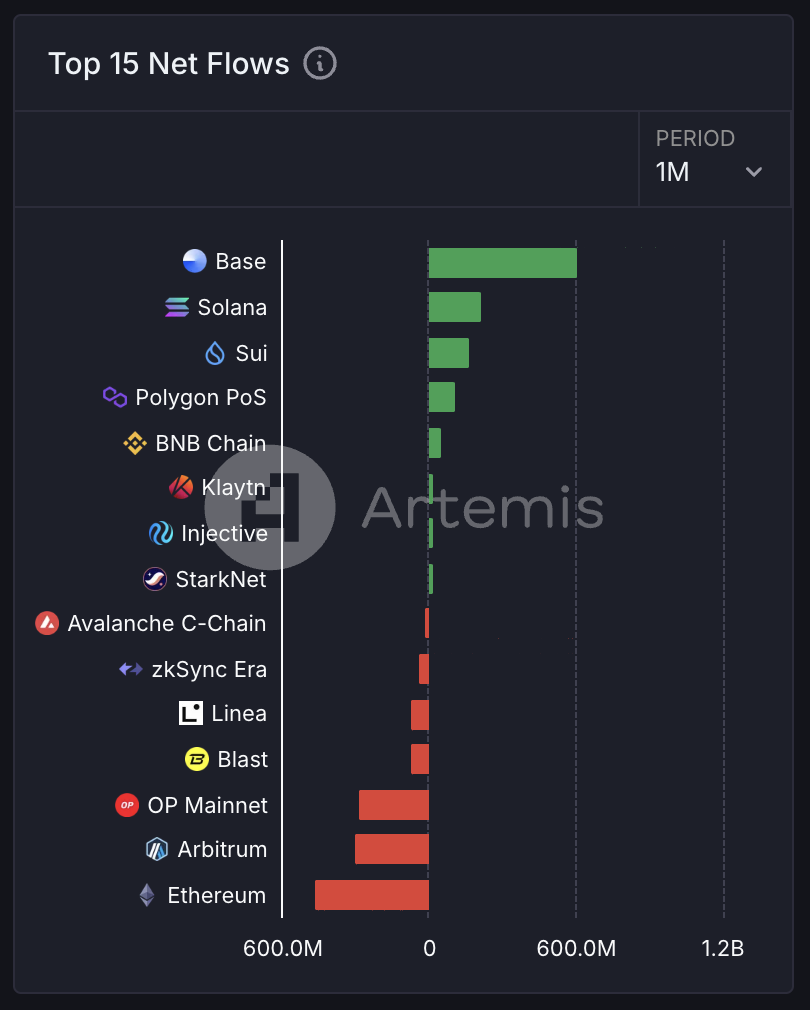
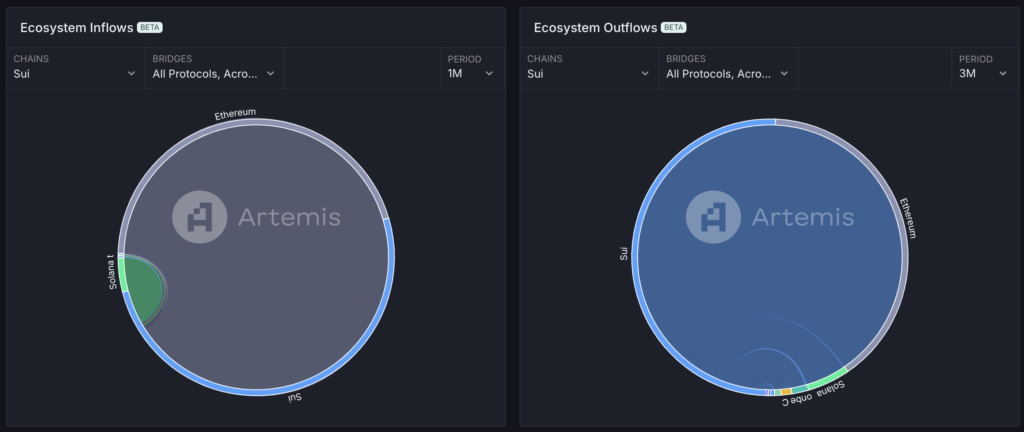
A more accurate indicator might be stablecoin market cap and capital inflows. The current market value of Sui ecological stablecoin is about $380m. After August 6, the market value of its stablecoin increased to 437M, and then declined rapidly. From the perspective of capital inflow, Sui's net capital inflow in the past month and the past three months has been positive, ranking third among all public chain ecosystems, and the capital inflow situation is good. In terms of the source of inflow and outflow funds, Sui’s main inflow and outflow ecosystem is Ethereum.
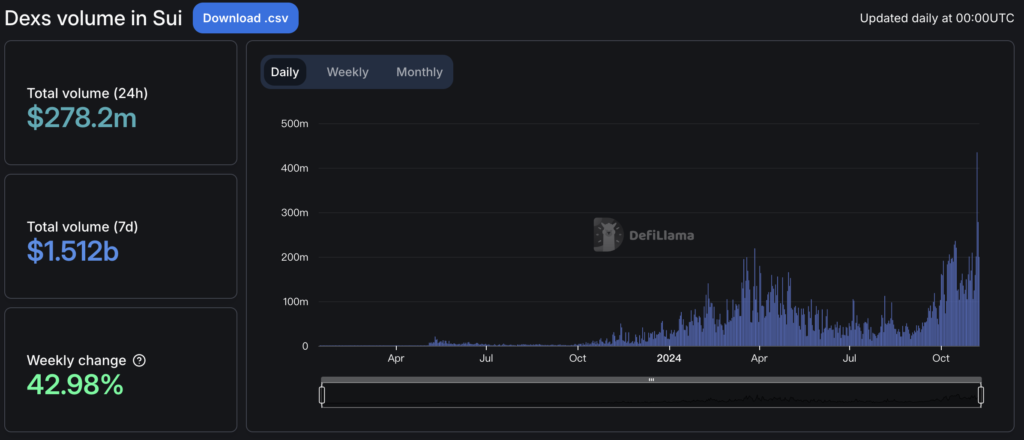
In addition, in terms of transaction activity, Sui's DEX Volume ranks 6th among all public chain ecosystems. Since September, transaction volume has been recovering significantly and has now exceeded the peak level in March-April, with daily transaction volume exceeding 200M. Among them, Cetus contributed more than 85% of the trading volume, and the main trading pairs are SUI-USDC, SUI-wUSDC, HIPPO-SUI, and CETUS-SUI.
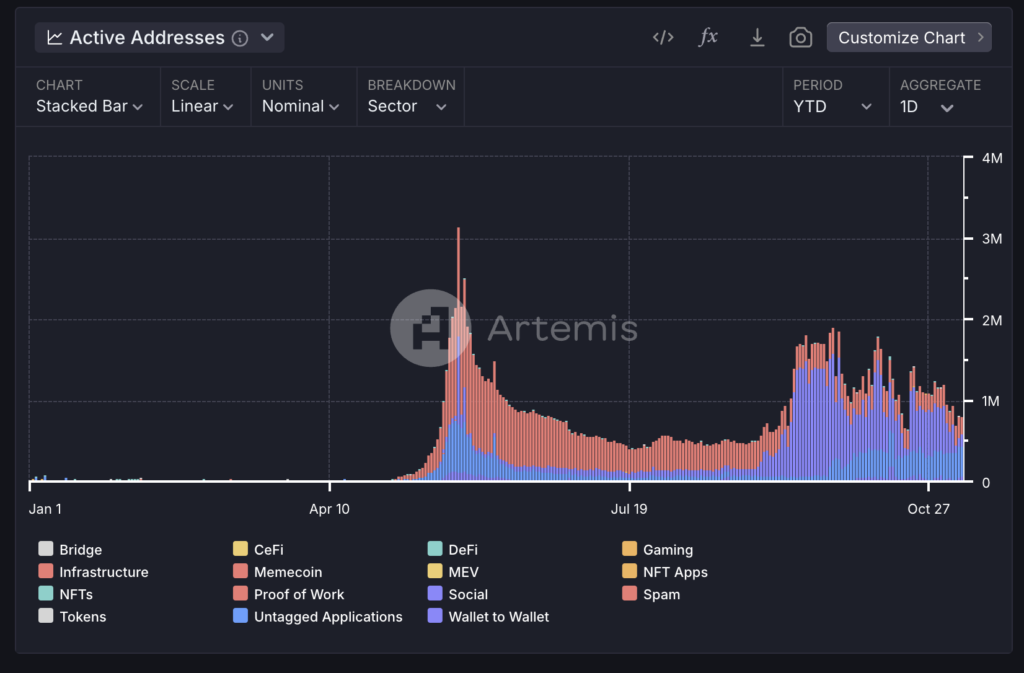
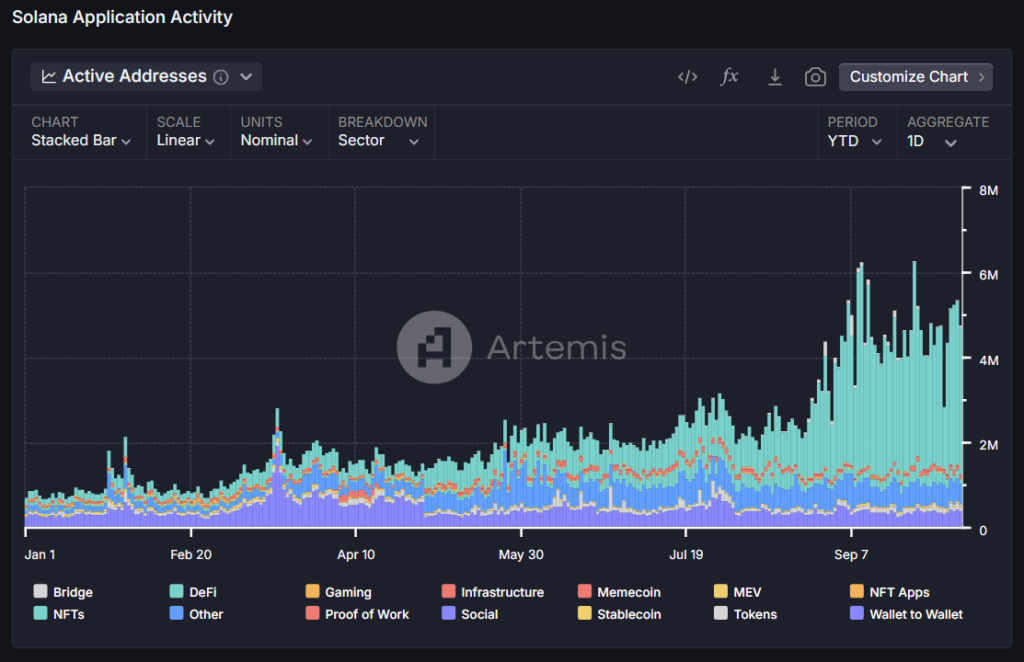
In terms of user data, the total number of active users of Sui has increased, but active users are mainly concentrated in the Social sector. The main active Dapps are RECRD, BIRDS, FanTv, etc. The discussion volume of these Dapps in the market has not increased simultaneously. , so how many real users there are is still open to question.
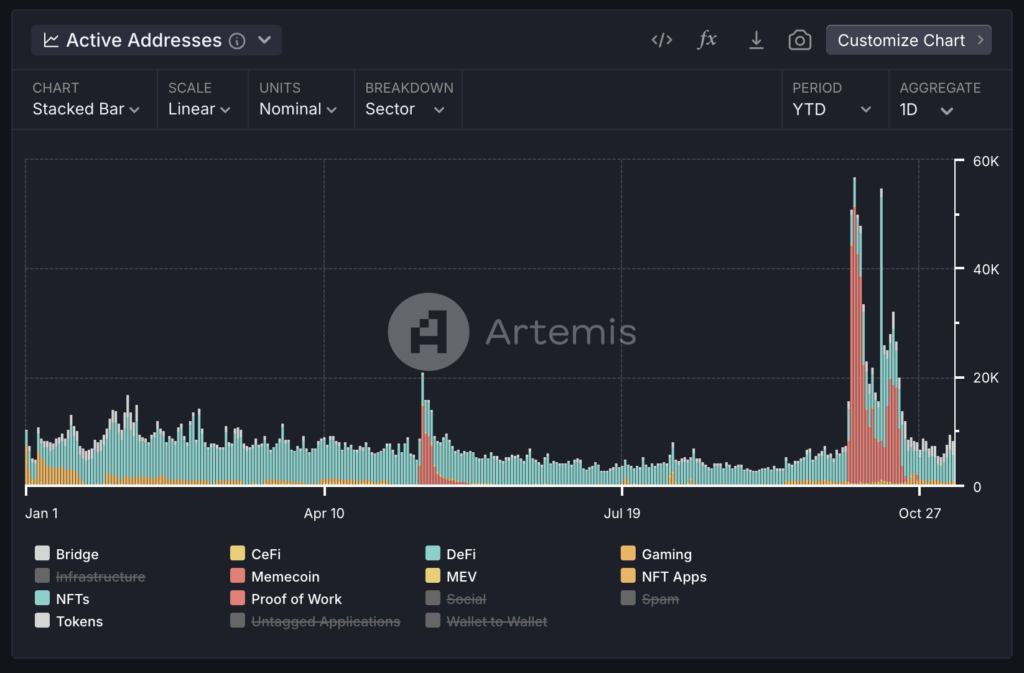
After excluding the Social sector and the Other sector to which BIRDS belongs, the user activity of the Sui ecosystem has not increased much. In particular, the number of daily active wallets in the DeFi sector is only 1-5K. Compared with Ethereum, Solana, etc. In terms of the user structure dominated by DeFi, the DeFi activities of the Sui ecosystem are weak and the user structure is not healthy. There are still doubts about how many real active users there are.
October 2024 witnessed the Memecoin active period in the Sui ecosystem, with the related peak daily active users exceeding 50K. However, this craze did not last, and the current Meme activity has once again fallen to the bottom.
Token Economics and Price Trends
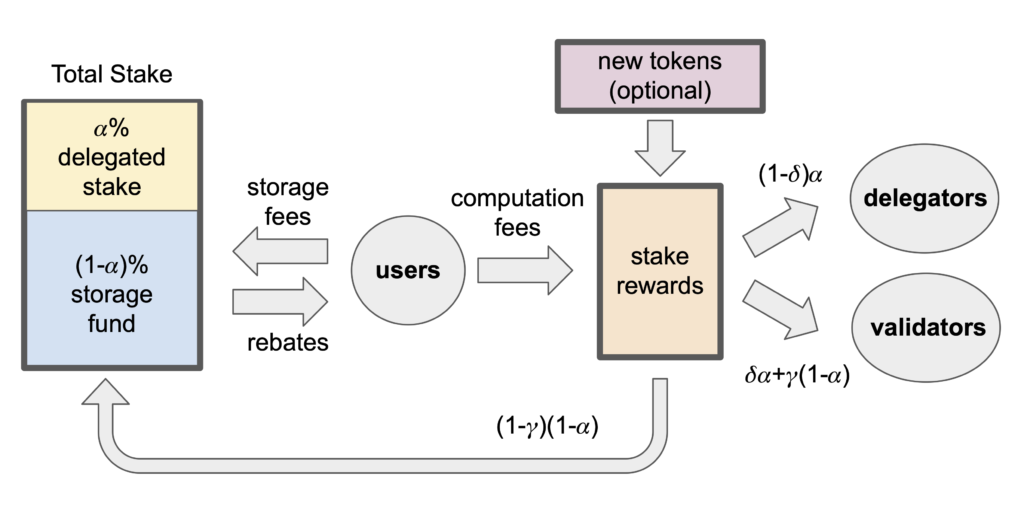
The flow process of SUI throughout the system is shown in the figure below. Sui has a Storage Fund and will receive a portion of the Storage fees and Stake Rewards paid by users at the same time. The fund flow for each Epoch is as follows:
- Users submit transactions and pay corresponding Computation fees and Storage fees, of which Storage fees go directly to the Storage fund.
- The new SUI token inflation and Computation fees together form Stake rewards
- The total pledge amount in each round includes two parts: the user’s pledge amount *α%* and the proportion of Storage fund (1-α)%
- Distribute Stake rewards proportional to γα to stakers and delegated stakers
- The remaining *(1-γ)(1-α)* Stake rewards will be transferred to the Storage fund
- If a user deletes the storage data, the Storage fund will return part of the storage fee to the user.
Therefore, in the early days of the Sui ecological development, the Storage fund had no outflow of funds except for the return of storage fees for deleted data, forming a locking mechanism for SUI. When the locked part exceeds token inflation, the SUI token enters deflation mode.
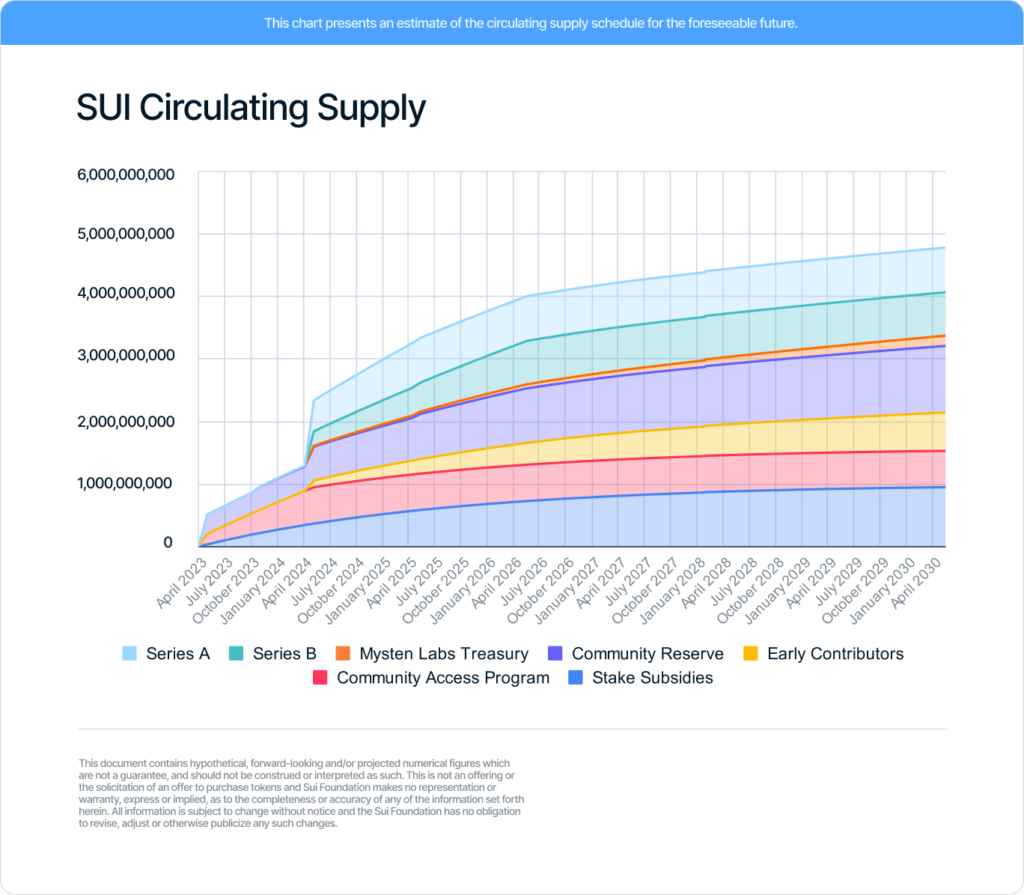
In terms of token distribution, the total supply of SUI is 10B. The token unlocking schedule announced by Sui on June 29, 2023 is as shown in the figure below.
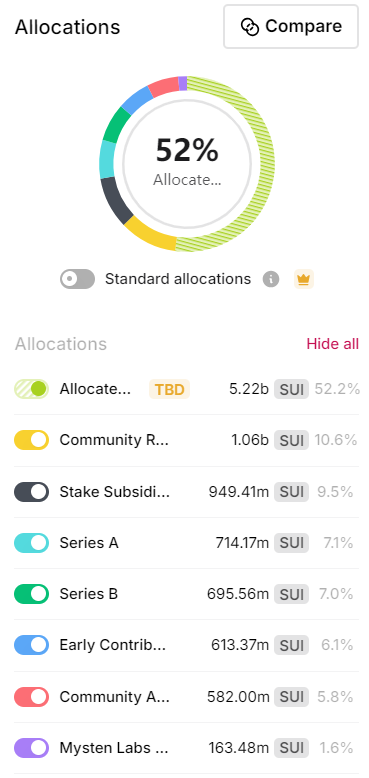
According to Token Unlock information, SUI’s token distribution is shown in a fan chart.
The circulating supply of SUI is 2,763,841,372.61, accounting for 27.64%. Currently, the main inflation pressure of SUI comes from staking rewards and token unlocking. Starting from April 2024, investors, early contributors and team tokens will begin to be unlocked monthly , a total of 64.19M SUI tokens were unlocked on November 1, 2024, accounting for 2.32% of the circulating supply. Continued token unlocking and inflation may become upward pressure on SUI.
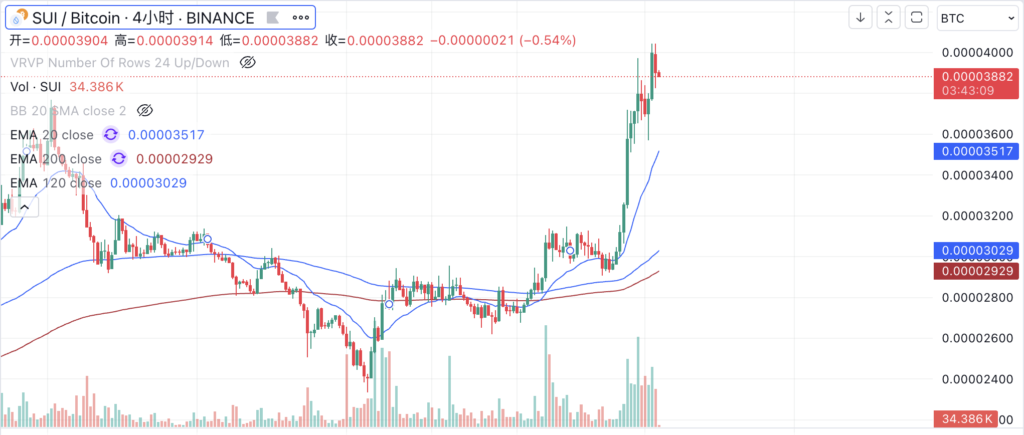
From the perspective of price performance, the exchange rate trend of SUI against BTC is very strong. After falling to a low on October 29, it quickly rebounded. After a period of adjustment, it continued to rise. After November 9, it rose sharply with strong volume and broke through. highs at the start of the year.
summary
In the past month or so, the market's attention to the Sui ecosystem has greatly increased. This is mainly caused by the wealth-creating effect of Sui and its ecological tokens. We can see that Sui and its ecosystem are forming a synergy, through pulling the market and benefiting Messages are released to quickly attract attention. So has the Sui ecosystem formed a "new Solana" trend?
- On the positive side, we are seeing funds flowing into the Sui ecosystem. Although TVL's data is somewhat flawed, Sui's net inflow of bridging funds ranks third, showing Sui's attraction to on-chain funds.
- Sui ecologically produced a good Memecoin in early October and gained a certain amount of market attention, but its momentum and volume were obviously not as strong as those of Solana and Ethereum. We have not yet seen any funds for Meme’s speculation coming from Ethereum and Solana. There are signs of a shift to Sui, and the development momentum of Memecoin is not lasting, and user activity has once again dropped to freezing point.
- Sui still regards Web3 Gaming as one of its main strategies, but Gaming is not optimistic in this round. The TON ecological mini-games regarded as Mass Adoption are also gradually being falsified. If Sui's ecological project cannot be taken on after this round of momentum, Sui Ecology may still be unable to escape the fate of being forgotten by the market.
- The total number of daily active users of Sui has increased significantly, but it is not healthy when dismantled, and there may even be moisture. Like the ecological strategy, this makes us cautious about the health and sustainability of Sui's ecology.
- From a token perspective, SUI faces long-term and sustained inflationary pressure, which will put great pressure on the rise in its currency price. Many people compare SUI to the new SOL, but SOL has basically been unlocked during this round of rise, and there is not much inflationary pressure. It is necessary to continuously monitor the chip structure and unlocking situation of SUI. If the breakthrough of the local currency of the public chain is blocked, it will have an impact on the ecosystem. Continuous development creates greater pressure.
Aptos ecological analysis
Basic information and recent progress of public chains
Aptos is also a Layer 1 high-performance public chain based on the Move language, but compared to Sui, Aptos retains more of the core of Diem, while Sui introduces more modifications.
The biggest difference between the two is that Sui introduces an object-based model, while Aptos uses an account-based model. In addition, there are certain differences in the parallel execution strategy of transactions.
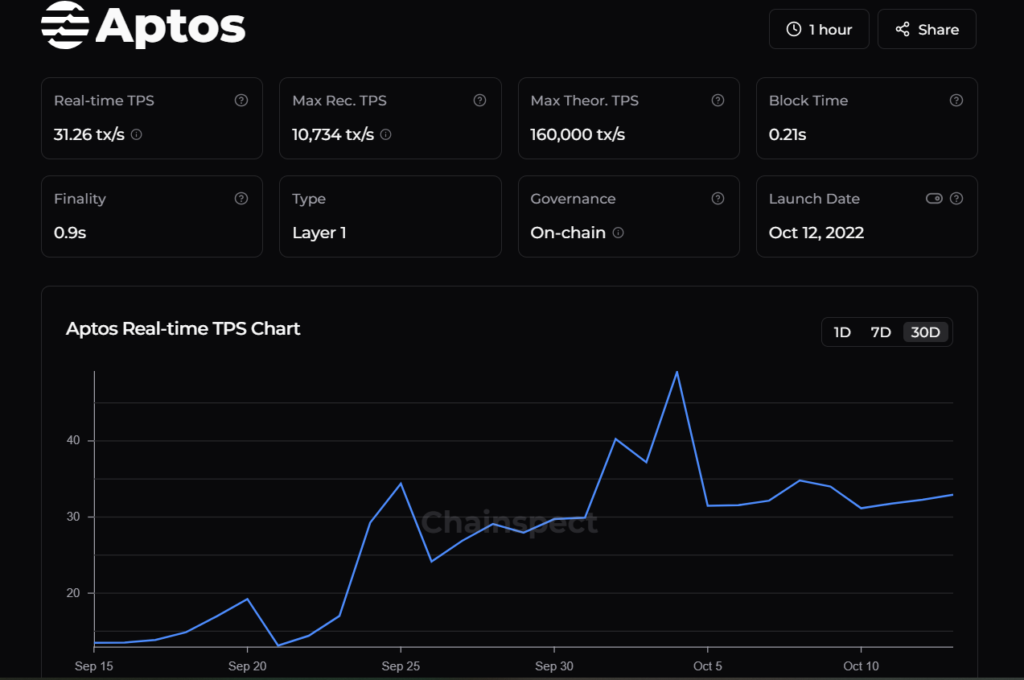
In summary, Aptos focuses more on modularization and optimization of traditional blockchain structures, while Sui proposes greater innovation in architecture. In terms of performance, according to Chainspect data, the theoretical maximum TPS of Aptos can reach 160,000. In actual execution, the highest recorded TPS is 10,734, and the daily TPS remains at 500-1000.
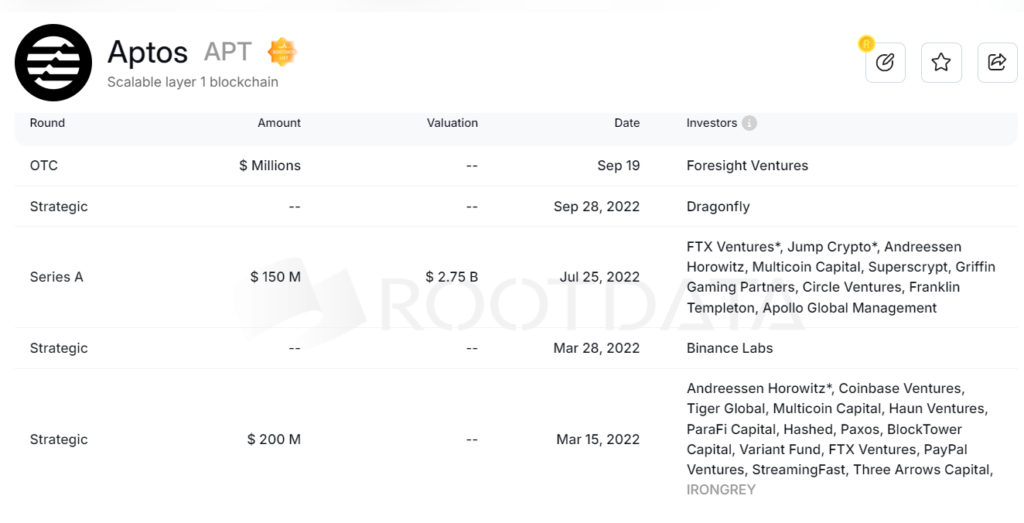
In terms of financing background, Aptos announced multiple rounds of financing in 2022, with a Series A financing valuation of $2.75B. It was also supported by top funds such as A16z, Binance Labs, and Coinbase Ventures. On September 19, 2024, MEXC Ventures, Foresight Ventures Launched a fund with Mirana Ventures to support projects launched in the Aptos ecosystem.
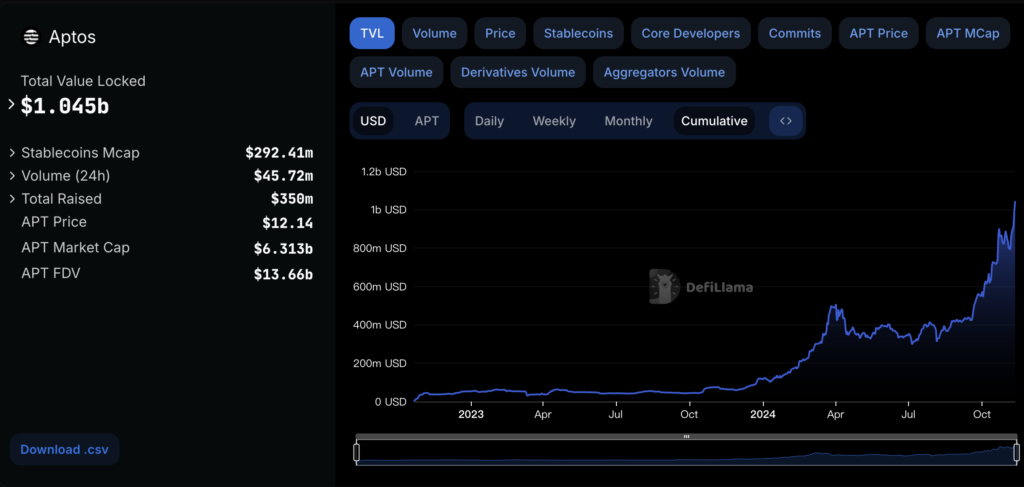
The Aptos mainnet will be launched on October 17, 2022. After 2024, TVL began to rise rapidly, rising more than 3 times since the beginning of this year. It currently ranks 12th among all public chain ecosystems, and has also formed a relatively complete DeFi infrastructure ecosystem.
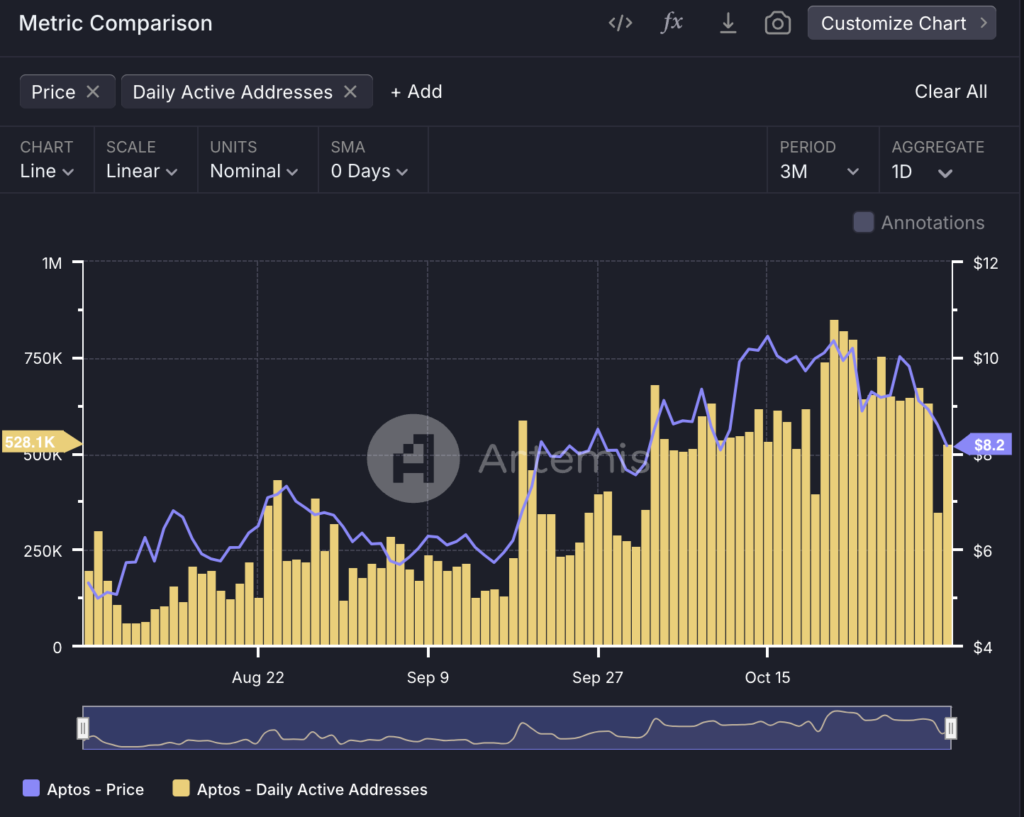
Aptos had a large number of daily active users in the first month after the mainnet was launched, and then fell into silence for more than half a year. It did not regain a certain level of user activity until August 2023. The current number of daily active addresses Around 500-600K.
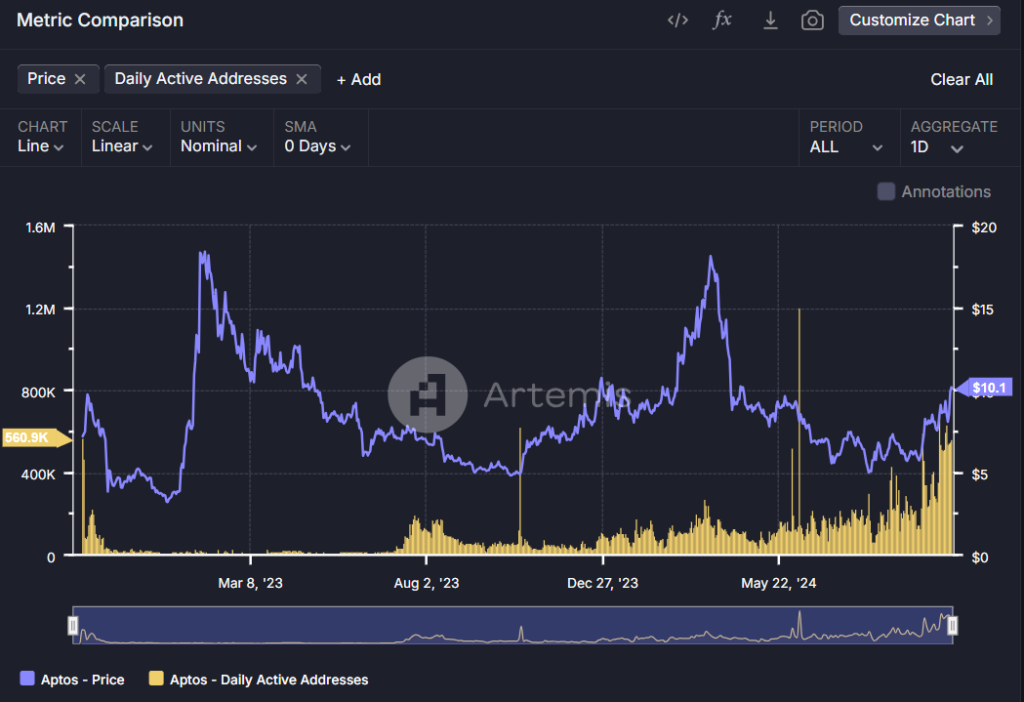
APT has more than doubled since its lows on August 5, 2024, but is still within striking distance of its ATH price. Aptos has not had any sensational benefits recently. The main ecological developments include:
- On September 19, 2024, MEXC Ventures, Foresight Ventures and Mirana Ventures jointly launched a fund to support projects launched in the Aptos ecosystem.
- On October 3, 2024, Aptos Labs announced that it has acquired the strategic expansion suite of Palette chain developer HashPalette to the Japanese market, which will promote the popularity of Web3 in the fields of Japanese entertainment, games and digital assets.
- On October 2, 2024, Franklin Templeton expanded the on-chain money market fund suite to the Aptos network.
- On October 28, 2024, native USDT was launched on the Aptos mainnet.
Base trading activity
There are almost no means to realize standard transactions on Aptos. There is no active and leading Memecoin, and the entire ecosystem is still in its infancy.
Ecosystem overview
According to the Aptos official website, there are currently 192 projects, far exceeding Sui's data. Among them, according to DeFillama data, there are 49 DeFi protocols, which is basically the same number as the Sui ecosystem. However, there are relatively few projects that have issued tokens in the Aptos ecosystem. Among the top 1,000 ecological native token issuance projects, only Propbase (RWA platform) and Thala are among the top 1,000 by market value. In addition, the market value of Cellana’s token CELL ranks only over 1,300.
Thala
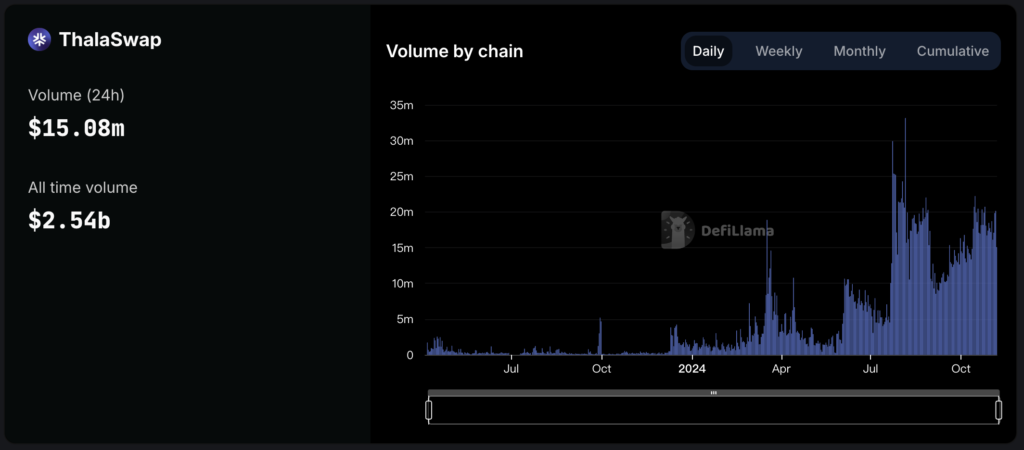
The leading DEX on Aptos accounts for 50% of the transaction volume on the Aptos chain. Its core products include Swap, liquidity collateral and over-collateralized stablecoins. Thala currently has a relatively single trading function, mainly focusing on AMM transactions. In addition, it has opened liquidity staking. Users can obtain the liquidity token thAPT and pledge it to obtain about 8% APR.
Thala is the publisher of native stablecoin MOD on Aptos. Users mint MOD by over-collateralizing APT, thAPT and sthAPT.
In terms of trading volume, compared to the other two DEXs (LiquidSwap and Cellana Finance), Thala's recent trading volume data has performed best. The token pair that constitutes the main trading volume is MOD/zUSDC (LayerZero's USDC), which trades 24 hours a day. The volume is approximately 6M US dollars, which shows the empowerment of MOD stablecoin for Thala. In addition, the trading pairs with higher trading volume are stablecoins, APT and derivative assets.
The THL token will be launched in June 2023, and will only be listed on the MEXC and Gate exchanges. The main trading volume is concentrated on the THL/MOD trading pair on the chain. The currency price of THL will peak at about US$3 in March-April 2024. Currently, It fell back to around $0.8.
LiquidSwap
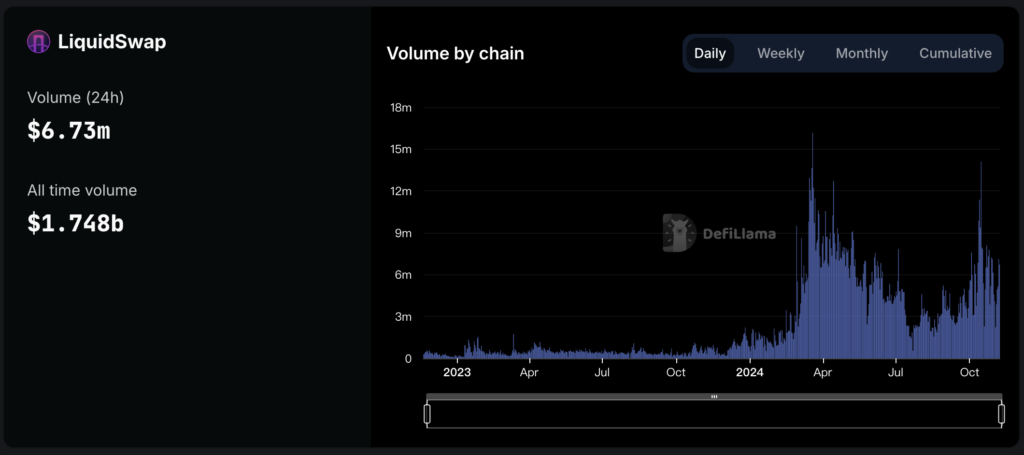
Dragon Er DEX on Aptos accounts for 22% of the transaction volume on the Aptos chain. This DEX is developed by Pontem Network. Its main trading pair is USDC-APT, with a 24-hour transaction volume of 3M and a TVL of about 20M, accounting for 22% of the transaction volume on LiquidSwap. Trading volume is half of TVL.
Cellana Finance
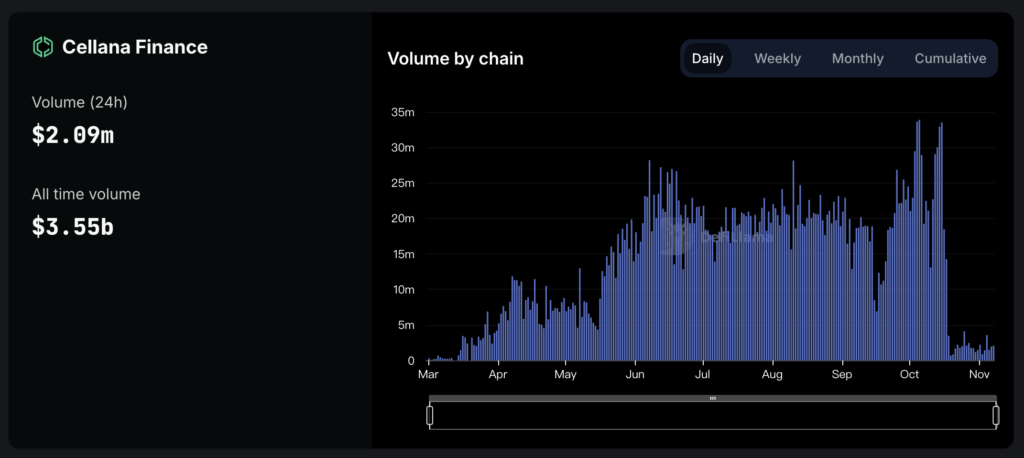
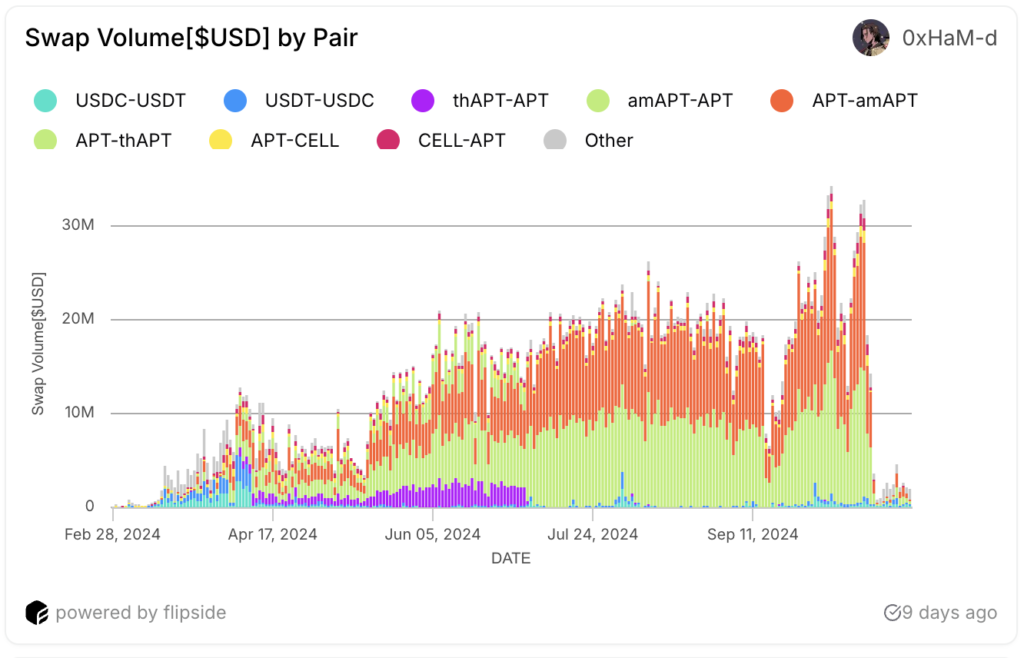
Cellana was launched in February 2024, but it is already the DEX with the highest cumulative trading volume on Aptos. From January to October 2024, it maintained a daily trading volume of more than 25M. However, the trading volume dropped sharply after October 18. The current The daily trading volume is only about 2M. Previously, its trading volume mainly came from the mutual exchange between amAPT-APT, but the trading volume of this trading pair dropped sharply after October 18.
Cellana is Aptos and one of the few protocols that has issued tokens. Its token CELL can be pledged to obtain veCELL. According to the pledge time, you can obtain certain voting rights to determine the distribution of the next round of CELL liquidity incentives in different pools. veCELL votes People will receive 100% of the trading fees of the liquidity pool they voted for during that time period.
CELL can currently only be traded on Cellana, with the CELL-APT trading pair accounting for 88% of its total trading volume.
Aries Markets
Aries is the largest lending protocol in the Aptos ecosystem and the DeFi protocol with the highest TVL. The current total supply loan amount is $664M and a total of $402M has been lent. TVL has achieved significant growth in the past two years. The main asset types are zUSDT, zUSDC, stAPT and APT, among which zUSDT and zUSDC deposits can obtain an annualized rate of return of 12%, mainly from the subsidy of APT, which is one of the main interest-earning places for stablecoins on Aptos.
In addition to lending functions, Aries integrates AMM, limit order trading and cross-chain bridges. Aires has not issued coins yet, but is working on a points program to reward users for deposits and borrowings.
Amnis Finance: Amnis is the largest liquid staking protocol on Aptos. Users can get 1amAPT by depositing 1APT, and can get stAPT by staking amAPT, and obtain the corresponding staking income, which is about 9%. The protocol was launched in October 2023, and its TVL has been growing steadily, making it the second-largest DeFi protocol in terms of TVL on Aptos.
amAPT and stAPT have been widely integrated in the Aptos ecosystem. Starting in November 2023, Amnis will launch a points and retroactive airdrop plan, and clearly stated that points will be directly related to the airdrop of AMI tokens.
Echo Lending
Echo introduces BTC assets into the Move ecosystem by bridging BTC assets on the Bsquared Network to Aptos and obtains multi-layered benefits.
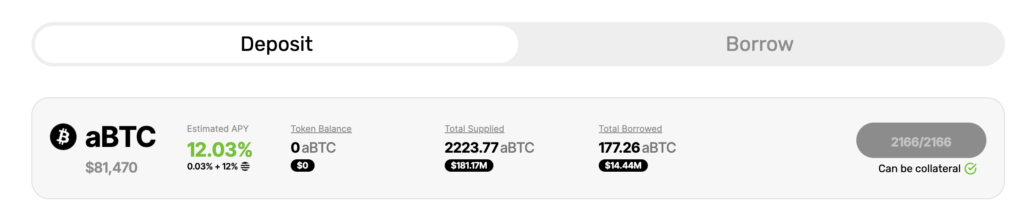
Specifically, Echo bridges BTC L2's uBTC to Aptos to obtain aBTC. Users can lend aBTC in the Echo protocol and obtain APT subsidy income. In this process, users can achieve more than one fish: Bsquared points, Echo points and APT rewards. Currently, lending aBTC can get an annual 12% APT subsidy, but the deposit limit has been reached.
Echo's TVL has grown rapidly since it was launched on Aptos. It currently exceeds 170M and is the fourth protocol with the highest TVL on Aptos.
ecological development strategy
In terms of ecological strategy, Aptos and Sui have different focuses. Aptos' recent efforts include RWA, Bitcoin ecosystem and AI.
RWA
Aptos is actively promoting the tokenization of real assets and institutional financial solutions. In July 2024, Aptos officially announced that Ondo Finance’s USDY would be introduced into the ecosystem and integrated into major DEX and lending applications. As of November 10, the market value of USDY on Aptos was approximately US$15 million, accounting for approximately 10% of the total market value of USDY. 3.5%.
In October 2024, Aptos announced that Franklin Templeton had launched the Franklin Chain U.S. Government Currency Fund (FOBXX) represented by the BENJI token on the Aptos Network. In addition, Aptos has also reached a cooperation with Libre to promote securities tokenization.
Bitcoin Ecology
Aptos actively joins BTCFi and connects Bitcoin assets on BTC L2 to the Aptos ecosystem to increase asset diversity on Aptos and expand TVL. In September 2024, Aptos officially announced its cooperation with Stacks to introduce sBTC to the Aptos network. However, sBTC has not yet been effectively integrated with mainstream DeFi protocols. The effect of this strategy on Aptos remains to be seen.
In addition, Aptos has realized cooperation with Bsquared Network through the Echo protocol. The BTC assets introduced so far have exceeded 170M US dollars. Aptos provides high APT incentives (annualized 12%) to stimulate cross-chain and deposits of BTC assets, demonstrating the Aptos ecosystem. The importance placed on strategies to attract BTC assets.
The introduction of BTC assets will increase the growth ceiling of TVL and the development of DeFi protocols on Aptos. It is necessary to continue to pay attention to changes in related asset TVL and Aptos official incentives.
artificial intelligence
The development of Aptos in AI is still in a very early stage. In September 2024, Aptos issued a document announcing its cooperation with the Ignition AI accelerator supported by NVIDIA, Tribe and DISG to promote the development of AI startups in the Asia-Pacific region and other regions.
Funds and user data changes
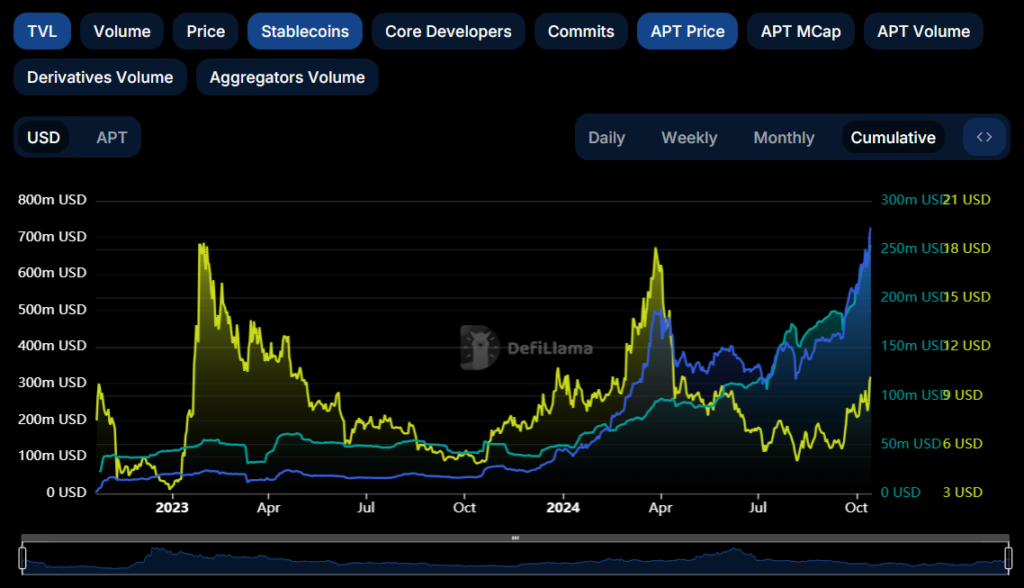
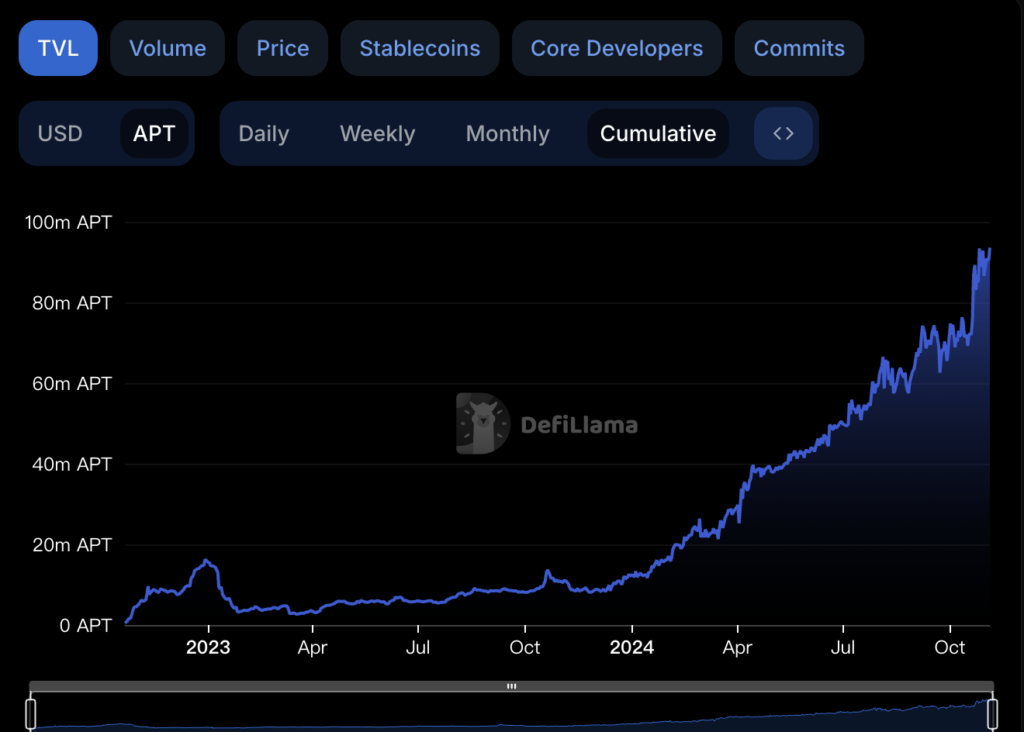
In terms of funding information, Aptos’ TVL and stablecoin market value have maintained a relatively healthy growth trend. TVL in US dollars reached a high point in early April, and then declined due to the sharp decline in the price of APT and its ecological tokens, but since APT-denominated TVL has been maintaining an upward trend.
From September 18th to the high point on October 22nd, the TVL denominated in USD doubled. Currently, due to the decline in APT prices, there has been a slight decline. The TVL denominated in APT has increased from 70M APT to 90M APT.
There are two main reasons for tracking the increase in TVL within this month: First, the increase in APT prices, and APT is the main asset of its ecological TVL; second, the launch of Echo lending, which quickly attracted 14.7M APT of TVL, constituted an increase in TVL The main part measuring 20M. Therefore, Aptos’ TVL seems to have increased significantly this month, but in fact it has made limited contribution to ecological liquidity.
The stablecoins in the Aptos ecosystem are dominated by USDC. The market value of stablecoins has steadily increased from $50M in early 2024 to $292.41m now, an increase of more than four times, and it still maintains an upward trend.
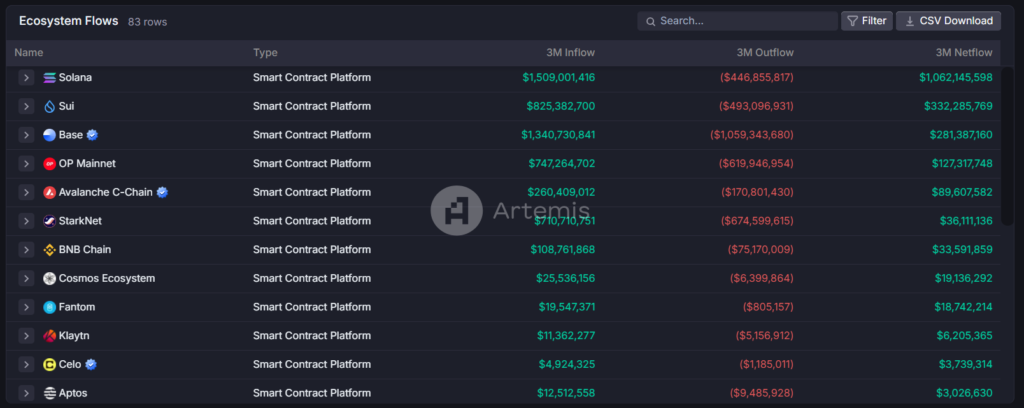
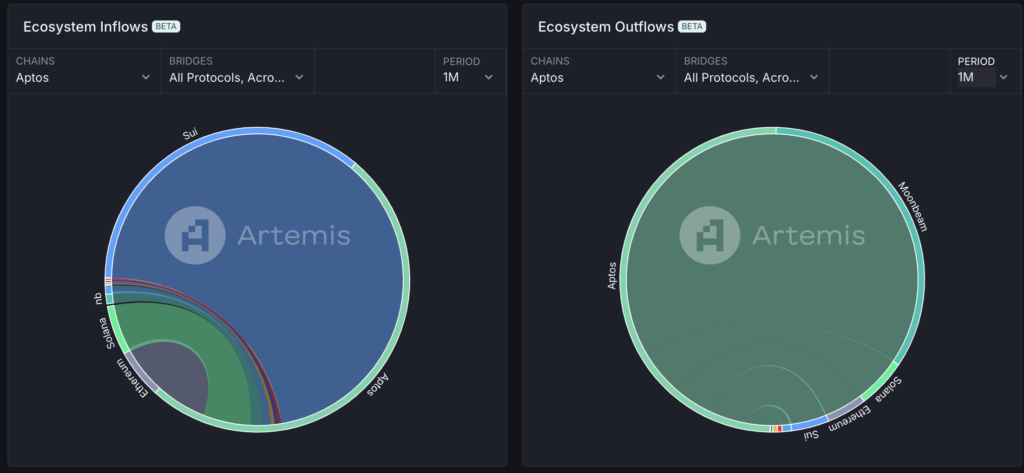
In terms of capital inflows, Aptos has seen a net inflow of funds within three months, with inflows of approximately $3M. In the past month, Aptos' main capital inflows came from Sui, in addition to Solana and Ethereum, and the main destination of capital outflows was Moonbeam.
In summary, Aptos is relatively healthy in terms of funding. The amount of funds in the ecosystem is increasing, but there is no tendency to take on overflow funds from other ecosystems (especially Ethereum and Solana).
In terms of transaction activity, Aptos’ DEX transaction volume ranks 12th among all public chain ecosystems. The transaction volume began to increase significantly after April 2024 and currently remains at a relatively high level. The transactions are mainly concentrated in Thala and on LiquidSwap.
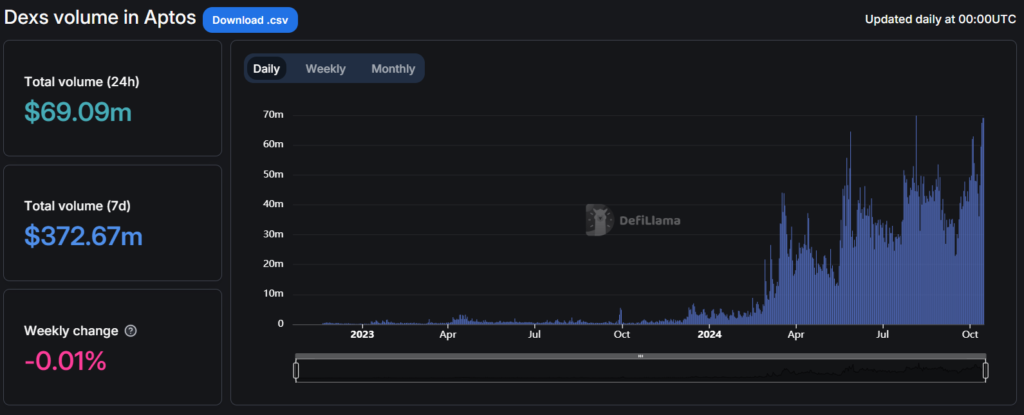
In terms of user growth, the number of daily active users of Aptos reached the peak of ecological development at the end of October, with the number of daily active wallets exceeding 800K.
According to DappRadar data, the applications with the most active users on the Aptos ecosystem include Kana Labs, Chingari, STAN, KGeN and ERAGON, while the DeFi infrastructure project Aminis with the highest active users only has 6k UAW (compared to Kana Labs’ active users The number of users exceeds 150k), and the number of active users of DEX is only 1k, which shows that Aptos has not entered a healthy ecological development. The number of transaction users on the chain is very low, and the demand for users to enter the Aptos ecological transaction and speculation is very low.
(Comparing Solana's user data, the UAW of Raydium, the first place, exceeds 3M, and the UAW of Jupiter, the second place, is 251K, far exceeding other projects)
Token Economics and Price Trends
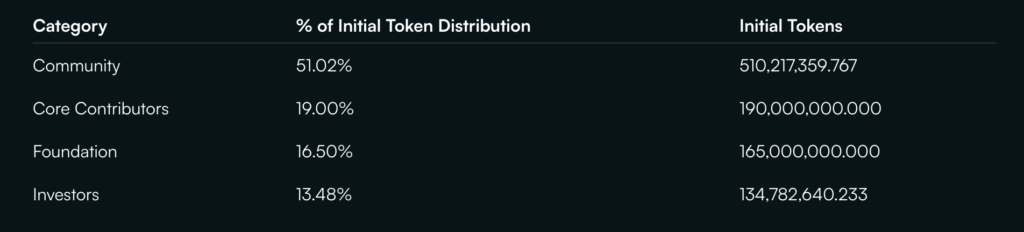
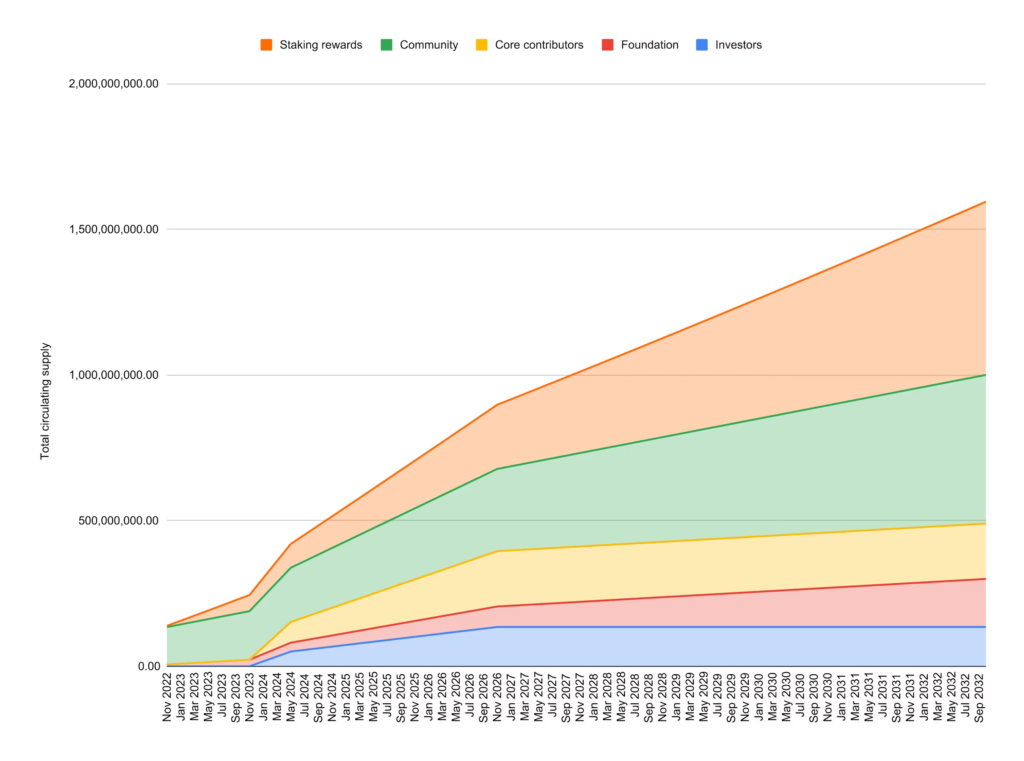
APT’s initial token supply is 10B, and the distribution ratio and schedule are shown in the figure below. Although 51.02% of the tokens are allocated to the community, these tokens are initially concentrated in the hands of the foundation. 410,217,359.767 are managed by the foundation, and 100,000,000 are held by Aptos labs. 125,000,000 of them will be used for ecological project incentives, and the rest are distributed relatively Not clear.
For core contributors and investors, linear unlocking will occur after one year of lock-up. The current main token unlocks come from the community, foundations, investors and core contributors. 11.31M tokens are unlocked every month. The selling pressure is relatively large.
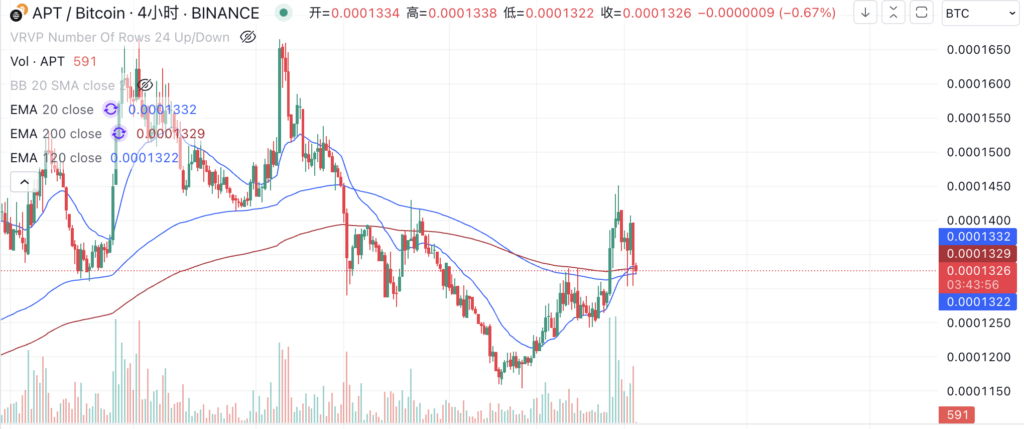
Judging from the price trend, APT is slightly weaker against BTC. It has been at a low level since its decline in early 2024. After a certain rise from September to October, it fell sharply on October 29 and is now experiencing a slight increase. It has risen, but it has not broken through the high of BTC in early October, and there is still a large gap with the high of the beginning of this year.
summary
As the Move twin star with the same name as Sui, Aptos has also received greater market attention in the past period. Compared with Sui, there has been an ongoing debate about who can become the Solana Killer. Here is a summary of the development of the Aptos ecosystem:
- Aptos's TVL is rising sharply while maintaining positive inflows, but the inflows are much smaller than Sui. The ecological development of Aptos is in its early stages. There are few transaction targets on the chain and there is no Memecoin with high market value. Therefore, the transaction volume and transaction activity on the chain are extremely low.
- Aptos regards RWA and BTCFi as the core of its ecological development strategy, hoping to open new capital entrances to expand ecological TVL. It can keep track of the market value growth of related assets and the integration with Aptos DeFi applications.
- Like Sui, Aptos’ user structure also has unhealthy problems, and the number of DeFi users is low.
- From the perspective of tokens, APT is also facing high unlocking selling pressure, which may create certain resistance to price increases. At the same time, from the perspective of price performance, the price trend in the short term is not as strong as SUI, but is similar to SUI. Follow the rising trend.
Summary: Comparison between Sui Ecosystem and Aptos Ecosystem
| Public chain | Sui | Aptos |
| MC | $8,963,108,373 | $5,577,149,571 |
| FDV | $31,496,463,786 | $12,068,813,424 |
| TVL | $1.383B | $996.28M |
| Stablecoin market capitalization | $388.29m | $292.6m |
| DEX trading volume (7d) | $2.019b | $208.58m |
| Fund inflows in the past month | $168,226,279 | $1,162,500 |
| source of capital inflow | Ethereum | Sui |
| The direction of capital outflow | Ethereum | Moonbeam |
| protocol | Ecology | TVL | DEX Volume(7D) | MC | FDV |
| Thala | Aptos | $238.36m | $107.28M | $41,772,087 | $84,660,614 |
| Aries Markets | Aptos | $275.95m | – | – | – |
| Cetus AMM | Suiv | $251.77m | – | $244,998,242 | $405,278,557 |
| NAVI Protocol | Sui | $453.36m | $1.688B | $61,801,250 | $194,312,795 |
| Suilend | Sui | $402.82m | – | – | – |
The above table lists the main data comparison between Sui and Aptos ecology, as well as the data comparison of the two main DeFi protocols. Here we make a summary of the comparative study of the two ecology:
TVL aspect
The gap between the two is not big, and the price increase of SUI has recently far exceeded that of APT, and the market value of ecological tokens is also higher, which is also an important reason why Sui is ahead of Aptos in TVL. Both Sui and Aptos have achieved new highs in TVL recently, but this is mainly due to the increase in ecological token prices, and the organic growth behind them is actually very limited.
Fund flow direction
The Sui ecosystem continues to have a large net inflow of funds, currently second only to the Base and Solana ecosystems. Sui mainly accepts funds from Ethereum. In contrast, the net inflow of funds from Aptos is very limited, less than 1% of Aptos, and The funds mainly come from Sui, which shows that Sui is currently the main entrance to the Move ecosystem, while Aptos mainly takes over the capital surplus from Sui, and this capital surplus effect is very weak.
On-chain activity
The DEX trading volume of the Sui ecosystem is 10 times that of Aptos, showing the higher trading activity of the Sui ecosystem. However, in terms of user activity, the DeFi user activity of both is relatively low. Compared with mature public chains such as Solana, the health of the user structure is far from enough.
Ecological development
In October, Sui experienced a strong push for local currency and ecological tokens, and actively promoted ecological projects to be listed on exchanges. NAVX was listed on Bybit, and Cetus was listed on Binance, which increased market attention and opened up the imagination space for Sui's ecology. The push for ecological tokens has also formed a synergy for the rapid development of the entire ecosystem in a short period of time.
The ecological development on Aptos is even weaker. There are no core ecological tokens except THL and CELL, and Memecoin has not been developed. Although the price of APT has increased rapidly, the ecological tokens have not increased significantly.
Ecological development strategy
Sui attracted some on-chain funds through Memecoin in the short term, but the craze did not last. Long-term development focuses on Web3 Gaming. Aptos hopes to introduce more assets into the ecosystem through RWA and BTCFi to increase the TVL of the ecosystem. Echo in the short term Achieved good results.
Token unlocking
Both SUI and APT are facing relatively large monthly unlocking selling pressure. SUI unlocks 64.19M (approximately US$2 million) every month, accounting for 2.32% of the circulating supply, and APT unlocks 11.31M (approximately US$1.2 million) every month, accounting for 2.17% of the circulating supply.
Price trend
Under this election transaction, SUI's rising momentum was even stronger, quickly breaking through the previous high, and also breaking through the high point of the exchange rate against BTC this year, while APT was relatively weak and had not returned to the exchange rate against BTC at the end of October.