


Abstract
Magic Eden is an NFT trading market created by a team with Chinese background. It was established on the Solana chain in 2021 and has quickly expanded to support the Ethereum (ETH), Polygon, BASE, and Bitcoin (BTC) ecosystems. Despite the decline in the NFT market, Magic Eden has successfully captured the majority market share on the Solana chain through rapid product iteration and feature-rich design.
The platform's core functions include an NFT trading market, multi-chain support, a project incubator (Launchpad), staking and reward programs, an aggregated market, data analysis and rankings, wallet integration, community governance (DAO), and API integration. Additionally, Magic Eden offers user-exclusive limited-time offers, a dynamic rarity scoring system, on-chain identity verification, membership passes, batch trading, and customized bundles. These value-added services and detailed data support have lowered the usage threshold for new users, optimized the trading experience, and enhanced user stickiness.
Magic Eden's primary revenue sources include transaction fees and Launchpad project service fees. Although the platform has not issued its own token, it has launched a point system, allowing users to accumulate points through platform activities for future airdrops. By the end of 2024, the platform will also introduce a test token, $TestME, to test the issuance process for the future official token, $ME.
Against the backdrop of an overall sluggish NFT market, Magic Eden remains competitive, with its growth potential primarily stemming from its support for the BTC ecosystem, which is still a blue ocean market. If NFTs on the BTC chain gain widespread adoption, Magic Eden is poised to have a broader development space in the future, further consolidating its leading position in the multi-chain NFT trading market.
Project Introduction
Magic Eden is a multi-chain NFT trading market with a Chinese background. In the face of a severely depressed NFT market, it has gradually captured a large market share through its engineering advantages and rapid iteration. Seeing the development of the Solana public chain, Magic Eden was initially created on the Solana chain in 2021. Subsequently, Magic Eden has expanded to support the ETH, Polygon, BASE, and BTC ecosystems.
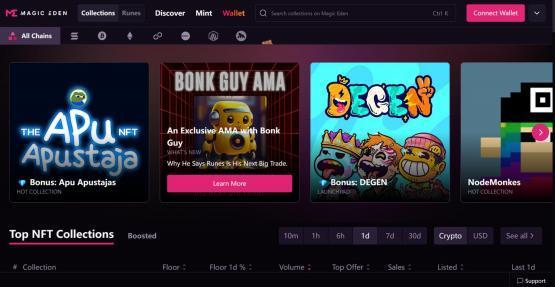
Figure 1 Magic Eden
Source: Magic Eden
1. Magic Eden Platform Functions
Magic Eden is now not just an NFT trading market, as its business has expanded to include the following functions:
NFT Trading Market: Provides a user-friendly interface for browsing, buying, selling, and auctioning Non-Fungible Tokens. Users can filter by price, rarity, and popularity.
Multi-Chain Support: Supports not only the Solana ecosystem but has also expanded to the Ethereum and Bitcoin ecosystems, allowing users to create and trade Non-Fungible Tokens on different chains.
Launchpad: This is a platform for incubating and launching new NFT projects. Through the Launchpad, project teams can receive support to more easily issue and promote Non-Fungible Tokens, while users have the opportunity to purchase them in advance.
Staking and Rewards: Users can stake their Non-Fungible Tokens to earn rewards (such as tokens or other Non-Fungible Tokens), thereby increasing the holding value of their Non-Fungible Tokens.
Aggregated Market: This feature can aggregate the listing of Non-Fungible Tokens from other platforms, helping users find trading prices and supplies across major NFT markets on a single platform.
Analytics Tools and Rankings: Provides market analysis, trading trends, and Non-Fungible Token collection rankings to help users understand popular NFT projects and market dynamics.
Wallet Integration: Compatible with multiple cryptocurrency wallets, making it convenient for users to deposit, withdraw, and trade.
DAO and Community: Magic Eden has a community governance and discussion platform, where users can participate in DAO voting and provide suggestions for platform development.
API Integration: Provides APIs for developers to integrate into other applications, enhancing the platform's ecosystem.
2. Unique Features of Magic Eden
In the core NFT trading, Magic Eden has also expanded more user-friendly features:
Limited-Time Offers: Magic Eden periodically launches limited-time offer activities, where users can enjoy discounts or special prices when purchasing specific Non-Fungible Tokens within a set time frame. These limited-time offers increase trading activity and give users opportunities to acquire high-quality Non-Fungible Tokens at lower costs.
Dynamic Rarity Scoring System: To help users quickly assess the scarcity of Non-Fungible Tokens, Magic Eden has designed a dynamic rarity scoring system. When browsing Non-Fungible Tokens, users can see their rarity level or score in real-time, which helps determine whether a Non-Fungible Token is worth bidding high prices or purchasing directly.
On-Chain Identity and Verification: To enhance trading security, Magic Eden allows project teams to verify the on-chain identity of their Non-Fungible Token collections, ensuring their authenticity. The platform will display "Verified" or "Not Verified" labels, allowing users to confidently purchase authentic Non-Fungible Tokens and avoid acquiring counterfeit assets.
Magic Eden Pass Exclusive Features: Magic Eden has issued membership pass Non-Fungible Tokens (Magic Eden Pass), whose holders can enjoy a series of exclusive benefits, such as priority purchasing rights, trading discounts, and limited edition airdrops. This membership mechanism incentivizes users to remain active on the platform.
Batch Trading and "Instant Sale": Magic Eden supports batch buying and selling of Non-Fungible Tokens, allowing users to transact multiple Non-Fungible Tokens at once, suitable for large collectors or investors. Additionally, the platform has introduced an "Instant Sale" feature, where users can immediately sell their Non-Fungible Tokens at the lowest price offered by the platform, facilitating a quick liquidation.
Customized NFT Bundles: Magic Eden provides a unique customized bundle feature, where users or project teams can create and sell bundles containing multiple Non-Fungible Tokens, grouping related Non-Fungible Tokens together for a higher selling price. This approach appeals to collectors and users interested in specific themes.
NFT Staking and Yield Distribution: Users can stake their Non-Fungible Tokens on the platform to earn rewards, or participate in profit-sharing projects. For example, staking game-related Non-Fungible Tokens can generate in-game rewards, or share in the profits. This feature increases the investment attributes of Non-Fungible Tokens, allowing users to generate yields during the holding period.
"Minting" Window: Magic Eden provides a unique "minting window" feature for certain popular projects, where new Non-Fungible Tokens are made available for a limited time. This time-limited and scarce minting approach gives users the opportunity to acquire Non-Fungible Tokens at the original price, rather than having to purchase them at a premium on the secondary market.
Personalized Recommendations from On-Chain and Off-Chain Data Aggregation: Magic Eden utilizes on-chain and off-chain data (such as a project's community activity and holder data) to provide users with personalized Non-Fungible Token recommendations. Users not only see Non-Fungible Tokens they are interested in but also receive suggestions to explore new projects or trends, improving their efficiency in discovering potential Non-Fungible Tokens.
3. Magic Eden's Revenue
Like other NFT trading markets, Magic Eden's primary revenue sources are transaction fees and service fees from project launches.
Transaction Fees: Magic Eden charges a transaction fee for each Non-Fungible Token trade, typically 2% of the transaction value. This is its main revenue source.
Launchpad Fees: Magic Eden's Launchpad platform helps new projects issue and promote Non-Fungible Tokens. Project teams using the Launchpad need to pay a service fee, or a portion of the issuance amount as a return. The Launchpad provides project teams with platform exposure, promotional support, on-chain verification, and other resources, so the fees are relatively high.
The Technologies Group has been working for several years, engaged in autonomous driving production modeling and research, focusing on computer vision and forecasting. Finally, he joined Facebook's artificial intelligence team, and later co-founded Magic Eden with others.
CEO: Jack Lu
Jack began to get involved in the cryptocurrency field in 2013, when he started cracking Bitcoin wallet applications. Before co-founding Magic Eden, Jack had worked as a product manager at a cryptocurrency exchange and Google, and as a consultant at Boston Consulting Group.
COO: Zhuoxun Yin
Since 2017, Zhuoxun has been working full-time in the cryptocurrency industry, he was the second employee of dYdX, and also a senior product manager at Coinbase. Prior to entering the cryptocurrency industry, his early career was in strategic work at early-stage companies, and he provided consulting services to corporate clients at Bain.
CE: Zhuojie Zhou
Rex started his cryptocurrency journey around 2014, engaged in cryptocurrency mining. He was an early engineer at Uber and Checkr, and recently worked as a senior engineer at Facebook AI, responsible for the development of PyTorch Dev Infra, and later co-founded Magic Eden with others. He is passionate about the open-source developer community and has created Flagr, OpenMock, Open Privacy Vault, and DSRHub. Rex is also one of the champions of the Kong API Gateway community.
Investment and Financing Background
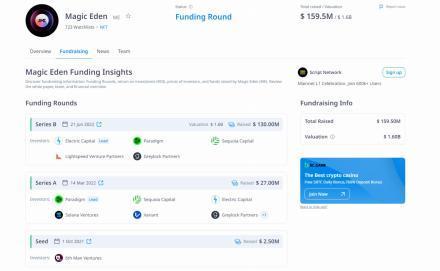
Figure 9 Magic Eden Financing Details
Data source: CryptoRank
Financing Details:
Seed round: On October 1, 2021, the investment institution "6th Man Ventures" invested $25 million.
Series A: On March 14, 2022, Radigm, Seqoia Capital, Solana Ventures and others invested $27 million.
Series B: On June 21, 2022, Electric Capital, Paradigm, Sequoia Capital and others invested $13 million.
Overall, Magic Eden has raised $159 million in financing at a valuation of $1.6 billion.
Project Prospects and Outlook
The NFT track with the greatest potential should be the BTC ecosystem, because the total market value of NFTs on other chains is much higher than the proportion of the main chain ecosystem. Coincidentally, the NFT market here only supports the BTC ecosystem.
The development of NFTs on other chains will only start to rebound and grow due to the overflow of FT capital due to the bull market. But the BTC ecosystem is still in the blue ocean stage of growth. Therefore, it can be said that MagicEden is a unicorn in this track. As long as BTC's NFTs are recognized by a wide range of users, the growth of MagicEden will open up a new ceiling.






