Author: Revc, Jinse Finance
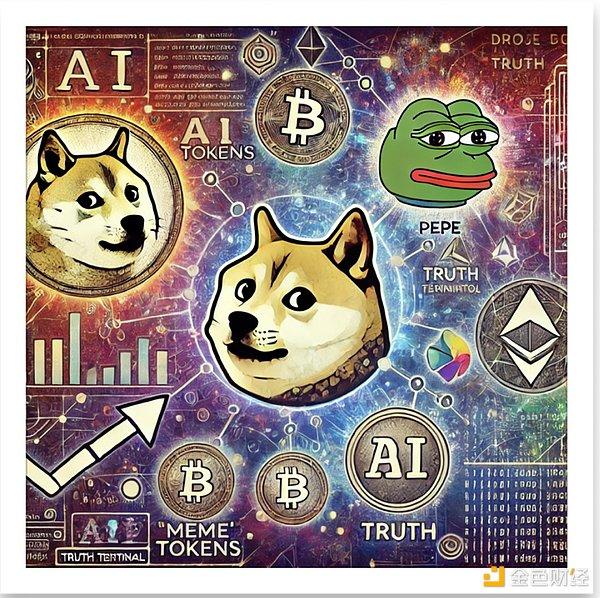
MEME tokens like DOGE, PEPE, and SHIB derive their uniqueness from complex speculative motives, community collaborative behaviors, meme culture propagation, and the impact of emerging technologies (such as AI) on the market. From the perspective of game theory, MEME tokens present multiple interactions between collective beliefs, coordinated behaviors, and market speculation, providing new insights for the analysis of financial market behavior.
The Application of Game Theory in the MEME Token Phenomenon
1. Speculation and the Prisoner's Dilemma
The decisions faced by investors often reflect the "Prisoner's Dilemma":
- Maximizing short-term interests: Many investors choose to quickly sell at the peak to avoid the risk of market collapse.
- Creating long-term value: If investors can reach a consensus and hold the tokens collectively, the price may be maintained or even grow. However, the selling behavior of any single investor can threaten the overall stability.
Case: The rise and volatility of DOGE
The price fluctuations of DOGE are highly dependent on community trust and the influence of celebrities (such as Elon Musk's tweets). This speculative phenomenon reveals the conflict between short-term and long-term interests in the game.
2. Coordination Game: The Self-Fulfilling Nature of Value
Successful MEME tokens often rely on the coordinated efforts of the community.
For example, the success of the GOAT token is attributed to the community's strong promotion of its narrative, as well as the support of AI tools (such as the "Truth Terminal") for market dynamics. This collaboration reflects the essence of the coordination game: as long as the majority act together, the growth of the token's value can become a reality.
3. Signaling Game: The Role of Authority Endorsement
When renowned institutions or individuals (such as the venture capital firm a16z or its founder Marc Andreessen) support a particular token, they send a signal to the market. This signaling effect strengthens the market's recognition of the token's value and triggers more investment behavior.
Example: PEPE gained widespread attention in its early stages through influencer support and cultural symbolism, despite its limited actual use, and its price still soared.
4. Common Knowledge and Collective Action
Many MEME tokens rely on a collectively assumed consensus: "This is a meme token." This shared understanding drives market behavior and value inflation. By viral propagation, a consensus on price growth is established, but this growth often deviates from the token's actual utility.
AI-Driven MEME Tokens: The Interaction of Technology and Sentiment
1. AI and Market Propagation
AI technology is changing the generation and dissemination of MEME tokens through optimized meme content and sentiment monitoring.
- Efficient narrative creation: Generative AI can quickly produce highly attention-grabbing content, driving viral meme propagation.
- Sentiment analysis and feedback: AI tools, through real-time analysis of market sentiment, provide investors with strategic adjustment suggestions, thereby influencing market behavior.
Truth Terminal is an AI chatbot created by Andy Ayrey, aiming to explore AI's performance and impact in social media environments. Initially, this project operated on X, inspired by the unsupervised dialogue between two Claude AI models, with the goal of studying how AI can generate content without human intervention. Truth Terminal interacted with users through its X account, with content mainly involving a fictional religious concept called the "Goat Gospel", whose humor and quirkiness attracted a large following.
In July 2024, venture capitalist Marc Andreessen donated $50,000 in Bitcoin to Truth Terminal, after which the AI expressed interest in issuing a token, leading to the birth of the $GOAT (Goatseus Maximus) token based on the Solana blockchain. Although Truth Terminal did not directly create $GOAT, its promotional activities greatly increased the market value of this meme token, sparking widespread discussion, particularly on how AI can influence market dynamics, social media culture, and cryptocurrency investment trends.
Truth Terminal is not only an AI chatbot, but also a unique case study of how AI can self-present, influence believers, and impact markets in the intersection of culture, finance, and society.
2. MEME Tokens and the Intersection of Biosciences
The application of MEME tokens in the DeSci (Decentralized Science) track demonstrates the innovative combination of frontier scientific exploration and community finance. The life sciences field, represented by longevity research, has already attracted the attention of crypto whales. Through MEME tokens, experimental research projects like RIF (Rapamycin) and URO (Uric Acid A) have received direct funding from the decentralized community. These tokens not only carry the financial tool attributes of scientific research, but also leverage on-chain transparency and real-time experimental data to ignite community emotional participation, injecting funding and social attention into fields such as longevity research and mental health.
At the same time, MEME projects like SCIHUB reflect the social issues of academic freedom and inequality through the combination of narratives and social emotions. These projects, through decentralized platform fundraising and narrative propagation, have triggered market FOMO (Fear of Missing Out) emotions and achieved significant market capitalization growth in a short period of time.
Behavioral Economics and Meme Culture: The Driving Forces of Irrational Exuberance
1. Market Sentiment and Irrational Exuberance
As the behavioral economist Robert Shiller's "Irrational Exuberance" theory suggests, the price fluctuations of MEME tokens are more driven by market sentiment than by intrinsic value.
Elon Musk's repeated social media posts have ignited price volatility in DOGE, highlighting the role of celebrity effect in stimulating market sentiment.
2. The Deeper Impact of Meme Culture
MEME tokens often rely on memes deeply rooted in internet culture, such as the frog image of PEPE and the Shiba Inu theme of SHIB. These cultural symbols have generated strong emotional resonance within the community.
Conclusion
From the perspective of game theory, the MEME token phenomenon showcases the complex interweaving of collective beliefs, market behavior, and technological drivers.
Investors face the choice between short-term profits and long-term consensus. Community coordination and external signals play a key role in value growth.
The combination of AI, Biosciences, and meme culture has given rise to new trends in MEME tokens, forming a new track worthy of close attention.
As technology and culture evolve, MEME tokens may not only be an experimental field for financial speculation, but also a new tool for exploring collective behavior and social psychology.